When you're comparing Shopify and BigCommerce, the fundamental difference boils down to this: Shopify is king for beginners and direct-to-consumer brands who want simplicity and endless customization through apps. BigCommerce, on the other hand, is built for established, high-volume stores that need powerful, native features right out of the box.
Ultimately, your choice hinges on a simple question: do you want to start lean and add on, or do you need a powerhouse from day one?
Understanding the Core Platform Philosophies
Before we get into the nitty-gritty of features and pricing, it’s crucial to understand how each platform thinks. This core philosophy shapes everything from your daily workflow to how you'll scale down the road.
Shopify follows a lean model. It gives you a fantastic set of core tools to get started quickly and easily, then lets you bolt on new functionality through its massive app marketplace. BigCommerce takes the opposite route, opting for an all-in-one approach that packs more advanced features directly into the platform.
This visual gives a great summary of who each platform is built for.
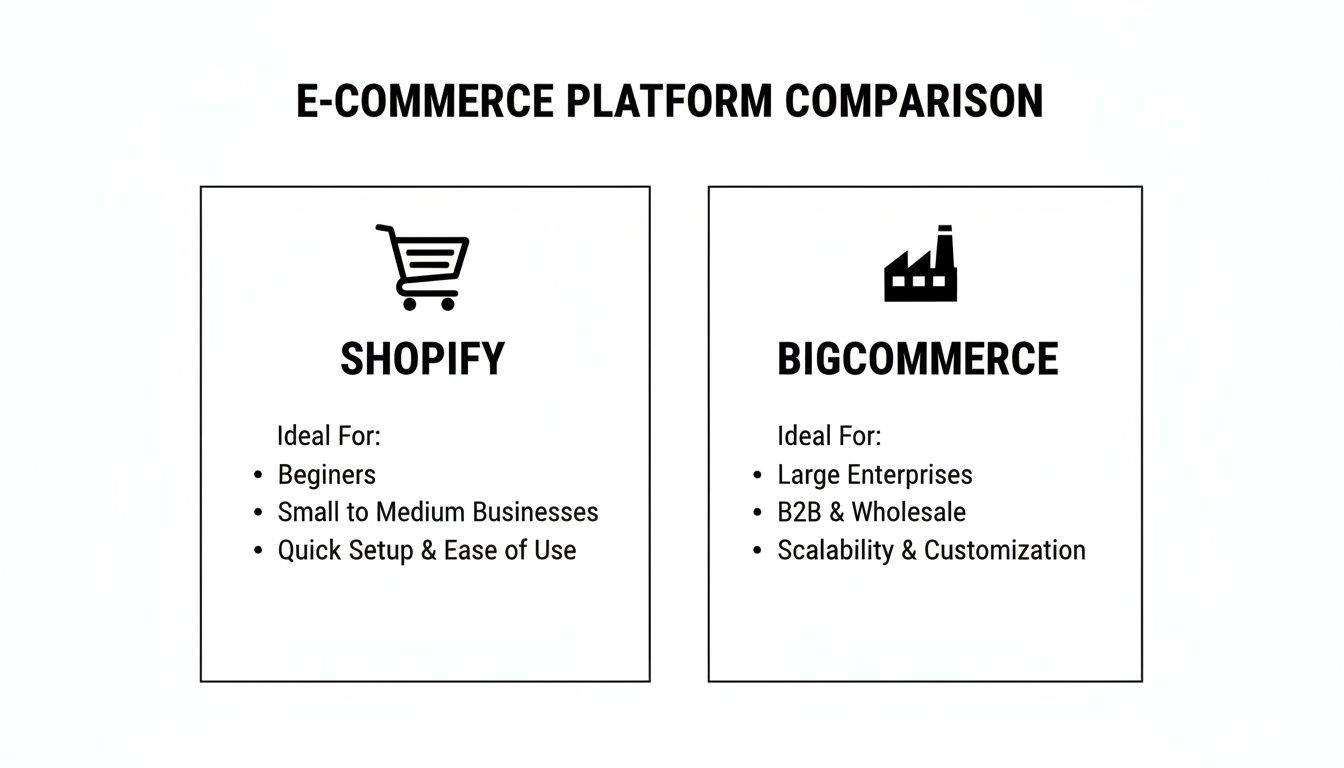
As you can see, Shopify is positioned as the go-to for new entrepreneurs and brands focused on a clean, direct-to-consumer experience. BigCommerce is clearly framed as the more robust solution for larger, more complex B2B or enterprise-level businesses.
Shopify vs BigCommerce at a Glance
For a quick overview, let's break down the fundamental differences in a simple table. This should give you an immediate sense of which platform might align better with your business model.
| Attribute | Shopify | BigCommerce |
|---|---|---|
| Core Strength | Incredible ease of use and a massive app ecosystem. | Powerful, built-in features for complex catalogs and B2B. |
| Ideal User | Beginners, dropshippers, and direct-to-consumer brands. | Established businesses, enterprises, and large inventories. |
| Pricing Model | Fixed monthly fees plus transaction fees unless you use Shopify Payments. | Monthly fees tied to your annual sales volume, with no platform transaction fees. |
| Overall Philosophy | Start simple and add what you need with apps. | Get a comprehensive, powerful toolkit from the start. |
The market share numbers really tell the story of Shopify's widespread appeal. As of 2025, Shopify holds a commanding 29% of the U.S. ecommerce software market and powers over 8.2 million websites worldwide. BigCommerce sits at around a 3-5% market share with about 137,000 websites. Check out this detailed Shopify vs WooCommerce vs BigCommerce guide for more context.
The bottom line is this: Shopify's massive popularity comes from its accessibility. It's an incredible launchpad for most new stores. BigCommerce’s appeal is more focused, catering to merchants who already know they need advanced, built-in tools to manage complexity.
Comparing the True Cost of Each Platform
When you're trying to decide between Shopify and BigCommerce, looking at the monthly plan price is only scratching the surface. The real cost—what you’ll actually pay to run your store—is buried in the details of transaction fees, credit card rates, and how each platform handles your growth.
To get the full picture, you have to look past the advertised price tag.

Shopify's pricing seems simple at first, but there's a fork in the road right away. You pay a flat monthly fee, but if you decide to use a third-party payment gateway like Stripe or PayPal, they tack on an extra transaction fee. This fee starts at 2% on the Basic plan and drops to 0.6% on the Advanced plan.
However, if you stick with their own payment processor, Shopify Payments, those extra fees disappear completely. It’s a pretty smart way to encourage you to stay within their system, which can genuinely simplify things and often lower your costs.
Understanding Shopify's Fee Structure
Shopify's model is all about predictability. You pay your monthly subscription plus standard credit card processing rates through Shopify Payments. The only "gotcha" is that extra transaction fee, which, again, is easy to avoid.
This structure is a huge draw for businesses that want an all-in-one, no-fuss payment setup. No need to mess with separate merchant accounts—it’s a big reason why so many new entrepreneurs start with Shopify.
BigCommerce's Revenue-Based Tiers
BigCommerce comes at pricing from a totally different angle. They proudly wave the banner of zero platform transaction fees on every single plan, no matter which payment gateway you bring to the table. This is a massive plus if you already have a processor you love or want the freedom to shop around for better rates.
But here’s the catch: your plan is tied to how much you sell. Each BigCommerce plan has a hard cap on your annual sales. For example, their Standard plan is designed for stores doing up to $50,000 a year. The moment you cross that threshold, you’re automatically bumped up to the next, more expensive plan.
This is the most important difference to understand. Shopify's pricing is based on the features you need. BigCommerce's pricing is tied directly to your revenue. As you grow on BigCommerce, your monthly bill is guaranteed to go up.
A Tale of Two Scenarios
Let's break this down with a practical example. Imagine two stores, both making $10,000 in sales per month.
- Store A (Shopify): They're on the Basic Shopify plan ($24/mo paid annually) and use Shopify Payments. They pay their subscription and the credit card fees. No extra transaction fees.
- Store B (BigCommerce): They're on the Standard plan ($29/mo) and use their own payment gateway. They pay their subscription and credit card fees. No platform transaction fees.
At this level, their monthly costs are almost identical.
But what happens when both stores hit $200,000 in annual sales? Store A can stick with their Shopify plan as long as it has the features they need. Store B, on the other hand, has flown past the revenue limit for the Plus plan and is now forced to upgrade to the more expensive Pro plan. Their base monthly cost just jumped significantly.
Getting a handle on these platform fees is just one piece of the puzzle. For a complete financial picture, check out our guide on the full cost of an ecommerce website, which dives into everything from design to marketing.
Ultimately, it comes down to this: Shopify's fixed monthly costs give you more predictable expenses as you scale, even if it seems a bit pricier at first glance. BigCommerce's zero-fee model is tempting, but its mandatory, revenue-based plan upgrades can lead to some serious sticker shock as your business takes off. The right choice depends on whether you value predictable costs or prefer a model that grows directly with your sales.
Core Features: Built-In Power vs. App-Driven Flexibility
When you get down to the nuts and bolts, the core philosophies of Shopify and BigCommerce really start to show. This isn't just about a feature list; it's about how you'll run your business day-to-day and what your long-term costs will look like. It boils down to a classic trade-off: built-in power versus app-driven flexibility.
BigCommerce’s approach is to hand you a powerful, feature-packed toolkit right from the start. Shopify, on the other hand, gives you a sleek, streamlined core that’s designed to be customized and expanded through its massive app store. This single difference is the heart of the Shopify vs BigCommerce debate.
This distinction has an immediate impact on how you manage your store, especially if you have a complex catalog or very specific ways of operating.
Product Management and Variants
Let's dive into one of the biggest differentiators right away: product management. BigCommerce was clearly built with complex inventories in mind, and it shows.
Out of the box, BigCommerce gives you a much more robust system for handling product variations. On any plan, you can create up to 600 variants per product. For anyone selling apparel, parts, or anything with tons of options, this is a game-changer. Think sizes, colors, materials, and finishes—you won't hit a wall.
Shopify, by default, caps you at 100 variants per product and just three option types (like Size, Color, and Style). This is fine for a lot of stores, but it can become a serious headache for businesses with more intricate product lines. To get around this, you’ll need to lean on third-party apps, which can add another layer of complexity and another monthly bill to your operations.
Key Features: Included vs. Added On
This pattern—built-in versus add-on—plays out across many other essential e-commerce functions. BigCommerce bakes a surprising amount of advanced functionality right into its standard plans.
Just look at what comes standard with BigCommerce:
- Customer Groups & Segmentation: You can set up different pricing tiers or show specific products to different customer groups (think wholesale vs. retail) without needing an app.
- Real-Time Shipping Quotes: BigCommerce connects directly with major carriers to show live shipping rates at checkout, a feature available on all its plans.
- Faceted Search (Product Filtering): That advanced filtering you see on major retail sites, letting customers drill down by price, brand, and color? That’s a standard feature here.
On Shopify, getting this same level of functionality almost always means a trip to the app store. While the app selection is fantastic, relying on it for core features can lead to "app bloat," which can potentially slow your site down and definitely drives up your monthly costs.
BigCommerce gives merchants powerful tools for complex B2B or B2C operations from day one. Shopify empowers you with choice, but that choice often comes with an additional price tag for the apps needed to match BigCommerce's native capabilities.
The App Ecosystem: The Great Equalizer
While BigCommerce leads on built-in features, Shopify’s app marketplace is its undisputed superpower. This is where the platform’s lean core becomes a blank canvas for you to build almost any kind of selling machine you can imagine.
The sheer number of options is staggering. Shopify's app marketplace boasts over 8,000 third-party apps, completely dwarfing the 1,188 integrations available for BigCommerce. That’s a difference of over 6,800 tools, giving Shopify merchants an incredible advantage in everything from sophisticated marketing automation to niche inventory management. This adaptability is a key reason why we at OneNine often recommend Shopify to clients who need to pivot and grow quickly. You can learn more about how these platforms stack up by exploring detailed platform comparisons online.
With a Shopify store, you can easily add functionalities like:
- Subscription billing services
- Advanced loyalty and reward programs
- Custom product builders
- Seamless dropshipping integrations
This app-first approach means if you can dream up a feature, there's almost certainly an app for it on Shopify. The trade-off, of course, is that you become the manager of multiple third-party solutions, each with its own support team and potential for compatibility hiccups. Ultimately, the Shopify vs BigCommerce decision often hinges on whether you prefer an all-inclusive toolkit or an à la carte box of building blocks.
Design Flexibility Themes and Customization
Think of your store’s design as its digital curb appeal. It’s the very first thing a customer sees, and it’s what builds the trust that leads to a sale. When you’re weighing Shopify vs BigCommerce, you'll find both give you great tools to create a beautiful, on-brand store. But they get there in different ways. The best platform for you really hinges on how comfortable you are with tech and how deep you want to get into the nuts and bolts of your site's design.

Shopify's theme store is famous for its slick, modern, and mobile-friendly designs. They're built to sell right from the get-go. With a curated collection of over 220 themes, the focus is clearly on quality, not just quantity. You'll find a handful of solid free options, but most of the premium themes will set you back between $180 and $350.
BigCommerce has a comparable number of high-quality themes in its marketplace, but the pricing is a little different, typically running from $160 to $400. On both platforms, you can trust that the themes are held to a high standard for speed and overall user experience.
Comparing the Theme Editors
The real separation between the two platforms appears once you start tweaking your theme. Shopify’s theme editor is legendary for its simplicity. It’s a clean, section-based system where you can literally drag and drop elements to add, remove, or reorder content. Building a custom homepage or a new landing page feels intuitive, even for total beginners.
BigCommerce’s Page Builder is also quite capable, but it can feel a bit less intuitive if you're not technically inclined. It gives you solid control over layouts and widgets, but its real ace in the hole is the Stencil framework that powers it. If you know your way around HTML and CSS, Stencil lets you customize your site on a much deeper level than Shopify’s Liquid templating language does out of the box.
For merchants without coding skills, Shopify offers a more direct and satisfying customization experience. For those who want to get under the hood and make significant structural changes, BigCommerce's Stencil framework provides greater power and flexibility.
Finding the Right Fit for Your Skills
Your own technical comfort level is a huge factor here. A founder with no coding background can get a polished, professional-looking store up and running on Shopify in just a few hours. The platform is built so that business owners can make quick changes themselves without having to call a developer for every little thing.
On the other hand, a business that has a developer on staff might feel a bit boxed in by Shopify's structure. BigCommerce is designed for these users, giving them the freedom to build a completely custom shopping experience from the ground up. This is a big reason why established brands with very specific design requirements often lean toward BigCommerce.
Here’s a quick way to think about it:
- Choose Shopify if: You value speed and ease of use. You want to be able to make design changes yourself without touching a single line of code.
- Choose BigCommerce if: You have a developer (or are one yourself) and need total control over your site's HTML and CSS to create a highly tailored storefront.
At the end of the day, you can build a stunning website on either platform. The key difference in the Shopify vs BigCommerce design debate is more about the process than the final product. Shopify gives you a guided, user-friendly experience, while BigCommerce offers a more technical route with fewer guardrails, perfect for those who want to blaze their own trail.
SEO and Performance: Which Platform Helps You Grow Faster?
When you’re thinking about long-term growth, search engine optimization (SEO) and scalability aren’t just nice-to-haves; they're everything. Your e-commerce platform should act like a tailwind, helping you climb search rankings and easily handle those huge traffic spikes during sales. The wrong one can feel like an anchor, bogging you down with technical headaches.
In the Shopify vs. BigCommerce showdown, both platforms give you a solid SEO foundation right out of the box. You get all the essentials: editable title tags, meta descriptions, image alt tags, and an automatically generated sitemap.xml file. The real differences show up in the details, and those details start to matter a lot more as your business gets bigger.
A Closer Look at SEO Features
There's a persistent myth that Shopify's URL structure is a major SEO handicap. By default, Shopify adds prefixes like /products/ or /collections/ to your URLs, and you can’t change it. While that might sound like a problem, it rarely holds a store back in the real world. Search engines are sophisticated enough to understand these structures, and your energy is much better spent on great content and earning backlinks.
BigCommerce, on the other hand, gives you total control over your URLs from day one. You can create short, clean URLs without any forced prefixes, which is a feature SEO purists definitely appreciate. It's a clear win for merchants who want to obsess over and optimize every last on-page detail.
The bottom line is this: BigCommerce offers more granular URL control, but Shopify's structure is not the SEO deal-breaker it's often made out to be. A smart SEO strategy will thrive on either platform.
Beyond URLs, both platforms nail the other SEO fundamentals:
- SSL Certificates: Every plan on both Shopify and BigCommerce includes a free SSL certificate, keeping your site secure and satisfying Google's requirements.
- Site Speed: Both are hosted platforms optimized for speed, but your final performance will really depend on your theme and the apps you install. On average, Shopify stores tend to be up to 1.4x faster than those on BigCommerce.
- Blog Functionality: A blog is essential for content marketing, and both platforms have one built-in. Shopify’s is clean and simple, while BigCommerce provides a few more advanced features like RSS feeds.
No matter which platform you go with, building an SEO-friendly web design from the very beginning is what truly gives you a competitive advantage.
Built to Scale: Handling Traffic and Growth
Scalability is where you see what a platform is really made of. You need a solution that won't buckle under the pressure of a Black Friday rush or a campaign that suddenly goes viral. Since both Shopify and BigCommerce are fully hosted SaaS platforms, they handle all the server maintenance, security, and uptime for you—a huge relief compared to self-hosted options.
Shopify has earned a rock-solid reputation for its bulletproof performance. Its infrastructure is built to handle absolutely massive traffic surges, making it a go-to for ambitious brands. The numbers speak for themselves: by 2024, Shopify had processed over $1 trillion in cumulative gross merchandise value (GMV) across its 4.8 million stores. This includes a staggering $4.2 million in Black Friday sales from over 17,500 new small sellers alone. While BigCommerce also boasts strong performance with a 26% jump in Cyber Week sales in 2024, Shopify's incredible volume is a testament to its raw scaling power. You can see more about these growth metrics on netsolutions.com.
This unmatched reliability is why so many high-growth DTC brands put their trust in Shopify. They know the platform can handle anything they throw at it. BigCommerce also delivers excellent uptime, but its pricing is tied to your sales volume. This means your platform costs will automatically rise as you grow, which is something you'll need to factor into your financial planning.
How to Choose the Right Platform for You
So, how do you actually decide between Shopify and BigCommerce? The trick is to stop looking at endless feature lists and start thinking about your business's unique DNA. The right platform for you comes down to your daily operations, how comfortable you are with technology, and where you see your business in a few years.
This framework is designed to help you cut through the noise and make a clear, confident choice. Each platform was built with a different kind of merchant in mind. Picking the one that aligns with your goals will save you a ton of headaches down the road and set you up for much smoother growth.
Decision Framework Scenarios
Let's break this down into a few common scenarios. Chances are, your business fits into one of these, which should make the decision a lot simpler.
Think about what matters most to you right now:
- You're a DTC brand that needs to launch fast. If your main goal is to get a beautiful, easy-to-use store online as quickly as possible and tap into a world of marketing apps, Shopify is the clear winner. Its entire ecosystem is built for speed and simplicity.
- You're running a B2B operation or have a huge, complex catalog. For stores juggling products with hundreds of variants, or those needing different pricing for wholesale and retail customers, BigCommerce is the stronger choice. Its core features handle this kind of complexity right out of the box, often without needing a bunch of extra apps.
- You want predictable costs as your business grows. Shopify's pricing is based on the features you need, not how much you sell. This means your monthly bill is much more predictable, and you won't be bumped to a more expensive plan just for having a good month.
- You absolutely want to avoid platform transaction fees. If you have a preferred payment processor and don't want to pay extra fees to the platform itself, BigCommerce is a huge advantage. They charge zero transaction fees on all their plans.
The core trade-off is this: Shopify gives you incredible ease of use and an unmatched app store for endless customization, making it perfect for most DTC brands. BigCommerce, on the other hand, packs more powerful features into its core platform, which is ideal for established businesses with more complex operational needs.
Making Your Final Choice
To lock in your decision, think about where you'd rather put your resources. Are you happy to invest in monthly app subscriptions on Shopify to get the exact features you need? Or would you prefer a platform like BigCommerce that includes more of those heavy-duty tools from the get-go?
For another great perspective, check out this definitive guide on BigCommerce or Shopify. It might help solidify your choice by covering a few more angles.
At the end of the day, both platforms are fantastic—but they are not one-size-fits-all. Your business isn't generic, so your e-commerce platform shouldn't be either. Whether you need a simple launchpad or a complex B2B engine, there’s a clear answer for you. If you're still weighing your options, our detailed ecommerce platform comparison can provide even more clarity.
Frequently Asked Questions
When you're this close to a decision, it's usually the small, practical questions that make all the difference. We get these all the time from business owners trying to choose between Shopify and BigCommerce. Here are some straight answers to help you lock in your choice.
We’ve already walked through the big-picture differences, but let's clear up a few final points that will impact your daily operations and how you grow.
Which Platform Is Better for Beginners?
If you're just starting out and launching your very first store, Shopify is the hands-down winner. Its entire experience is built for people who aren't tech-savvy. From the guided setup to the drag-and-drop theme editor, you can get a polished, professional-looking store live in a few hours without touching a line of code.
BigCommerce is incredibly powerful, but it comes with a steeper learning curve. Its advanced feature set and Stencil theme framework are fantastic, but they're really geared toward merchants with some technical know-how or a developer on standby. The verdict from new sellers is almost unanimous: Shopify gets you to market faster and with fewer headaches.
Does BigCommerce Really Have No Transaction Fees?
This is a huge talking point for BigCommerce, and yes, it’s true. BigCommerce charges zero platform transaction fees on every single one of its plans, no matter which payment gateway you hook up. You'll still pay the standard processing fees to your provider (like Stripe or PayPal), but BigCommerce won't skim anything extra off the top.
Shopify also lets you avoid its own transaction fees, but there's a catch: you have to use its in-house processor, Shopify Payments. If you decide to use a different gateway on Shopify, you'll be hit with an additional fee between 0.6% and 2.0% on top of whatever your processor charges.
The bottom line is BigCommerce gives you the freedom to choose your payment processor without a financial penalty. Shopify, on the other hand, gives you a very strong push to use its own all-in-one payment solution if you want to avoid extra costs.
Which Is More Scalable for a Growing Business?
Both platforms can absolutely handle serious growth, but they get there in different ways. Shopify has an ironclad reputation for supporting some of the world's biggest brands, effortlessly handling massive traffic spikes during events like Black Friday. Its scalability comes from its rock-solid infrastructure and a massive app store that lets you bolt on new features as your needs evolve.
BigCommerce is also a scaling powerhouse, particularly for stores with huge, complex product catalogs or B2B needs, thanks to its rich built-in feature set. The one thing to watch out for is its pricing model, which is tied directly to your annual sales. As you sell more, your platform costs will automatically go up, which can sometimes lead to unexpected budget adjustments for rapidly growing brands.
For most direct-to-consumer businesses, Shopify's more predictable pricing and proven performance make for a smoother scaling journey.
Picking the right platform is a huge first step, but it's just the beginning. Whether you're moving a store over or starting fresh, the team at OneNine has the expertise to bring your vision to life. Let us worry about the technical side of things so you can get back to growing your business. Get in touch with us today and let's talk about what we can build together.


