
When you're trying to decide between Shopify and WordPress for your online store, the whole debate really boils down to one simple question: Do you want an all-in-one, managed solution, or do you want total control and endless customization?
Shopify is built from the ground up to be a streamlined selling machine, while WordPress paired with WooCommerce gives you the keys to the kingdom, letting you build anything you can imagine. The right answer for you depends entirely on what you value more—simplicity and speed, or flexibility and ownership.
Choosing Your Ecommerce Platform A Quick Guide
Picking between these two powerhouses can feel like a huge decision, but it gets a lot easier when you look at your own technical skills and what you want to achieve with your business.
Shopify is a dedicated e-commerce platform. It’s a Software-as-a-Service (SaaS) product, which is a fancy way of saying they handle all the tricky technical stuff for you—hosting, security, updates, you name it—all for a straightforward monthly fee. This makes it a fantastic choice for anyone who just wants to get their store up and running fast and focus on selling, not on being a web developer.
On the other side of the coin, you have WordPress. It’s an open-source Content Management System (CMS) that can become an incredibly powerful online store once you install the WooCommerce plugin. This setup is self-hosted, meaning you have complete and total control over everything, from the server it lives on to the last line of code. It's the go-to for businesses that need deep custom features, want absolute creative freedom, or are building their brand around a strong content marketing strategy. But with great power comes great responsibility—you’re in charge of your own hosting, security, and maintenance.
This visual breaks down that core choice perfectly: Are you after an easy, all-in-one system, or do you need ultimate control and the ability to customize everything?
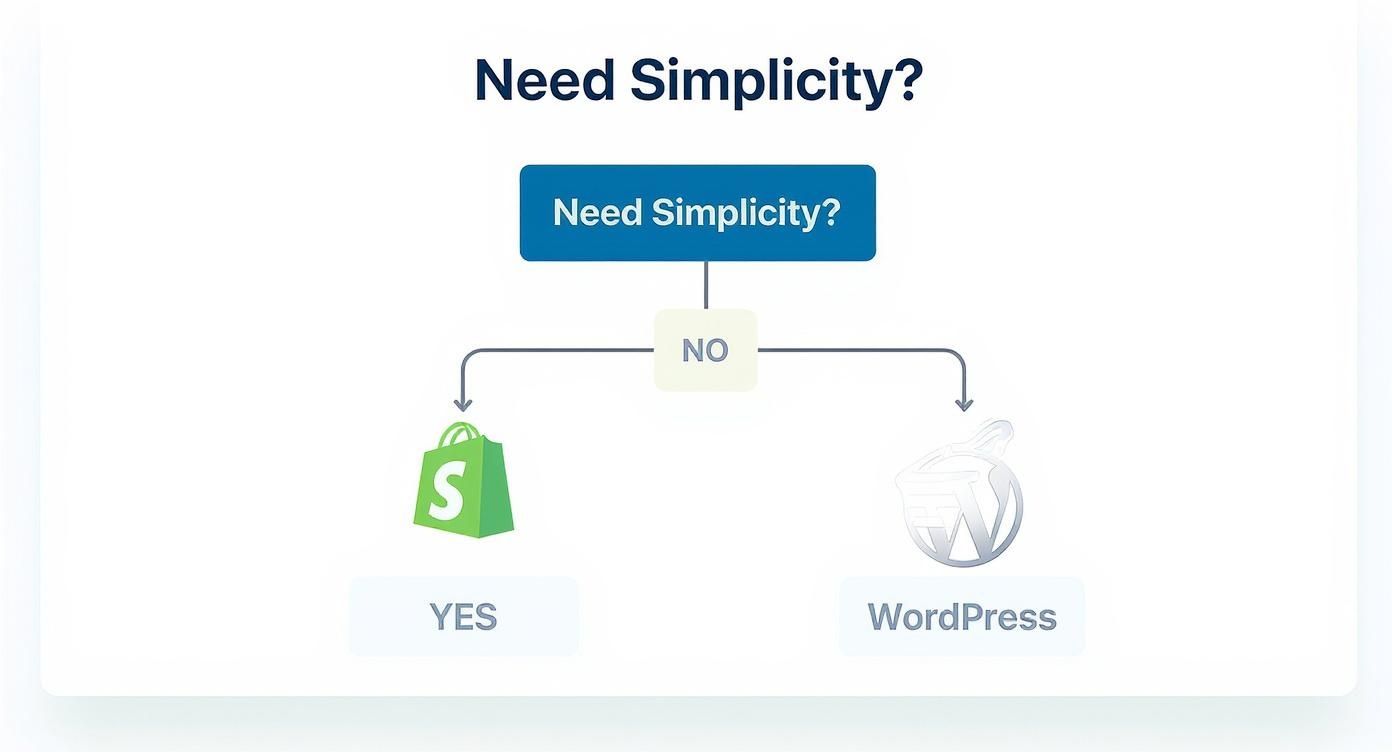
As you can see, the path you take really depends on whether your top priority is convenience or complete flexibility.
To make things even clearer, let's look at a quick side-by-side comparison.
Shopify vs WordPress At a Glance
This table gives you a high-level overview of how Shopify and WordPress stack up, helping you quickly see the key differences at a glance.
| Criterion | Shopify | WordPress (with WooCommerce) |
|---|---|---|
| Ideal User | Beginners, dropshippers, and merchants wanting an all-in-one solution. | Tech-savvy users, developers, and brands needing full customization. |
| Setup Complexity | Very low; guided setup gets you selling in hours. | Moderate to high; requires finding hosting and installing software. |
| Pricing Model | Predictable monthly subscription fee plus transaction fees. | Variable; costs for hosting, themes, and premium plugins add up. |
| Maintenance | Fully managed by Shopify, including security and updates. | Self-managed; you are responsible for all updates and security. |
Ultimately, this comparison highlights the fundamental trade-off: Shopify offers peace of mind and simplicity, while WordPress gives you unparalleled freedom at the cost of more hands-on management.
Understanding Core Platform Architectures
To really get to the bottom of the Shopify vs. WordPress debate, you have to start with how they’re built. Their fundamental architecture is the single biggest difference, and it dictates everything from your day-to-day responsibilities to your total costs and creative control. Think of it as the classic "rent vs. own" argument, but for your online store.

Shopify operates on a Software-as-a-Service (SaaS) model. It's a fully hosted, managed environment where all the technical headaches are handled for you. It’s a lot like leasing a storefront in a popular shopping mall—the management takes care of security, building maintenance, and utilities, so you can just focus on your products and customers.
You pay a monthly fee, and for that, Shopify gives you the server space, handles security patches, and makes sure your site stays up and running fast. It's an all-in-one package built from the ground up specifically for selling online.
The Turnkey Commerce Engine
Shopify is a complete, ready-to-go ecommerce platform. This is a stark contrast to WordPress, which starts as a content management system and needs plugins like WooCommerce to handle sales. Shopify's entire system is built around the act of selling, giving you a single dashboard to manage orders, products, payments, and marketing.
This integrated design means you can get a store launched with almost zero technical friction. For a closer look at how this helps new businesses, a great resource can be found on Omnisend.com.
With Shopify, you're a customer of a comprehensive service. Your job is to run the business, not the technology behind it.
The Open-Source Powerhouse
On the other side, you have WordPress. It’s an open-source, self-hosted Content Management System (CMS). Using WordPress is like owning the building your store is in. You have total freedom to customize absolutely everything, but you're also responsible for every last bit of it.
You’ll need to find your own hosting, set up security measures like SSL certificates, and stay on top of all software updates yourself. To turn it into an ecommerce store, you install the WooCommerce plugin. While incredibly powerful, it's an extension bolted onto the core WordPress framework, not an integrated part of it.
This setup creates a completely different set of tasks compared to Shopify. You’re not just a merchant; you're also the system administrator. For anyone who craves ultimate control and wants to build a deeply customized, content-first shopping experience, this is a massive plus. It's the perfect platform for tinkerers and builders who don't want any limitations on their vision.
A Detailed Look at Their Ecommerce Capabilities
Picking an ecommerce platform is about a lot more than just the tech behind it. It's really about the tools you'll use every single day to sell your products, run your business, and build your brand. Let's move past the high-level ideas and get into the nitty-gritty of what it’s actually like to use Shopify and WordPress.
This side-by-side breakdown will unpack the real costs, the day-to-day management realities, the design potential, and what it takes to grow on each platform. By digging into these critical pieces, you'll get a much clearer picture of how Shopify and WordPress actually stack up in the real world.
Pricing and True Costs
One of the first things you'll notice when comparing Shopify and WordPress is how you pay for them. Their pricing models are worlds apart, and that has a huge impact on your long-term costs.
Shopify is built on a straightforward subscription model. You pay a set monthly fee, which can range from a Basic plan for startups to Shopify Plus for huge enterprises. This single fee covers your hosting, security, and all the core platform features. That predictability is a huge win for businesses that need to nail down their budget.
WordPress, on the other hand, is open-source, which means the software itself is technically free to download. But that "free" label can be a bit deceiving. To get a real ecommerce store running with WooCommerce, you have to budget for a bunch of other variable costs:
- Web Hosting: This can run you anywhere from $10 to over $100 a month, all depending on your traffic and performance needs.
- Domain Name: Usually about $15-$20 a year.
- Premium Theme: A quality, professionally designed theme will likely set you back $50 to $200 as a one-time payment.
- Premium Plugins: Many must-have features, like subscription billing or complex shipping rules, require paid plugins. These can easily cost $50 to $300 per year for each one.
Key Takeaway: Shopify gives you predictable, all-in-one pricing that makes budgeting a breeze. WordPress might look cheaper at first, but once you add up hosting, themes, and essential plugins, it can get more expensive and your monthly costs become a moving target.
Ease of Use and Daily Management
How you interact with your store every day is just as critical as the technology it runs on. This is where Shopify and WordPress feel like two completely different animals.
Shopify was built from the ground up for merchants, not developers. Its dashboard is clean, intuitive, and practically holds your hand through every process. Adding products, checking inventory, and fulfilling orders are all simple tasks designed for someone who has never touched a line of code. Everything you need, from creating marketing campaigns to managing discount codes, is right there in one central hub.
WordPress with WooCommerce has a much steeper learning curve. While the main WordPress interface is great for blogging, tacking on WooCommerce and a handful of other plugins makes for a more scattered experience. You'll often find yourself jumping between different settings menus for your theme, then for WooCommerce, then for another plugin, just to get one thing done.
This difference extends to maintenance, too. Shopify takes care of all the updates, security patches, and performance tweaks for you behind the scenes. With WordPress, you're the one in charge of keeping the core software, your theme, and all your plugins up to date. If you let it slide, you can run into compatibility headaches or, worse, security holes.
Design Flexibility and Customization
Your store's design is your digital storefront, and both platforms give you powerful ways to create a great-looking, functional site—they just go about it differently.
Shopify's theme store has over 140 professionally designed, mobile-friendly themes ready to go. These themes are built specifically for selling and are pretty easy to customize with a visual drag-and-drop editor. While this gives most users a fantastic starting point and a lot of control, making deep structural changes usually means you need to know Shopify's coding language, Liquid, or bring in a Shopify developer.
WordPress, in contrast, offers nearly infinite design flexibility. With thousands of themes on marketplaces like ThemeForest and the power of page-builder plugins like Elementor or Divi, you can build almost any design you can dream up, often without writing any code. And if you do know how to code, you have full access to every single file, giving you total creative freedom.
Of course, that absolute freedom comes with a catch. It's much easier to accidentally build a slow, clunky, or even broken site with WordPress if you aren't careful. Shopify's more structured environment acts as a guardrail, helping ensure your store maintains a solid baseline of quality and performance.
SEO and Marketing Tools
Both platforms arm you with powerful tools for SEO and marketing, but they come at it from different angles.
WordPress has a legendary reputation as an SEO powerhouse. That's largely thanks to its blogging roots and incredible plugins like Yoast SEO. These tools give you fine-grained control over just about every part of your on-page SEO, from meta descriptions and XML sitemaps to schema markup. For a comprehensive overview of different ecommerce platforms and their features, check out our guide on ecommerce platform comparison.
Shopify, however, has fantastic SEO capabilities baked right into its core. It automatically generates sitemaps, creates clean URLs, and handles technical SEO details like canonical tags without you lifting a finger. While you don't get the same microscopic level of control as you might with a WordPress plugin, its managed infrastructure means your site will be fast—and site speed is a massive ranking factor. When thinking about boosting sales, it's worth looking into proven Shopify conversion rate optimization strategies.
Scalability for Growing Businesses
As your business takes off, you need a platform that can grow with you. Both Shopify and WordPress can handle huge amounts of traffic and massive product catalogs, but how they get there is very different.
Shopify is built to scale without any fuss. Since it's a fully hosted solution, you never have to think about server capacity or performance issues. Plans like Shopify Plus are engineered to handle enormous traffic surges—think Black Friday chaos—without you having to do a thing. That kind of reliability is a huge reason so many big brands trust it.
Scaling a WordPress site is a much more hands-on job. As your traffic grows, you'll have to upgrade your hosting plan, maybe moving from a shared server to a VPS or even a dedicated server. You'll also be responsible for performance optimization, which means setting up caching plugins and a Content Delivery Network (CDN) to keep things speedy. It can absolutely scale to handle massive traffic, but the responsibility for managing that growth falls squarely on your shoulders.
Payment Processing Options
A smooth and secure checkout is absolutely non-negotiable, and both platforms integrate with tons of payment gateways.
Shopify has its own built-in solution, Shopify Payments (which is powered by Stripe), and it's incredibly simple to set up. It also works with over 100 other third-party gateways. The one thing to keep in mind is that Shopify charges an extra transaction fee (from 0.5% to 2%) if you decide not to use Shopify Payments.
WooCommerce integrates with every major payment gateway right out of the box, including Stripe, PayPal, and Authorize.net, with countless more available as extensions. The crucial difference here is that WooCommerce never charges you a transaction fee. You only pay the standard processing fees from your payment provider, which gives you more control over your transaction costs.
Market Share and Community: Sizing Up the Ecosystems
When you're picking an e-commerce platform, it's easy to get lost in feature lists. But some of the most important factors aren't features at all—they're the platform's market share and the community around it. Think of it this way: a platform's popularity is a good sign of its health, and a strong community is your built-in support system.
The numbers paint a really interesting picture. You have WordPress, the undisputed king of the entire web, and Shopify, the specialist that has carved out a massive chunk of the e-commerce world.
A Tale of Two Markets
Looking at the whole internet, WordPress is in a league of its own. It powers a staggering 60.8% of all websites that use a known content management system (CMS). Shopify, by comparison, runs about 6.7%.
But for an online store, that's not the whole story. When you zoom in on just e-commerce, Shopify's dominance becomes clear. It holds about 10.32% of the global e-commerce market and an incredible 29% of the market in the United States. This highlights a critical distinction: WordPress is the jack-of-all-trades, while Shopify is the master of one.
You’re not just choosing a piece of software; you're plugging into an entire ecosystem. WordPress gives you a massive, open-ended community. Shopify offers a dedicated, commerce-driven network.
The People Behind the Platforms
The vibe of each community directly shapes your day-to-day experience. The WordPress world is vast, decentralized, and built on open-source collaboration. It's a global network of developers, designers, and hobbyists. For a business owner, this means:
- A huge talent pool: Need to hire a developer? There are legions of them, often at very competitive rates.
- Limitless free help: You can find a forum thread or a YouTube tutorial for just about any problem you could possibly imagine.
- An ocean of plugins: The official directory has over 59,000 free plugins, giving you a tool for almost any function.
Shopify’s community, on the other hand, is curated and laser-focused on one thing: selling. The ecosystem revolves around the Shopify App Store and the Shopify Experts Marketplace. This more controlled environment has its own unique perks:
- Vetted professionals: Shopify Experts are specialists who know e-commerce inside and out. You're hiring someone with proven experience in growing online stores.
- Commerce-focused apps: Every app is built with the goal of helping you sell more, manage inventory better, or improve the customer journey.
- 24/7 official support: This is a huge one. If your site goes down at 3 AM, you can get a real person from Shopify on the phone or chat. That's a safety net WordPress simply can't match.
So, what's the takeaway? WordPress offers a sprawling, do-it-yourself universe with endless possibilities. Shopify gives you a focused, expertly supported ecosystem built from the ground up to help you sell.
Which Platform Best Suits Your Business Model
Deciding between Shopify and WordPress isn't a simple tech choice. It's a strategic business decision that needs to mesh with how you plan to run and grow your store. The right platform is the one that gets out of your way, not the one with the most bells and whistles. Let's break down those detailed comparisons into real-world advice for specific types of businesses.
My goal here is to help you see your own business in one of these scenarios. By connecting the platform's strengths directly to what you need to succeed, the Shopify vs. WordPress choice should become a lot clearer.
The First-Time Entrepreneur
If you're launching your first store, your number one priority is getting to market quickly without getting bogged down in technical details. You need to be focused on your products, marketing, and talking to customers—not fiddling with server settings or worrying about plugin conflicts.
For that reason, Shopify is the clear winner for first-time entrepreneurs. Its setup process is incredibly intuitive; you can honestly go from an idea to a live store ready for its first sale in an afternoon. Because it’s an all-in-one platform, you never have to think about security patches, hosting issues, or software updates. It just works.
Shopify’s greatest strength for a new business is that it lets you be a merchant, not a system administrator. The predictable monthly costs also make budgeting simple and transparent, which is critical when you're just starting out.
The Content-Driven Brand
Does your business run on a foundation of expert articles, in-depth tutorials, or a thriving online community? If your sales funnel often begins with a blog post, your platform needs to be a content machine first and an e-commerce store second.
This is where WordPress with WooCommerce truly shines. WordPress started as a blogging platform, and its content management tools are still the best in the business. You get total control over your SEO, can create complex category and tag systems, and have the freedom to build a content hub that’s perfectly tailored to your audience.
With this model, content and commerce are woven together. WordPress lets you create a seamless experience where a reader can become a customer without ever feeling like they were pushed into a sale. The thousands of themes and page builders available give you the power to design a unique, magazine-quality website that Shopify's more rigid theme structure can't quite match.
The Niche Retailer with Custom Needs
Imagine you sell products with a dozen customization options, need a specialized booking system, or want to build a marketplace with multiple vendors. When your business model hinges on functionality that isn't out-of-the-box, you need a platform you can bend to your will.
WordPress with WooCommerce offers the limitless flexibility these businesses require. As an open-source platform, you have full access to the code. A good developer can build literally any feature you can dream up, without being boxed in by a proprietary system's limitations.
While the Shopify App Store is impressive, you're still working within the sandbox that Shopify has created. With WordPress, if a plugin for your specific need doesn't exist, you can have one built from scratch. That level of control is essential for businesses that stand out by offering a unique online experience or workflow. When planning for growth, it's also wise to consider how your platform will integrate with marketing technologies, such as automated ad launching tools.
The Modern Dropshipper
The dropshipping game is all about speed, automation, and a rock-solid connection to your suppliers. Success depends on adding products fast, automating order fulfillment, and managing inventory you never actually touch.
Shopify is purpose-built for the modern dropshipper. Its app ecosystem is deeply connected with major dropshipping tools like DSers (for AliExpress), making product imports and inventory syncs practically a one-click affair. The entire workflow, from a customer's purchase to the order hitting your supplier's desk, can be fully automated.
This tight integration saves a massive amount of time and cuts down on the risk of human error. While you can absolutely dropship on WordPress with plugins, the setup is often more clunky and involves patching multiple tools together. Shopify offers a much smoother, more cohesive experience right from the start, which is a huge leg up in this fast-moving business model. If you're exploring various platforms for your venture, our guide to the best website builders for online stores offers further insights.
Making Your Final Decision
So, which one is it? Shopify or WordPress? At the end of the day, the decision really comes down to a simple trade-off: do you want a specialized, all-in-one service, or a flexible, do-it-yourself framework? Your final pick depends entirely on your business goals, how comfortable you are with technology, and what your budget looks like.

Shopify is your best bet if you need to get up and running fast. It’s for the business owner who wants predictable monthly costs and top-notch security without having to lift a finger to manage it. It's a complete package built to help you start selling right away, perfect for anyone who'd rather focus on products and marketing than on website maintenance.
On the other hand, WordPress with WooCommerce is the clear winner if you need total creative control and complete ownership over your site. It’s designed for brands that want to deeply weave content and commerce together and aren't afraid to get their hands dirty managing the technical side to create something truly one-of-a-kind. For those already using WordPress, this guide on migrating your WordPress website is a great resource if you're ever thinking about a switch.
Taking the Next Step
Reading comparisons can only get you so far. The best way to know for sure is to actually get in there and try them out. A little hands-on experience will tell you more than any article can, showing you which one just feels right for how you work.
Your final choice isn't just about features; it’s about aligning the platform’s core philosophy with your long-term business strategy.
Ready to make a move? Here are two simple, practical steps you can take right now to lock in your decision:
- Start a Shopify Free Trial: Sign up—it's free. Build a quick test store, add a couple of products, and walk through the checkout. This will give you a real sense of what it's like to manage a Shopify store day-to-day, and it won't cost you a dime.
- Explore Managed WordPress Hosting: Check out a specialized host like Kinsta or WP Engine. Most offer trials or money-back guarantees, letting you test drive the WordPress dashboard and WooCommerce setup in a professional environment without any long-term risk.
Frequently Asked Questions
Alright, let's tackle some of the common questions that pop up when you're weighing Shopify against WordPress. Getting these last few details sorted can help you make a decision you feel great about.
Which Platform Is Better for SEO, Shopify or WordPress?
Honestly, both platforms can get you to the top of Google, but they take different routes. WordPress, when paired with a powerhouse plugin like Yoast SEO, gives you an incredible amount of control. If you love digging into the technical weeds and tweaking every last meta tag and schema setting, WordPress is your playground.
Shopify, on the other hand, handles a lot of the heavy lifting for you. It comes with strong SEO features right out of the box, and its infrastructure is built for speed—a huge ranking factor. You don't have to worry about optimizing servers for performance, which is a big win.
The bottom line: Don't get bogged down in an SEO-only debate. Shopify’s built-in performance gives you a head start, while WordPress offers deeper customization. Your success will ultimately hinge on your content and keyword strategy, not just the platform itself.
Can I Switch from Shopify to WordPress Later?
The short answer is yes, you can. The realistic answer is that it's a major undertaking. Migrating an online store isn't like moving a simple blog. You're dealing with sensitive product data, customer histories, and order information.
Exporting and importing all that data is tricky, and if it's not done perfectly, things get lost. Plus, you’ll have to completely rebuild your store's design and functionality from the ground up on the new platform. While tools and migration services exist, it's far easier and cheaper to pick the right platform from the start to avoid the headache, cost, and downtime later on.
What Are the True Long-Term Costs of Each Platform?
This is where the two platforms really diverge. With Shopify, your costs are predictable. You pay a set monthly fee, and you know exactly what any extra apps or transaction fees will cost if you don't use Shopify Payments. It’s a straightforward, all-in-one package.
WordPress looks free upfront, but the costs are variable and can add up fast. You're on the hook for hosting, a premium theme, and often a handful of paid plugins to get the features you need. Over time, you might also need to pay a developer for custom work, troubleshooting, or maintenance. Security and updates are also on your tab, which can become a hidden cost in both time and money.
Deciding between Shopify and WordPress is a big step, but it’s the foundation of your online business. If you need an experienced partner to build, manage, or grow your store on either platform, OneNine is here to help. Our team brings the development expertise and strategic thinking to make sure your e-commerce presence is a success. Learn more about how we can support your business.


