

A solid marketing campaign planning template is your blueprint for success. It’s what takes your strategy from a collection of good ideas to a structured, measurable plan that actually gets results. Think of it as the framework that ensures every goal, message, channel, and dollar is accounted for, giving your whole team a clear path forward.
Why Your Campaigns Need a Real Plan, Not Just a Checklist
Let's be real for a moment. Kicking off a marketing campaign without a proper plan is like trying to build a house without blueprints. You might have top-notch materials and a talented crew, but you’re practically guaranteed a chaotic, over-budget mess. A simple checklist can help you track tasks, but it's the strategic foundation of a real campaign plan that sparks genuine growth.

This structured approach is what turns vague goals into concrete actions. Instead of just saying you want to "increase brand awareness," a plan forces you to get specific: "Achieve a 15% increase in social media mentions and a 10% lift in direct website traffic within Q3." This is the kind of detail that separates wishful thinking from a winning strategy.
From Chaos to Cohesion
I’ve seen it happen too many times: without a central plan, teams drift into their own little bubbles. The content team is busy creating assets without knowing who the ad team is targeting. Meanwhile, the social media manager has no idea what the email campaign's core message is. This kind of disconnect just leads to a muddled brand voice and a lot of wasted effort.
A good template fixes this by creating a single source of truth. Everyone, from the CMO down to the marketing intern, can see the entire game plan at a glance:
- The Big Goal: What are we trying to achieve?
- The Audience: Who are we talking to and what do they care about?
- The Message: What’s our core story and value proposition?
- The Channels: Where are we going to show up and why?
- The Budget: How much are we spending on each activity?
This shared roadmap makes sure every blog post, ad, and email is pulling in the same direction. It's no surprise that campaigns using SMART goals see up to 30% higher success rates. And when you consider that 72% of top-performing campaigns map out their budgets before launch, it's clear that planning prevents you from burning through cash.
The Foundation for Measurable Success
A plan isn't just about getting organized—it’s about accountability. By defining your Key Performance Indicators (KPIs) from day one, you’re setting a clear benchmark for what success looks like. This lets you track progress as it happens and make smart, data-driven tweaks instead of just guessing what’s working. For a deeper dive, this guide on how to create a marketing campaign that works is a great resource.
A great campaign plan is a living document. It’s your map at the start, but it’s also your compass along the way, helping you navigate unexpected turns and stay on course toward your destination.
At its core, a marketing plan gives your team a high-level view of all the moving parts. This table breaks down what you'll find in our template.
Core Components of a Winning Campaign Plan
| Component | Purpose | Key Question It Answers |
|---|---|---|
| Campaign Goals & Objectives | To define what success looks like in clear, measurable terms. | What are we trying to achieve? |
| Target Audience | To create a detailed profile of the ideal customer. | Who are we talking to? |
| Key Messaging & Offer | To craft a compelling narrative and value proposition. | What’s our story and what’s in it for them? |
| Channels & Tactics | To select the most effective platforms to reach the audience. | Where will we find our audience? |
| Budget & Resources | To allocate funds and team resources efficiently. | What will it cost and who will do the work? |
| Timeline & Milestones | To set a realistic schedule with key deadlines. | When will each phase be completed? |
| KPIs & Measurement | To establish metrics for tracking performance and ROI. | How will we measure success? |
This process is about building a solid foundation, which is what you need for sustainable, long-term growth. To see how this campaign-level planning fits into your overarching strategy, check out our guide on the https://onenine.com/ultimate-digital-marketing-strategy-template/. After all, a well-executed campaign is a powerful building block for a stronger, more effective marketing engine.
Defining Your Goals and Finding Your Real Audience
Before you spend a single dollar on ads or write one line of copy, every great campaign starts with two core questions: What are we trying to achieve, and who are we actually trying to reach? Answering these with brutal honesty is the foundation of a solid marketing campaign planning template. Vague goals like "increase awareness" are campaign killers.

Real clarity comes from setting goals that are specific, measurable, achievable, relevant, and time-bound—the classic SMART framework. It’s the difference between a fuzzy wish and a concrete target. Instead of saying, "get more leads," a SMART goal is precise: "Boost qualified leads from our new website by 20% by the end of Q4." That simple shift gives your entire team a clear finish line to run toward.
Setting Goals That Actually Guide Your Campaign
The beauty of a well-defined goal is that it automatically dictates your strategy. If your main objective is lead generation, your tactics will look completely different than if you were trying to increase customer lifetime value. Every single decision—from the channels you pick to the message you craft—should ladder up to that one primary goal.
Let's look at a practical example of a SMART goal in action for a SaaS company:
- Specific: We want to increase free trial sign-ups for our new software.
- Measurable: The target is 750 new trial sign-ups generated directly from this campaign.
- Achievable: Our campaign last quarter brought in 500 sign-ups, so a 50% increase is a stretch but doable with the new ad budget.
- Relevant: This directly supports our larger business objective of growing monthly recurring revenue.
- Time-bound: The campaign will run for 60 days, from October 1st to November 30th.
This isn't just paperwork; this level of detail turns your plan into an actionable guide. It gives your team a shared purpose and a clear benchmark for success when you're looking at the results.
Moving Beyond Basic Demographics
Once your goals are locked in, it's time to figure out who you're talking to on a much deeper level. Too many marketers stop at the basics—age, location, job title. That's a start, but it barely scratches the surface of what actually motivates someone to buy from you.
The most effective campaigns don't just speak to a demographic; they connect with a mindset. They understand the audience's problems, values, and hidden motivations so well that the marketing feels less like an ad and more like a helpful conversation.
To get there, you need to build out detailed buyer personas that go beyond demographics and dig into psychographics and behaviors. These elements bring your ideal customer to life, turning them from a number in a spreadsheet into a person you can actually talk to.
Building Buyer Personas with Real Depth
A great buyer persona should read like a profile of a real person. It gives your writers and designers a specific individual to create for, which is far more powerful than trying to appeal to a faceless crowd.
Your persona research should explore these key areas:
- Psychographics: What do they truly value? Do they prioritize innovation over stability? Are they laser-focused on budget, or are they willing to pay a premium for top-notch quality?
- Behaviors: How do they find information? Do they pour over detailed case studies or prefer quick-read blog posts? Are they all over LinkedIn but never touch Instagram? Knowing this is vital for a good user journey mapping process and picking the right channels.
- Pain Points: What's the specific problem that keeps them up at night? What are the biggest frustrations in their day-to-day work that your product can actually solve?
- Watering Holes: Where do they hang out online? Are they in niche Slack communities, specific subreddits, or industry-focused Facebook groups?
This is where deep audience segmentation becomes your secret weapon. Breaking down your audience by demographics (e.g., 70% of SMB owners aged 30-50), behaviors (frequent Shopify users), and psychographics (value-driven) has been shown to lift engagement by as much as 40%. History is littered with examples of brands that got this wrong, like the infamous New Coke launch in 1985, which resulted in massive financial losses.
By putting in the work upfront to define your goals and truly understand your audience, you're setting the stage for a campaign that isn't just organized—it's resonant, effective, and far more likely to hit its mark.
Crafting a Message That Sells
Alright, you’ve defined your goals and you know exactly who you’re talking to. Now for the fun part: figuring out what you’re actually going to say. This is more than just coming up with a catchy tagline. It’s about creating a core message that answers your customer's #1 question: “What’s in it for me?”
A strong message bridges the gap between their problem and your solution.

Think of this message as the DNA of your campaign. It’s the single idea that connects everything—from a 280-character tweet to a 10-page landing page. This consistency is crucial for building recognition, especially when people see your brand in a dozen different places.
Nailing Your Core Value Proposition
Your value proposition is just a straightforward statement that explains the unique benefit you deliver. It’s the thing that makes you the obvious choice. The trick is to stop talking about your product's features and start talking about the customer's outcomes.
To get there, just answer these three questions:
- What problem do you really solve? Don't be vague. "Saving time" is weak. "Cut your weekly reporting from 3 hours down to 15 minutes" is a promise.
- What are the tangible results? Put a number on it. Can they expect more revenue, lower costs, or better efficiency?
- Why you? This is your secret sauce. Is it your legendary customer support? A game-changing feature nobody else has? An easier-to-use interface?
The answers become the raw material for your core message. From there, you can pull out specific talking points to highlight in different ads and content pieces.
Find the Channels Where Your Audience Actually Hangs Out
Once you have a powerful message, you need to decide where to deliver it. The single biggest mistake I see marketers make is trying to be everywhere at once, chasing every shiny new platform. A much smarter move is to go where your audience is already listening.
A perfect message on the wrong platform is just expensive noise. Your channel selection shouldn't be about what's trendy; it should be about knowing where your ideal customers spend their time and look for answers.
Let's be real: if you're a B2B SaaS company trying to reach VPs of Operations, your message about factory floor efficiency belongs on LinkedIn, not TikTok. On the flip side, a new fashion brand will get way more traction on Instagram. It’s all about context.
A Simple Framework for Choosing Your Channels
Instead of just guessing, use a quick scoring system to make an informed decision. Rate each potential channel on a few key factors to see where you should put your money.
| Channel | Audience Fit (1-5) | Engagement Potential (1-5) | Cost-Effectiveness (1-5) | Total Score |
|---|---|---|---|---|
| LinkedIn Ads | 5 | 4 | 3 | 12 |
| Instagram Reels | 2 | 5 | 4 | 11 |
| Industry Newsletters | 4 | 3 | 5 | 12 |
| SEO & Blog Content | 5 | 3 | 5 | 13 |
A simple table like this—which you'll find in any good marketing campaign planning template—can instantly clarify your priorities. In this example, SEO and a targeted newsletter sponsorship might deliver a much better return than flashier, more expensive ad platforms.
The final piece is to tailor your core message for each channel without losing its soul. The tone, format, and call-to-action will change, but the central promise stays the same. A LinkedIn ad will sound professional and link to a whitepaper, while an Instagram story might be casual with a "swipe up" to a product page. That's how you build a memorable brand.
Mapping Your Budget, Timeline, and Resources
This is where the rubber meets the road. You’ve got a brilliant idea, but without a firm grasp on the money, the timeline, and who’s doing what, even the best strategy can fall apart. This is a critical piece of any solid marketing campaign planning template.
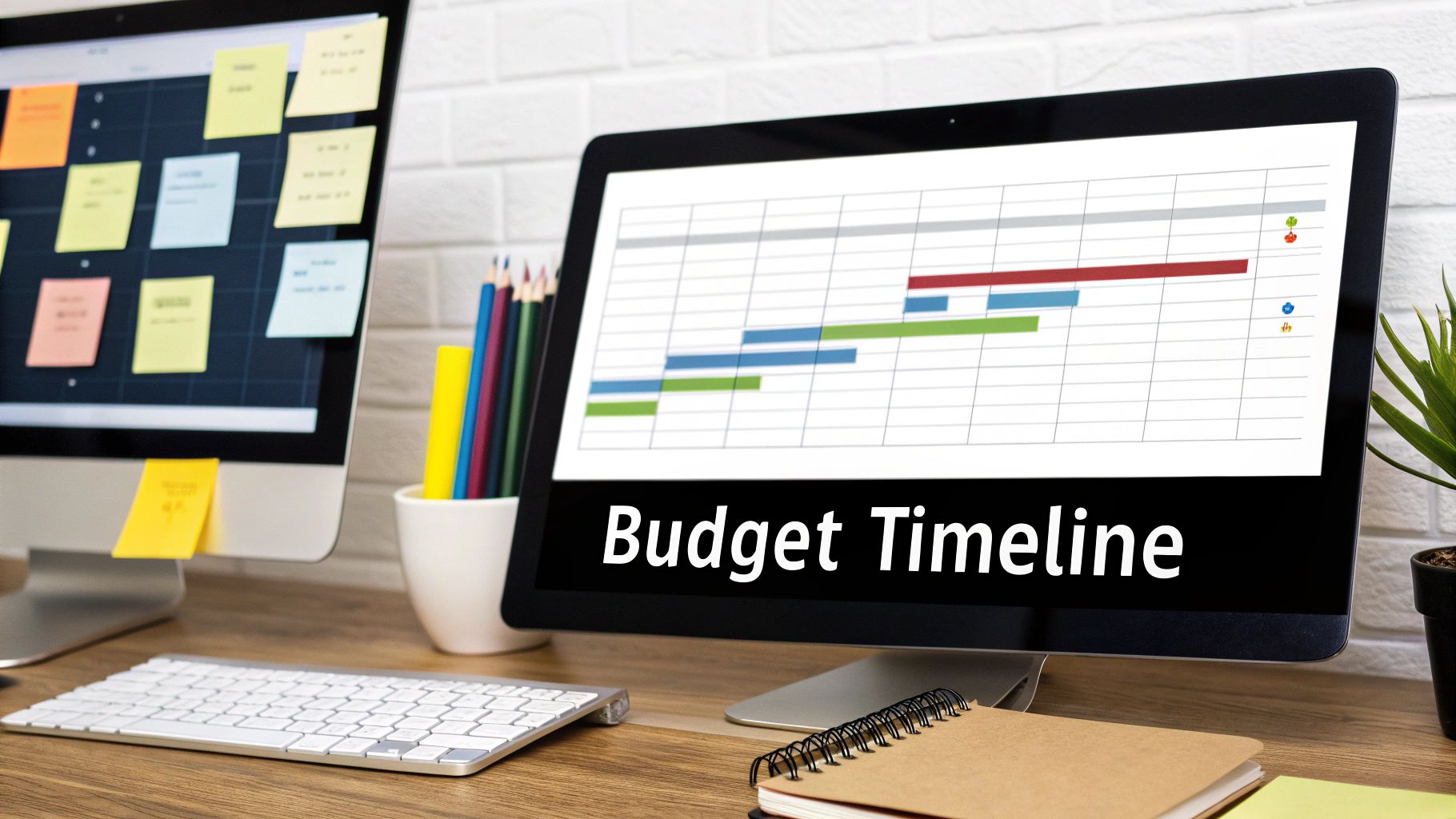
Let's get practical and pin down these details. A realistic plan for your resources is what keeps a campaign on track and prevents a lot of headaches down the line.
Building a Budget That Bends, Not Breaks
Your budget isn’t just one big number; it’s a living document that details every single cost you can think of. The more thorough you are now, the fewer surprises you’ll have later. A good template will force you to think through every line item.
You’ll want to account for costs like:
- Paid Media Spend: The cash you're putting behind ads on Google, LinkedIn, Instagram, etc.
- Content Creation: Do you need to hire a freelance writer? A graphic designer? A video crew?
- Marketing Technology: Think about your email software, analytics tools, or social media schedulers.
- Team Resources: While usually an operational cost, it's smart to estimate the internal hours your team will spend on this.
It’s crucial to track what you planned to spend versus what you’re actually spending. This gives you the flexibility to move money from a channel that’s not working to one that’s crushing it. To really see how your budget is performing, use our customer acquisition cost calculator to connect your spend directly to new customers.
Moving Beyond a Simple Calendar
A campaign timeline is so much more than a list of deadlines. Think of it as a strategic roadmap with distinct phases, each with its own goals. A simple calendar tells you when; a proper timeline tells you why and how everything connects.
I like to break my timelines into three stages:
- Pre-Launch (Weeks 1-4): This is all prep work. We’re doing audience research, writing copy, designing creative, and getting tracking pixels in place. The main goal here is to get everything approved and ready to fly.
- Launch (Weeks 5-8): Time to go live. The focus immediately shifts to managing the campaign, watching the early data roll in, and making quick tweaks to optimize performance. A good milestone might be hitting 50% of your lead goal by the end of week six.
- Post-Launch (Weeks 9-12): The campaign is still running, but now we’re digging deep into the results, gathering insights, and building our final report. The key milestone is compiling all the data and sharing what we learned with the team.
This phased approach keeps everyone focused on the right priorities at the right time and gives the whole project a clear, manageable flow.
Defining Who Does What
A plan is completely useless if nobody knows who’s in charge of what. When roles are fuzzy, tasks get dropped and deadlines get missed. The easiest way I’ve found to solve this is with a RACI chart.
A RACI chart is a simple grid that kills confusion. It makes it crystal clear who is Responsible, Accountable, Consulted, and Informed for every task.
Here’s a quick example for a new blog post:
| Task | Content Writer | Marketing Manager | SEO Specialist | Social Media Manager |
|---|---|---|---|---|
| Keyword Research | Consulted | Accountable | Responsible | Informed |
| Drafting Content | Responsible | Accountable | Consulted | Informed |
| Content Approval | Informed | Accountable | Informed | Informed |
| Social Promotion | Informed | Accountable | Consulted | Responsible |
With a chart like this, everyone knows their role at a glance. No more guessing games.
It’s no wonder 80% of marketers regret under-budgeting. The good news is that templates with real-time tracking can help save up to 20% on campaign spending. We’ve also seen that teams whose plans connect goals, channels, and budgets launch 30% faster and hit their KPIs 25% more often. A little structure goes a long way.
Measuring What Matters for Your Campaign
You’ve built the strategy and mapped out all the moving parts, but a plan is only as good as the results it delivers. This is where we close the loop, shifting from planning to proving. A successful campaign isn’t just about making noise; it’s about making an impact you can actually measure against the goals you set right at the start.
The key is to focus on metrics that truly signal business success. It’s incredibly easy to get distracted by numbers that look good on paper but don’t actually move the needle. These are what we call vanity metrics.
Avoiding the Vanity Metric Trap
Vanity metrics feel great but offer very little strategic value. Think of things like social media likes, raw page views, or your total follower count. Sure, a big spike might give you a temporary ego boost, but these numbers rarely tell you if you're actually acquiring new customers or driving revenue.
Actionable metrics, on the other hand, tie directly back to your campaign objectives. They give you the real story, the insights you need to make smart decisions. These are the numbers that deserve a prime spot on your reporting dashboard.
The goal isn't to track everything you can, but to measure everything that matters. An actionable KPI tells you a story about customer behavior and campaign effectiveness, while a vanity metric is often just noise.
This distinction is a fundamental part of a solid marketing campaign planning template. By defining your true KPIs upfront, you force your team to stay focused on outcomes, not just activity. Once your campaign is live, it's vital to assess its impact; for specific insights, you can find a detailed guide on tracking influencer performance that shows how to connect social activity to real business results.
Vanity Metrics vs. Actionable KPIs
Let's get crystal clear on the difference. It's easy to get these mixed up, but focusing on the right ones will completely change how you view campaign performance.
The table below is a quick cheat sheet to help you distinguish between the numbers that feel good and the numbers that do good.
| Metric Category | Vanity Metric (Avoid Relying On) | Actionable KPI (Focus On) |
|---|---|---|
| Website Performance | Total Page Views | Conversion Rate on key landing pages |
| Social Media | Number of Followers or Likes | Engagement Rate (comments, shares) and Click-Through Rate |
| Lead Generation | Total Leads Generated | Cost Per Qualified Lead (CPL) and Lead-to-Customer Conversion Rate |
| Customer Acquisition | Number of New Customers | Customer Acquisition Cost (CAC) and Customer Lifetime Value (CLV) |
By prioritizing the KPIs in that right-hand column, you get a much clearer, more honest picture of your campaign’s health and its return on investment.
Creating a Cycle of Improvement
Your campaign data is your most valuable asset for the future. Seriously. The insights you gather from this campaign should directly inform the strategy for your next one. This creates a powerful feedback loop where each marketing effort gets smarter, sharper, and more efficient.
You don't need a complicated setup. A simple dashboard in a tool like Google Data Studio or even a well-organized spreadsheet will do the trick. Just make sure you're tracking your main KPIs weekly.
- Did a certain ad creative drive a much lower CAC? Great, double down on that style.
- Is one email subject line getting a ridiculously high open rate? Let's use that formula again.
- Did a specific blog post generate a high number of qualified leads? Time to create more content around that topic.
This process of continuous improvement is what separates good marketers from great ones. It transforms your marketing from a series of one-off projects into a strategic, data-driven engine for growth. Your template isn't just for planning; it's the start of an ongoing conversation with your audience, guided by the data they give you.
Got Questions About Campaign Planning? We’ve Got Answers.
Even with the perfect marketing campaign template, questions always come up. That’s completely normal. The moment a plan moves from a document to the real world, you're bound to hit a few practical hurdles.
This is where we tackle the most common questions I hear from marketers day in and day out. Think of this as your field guide for navigating those final challenges and launching your campaign with confidence.
How Often Should I Update My Marketing Campaign Plan?
One of the biggest traps you can fall into is treating your campaign plan like it’s set in stone. The best plans are living, breathing documents, not static artifacts you create once and then forget about. While your main goals and audience should stay pretty consistent, your tactics and how you spend your money need a regular look.
Think of it this way: your plan is your best guess—your hypothesis. The live campaign is the experiment. You’d never run a lab experiment without checking in on the results, right? Same thing here.
I always recommend a weekly or bi-weekly review. This doesn’t have to be some long, drawn-out meeting. A quick huddle to check on a few key things is all you need:
- Pacing and Budget: Are we on track with our spend? Is one channel absolutely tearing through the budget faster than we thought?
- Performance vs. KPIs: How are our channels holding up against the goals we set? Is that one ad set on Facebook bringing in leads for way cheaper than the others?
- Messaging Resonance: Is our message actually landing with people? Do comments or social media chatter tell us we need to tweak our tone?
This kind of agile approach lets you make smart changes on the fly. For instance, if your Google Ads are just not performing after two weeks but your LinkedIn campaign is knocking it out of the park, you can confidently shift budget from one to the other. Waiting until the end of the campaign to learn that lesson is just a recipe for wasted ad spend.
What Is the Biggest Mistake to Avoid When Using a Template?
This one’s easy: treating the template like a fill-in-the-blanks checklist instead of a tool for strategic thinking. A template gives you structure, but it can't ever replace the deep research and critical thought that goes into a truly great campaign. It’s a guide, not a magic bullet.
When you rush to fill every box with generic info, you completely miss the point. Seeing entries like "increase brand awareness" for a goal or just "millennials" for an audience is a huge red flag. It shows the thinking stopped before it even started.
The real power of a planning template isn't in the boxes you fill, but in the tough questions it forces you to answer. Use it to poke holes in your own assumptions, back up your decisions with data, and build a strategy that actually holds together.
To sidestep this common mistake, challenge every single thing you write down. Ask yourself "why" constantly. Why is this our number one goal? Why is this audience segment the most valuable? Why is this channel the absolute best place to find them? Forcing yourself to justify your choices will lead you to a much stronger, more intentional plan.
Can This Template Be Used for Any Type of Marketing Campaign?
Absolutely. We designed this framework to be incredibly versatile. The core ingredients of strategic marketing—defining goals, knowing your audience, crafting a message, picking your channels, setting a budget, and measuring what matters—are universal. They apply whether you’re a B2B SaaS company launching a new feature or a direct-to-consumer brand running a big holiday sale.
The beauty of a good template is its flexibility. The main components stay the same, but the nitty-gritty details change depending on what you’re trying to achieve.
Just look at how different it can be:
- A B2B Lead Generation Campaign: Here, your world revolves around Cost Per Qualified Lead (CPL). Your audience is defined by things like job titles and company size. Your go-to channels might be LinkedIn ads and industry-specific webinars.
- A D2C Product Launch: It’s all about sales revenue. Your audience is defined by lifestyles and interests. You’ll probably be living on Instagram, TikTok, and working with influencers.
- A Content Marketing Initiative: Maybe your main goal is getting more email newsletter sign-ups. Your audience is defined by the problems they’re trying to solve. Your game plan will be SEO-driven blog posts and social media promotion.
The template is the scaffolding; you’re the architect. Its real strength is bringing structure and clarity to just about any marketing idea you can cook up.
How Do I Get My Team On Board with Using a New Planning Template?
Getting a team to adopt any new process can feel like pulling teeth, especially if they’re used to a more "figure it out as we go" approach. The secret is to frame the template not as more red tape, but as a tool that makes everyone’s job easier and more collaborative.
Kick things off with a team meeting where you walk through it together. Don’t just present a finished document. Explain the why behind each section and connect it directly to their roles. Show the content writer how a detailed buyer persona helps them write copy that actually connects. Show the paid media specialist how clear KPIs help them prove their value.
The best way to get buy-in is to make them part of the process from the start.
- Ask for Their Input: Your social media manager knows what’s buzzing on the ground. Your sales team has real-world feedback that can make your buyer personas a thousand times better. Use that expertise.
- Assign Clear Ownership: Put people’s names next to sections and tasks right in the template. When someone sees they own a piece of the puzzle, it creates natural accountability.
- Celebrate the Clarity: Talk about how this plan means fewer last-minute fire drills and conflicting priorities. Position it for what it is: a way to work smarter, not just harder.
When your team sees the template as a tool that helps them win and cuts through the chaos, they won’t just adopt it—they’ll champion it.
Ready to transform your campaign planning from chaotic to cohesive? At OneNine, we specialize in building the strategic foundation your business needs to thrive online. We can help you turn a great plan into a high-performing website that drives real results. Let's build something great together.


