
A customer acquisition cost calculator turns your sales and marketing expenses into one clear metric. Suddenly, you can see exactly how much it costs to win a new customer. That clarity reshapes your growth plans—no more guesswork.
Why Calculating Your CAC Is Non-Negotiable
Let’s face it: Customer Acquisition Cost—or CAC—is more than just another line item. When you really understand your CAC, you can:
- Back up your marketing budget with real numbers
- Double down on channels that deliver
- Plug money leaks before they sink your ROI
Think of it as your strategic roadmap. Without it, you’re navigating blind.
The Rising Cost Of Gaining Customers
Over the last decade, competition has driven ad costs through the roof. Between 2013 and 2021, the average CAC shot up by 222%.
That jump makes one thing crystal clear: you can’t afford to guess. Running campaigns without knowing your cost per acquisition is a direct ticket to wasted spend.
A precise handle on your CAC is no longer optional—it's the foundation of a successful growth strategy. It tells you if your business model is healthy and whether your marketing efforts are an investment or an expense.
Turning Data Into Decisions
Cracking the CAC code answers the questions that really matter:
- Is our marketing budget effective? You’ll see the true return on every ad dollar.
- Which channels drive the best ROI? Compare CAC for Google Ads, social campaigns, email and more.
- Can we scale paid campaigns? Forecast exactly how much you’ll need to hit your next milestone.
With a solid calculator in hand, you swap assumptions for data. Every dollar you spend moves you closer to sustainable, profitable growth.
Getting the Right Data for Your CAC Formula
Before you can get a truly useful Customer Acquisition Cost (CAC), you need to get your numbers straight. The old saying "garbage in, garbage out" has never been more true. A solid CAC calculation hinges entirely on the quality and completeness of the data you feed it.
The basic idea is simple: add up everything you spent to get new customers over a specific period, then divide that by the number of new customers you actually brought in. But the devil, as always, is in the details.
What Costs Should You Actually Include?
It's easy to just count ad spend, but that’s a rookie mistake that gives you a misleadingly low CAC. To get the real picture, you have to account for everything that contributes to your marketing and sales efforts.
This includes the obvious stuff like your PPC campaigns and social media ads, but also the less obvious expenses. Think about the salaries of your marketing and sales teams, the money you spend on CRMs and analytics software, and even the cost of creating that blog post or video that drew people in.
To make sure you're not missing anything, here’s a quick rundown of the costs you'll want to track.
Essential Costs to Include in Your CAC Calculation
This checklist breaks down the direct and indirect costs that are critical for an accurate CAC calculation. Forgetting any of these can throw your numbers off significantly.
| Cost Category | Examples | Why It's Included |
|---|---|---|
| Advertising Spend | PPC campaigns, social media ads, display ads | These are the most direct costs of reaching potential customers through paid channels. |
| Team Salaries | Salaries & commissions for marketing and sales staff | Your people are your biggest asset and often your biggest expense; their time is a direct cost of acquisition. |
| Software & Tools | CRM platforms, analytics software, email marketing tools | These are the essential technologies that power and track your marketing and sales engine. |
| Content Creation | Freelance writers, video production, graphic design | This captures the investment needed to create the assets that attract and nurture leads. |
| Overhead | A portion of office rent or utilities for the M&S team | These general business costs support the acquisition teams and should be partially allocated. |
By tracking these categories diligently, you'll have a much clearer, more honest view of what it really costs to win a new customer.
Putting It All Together
Once you've got this data compiled, you're ready for the next step. To get a better handle on where your new customers are even coming from, you might want to check out our guide on how to https://onenine.com/how-to-analyze-website-traffic/. This context is super helpful before you start assigning costs.
For a deeper dive into all the components that go into this metric, this guide on mastering the customer acquisition cost formula is an excellent resource.
Let’s imagine a real-world scenario. A SaaS startup diligently tracked these costs and discovered their CAC had shot up by 12% after launching an ambitious new ad campaign. Because they had detailed data, they could quickly see which channels weren't performing, cut the wasted spend, and managed to lower their overall CAC by 20% in less than two months. That's the power of good data.
My Pro Tip: Set up a monthly or quarterly audit of all these costs. It helps you spot trends and catch any surprise spikes before they have a chance to seriously mess with your budget.
With accurate numbers in hand, you can move forward with confidence, ready to plug them into a calculator and get an answer you can actually trust. Now, let’s look at how to do just that.
Using a Customer Acquisition Cost Calculator
Alright, you’ve pulled together all your sales and marketing expenses. Now for the fun part: putting those numbers to work.
The math for figuring out your Customer Acquisition Cost is surprisingly simple, but the insight it gives you into your business's health is incredibly powerful. It all boils down to one straightforward formula.
(Total Marketing Costs + Total Sales Costs) / Number of New Customers = CAC
That’s it. This single number tells you precisely how much you spent to get each new customer in the door over a specific timeframe. No more guesswork, just a clear metric to help steer your strategy.
Let's Walk Through a SaaS Example
To see how this plays out in the real world, let's imagine a SaaS company calculating its CAC for the second quarter. They’ve done their homework and tallied up all the relevant costs.
- Total Q2 Marketing Costs: $35,000 (This covers everything from ad spend and content creation to their marketing software subscriptions).
- Total Q2 Sales Costs: $15,000 (This includes salaries and commissions for their sales team).
- New Customers Acquired in Q2: 500
Now, we just plug those figures into our formula:
($35,000 + $15,000) / 500 = $100 CAC
The result? On average, the company spent $100 to acquire each of its 500 new customers during that quarter. This isn't just a random number; it's a vital benchmark. With this $100 figure, they can now evaluate which marketing channels are actually profitable and plan their future budgets with much greater confidence.
Your CAC is more than just a look in the rearview mirror. It’s a tool for looking ahead. If you know it costs you $100 to win a customer, you know exactly what kind of investment you’ll need to acquire the next 1,000.
This visual helps break down how all your acquisition spending and new customer numbers come together to give you that final CAC.
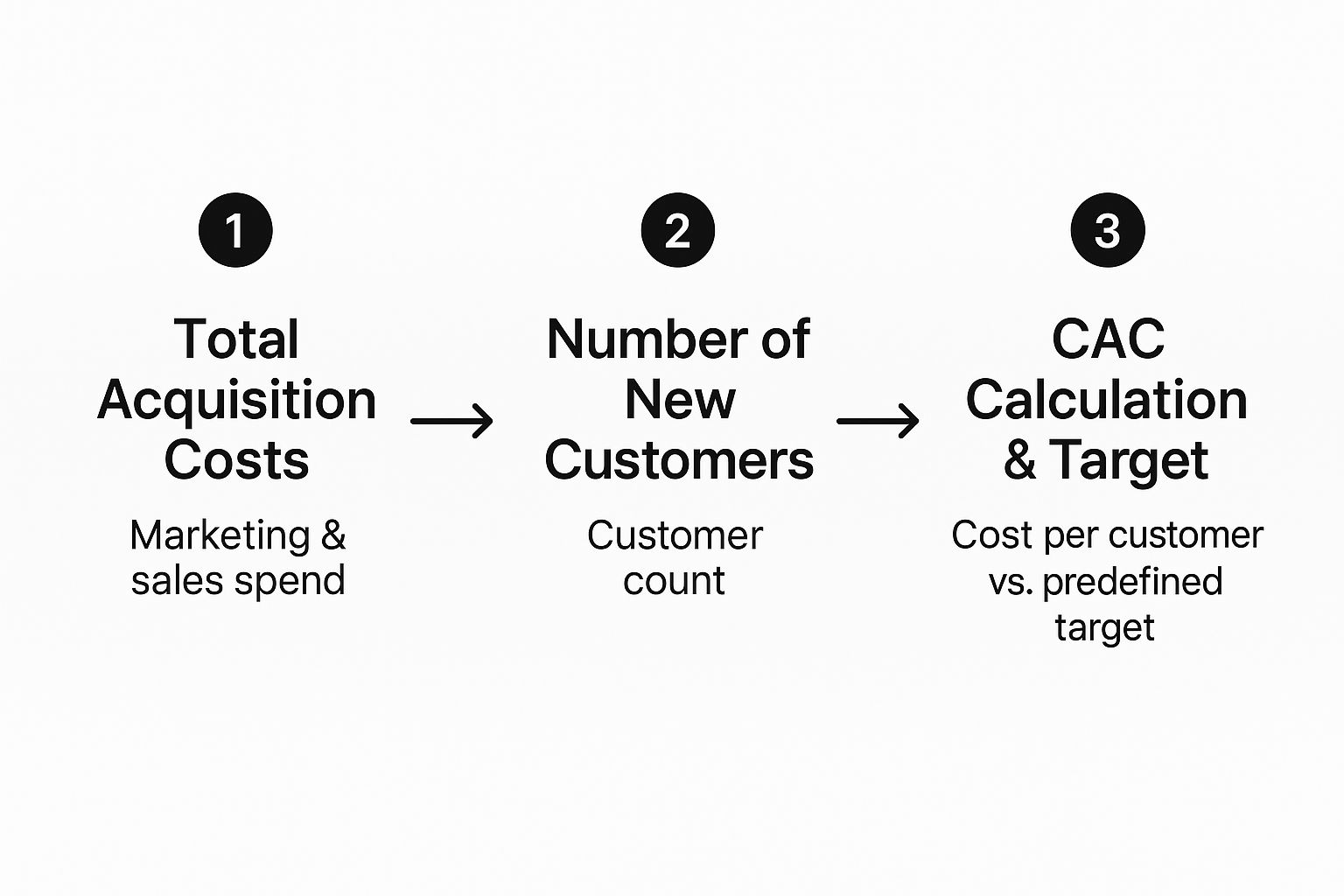
It really highlights the direct link between what you spend and what you get, making it easy to see how a change on either side of the equation affects your cost per customer.
From Manual Math to Instant Insights
Doing the calculation by hand is a great way to get a feel for the moving parts. But for day-to-day use, an interactive CAC calculator is the way to go.
You just pop your total costs and the number of new customers into the fields, and you get an instant, accurate result. This makes it incredibly easy to play around with different scenarios. For example, you can quickly see how a budget increase might impact your CAC if your customer growth stays flat.
What Your CAC Result Actually Means for Your Business

Alright, so you’ve calculated your Customer Acquisition Cost. That number is a great start, but on its own, it doesn't tell the whole story. The real magic happens when you put that number into context. Think of your CAC as just one piece of a much larger puzzle about your business's sustainability.
The other crucial piece is your Customer Lifetime Value (LTV). This metric tells you how much revenue a single customer is likely to generate throughout their entire time with your company. When you put CAC and LTV side-by-side, you get an incredibly clear snapshot of your business's long-term viability.
The LTV to CAC Ratio
This is where things get interesting. The relationship between LTV and CAC is probably the single most important health check for your business model. The LTV:CAC ratio reveals whether your acquisition spending is a smart investment or just money down the drain.
So, what’s a good number to aim for? The industry benchmark for a healthy ratio is 3:1.
- A 1:1 ratio is a major red flag. It means you’re spending just as much to get a customer as they’ll ever spend with you. You're basically treading water with no room for profit, which is a recipe for disaster.
- A 3:1 ratio is the gold standard. For every dollar you put into acquiring a customer, you're getting three dollars back. This is the sign of a profitable, scalable business.
- A 5:1 ratio or higher is phenomenal. Your marketing is running like a well-oiled machine, and it might be time to press the accelerator and pour more fuel on the fire to grab more market share.
Looking at this ratio shifts your thinking from just "how much did we spend?" to "what's the return on our investment?" A solid LTV:CAC ratio proves your marketing is building a profitable engine, not just filling a leaky bucket.
To really get a handle on this, it helps to understand the core definition of Customer Acquisition Cost (CAC). Remember, this isn't a one-and-done calculation. You need to track this ratio over time. If you notice it starting to dip, it’s an early warning that you need to re-evaluate your acquisition strategy or work on customer retention.
Ultimately, this is a powerful way to measure how effective your marketing truly is. To dig deeper into that, you can check out our guide on https://onenine.com/how-to-calculate-marketing-roi/.
Proven Strategies to Lower Your Acquisition Costs
Knowing your Customer Acquisition Cost is just the starting line. The real race is won by actively bringing that number down. Lowering your CAC isn’t about gutting your marketing budget; it’s about getting smarter with every dollar you spend. Think of it as optimizing your entire acquisition funnel, piece by piece, to turn waste into growth.
One of the quickest wins? Rigorous A/B testing on your landing pages. It sounds simple, but bumping your conversion rate from 2% to 3% can slash your CAC without you spending a single extra cent on ads. Experiment with everything—headlines, button text, images, and even the number of form fields. Find out what truly clicks with your audience.
Reallocate Your Budget to Winning Channels
Take a hard look at where your best customers are actually coming from, because not all channels are created equal. You might discover that LinkedIn Ads are bringing in high-value B2B leads, while another platform is just delivering low-quality traffic that never converts.
This is where you get strategic. By shifting your budget away from the underperformers and doubling down on what works, you’re instantly maximizing your return. This is why a solid multi-channel marketing strategy is so crucial—it gives you the data to make these smart pivots and builds a more resilient acquisition model.
The goal isn't just to get cheaper customers; it's to acquire the right customers more efficiently. Focusing on channels that deliver high LTV users makes even a slightly higher CAC sustainable and profitable in the long run.
Beyond paid ads, don't forget the long game. Investing in content marketing and SEO is one of the most powerful moves you can make. These efforts attract high-intent organic traffic that, over time, often comes with a much lower acquisition cost than paid channels.
Focus on Retention to Make CAC More Sustainable
Finally, one of the most overlooked levers for managing acquisition costs is actually customer retention. When your customers stick around longer, the initial cost to acquire them becomes much more manageable.
The pressure here is very real. For ecommerce businesses, the average CAC is projected to hit between $68 and $78 by 2025, and costs have already jumped by around 40% since 2023. These numbers make it absolutely essential to increase your Customer Lifetime Value (CLV) by keeping your existing customers happy.
A higher LTV gives you more breathing room to invest in acquiring new, high-quality customers, creating a much healthier and more scalable business model.
Common Questions About Calculating CAC
Even with a handy calculator, a few practical questions always pop up when you start digging into your customer acquisition cost. Getting these details right is the difference between a vanity metric and a number you can actually use to make smart decisions.
Let's walk through the most common ones I hear.
How Often Should I Run This Calculation?
I’ve found that for most companies, a mix of monthly and quarterly calculations works best.
Think of it this way: monthly calculations are for your tactical, in-the-weeds adjustments. They give you a quick pulse check on new campaigns and let you spot any weird trends before they snowball.
Your quarterly calculations, on the other hand, give you a more stable, big-picture view. Looking at a three-month period smooths out any random spikes or dips, which is exactly what you need for strategic planning and setting next quarter's budget.
What's a Good LTV to CAC Ratio?
The magic number you'll hear thrown around is 3:1. And for good reason. It means for every dollar you spend to get a customer, you're getting three dollars back over their lifetime.
If your ratio is 1:1, you're basically losing money on every new customer. On the flip side, a 4:1 or 5:1 ratio is fantastic—it’s a strong signal that you’ve built a healthy business and might have room to get more aggressive with your growth spending.
The 3:1 ratio is more than a benchmark; it’s your north star for sustainable growth. It proves you're not just buying customers, you're building profitable relationships.
Do I Really Need to Include All Marketing Salaries?
Absolutely. You need to include the salaries of anyone who directly touches customer acquisition.
This includes your ad specialists, content marketers, SEO folks, and even your sales team. If someone splits their time—say, a designer who works on both acquisition campaigns and product features—just allocate a percentage of their salary that reflects the time they spend on acquisition work. It’s the only way to get a truly honest number.
Ready to manage your website with a team that understands your goals? OneNine offers expert design, development, and support to keep your online presence powerful and effective. Learn more about our services.


