

Ever wonder what it's really like to be one of your customers? User journey mapping is how you find out. It’s the process of creating a visual story of every single interaction a customer has with your company, all from their point of view.
Think of it less like a business flowchart and more like a road trip map for your customer experience. It shows every stop they make, every feeling they have, and every detour they take on their way to solving a problem with your help.
Beyond The Diagram The True Purpose Of A Journey Map
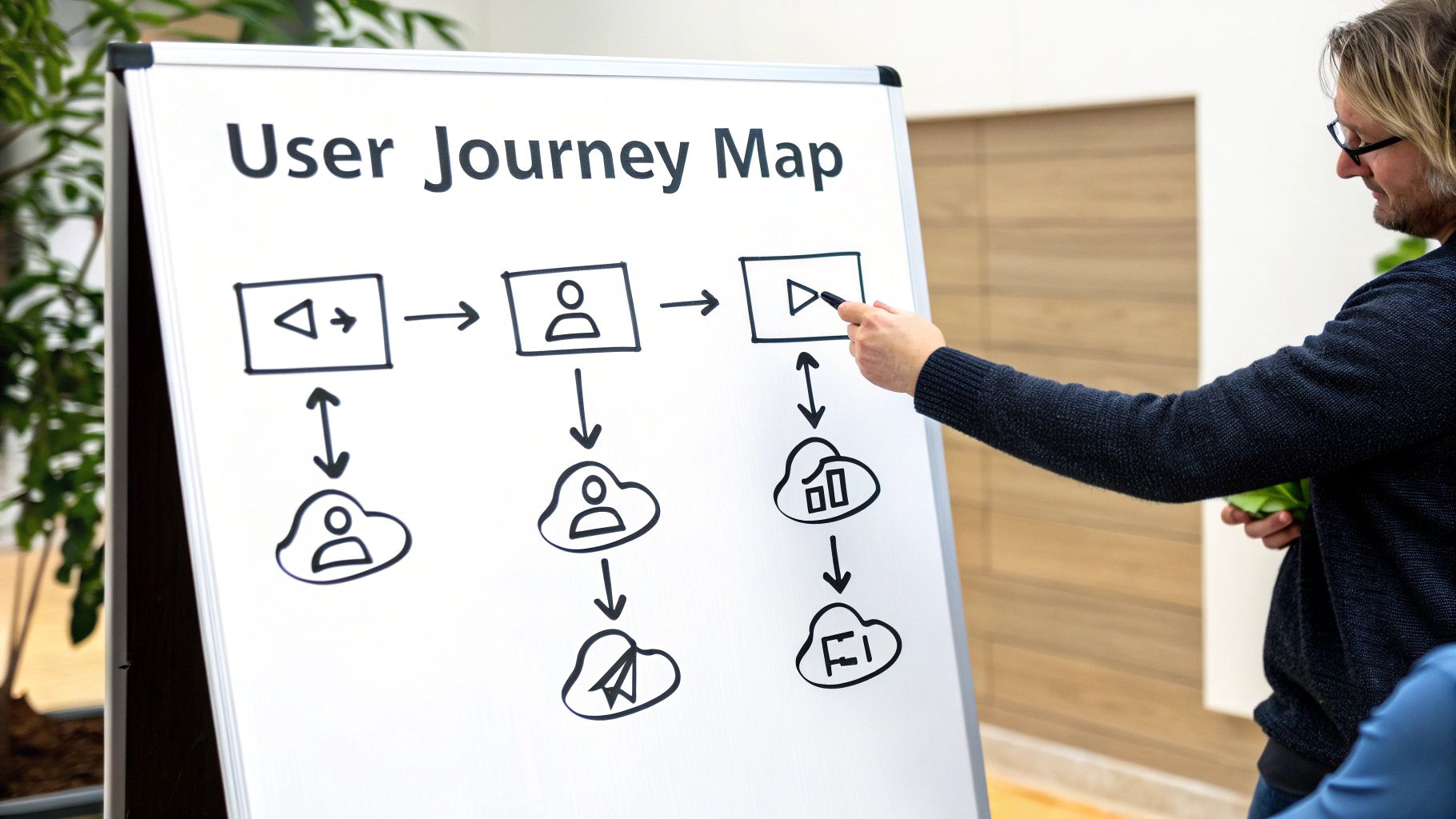
At its heart, a user journey map is an empathy-building machine. It gets everyone on your team—from marketers to developers to the CEO—to stop thinking like an employee and start seeing the world through the customer's eyes. This change in perspective is where the magic happens, helping you spot hidden frustrations and moments of unexpected joy.
It’s basically a timeline that lays out a user’s entire experience, from the first time they hear about you all the way through to becoming a loyal fan. This whole practice really took off in the early 2000s alongside the rise of user experience (UX) design. If you're curious about the history, you can learn about its origins from design experts.
To put it simply, here’s a quick breakdown of what a user journey map is and what it aims to do.
User Journey Map At a Glance
| Concept | What It Is | Primary Goal |
|---|---|---|
| User Journey Map | A visual timeline of a customer's experience with a company. | To understand and improve the customer experience by seeing it from their perspective. |
This table shows how a simple concept—mapping out a journey—can have a massive impact on your business strategy.
Why This Story Matters
Mapping out this experience gives your entire organization a shared, crystal-clear picture of what it actually feels like to be your customer. No more guessing games or relying on assumptions. You can point to the exact moments where things go wrong or, just as importantly, where they go right.
A journey map transforms abstract data into a human story, revealing not just what users do, but why they do it. It connects their actions to their emotions, goals, and pain points.
When you can see the whole process laid out, you can finally get all your teams on the same page. The sales team understands what the marketing team promised, and the support team knows what happened before the customer ever called them. This kind of alignment is invaluable and can directly influence things like how to organize website content to perfectly match what users need at each stage.
Ultimately, understanding this journey helps you:
- Identify pain points: Pinpoint and fix the things that frustrate your customers.
- Discover opportunities: Find new moments to add value and delight people.
- Improve conversion rates: Smooth out the path from casual browser to happy customer.
- Boost customer loyalty: Craft a consistently positive experience that keeps people coming back for more.
The Building Blocks Of An Effective Journey Map

A great user journey map is really a story. And like any good story, it needs a few key ingredients to bring it to life. Think of these elements not as items on a checklist, but as the essential pieces that reveal what your customer is actually going through.
The story always starts with a protagonist. For us, that's the user persona—a detailed, semi-fictional character who represents your ideal customer. This goes way beyond basic demographics. A good persona captures their goals, what drives them, and what frustrates them, giving you a crystal-clear picture of who you're actually serving.
Defining The Quest And The Path
Once you know your hero, you have to define their quest. In mapping terms, this is the scenario. It’s the specific goal your persona is trying to accomplish, like "ordering a coffee on the way to work using a mobile app." The scenario sets the stage and keeps the map focused on one specific experience.
This journey doesn't happen all at once. It breaks down into several journey stages, which are the high-level phases the user moves through. For our coffee-run scenario, the stages might look something like this:
- Awareness: The "I need coffee now" moment.
- Discovery: Searching for coffee shops that offer mobile ordering.
- Order & Pay: Actually using the app to choose and buy the drink.
- Pickup: Swinging by the store to grab the coffee.
- Post-Pickup: Enjoying the coffee and maybe leaving a review later.
Think of these stages as the chapters in your customer's story. They help break down a big goal into smaller, more manageable parts.
Capturing Actions And Emotions
Within each of those chapters, a few other critical things are happening. We have touchpoints, which are any and all moments where the user interacts with your business. This could be your website, the app itself, an email, or even the barista at the counter.
At each touchpoint, the user performs an action. These are the specific things they do, like tapping the "Order Now" button or scanning a QR code at the pickup counter.
But here's the most important part: the map must also capture emotions. This is where you track how the user is feeling at every step. Are they delighted? Relieved? Or are they confused and frustrated?
A journey map's real magic comes from connecting what a user does with how they feel. This is how you discover why they ditched their cart or why they became a raving fan, giving you the insights you need to make things better.
When you bring all these pieces together, you get so much more than a simple flowchart. You create an empathetic story that shows you exactly where your experience is winning and, more importantly, where it’s letting your customers down.
Navigating The Five Stages Of The User Journey
Every single customer interaction, from their first Google search to their tenth purchase, is part of a larger story. This story, or path, is what we call the user journey, and it typically unfolds across five distinct stages.
If you really want to connect with your customers, you have to understand what they're thinking and feeling at each step. This lets you give them exactly what they need, right when they need it.
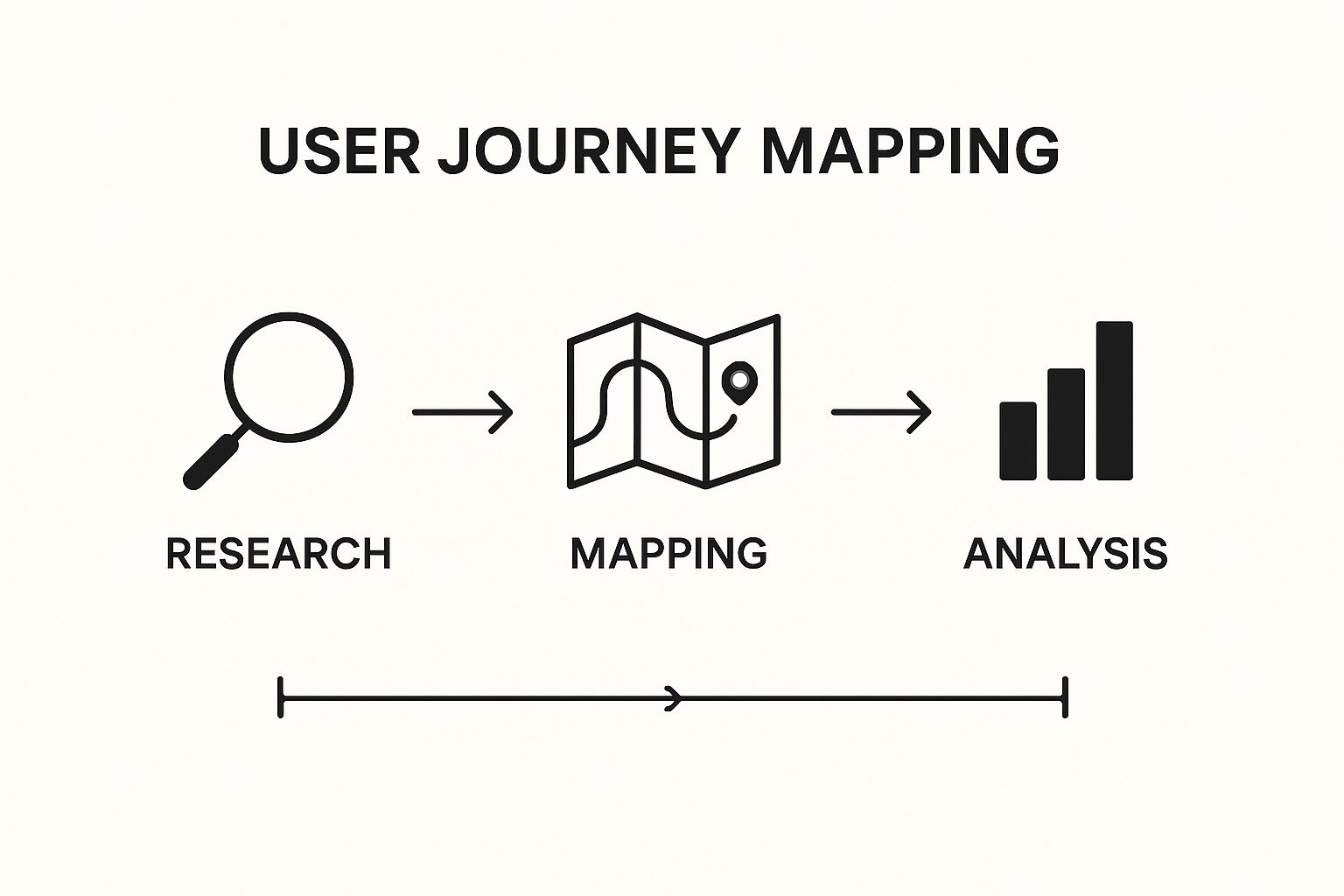
As you can see, a powerful user journey map isn’t just a creative exercise. It's built on a foundation of real research and leads to insights you can actually use.
The Initial Stages: Awareness and Consideration
The journey always starts long before someone lands on your pricing page. It begins with Awareness—that "aha!" or "uh-oh" moment when a person first realizes they have a problem to solve or a need to fill. They aren't thinking about your brand yet; they're just focused on the problem itself.
Think about someone who gets invited to a fancy wedding. Their first thought is, "I have nothing to wear." Or a manager who sees her team dropping the ball on deadlines. She thinks, "We need a better way to keep track of our work."
This naturally leads to the Consideration stage. Now that the problem is clear, they start actively looking for solutions. They're doing their homework: Googling options, reading reviews, and comparing features. Your business is now on their radar, but you're one of several contenders.
That wedding guest is now searching for "summer wedding guest dresses," and the manager is looking up "best project management software for small teams."
At this point, they're looking for proof. They want to be sure they're picking the most reliable, effective solution for their specific problem. Your content's job is to build that trust.
The Decisive Stages: Purchase, Service, and Loyalty
The Purchase stage is the moment of truth. After all the research, the user is finally ready to pull the trigger and choose a solution. Their mindset is all about action: "Okay, this is the one. How do I buy it?"
Any friction here can kill the sale. A clunky checkout process or hidden fees will send them running right back to their list of alternatives.
But the journey doesn't end at the checkout. Next up is Service (sometimes called Onboarding). The money has been exchanged, but the experience is far from over. Now the customer is wondering, "Did I make the right call? How does this thing even work?"
A quick shipping confirmation, a friendly welcome email, or a super-simple setup guide goes a long way in making them feel good about their decision.
The final—and most valuable—stage is Loyalty. This is the holy grail. It's when a customer's experience is so positive that they not only come back for more but start telling everyone they know about you. They've gone from a customer to a true fan. This is where you get word-of-mouth marketing and sustainable, long-term growth.
How Real Companies Use Journey Mapping To Win
It’s one thing to understand the theory behind user journey mapping, but seeing it in action is where you really grasp its power. Top companies don’t just create these maps as a one-off exercise; they treat them as living, breathing tools that drive actual business growth.
By visualizing every single step a customer takes, from their first interaction to their last, brands can pinpoint the exact moments of frustration or delight that raw data alone would never reveal. It turns a spreadsheet of analytics into a compelling story about your customer's experience.
From Friction To Flow
Think about a simple signup process. A journey map could show that users feel confident at the start but then get confused or anxious when asked for a specific piece of information. That’s a huge insight.
With that knowledge, the team can simplify the form, add a helpful tooltip, or explain why they need that info. This one small change, discovered through the map, can directly boost signups.
This is how a journey map connects directly to tangible business results:
- Higher Conversion Rates: You can smooth out the bumps that stop people from completing a purchase.
- Better Retention: It helps you find and fix the problems that make customers leave for good.
- Fewer Support Tickets: You can solve problems proactively before customers even have a chance to complain.
Real-World Wins With Journey Maps
Global brands have been using this strategy to get ahead for years. Uber, for example, mapped out the entire experience from booking a ride to getting dropped off, noting all the emotional peaks and valleys along the way. That map informed everything from tiny interface tweaks to the timing of notifications.
Similarly, Spotify uses journey mapping to understand the key moments in music discovery that keep users engaged and coming back. You can find more inspiration by looking at these great user journey map examples from top companies.
By walking in your customer's shoes, you uncover issues you never knew existed and opportunities to go above and beyond, delighting users in unexpected ways.
At its core, this whole process is a vital part of effective user experience design. Mapping the journey ensures every touchpoint is intentional, intuitive, and designed to help the user succeed. Building that deep empathy is what separates a good company from a truly great one. If you want to dive deeper, check out our guide on what is user experience design.
How To Build Your First User Journey Map
Alright, let's get practical. Building your first user journey map isn't as intimidating as it might sound. Think of it less like creating a perfect, final document and more like sketching out a story—the story of your customer's experience with your brand.
The real goal here is to build empathy and find those "aha!" moments where you can make things better for them.
Step 1: Set a Clear Goal for Your Map
Before you dive in, you need a North Star. Ask yourself: what specific problem am I trying to solve? Are you trying to figure out why people abandon their shopping carts? Or maybe you want to improve your new customer onboarding?
Having a clear objective keeps your map from becoming a sprawling, unfocused mess. It ensures you're working toward real, actionable insights.
Next, you'll want to define your persona and the scenario you're mapping. For instance, your persona could be "Sarah, a busy small business owner," and her scenario might be "signing up for a free trial of our project management tool." This sharp focus is what makes the map truly useful.
Once you have your goal and persona, it's time to gather your intel. This is a mix of two kinds of research:
- Quantitative Data: This is the what. Dive into your website analytics, sales figures, and support ticket logs. This data tells you what people are doing on a broad scale.
- Qualitative Data: This is the why. Talk to your users! Conduct interviews, read customer reviews, or send out surveys to understand the feelings and motivations driving their actions.
Step 2: Visualize the Journey, Step by Step
With your research in hand, you're ready to start mapping. You can go old school with a whiteboard and a bunch of sticky notes—and honestly, that still works great for getting ideas flowing.
But today, we have a ton of great digital tools that make this much easier. In the past, journey maps were a manual effort, but now there are over two dozen digital tools with drag-and-drop features and analytics integrations. They let you blend all that quantitative and qualitative data into one clear picture.
To start building your map, lay out the key stages of the journey along the top. Think simple: Awareness, Consideration, Purchase, Service, and Loyalty.
Under each stage, you'll fill in the details from your persona's point of view. What are their actions? What are their thoughts and emotions? And most importantly, what are their pain points?
The magic of a user journey map happens when you visualize the emotional highs and lows. A sudden dip in that emotional line is like a big, flashing sign pointing directly to a problem you need to solve.
For a more detailed walkthrough, this step-by-step guide to creating a customer journey map is a fantastic resource.
And as you get into it, you’ll find the right software can make a huge difference. To help you pick the best one for your team, we put together an ultimate guide to user journey mapping tools.
Common Questions About User Journey Mapping
When you first dive into user journey mapping, a few questions always pop up. It's totally normal. Let's walk through some of the most common ones so you can get started with confidence.
What’s the Difference Between a User Journey Map and a User Flow?
This is probably the number one question people ask, and it’s a great one. The two sound similar, but they serve very different purposes.
Think of it this way: a user journey map is the entire cross-country road trip. It covers the whole experience from start to finish—the planning, the long drives, the exciting stops, the flat tires, and the feeling of finally arriving at the destination. It’s a big-picture, emotional story.
A user flow, on the other hand, is like the GPS directions for a single task on that trip, like finding the nearest gas station. It’s a tactical, step-by-step diagram showing exactly how a user completes one specific action, like signing up for a newsletter or completing the checkout process.
So, the journey map is your strategic overview, while the flow is a tactical deep-dive into one part of that journey.
How Often Should I Update My Journey Map?
Another great question. It's tempting to create a map, check it off the list, and move on. But that’s a mistake. Your map should be a living, breathing document, not something that collects dust on a shelf.
As a rule of thumb, plan to revisit it at least annually. You should also pull it out anytime something significant changes in your business.
Consider an update when you:
- Roll out a major new product or feature.
- Overhaul your pricing or services.
- See a noticeable shift in how customers are behaving or what they're telling you.
Keeping your map current ensures it remains a true north for your team's decisions.
You don’t need a mountain of data to get started. The goal is to begin with what you have and build from there. Perfection isn't the starting point; empathy is.
Do I Need a Ton of Data to Build My First Map?
And finally, the question that holds so many people back: data. It’s easy to assume you need massive, complex datasets to even begin.
Good news: you don't. Just start with what you have. Your best initial sources are often people, not spreadsheets. Go talk to your customer support and sales teams—they're on the front lines every single day and have a goldmine of stories and insights.
Combine their qualitative feedback with the analytics you already track. Even just a handful of conversations with actual customers can give you more than enough to create an incredibly powerful and useful first map.
Ready to create a website experience that aligns perfectly with your customer's journey? The team at OneNine specializes in web design and strategy that puts your users first. Learn how we can help you build a better online presence.


