
Picking the right ecommerce platform for your SEO isn't about finding a single "best" option. It’s about finding the right fit for your business goals, your budget, and how comfortable you are with the technical side of things. Think of it this way: the platform you choose is the foundation of your online store's visibility. It can either help you climb the search rankings or hold you back.
This decision is one of the most important you'll make for your business, directly influencing how easily customers can find you through organic search.

Why Your Ecommerce Platform is Your SEO Foundation
You wouldn't build a skyscraper on a flimsy foundation, right? The same logic applies here. A platform with rigid SEO limitations will put a ceiling on your growth, no matter how much you invest in marketing.
A good platform makes technical SEO straightforward, gives you powerful tools for creating content, and grows with you. A bad one creates a constant stream of technical nightmares, from messy duplicate content to sluggish page speeds that Google penalizes. With over 63% of all shopping journeys starting on a search engine, your platform's built-in SEO features are a massive part of your revenue engine.
Key Factors in Platform Selection
Don't just look at the marketing hype. You need to dig into the core features that actually impact how your site performs in search results. Our complete ecommerce platform comparison guide goes into even more detail, but let's cover the essentials.
Here are the non-negotiables to look at:
- Technical SEO Control: Can you easily edit your robots.txt file? Do you have full control over your URL structures? How does it handle canonical tags?
- Performance and Speed: Is the hosting fast out of the box? Does it give you the tools to optimize for Google's Core Web Vitals?
- Content Capabilities: How easy is it to publish and optimize content that isn't a product page, like blog posts or detailed guides?
- Extensibility: How big is the app or plugin marketplace? Can you find high-quality tools to handle more advanced SEO tasks?
A platform's out-of-the-box SEO features determine your starting line in the race for organic visibility. While apps and plugins can fill gaps, a strong native toolkit saves time, reduces complexity, and prevents performance issues down the road.
To give you a quick snapshot, here’s how some of the major players stack up on these key SEO points.
| SEO Consideration | Shopify | WooCommerce | BigCommerce |
|---|---|---|---|
| URL Customization | Limited (forced directories) | Fully Customizable | Mostly Customizable |
| Blogging/Content | Good (Built-in) | Excellent (WordPress native) | Good (Built-in) |
| Site Speed | Excellent (Managed hosting) | Varies (Depends on host) | Very Good (Managed) |
| App Ecosystem | Extensive | Massive | Growing |
Understanding Foundational SEO Capabilities
Before we jump into a side-by-side comparison, let's talk about what actually makes an ecommerce platform good for SEO. Picking the best ecommerce platform for seo isn't about fancy bells and whistles. It’s about getting the fundamentals right—the core things search engines like Google need to find, understand, and rank your store.
If you don't nail these basics, even the most brilliant SEO campaign will struggle to get off the ground. Think of these as the non-negotiables for your store's visibility in search results.
The Anatomy of an SEO-Friendly URL
You’d be surprised how many people overlook their URL structure, but it’s a huge part of good ecommerce SEO. A clean, logical URL is like a signpost for both shoppers and search engine crawlers, telling them exactly what’s on the page at a glance. The best URLs are short, descriptive, and use your target keywords.
For instance, a URL like yourstore.com/cat?id=51&prod=882 is just a jumbled mess. It tells you nothing. But yourstore.com/womens-boots/leather-ankle-boot is crystal clear. The real power comes when a platform lets you fully customize these URLs without forcing you into rigid folders like /collections/ or /products/. That level of control is key.
Mastering On-Page Elements
Your control over on-page SEO elements, especially meta titles and descriptions, is what earns you the click. While they might not carry the same ranking weight they used to, they are your sales pitch right on the search results page.
A solid ecommerce platform should let you:
- Easily edit meta titles and descriptions on every single page—products, categories, blog posts, you name it.
- Use dynamic variables to create templates for metadata, but also let you manually override them for high-priority pages.
- Control indexing rules by adding
noindextags to certain pages, which is crucial for preventing duplicate content problems.
Your meta title and description are your digital storefront on Google. It's the very first thing a potential customer sees. You have to write it for both search engines and real people to win their attention.
Canonical Tags and Content Duplication
Duplicate content is the silent killer of many ecommerce sites. It often creeps in through filtered navigation—when customers sort by size, color, or price, the site creates new URLs with the exact same content. This is where canonical tags save the day. A canonical tag (rel="canonical") points search engines back to the one "master" version of the page you want them to index.
A great platform gives you precise control over these tags, letting you set them by hand or create smart rules to handle them automatically. This stops your SEO value from getting split across dozens of near-identical pages and funnels all that ranking power into a single, strong URL. This is a critical piece of a good site architecture SEO plan. It's a fundamental concept we cover more deeply in our guide to building a SEO-friendly web design.
Comparing The Top Ecommerce Platforms For SEO
Choosing the right ecommerce platform for SEO isn't about marketing hype; it's about digging into the technical nitty-gritty. The platform you pick will either supercharge or sabotage your ability to rank, pull in organic traffic, and ultimately, make sales. What works brilliantly for a small startup can become a major roadblock for a growing enterprise.
This breakdown puts the leading platforms under the microscope, offering a real-world analysis of their SEO performance. We'll look at how each one handles the critical stuff—URL structures, content management, and scalability—so you can make a smart, strategic decision for your business.
Shopify: Streamlined SEO With A Few Trade-Offs
Shopify is an absolute giant in ecommerce, and for good reason. Its main draw is how incredibly easy it is to get a store up and running. From an SEO standpoint, it gets a lot of the fundamentals right straight out of the box, which is why so many businesses start here.
The platform automatically handles canonical tags to prevent duplicate content, generates an XML sitemap for Google to crawl, and provides a fast, reliable hosting environment. If you want a hands-off solution that covers the SEO basics without you having to think about them, Shopify is a fantastic choice.
But that simplicity comes at a cost, and the biggest one is the lack of control over your URL structure. Shopify locks you into a rigid format, adding /collections/, /products/, and /pages/ to your URLs. It's not a complete deal-breaker, but for SEO pros who want clean, keyword-focused URLs, it can be a real source of frustration.
Key Takeaway: Shopify’s biggest win is how it automates the foundational SEO tasks, making it perfect for beginners or businesses that value simplicity. The main drawback is the inability to fully customize URLs or edit the robots.txt file, which can hold back more advanced SEO strategies.
This diagram shows the core SEO elements that any platform has to get right.
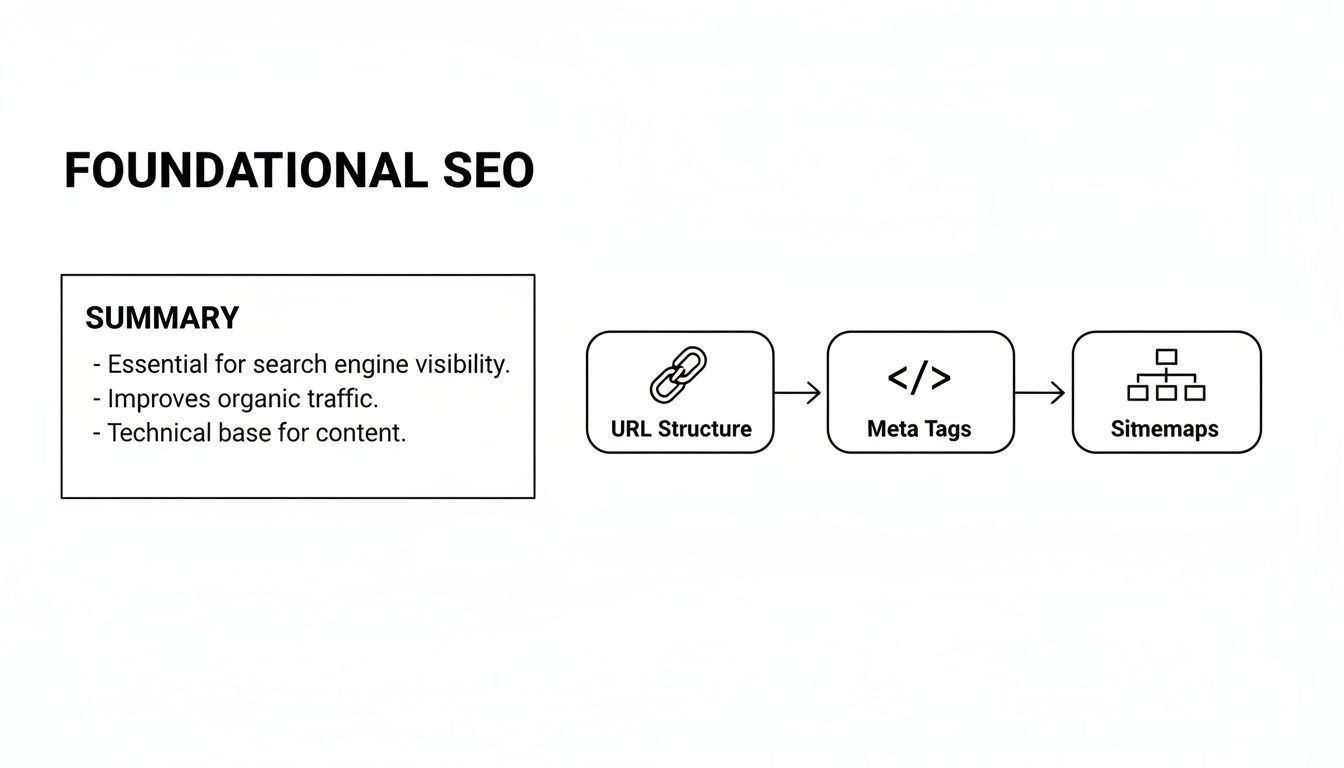
These pieces—your URL structure, meta tags, and sitemaps—are the technical foundation for everything else you do in SEO.
WooCommerce: Unmatched Flexibility On WordPress
WooCommerce is a completely different animal. As an open-source plugin for WordPress, it offers practically endless customization. If you want total control, this is where you'll find it, making it arguably the best ecommerce platform for SEO for those who need it. If you can dream it, you can probably build it with WooCommerce.
That flexibility touches every part of your SEO. You have complete command over your URLs, letting you create perfectly clean permalinks without any forced directories. And with powerful plugins like Yoast SEO or Rank Math, you can tweak every single on-page element, from meta descriptions and schema markup to complex redirect strategies.
Of course, with great power comes great responsibility. Since WooCommerce is self-hosted, you're on the hook for your store's performance, security, and maintenance. Site speed depends entirely on your hosting provider, your theme, and how many plugins you're running. If you don't manage it well, you can quickly end up with a slow, vulnerable site that kills your rankings.
- Hosting: You have to choose and pay for your own hosting, which can range from cheap shared plans to pricey dedicated servers.
- Performance: Site speed is 100% on you. Optimizing images, using caching, and picking a quality host are non-negotiable.
- Security: You are responsible for security measures, from SSL certificates to protecting against hacks.
- Maintenance: You have to stay on top of regular updates for WordPress, WooCommerce, and all your plugins to keep things running securely.
BigCommerce: Powerful Native SEO For Scaling Businesses
BigCommerce has carved out a space as a serious Shopify competitor, especially for businesses that are starting to scale. Its biggest advantage is the sheer number of SEO features that are built-in, which means you don't have to rely as much on third-party apps.
Right away, you’ll notice a huge difference from Shopify: BigCommerce gives you far more control over your URLs. You can chop off the product and category directories to create short, clean URLs, which is a big win for technical SEO. It also has built-in tools for editing your robots.txt file, managing 301 redirects in bulk, and handling faceted search in a way that search engines can actually crawl.
Another plus is its content management system. BigCommerce makes it simple to run a blog or create content pages, which is crucial for any good content marketing plan. The platform also gets high marks for performance, with fast load times and solid infrastructure that helps with Core Web Vitals. For a closer look, you can see our detailed comparison of Shopify vs. WooCommerce vs. BigCommerce to see how their features stack up.
The only real catch is that the BigCommerce app marketplace isn't as massive as Shopify's or WooCommerce's. You might have fewer choices for niche SEO or marketing tools, but then again, most of the essentials are already part of the core platform.
Magento (Adobe Commerce): The Enterprise-Level SEO Powerhouse
Magento, now part of the Adobe family as Adobe Commerce, is what huge enterprises with complex needs and deep pockets turn to. It’s an open-source platform that offers unmatched power and scalability, but it's also incredibly complex and requires significant resources to manage.
When it comes to SEO, Magento is an absolute beast. It gives you microscopic control over every part of your site, including:
- URL Customization: Total freedom to create whatever URL structure you want.
- Advanced Indexing: Detailed management of crawling and indexing rules for every single page type.
- Canonical Control: Precise settings for canonical tags to handle tricky product variations and filtered navigation.
- Internationalization: Powerful features for managing multiple storefronts, languages, and currencies for global SEO.
Magento is not for the faint of heart. Its complexity demands a team of seasoned developers to manage and optimize. For a business without that technical firepower or budget, Magento can quickly become more of a problem than a solution.
The platform's performance is completely tied to your hosting setup and optimization efforts. A badly configured Magento store can be painfully slow, which will destroy your SEO. But when it's optimized on a powerful server, it can handle enormous product catalogs and massive traffic without breaking a sweat. This makes it the go-to for established brands with very specific, demanding needs.
Webflow Commerce: A Designer's Choice With Strong SEO Chops
Webflow has made a name for itself as the platform for designers and businesses that want total visual control without writing code. Its ecommerce offering, Webflow Commerce, delivers that same design freedom along with some surprisingly solid SEO features.
One of Webflow's biggest SEO strengths is its clean code. The platform generates semantic HTML and CSS that search engines really like. Combine that with its fast, managed hosting on Amazon Web Services (AWS), and you have a great foundation for excellent site speed and technical health.
You get full control over your URLs, meta tags, and other on-page SEO elements. The built-in CMS is also one of the best out there, making it incredibly easy to create beautiful blog posts and landing pages that support your products. This smooth blend of content and commerce is a huge advantage for any SEO-focused content strategy.
Webflow Commerce's main limitation is its scalability for very large stores. It’s a better fit for businesses with smaller, curated product lines rather than those juggling thousands of SKUs. The app ecosystem is also still maturing compared to giants like Shopify, so you might need to find custom solutions for more advanced features.
Core SEO Feature Comparison Across Ecommerce Platforms
To see how these platforms stack up at a glance, I've put together a table comparing their out-of-the-box SEO features. This should help you quickly see which one aligns best with your technical needs without needing to hunt for plugins right away.
| SEO Feature | Shopify | WooCommerce | BigCommerce | Magento | Webflow Commerce |
|---|---|---|---|---|---|
| URL Customization | Limited (forced directories) | Full Control | Good (can remove directories) | Full Control | Full Control |
| Meta Tag Editing | Yes (all pages) | Yes (via plugins) | Yes (all pages) | Yes (all pages) | Yes (all pages) |
| Robots.txt Access | No (limited edits on Plus) | Yes (full access) | Yes (full access) | Yes (full access) | Yes (full access) |
| XML Sitemap | Auto-generated (not editable) | Auto-generated (editable) | Auto-generated (editable) | Auto-generated (editable) | Auto-generated (editable) |
| Canonical Tags | Auto-generated (some control) | Full Control (via plugins) | Good Control | Full Control | Full Control |
| Site Speed | Excellent (managed hosting) | Varies (depends on host) | Very Good (managed hosting) | Varies (depends on host) | Excellent (managed hosting) |
| Blog/CMS | Good (basic) | Excellent (WordPress) | Very Good (built-in) | Good (can be complex) | Excellent (built-in) |
| Mobile-Friendliness | Yes (theme dependent) | Yes (theme dependent) | Yes (theme dependent) | Yes (theme dependent) | Yes (built-in) |
This comparison shows a clear divide. Hosted platforms like Shopify and BigCommerce handle a lot for you, which is great for simplicity. On the other hand, open-source options like WooCommerce and Magento give you the keys to the kingdom, letting you customize everything—as long as you have the technical skills to manage it.
Choosing The Right Platform For Your SEO Needs
At the end of the day, the best ecommerce platform for SEO is the one that fits your specific situation—your business size, technical comfort level, budget, and where you want to go in the long run. There's no single right answer for everyone.
Shopify has clearly become the top choice for businesses that prioritize both SEO and an independent online store, holding about 27-30% of the ecommerce software market share as of 2025. With 6.59 million websites using its technology to sell online, Shopify is the go-to for entrepreneurs and SMBs looking to build a scalable, SEO-friendly presence. This market dominance is a direct result of its strong built-in SEO features, like customizable meta tags, automatic sitemaps, and mobile-first designs that play well with Google's ranking factors.
To go even deeper, this comprehensive ecommerce platform comparison offers more detailed insights. By carefully weighing the pros and cons of each platform against what you truly need, you can lay a solid foundation for long-term organic growth.
Advanced SEO for Serious Growth
Once your business starts to take off, the basic SEO that got you on the map just won't cut it anymore. To really scale and hold your own in a competitive space, you need a platform with some serious muscle. This is where you start to see the real daylight between the top platforms—the difference between a good starting point and a true growth engine.
When you're aiming for new markets, international SEO becomes non-negotiable. And it's so much more than just translating your product descriptions. It’s a technical game of telling search engines exactly which version of your site to show to which person, in which country. Get it wrong, and you're invisible.
Taking on International SEO
The key to winning at international SEO is the proper use of hreflang tags. These little code snippets are your way of telling Google, "Hey, this page is in French, and it's for people in France," or "This one's in English, but for shoppers in the UK." They prevent search engines from getting confused and showing the wrong language or currency to potential customers.
Platforms like Magento and BigCommerce really shine here, with built-in tools for managing different storefronts and languages from one central place. This makes handling hreflang tags much less of a headache. You can get there with WooCommerce using a heavy-duty plugin like WPML, but it definitely requires more manual setup. Shopify has made good progress with its Markets feature, but for really complex international structures, you'll likely still need to lean on third-party apps.
For a global brand, messing up hreflang is a silent killer. It can lead to Google indexing the wrong country's store, showing prices in Euros to a US customer, and creating a frustrating experience that tanks both your conversion rates and your rankings.
Performance and Core Web Vitals
Site speed isn't a bonus feature anymore; it's a core ranking factor. Google's Core Web Vitals (CWV) are the official metrics for this, measuring how users actually experience your site's speed, responsiveness, and stability. A clunky site doesn't just annoy people—it gets pushed down in the search results.
Here's how the platforms stack up on speed:
- Hosted Platforms (Shopify, BigCommerce): These guys handle the hosting for you, often on top-tier infrastructure like Google Cloud. You get a fast, reliable foundation right out of the box, and you don't have to worry about server maintenance.
- Self-Hosted Platforms (WooCommerce, Magento): With these, you're in the driver's seat. Your site's speed is a direct result of your hosting choice, your theme, and how well you optimize your images. This gives you ultimate control, but a bad setup can leave you with a painfully slow store.
This is all amplified by the fact that everyone is shopping on their phones. Mobile commerce now makes up a massive 62% of global ecommerce transactions in 2024, and U.S. mobile sales are on track to hit $580 billion by 2025. Since Google indexes the mobile version of your site first, a platform that delivers a blazing-fast mobile experience gives you a huge leg up. You can dig into more ecommerce statistics to see just how critical this is.
The Power of the App Ecosystem
Let's be realistic: no platform does everything perfectly on its own. That’s why the app (or plugin) ecosystem is so important. The quality and depth of available SEO tools can be the deciding factor in whether you can actually pull off your advanced strategies.
A great app store lets you plug in specialized tools as you need them. Think of an app to handle complex schema markup for eye-catching rich snippets, a tool to automate your internal linking, or a dashboard for running technical SEO audits without ever leaving your site.
Shopify and WooCommerce have the biggest marketplaces by a long shot, with an app for pretty much any SEO task you can dream up. BigCommerce has a more curated selection, but it’s because they’ve built more of that advanced functionality directly into the platform itself. Magento’s marketplace is aimed at enterprise-level businesses, and its solutions often require a developer to get them running. Ultimately, choosing the best ecommerce platform for SEO often comes down to how well its ecosystem can grow with you.
Picking the Right Platform for Your Business

So, how do you turn all this analysis into a decision? Simple. You match the platform’s strengths to your reality. The best ecommerce platform for SEO isn't some universal trophy—it's the one that fits your business, your team's skills, and where you plan to go.
Let's cut through the noise and get straight to situational advice. This will help you pick a platform that genuinely helps you grow instead of holding you back.
Recommendations by Business Size
Think of your ecommerce platform as a business partner. It needs to work for you right now, but also have the potential to grow with you. Your company’s size, budget, and team are the biggest factors here.
-
For Entrepreneurs and Small Businesses: It’s hard to argue against Shopify. It's an all-in-one package that handles the technical stuff so you can focus on what you do best: marketing and selling. With its user-friendly dashboard and massive app store, you can launch a store that’s already well-optimized for search in no time.
-
For WordPress Users and Content-Heavy Stores: If your strategy is built around content, WooCommerce is your go-to. Already being on WordPress makes it a no-brainer. It gives you complete control over every SEO detail and customization, perfect for brands that attract customers with blogs, guides, and articles.
-
For Mid-Sized and Growing Stores: BigCommerce really shines in this space. It packs a punch with its built-in SEO tools and, crucially, doesn't charge transaction fees. It's the logical next step for businesses that have outgrown the simpler platforms but aren't quite ready for the complexity of an enterprise-level system.
-
For Large Enterprises: When you need maximum power and have the team to wield it, Magento (Adobe Commerce) is the answer. It’s built for massive catalogs, complex international sales, and deep customization. This is the platform for enterprises that need total control and have the budget to match.
The single most important thing you can do is be honest about your team's skills. A platform’s most powerful features are worthless if you don’t have the technical know-how to use them properly. Pick the platform you can master today, not the one you hope you'll need tomorrow.
Choosing a platform where you own your SEO destiny is more important than ever. With Amazon projected to command 37.6% of U.S. ecommerce sales by 2025, it’s tough to stand out in a crowded marketplace you don't control. In contrast, platforms like WooCommerce, which powers 14.2% of all ecommerce sites, give you a direct path to building your own brand authority through search. You can find more of these ecommerce statistics to see just how the market is shifting.
Ecommerce SEO: Your Questions Answered
You're close to a decision, but a few questions are probably still floating around. Let's tackle some of the most common ones that come up when picking an ecommerce platform with SEO in mind. Getting these answers straight will help you make the final call with confidence.
Which Platform is Actually the Fastest for SEO?
This is a bit of a trick question—there isn't one "fastest" platform. Think of site speed less like a feature and more like an outcome. It really depends on your theme, how well you compress your images, how many apps you've installed, and crucially, your hosting.
Platforms like Shopify and BigCommerce are great because they handle the server-side heavy lifting for you. This gives you a really solid and reliable baseline speed without you having to become a server admin overnight.
On the flip side, self-hosted options like WooCommerce give you the keys to the kingdom. You have total control to tweak and optimize for maximum speed. But that control is a double-edged sword; you're also responsible for everything. A poorly managed WooCommerce site will always be slower than a standard Shopify store.
The Bottom Line: The fastest platform is the one that fits your team's technical skill set. Hosted solutions give you reliable speed with minimal fuss. Self-hosted platforms offer ultimate control, but only if you have the expertise to use it.
Can I Change Platforms and Keep My SEO Rankings?
Yes, you absolutely can, but you have to be incredibly careful. It’s less of a simple switch and more like a carefully planned military operation. A successful migration all comes down to planning and flawless execution.
The single most important part is your 301 redirect strategy. You need a plan to permanently redirect every single URL from your old site to the corresponding new one. If you miss even a few important pages, you're telling Google those pages are gone, and you'll lose the authority they've built up.
A solid migration checklist also includes:
- Moving all your product descriptions, blog posts, and other page content.
- Transferring every title tag and meta description.
- Making sure your structured data (schema markup) is correctly set up on the new site.
When you get it right, you not only keep your SEO equity but can actually see a boost by moving to a platform with a stronger technical foundation.
Does My Platform Really Impact My Content Marketing SEO?
It has a huge impact. Your platform is the engine for your content marketing, and a good content strategy is how you attract shoppers at the top of the funnel and establish your brand's authority.
This is where a platform’s built-in blogging tools really matter. WooCommerce, built on top of WordPress, is the undisputed champion here. It's designed for content. That said, Shopify and BigCommerce have solid blogging features that are more than enough for most stores. The last thing you want is a platform with a clunky or limited content system—it just creates excuses not to create the very content that earns backlinks and ranks for those valuable, non-branded keywords.
Ready to build a powerful, SEO-friendly website without the hassle? The team at OneNine specializes in custom web development and management across all major platforms. Let us handle the technical details so you can focus on growing your business.


