

Ever heard of white label web development? It’s a game-changer for agencies. In simple terms, it's a partnership where a specialized development firm builds websites for you, and you sell them to your clients under your own brand.
Think of them as the silent, expert partner working behind the scenes, making you look like the hero.
What Are White Label Web Development Services

Here’s an easy way to picture it: Imagine a fantastic local bakery known for its incredible cakes. A coffee shop down the street wants to offer those same amazing cakes, but they want to sell them under their own café's brand. The bakery agrees, delivering unlabeled cakes that the coffee shop can box up and sell as their own.
That’s exactly how white label web development works. It’s a business model that lets your digital agency offer top-tier web development without having to hire, train, and manage an in-house team. You handle the client relationship and project management, while your partner agency takes care of all the technical heavy lifting—from coding and testing to launch.
Why It's the Modern Agency's Secret Weapon
In today's competitive market, clients expect more. They want sophisticated websites with dynamic features, and they want them fast. This is where white label services really shine. Since 2023, the demand for complex features like storytelling UIs and custom graphics has exploded, and white label partnerships allow agencies to deliver these high-end projects in a matter of weeks, not months.
This approach helps you sidestep the long, expensive process of recruitment and slashes your delivery costs. What you get is a flexible, scalable way to grow your revenue that works right alongside your core services.
By partnering with a white label provider, you instantly expand your service offerings, meet diverse client demands, and create new revenue streams without the overhead of an in-house team.
White label services are a specialized type of outsourcing. If you're curious about the broader world of external development, this comprehensive guide to software development outsourcing is a great resource.
For your agency, the immediate benefits are clear:
- Instant Scalability: Say yes to more projects without worrying about your team's bandwidth.
- Access to Expertise: Tap into a deep well of specialized skills across various website development technologies whenever you need them.
- Reduced Overhead: Forget about the high costs of salaries, benefits, and ongoing training for a full-time dev team.
- Enhanced Brand Authority: Position your agency as a one-stop-shop, which builds massive trust and keeps clients coming back.
The Strategic Benefits of a White Label Partner
Bringing on a white-label web development partner is about so much more than just getting a website built. It’s a strategic move that can seriously upgrade your agency's efficiency, boost your profits, and set you up for real growth. Instead of sinking time and money into building an in-house team, you get to plug into a development powerhouse that's ready to go from day one.
Right off the bat, this slashes your overhead. You can completely skip the long, costly process of recruiting, hiring, and training developers. Just think about the money saved on salaries, benefits, and equipment—all of which you can pour back into what you do best, like sales, marketing, and taking care of your clients.
Scale Your Operations Seamlessly
One of the biggest wins here is the ability to scale up or down whenever you need to. A huge project lands in your lap? You no longer have to sweat about whether you have the bandwidth to handle it. A white-label partner gives you the flexibility to take on bigger clients and more ambitious work without the headache of expanding your payroll.
This agility works both ways. During a slow month, you aren't stuck paying a team of developers to sit around. You only pay for the development muscle when you actually need it, which makes for a much leaner and more resilient business.
A white-label partnership transforms your agency from one with fixed capacity to one with a virtually limitless ability to deliver. You can confidently pursue new business, knowing you have the expert support to handle any project that comes your way.
Tap Into Specialized Expertise Instantly
Your partner agency is essentially a concentrated hub of specialized talent. These folks live and breathe web development, so they're always on top of the latest tech and trends. This means you can confidently offer your clients complex solutions—from sophisticated e-commerce systems to custom web applications—without having to master every single framework yourself.
This is a massive advantage, especially now. The global web development market, which includes white-label web development services, is expected to jump from $80.6 billion in 2025 to $125.4 billion by 2030. That growth is all about demand for more interactive, complex digital experiences. You can explore the full market analysis on Mordor Intelligence to see the numbers for yourself. Having a partner with deep expertise allows you to meet that demand head-on.
This model also puts your project timelines on the fast track. When you have a dedicated team focused purely on development, projects get from kickoff to launch much quicker. Getting to market faster is a huge selling point for your clients, helping them hit their goals sooner and solidifying your reputation for delivering results. If you're weighing your options, it helps to understand the differences between various external development models, and a good place to start is learning the nuances of website development outsourcing.
How a White Label Partnership Actually Works
So, how does this all work in practice? It might seem complicated from the outside, but a good white label partnership is a well-oiled machine.
Think of yourself as the general contractor on a home build. You’re the one talking to the homeowner (your client), understanding their vision, and making sure the final product matches their dream. Your white label partner is your specialized crew—the expert plumbers, electricians, and framers—doing the heavy lifting behind the scenes. You direct the project, and they execute flawlessly.
The whole relationship hinges on clear communication and defined roles. You are always the single point of contact for your client, which protects your brand and keeps the feedback process simple and direct.
This infographic breaks down how the partnership helps you hit key goals like cutting costs, scaling up your services, and tapping into specialized skills you don't have in-house.
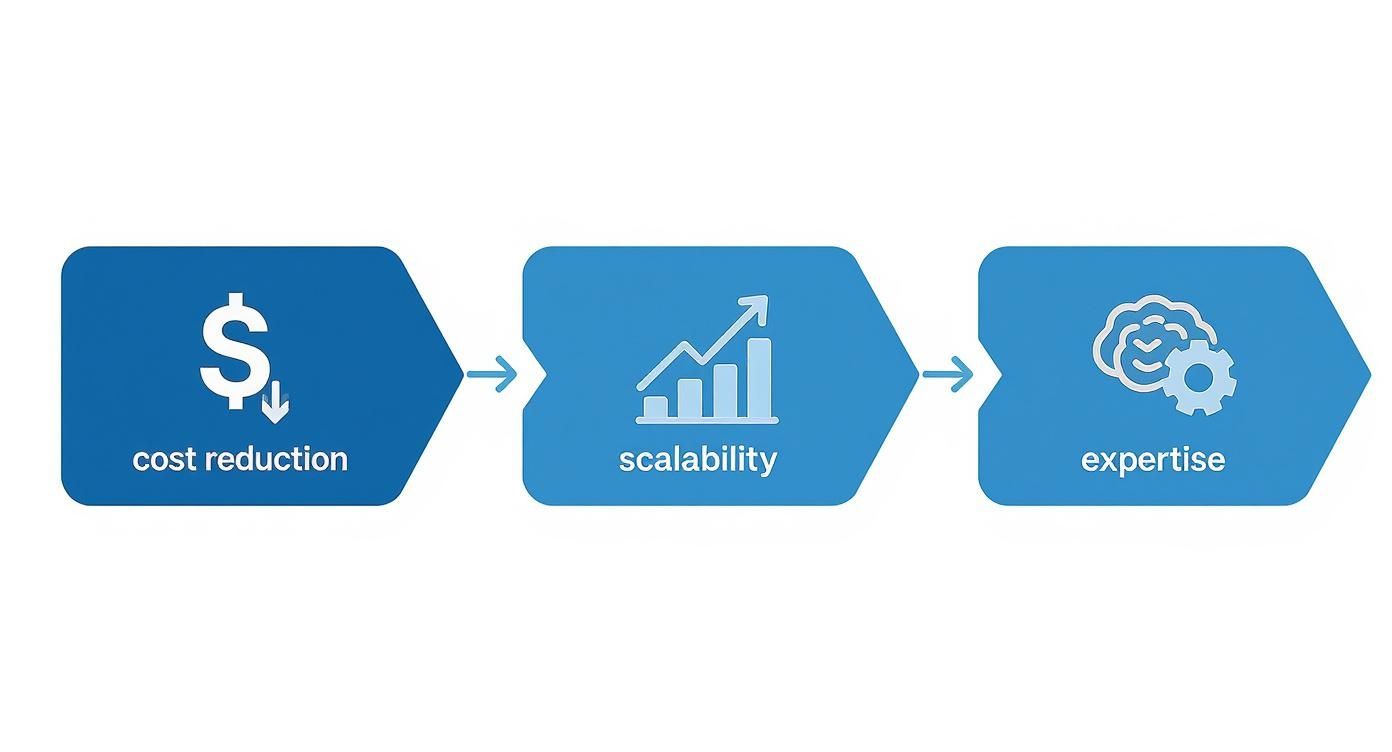
As you can see, every step is designed to build on the one before it, taking a client's idea and turning it into a real, polished website you can proudly deliver.
The Project Workflow, Step by Step
While no two projects are identical, the process of working with a white label web development services provider generally follows a predictable and organized path. This structure is what keeps everything on schedule and makes sure everyone is on the same page.
-
Discovery and Quoting: It all starts with a conversation between you and your partner. You’ll have a discovery call to dig into your client's specific goals, technical requirements, and what success looks like for them. From there, the white label provider puts together a detailed proposal and quote for you to review and approve.
-
Project Kickoff and Design: With the green light, the project officially begins. Your job is to hand over all the necessary client assets, like brand guidelines, logos, and content. The partner's design team then gets to work creating wireframes and mockups, which you'll review before presenting them to your client for their feedback.
-
Development and Feedback Loops: Once the designs are approved, the real magic happens: the coding. Your partner will build the website on a private staging server. This gives you a backstage pass to watch the progress without your client seeing the messy "work-in-progress" bits. You become the go-between, gathering your client's notes and passing them along to the development team.
This separation is key. It keeps you in the driver’s seat, managing the client relationship and the overall strategy. Meanwhile, the tech team can focus 100% on building, without getting bogged down in client calls, which honestly just makes everything go faster.
Quality Assurance and Final Handover
The final stretch is all about polishing the site until it shines. This is where a great partner really proves their worth.
For those interested in the more technical side of how these services are delivered, the principles are similar to other outsourced tech functions. You can find some interesting parallels in understanding DevOps as a Service delivery models.
Your partner will conduct rigorous quality assurance (QA) testing, checking the site on different browsers and devices to squash any bugs. After you and your client give the final thumbs-up, the partner handles the migration, moving the site from the staging area to the live server.
Finally, they hand over all the keys—the logins, files, and credentials—to you. The project is complete, delivered seamlessly and entirely under your company's name.
How White Label Pricing Actually Works
Figuring out how you'll pay your white-label partner is one of the most important parts of the deal. The pricing structure you choose directly shapes your project budgets, how you quote clients, and, ultimately, your agency's bottom line. Most white-label developers offer a few common models, each designed for different project styles and agency needs.
Picking the right model is a bit like choosing the right tool for a job. A sledgehammer is great for demolition, but not for hanging a picture frame. In the same way, the pricing needs to match the project's scope and your own workflow to make sense financially.
Per-Project Pricing
The most common and straightforward option is per-project pricing. You get a single, fixed quote for a project with a clearly defined scope. It's like buying a product off the shelf—you know exactly what you're getting and what it will cost before you commit.
This model is perfect for one-and-done websites with very specific requirements, such as a standard five-page business site or a basic online store.
- The upside: Costs are totally predictable, which makes it incredibly easy to budget and add your markup when quoting your client.
- The downside: Scope creep is the enemy here. If your client decides they want a new feature halfway through, that's a new quote and a potential delay.
Retainer-Based Models
If you have a constant flow of web development work, a retainer-based model might be a better fit. Here, you pay a set monthly fee, which reserves a block of development hours or guarantees access to a team. This is ideal for ongoing site maintenance, handling multiple smaller projects at once, or supporting a big client who always has new requests.
Think of a retainer as having a dedicated development team on speed dial. It ensures you have priority access to expert help right when you need it, building a much deeper, more collaborative partnership over time.
This subscription-style approach is gaining a lot of ground. In the broader white-label world, the related SaaS market is expected to explode, hitting an estimated $908.21 billion by 2030. This trend highlights how many businesses are turning to outsourced services to scale their operations without scaling their overhead. You can discover more insights about this market growth on White Label Wonder.
Hourly Rates
Last but not least, there are hourly rates. This model offers the most flexibility, as you only pay for the actual time a developer spends working on your tasks. It's the best choice for small, unpredictable jobs like fixing bugs, making quick content updates, or tackling projects where the scope isn't fully fleshed out yet.
The trade-off for this agility is a less predictable final cost. To avoid budget surprises, you'll need to maintain constant, clear communication with your partner and get regular progress updates.
Choosing the Right Pricing Model for Your Agency
So, which one is right for you? It really depends on the kind of work you do and the clients you serve. This table breaks down the core differences to help you decide.
| Pricing Model | Best For | Key Advantage | Potential Drawback |
|---|---|---|---|
| Per-Project | Agencies with one-off projects and a well-defined scope. | Cost Certainty: You know the total price upfront. | Inflexibility: Any changes or additions will cost extra. |
| Retainer | Agencies needing ongoing support, maintenance, or handling multiple projects. | Guaranteed Availability: Your partner is always on standby for you. | Potential for Unused Hours: You might pay for time you don't use. |
| Hourly | Small, unpredictable tasks, bug fixes, or projects with an evolving scope. | Maximum Flexibility: You only pay for the work that's done. | Unpredictable Costs: The final bill can be hard to forecast. |
Ultimately, the best pricing model is the one that aligns with your agency's financial goals and operational style. A good white-label partner will be transparent about their pricing and help guide you to the structure that makes the most sense for the project at hand.
How to Choose the Right White Label Partner

Choosing a partner for your white label web development services is a huge decision. Their work is a direct reflection of your agency, and their reliability can either make or break your reputation. This isn't just about finding a coder; it's about finding a true partner who gets it.
Think of it like hiring a key team member who will be doing critical work behind the scenes. They’ll be handling your clients' most important digital assets, so you need to vet them just as carefully. You're looking for someone who isn't just a vendor but a seamless extension of your own team.
Rushing this process is a recipe for disaster. A bad choice can lead to blown deadlines, shoddy work, and—worst of all—unhappy clients.
Scrutinize Their Portfolio and Technical Skills
First things first: dig into their portfolio. This is more than a gallery of pretty screenshots; it's hard evidence of what they can actually do. Don’t just skim the homepages.
Actually click through the sites they’ve built. Is the code clean? Do the pages load quickly? How do they look and feel on a phone? You're checking for smooth functionality, not just flashy design. A strong portfolio should showcase a variety of projects, proving they can handle everything from a basic marketing site to a complex e-commerce build.
Evaluate Communication and Project Management
Great code is useless if the communication is terrible. A solid partnership is built on clear, consistent, and proactive communication. Pay close attention to how they handle your initial conversations.
Ask pointed questions about how they work:
- How do you keep projects on track? They should be using project management tools like Asana, Trello, or something similar.
- Who is my go-to person? Having a dedicated project manager is a huge green flag. It shows they're organized.
- What happens when my client wants changes? You need to understand their process for feedback and revisions to avoid scope creep nightmares.
A partner who can't walk you through their process clearly probably doesn't have a good one. Smooth sailing depends on a system that keeps everyone on the same page from start to finish.
Verify Reliability and Confidentiality
Finally, you have to be able to trust them. Will they deliver on time? Will they keep your client's information private? This is where you do your homework. Ask for references and actually call them. Talk to other agencies they've worked with to get the real story.
And don't forget to talk about confidentiality. Any legitimate white label provider will have no problem signing a Non-Disclosure Agreement (NDA). This is non-negotiable; it protects you and your clients. It's also smart to think about their long-term support capabilities. You can find out more by reading our guide on white label maintenance services. Picking the right partner is all about building a foundation of trust that you can grow your business on.
Common Mistakes to Avoid When Partnering
Bringing on a white-label web development partner can feel like adding rocket fuel to your agency's growth. But like any powerful tool, it has to be handled correctly. A great partnership can be a game-changer, but a few common missteps can easily turn it into a massive headache.
The biggest mistake I see agencies make? Kicking off a project with a fuzzy, half-baked scope. Without a rock-solid Statement of Work (SOW), you’re practically inviting scope creep to the party. Those little client “tweaks” and “small additions” quickly add up, blowing your budget and wrecking your timeline. A detailed brief is your best friend here.
Another classic blunder is poor communication. When emails go into a black hole and feedback is vague, projects go off the rails fast. You need to know exactly who you’re talking to and when you can expect a response.
Misaligned Standards and Unclear Expectations
Never just assume your partner’s definition of "quality" is the same as yours. That’s a recipe for disaster. If the final product doesn't live up to the standard your clients expect from you, it’s your reputation that takes the hit. Always, always review their portfolio, and if you can, start with a small trial project to see how they really work.
The secret to a solid, lasting partnership is getting ahead of these problems before they even start.
- Define Everything: Put every feature, function, and deliverable in writing. Don't leave a single thing open to interpretation.
- Set Communication Rules: Settle on how you'll talk. Will it be Slack? Asana? Agree on a schedule for check-ins so no one is left guessing.
- Establish Quality Benchmarks: Give them your brand guidelines and show them concrete examples of what "great" looks like to you.
The strength of a white label partnership isn't just in the technical skill of the developer; it's in the operational clarity and mutual understanding established before the first line of code is ever written.
By steering clear of these common traps, you lay the groundwork for a partnership that actually works—one that helps you deliver amazing results for your clients, every single time. It’s this proactive approach that reinforces your agency's reputation for being reliable and top-notch.
Still Have Questions? Let's Clear Things Up
Jumping into a white-label partnership is a big decision, and it’s smart to have questions. You're trusting another team with your client's project, after all. Let's walk through some of the most common concerns we hear from agency owners just like you.
"How Do I Know the Quality Will Match My Standards?"
This is probably the number one question, and for good reason. Your reputation is on the line. The key lies in a solid, collaborative process. A good white-label partner doesn’t just take an order; they work from a detailed brief that you help create.
Think of yourself as the project's director. The development team builds everything on a private staging server that only you can access. You get to review the work at every key milestone, providing feedback and requesting tweaks long before your client ever lays eyes on it. This way, you're always in the driver's seat, ensuring the final product is something you're proud to put your name on.
"What If My Client Wants to Add Something Mid-Project?"
Ah, scope creep—the classic curveball in any web project. What happens when your client suddenly decides they need an e-commerce store on their simple brochure site? Your partner should have a clear and simple process for this.
Any request that falls outside the original plan is handled with a formal change request. Your partner will scope out the new work, give you a clear quote for the extra time and cost, and you then present that to your client. This keeps everything transparent and ensures you and your team are fairly compensated for the additional effort.
Your partner should never speak directly to your client. All communication, especially about changes and costs, flows through you. This keeps you in control and protects your valuable client relationship.
"Who Actually Owns the Website in the End?"
This is a deal-breaker, and the answer should be simple. Once the final invoice is paid, you and your client own 100% of the website and its code. Period.
Any professional agreement will state this explicitly, transferring all intellectual property to you. You should be free to host the site anywhere, modify it however you see fit, and have complete control over your client's asset. There should be absolutely no strings attached tying you to the white-label provider.
Ready to scale your agency without the growing pains? The team at OneNine delivers expert web development that you can proudly offer as your own. Learn more about how we can help you grow.


