
Think of your website as your business's most important employee. It works 24/7, greeting customers, answering questions, and making sales. But like any top performer, it needs a regular health check-up to make sure it’s still at the top of its game. That's exactly what a website audit is—a thorough, expert evaluation of your entire online presence.
Understanding Your Website's Annual Check-Up
Let's stick with the car analogy for a moment. You wouldn't drive your car for years without getting it serviced by a professional mechanic, right? You rely on an expert to check the engine, test the brakes, and make sure everything is running efficiently. A website audit is the same concept, but for your digital storefront.
Without this deep dive, you might be completely unaware of hidden problems. Maybe a "slow leak" in your site's code is deflating your search rankings, or a confusing "navigation system" is frustrating visitors and causing them to leave. On the surface, things might look okay, but these underlying issues are quietly hurting your business.
Why a Quick Glance Isn’t Enough
Many business owners use free online tools or just look at their basic analytics. While these can be useful for spotting obvious red flags, like a broken link, they rarely tell the whole story. It's like only checking if your car's headlights turn on—it doesn't tell you anything about the engine's health.
A professional audit goes much, much deeper. It’s not just about finding what's broken; it's about understanding why it's broken and, more importantly, how that impacts your bottom line. It connects the technical dots to your actual business goals.
An audit’s true value isn't just in the data it collects, but in the actionable story it tells about your website's relationship with search engines and users. It translates technical jargon into a clear roadmap for improvement.
Businesses are increasingly catching on to this. The demand for professional audits is growing fast as companies realize how critical a high-performing website is. The global market, valued at approximately USD 2.4 billion in 2024, is expected to skyrocket to USD 6.5 billion by 2033. This surge shows that a comprehensive audit is no longer a luxury—it's a necessity for staying competitive.
The Core Components of an Audit
A truly comprehensive audit isn’t a one-trick pony. It examines your website from every possible angle to build a complete picture of its health and performance. Think of it as a team of specialists—a technical engineer, a marketing strategist, and a user behavior expert—all working together. You can explore our dedicated website auditing services to see how a structured, multi-faceted approach gets real results.
To give you a better idea of what's involved, a proper audit looks at several key areas. Each piece of the puzzle is critical for understanding the whole picture.
Here’s a breakdown of the main focus areas you can expect from a professional audit:
Key Focus Areas of a Comprehensive Website Audit
| Audit Area | Objective | Example Checkpoints |
|---|---|---|
| Technical Health | Ensure the site is fast, secure, and accessible to search engines and users. | Page load speed, mobile-friendliness, broken links (404s), SSL certificate status, crawl errors. |
| SEO | Improve visibility in search engine results for relevant queries. | Keyword targeting, on-page optimization (titles, meta descriptions), backlink quality, site structure. |
| User Experience (UX) | Make the site intuitive, easy to navigate, and enjoyable for visitors. | Navigation clarity, call-to-action (CTA) effectiveness, mobile usability, design consistency. |
| Content Effectiveness | Verify that content is valuable, engaging, and aligned with business goals. | Content quality and relevance, keyword gaps, conversion-focused copy, internal linking strategy. |
By looking at these elements together, an audit provides a holistic view. It shows not just what needs fixing, but how improvements in one area, like technical speed, can have a massive positive impact on others, like user experience and search rankings.
The Four Pillars of a Professional Website Audit

A proper website audit goes way beyond a quick, automated scan for errors. I like to think of it like a thorough home inspection. You wouldn't just check the paint job; you'd look at the foundation, the plumbing, the electrical, and the roof. A website is no different. A comprehensive audit rests on four key pillars that together support your entire digital presence.
If one of these pillars is shaky, the whole structure suffers. That’s why a real audit looks at how these elements interact. Let’s break down what a professional service will actually examine.
Pillar 1: Technical SEO Health
This is all the crucial stuff happening behind the scenes—the digital plumbing and wiring of your site. Users don't see it, but they definitely feel it when it’s not working right. Technical SEO is all about making sure search engines like Google can efficiently find, crawl, and understand your website.
Think about it: if your technical health is poor, even the best content in the world won't get seen. Search engines will struggle to index your pages, and visitors will just get frustrated with slow load times or broken links.
Key technical checks include:
- Site Speed: How fast your pages load, especially on mobile. A slow site is a one-way ticket to a high bounce rate.
- Crawlability: Are search engine bots hitting dead ends like broken links ("404 errors")? We need to clear the path for them.
- Mobile-Friendliness: Your site absolutely must work flawlessly on a phone. The majority of your audience is likely there already.
- Site Security: Using HTTPS isn't optional anymore. It’s a baseline requirement for building trust with both people and search engines.
A technically sound website is the bedrock of everything else. Without it, you’re building on sand, and it’s just a matter of time before things start to slide.
Pillar 2: On-Page SEO and Content
With a solid foundation in place, we can move on to the content itself and how it's structured. This pillar is about one thing: making sure your content resonates with your ideal customer while also being optimized to show up in search results.
This means getting our hands dirty and digging into your blog posts, service pages, and product descriptions. We're looking to create content that gives people real answers and value, all while speaking the language search engines understand. A big part of this involves leveraging automated keyword research for SEO success to ensure you're targeting the right terms.
Pillar 3: Off-Page Authority
This pillar measures your website’s reputation across the internet. It’s not about what you say about your brand, but what other sites say about you. A strong off-page presence is a massive signal to search engines that your site is a credible, trustworthy authority in its field.
The main driver here is your backlink profile. Every link from another website to yours is like a vote of confidence. But here's the catch: not all votes are created equal. A single link from a well-respected industry journal is worth more than a hundred links from spammy, low-quality blogs. A deep audit analyzes the quality and quantity of these links to truly understand your digital street cred.
Pillar 4: User Experience and Conversion Analysis
This final pillar is where the rubber meets the road—and where your website makes you money. It’s all about turning visitors into leads and customers. This analysis is laser-focused on how a real person moves through your site. Is it easy for them to find what they need? Is the path from a landing page to the checkout or contact form a smooth ride or a bumpy, confusing mess?
We'll examine things like:
- Navigation: Are your menus clear and intuitive?
- Calls-to-Action (CTAs): Do your buttons and links grab attention and make people want to click?
- User Flow: Where are people getting stuck or leaving your site?
For a more granular look at all the checks involved, our complete guide offers an ultimate website audit checklist for expert-led success.
By carefully evaluating each of these four pillars, a professional website audit provides a full, 360-degree view of your online performance. It turns vague guesses into an actionable strategy that drives real growth.
A Step-by-Step Look at the Website Audit Process
Hiring a professional for a website audit can feel a bit like handing your car keys over to a new mechanic. You know it needs a check-up, but you're not entirely sure what goes on behind those closed doors. The good news is that a proper audit isn't some mysterious black box. It’s a clear, structured process designed to connect your business goals with concrete, fixable issues on your site. Think of it as a partnership, not just a service.
It all starts with a simple conversation. This first step, the discovery phase, is easily the most important because it sets the stage for everything else. The point isn't to immediately start talking about technical SEO or broken links. It's to understand your business inside and out.
What are you trying to achieve? What are your revenue targets? Who are your best customers? Knowing the answers helps the audit team see every piece of data through the lens of what actually matters to you. This ensures their final recommendations are strategic and tied to real-world results, not just a list of technical fixes.
Gathering the Data and Connecting the Dots
Once your business goals are locked in, the real dig begins. This is where experts use a whole suite of professional tools to crawl and analyze every corner of your website. They’re collecting a mountain of data covering everything from your site's technical health and SEO performance to how users actually behave on your pages and where you stand against the competition.
But data by itself is just noise. The real value comes from the analysis. This is where an expert translates all those numbers into a clear story. They can connect the dots between a slow-loading page and why so many people are leaving without taking action. They can pinpoint a specific content gap that’s sending would-be customers straight to a competitor.
A great website audit doesn’t just give you a list of problems. It tells you why those problems matter, explaining how specific technical errors, content gaps, or confusing design elements are holding back your business.
This is where human expertise really shines. An automated tool can flag an error, but it can’t understand business context or tell you which fixes will make the biggest impact. An experienced analyst, on the other hand, can spot that fixing one single technical problem could knock out ten smaller issues, giving you a huge win for your team's time and effort.
This infographic gives you a nice visual breakdown of how each stage flows into the next.
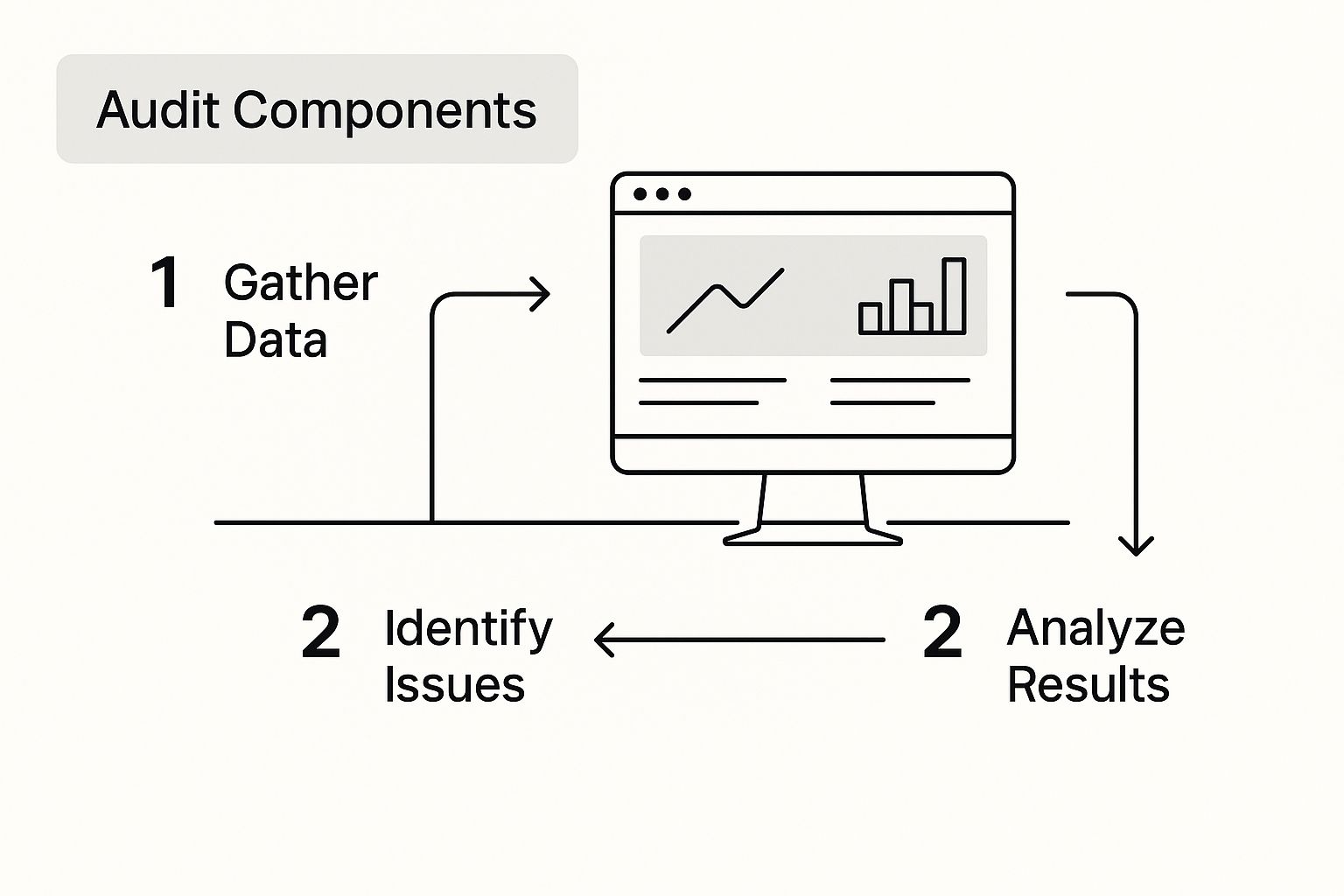
As you can see, a successful audit is a logical journey. It starts with understanding the big picture, moves into a deep analysis, and ends with a clear plan of attack.
Turning the Report into a Practical Roadmap
The end result of top-notch website auditing services isn't a dense, 100-page report that will gather dust on a shelf. It should be a clear, prioritized action plan—a genuine roadmap for growth.
This roadmap is built for getting things done. It slices complex problems into smaller, manageable tasks. More importantly, it prioritizes them based on two simple things:
- Impact: How much will this fix actually help you reach your goals (more traffic, more leads, more sales)?
- Effort: How much time and how many resources will it take to get it done?
This smart approach helps you focus on the "low-hanging fruit" first—those high-impact, low-effort tasks that deliver quick, noticeable wins. For instance, the audit might find that fixing the mobile menu on three of your most important pages could instantly lift conversions by 5%. That kind of thing goes straight to the top of the list.
In the end, a good audit takes you from a state of uncertainty to one of clarity. You stop wondering why your site isn’t performing and start knowing exactly what’s wrong, why it matters, and precisely what you need to do next to see real improvement.
Tangible Business Wins from a Website Audit
So, what’s the real-world payoff of a website audit? It’s not just about ticking off technical boxes. Investing in a professional website auditing service leads to genuine, measurable wins for your business. Think of it as turning messy data into a clear roadmap for growth that directly fattens your bottom line.
Every hidden glitch on your website is like a tiny leak in your sales funnel. A page that takes too long to load? You just lost a potential customer. A navigation menu that’s a jumbled mess? A visitor just gave up trying to find your services. These aren't just tech headaches; they're business problems with real financial costs.
Boost Your Visibility and Attract More Traffic
One of the first things you'll notice after a good audit is a serious bump in your search engine rankings. By digging up and fixing technical SEO problems—things like broken links, a clunky site structure, or poor mobile speed—you’re basically rolling out the red carpet for Google.
When search engines can crawl and understand your site without hitting roadblocks, they reward you with better visibility. This means more organic traffic from people who are actively looking for what you sell. A single, comprehensive audit can uncover dozens of chances to climb above your competitors and get your brand seen by a much larger, more relevant audience.
It's no wonder the website audit service sector is booming, with projections to become a market worth over USD 10 billion by 2033. More and more businesses see the clear line connecting a healthy website to a healthy sales pipeline.
Enhance User Experience and Reduce Bounce Rates
We've all done it: clicked on a website, waited a few seconds for it to load, got frustrated, and left. Your visitors are no different. An audit acts like a magnifying glass for your user experience (UX), pinpointing exactly why people are bouncing off your site.
A great user experience isn't about fancy bells and whistles. It’s about being clear and efficient. You want to make it dead simple for visitors to find what they need and do what they came to do, turning a casual browse into real interest.
Fixing these snags has an immediate effect on the numbers that matter:
- Lower Bounce Rates: When a site is fast and easy to get around, people stick around longer. Simple as that.
- Increased Time on Page: Intuitive design and helpful content naturally encourage visitors to click around and explore.
- Higher Return Visits: A smooth first visit builds trust and makes people far more likely to come back.
Drive More Conversions and Increase Revenue
At the end of the day, this is what it's all about. A website audit's most powerful benefit is its ability to directly boost your leads and sales. The process is designed to find "conversion blockers"—those subtle hurdles that stop a visitor from filling out a form, requesting a demo, or clicking "buy."
An audit might show that your call-to-action buttons are nearly invisible, your checkout process has too many steps, or your service pages just aren't convincing. By fixing these specific friction points, you smooth out the path for your customers, making it easy and appealing for them to convert. This is the entire philosophy behind website performance optimization, where every single tweak is aimed at producing a tangible business result.
Choosing the right partner for your website audit is probably the most critical decision you'll make in this whole process. Get it wrong, and you could end up with a useless, data-heavy report. But the right partner? They’ll hand you a clear blueprint for growth. This single choice is what separates a simple expense from a true strategic investment.
https://www.youtube.com/embed/W3MtqAxB8t4
Think of it like hiring a general contractor to build your dream home. You wouldn’t just pick the cheapest quote, right? You'd want to see their portfolio, talk to past clients, and make sure they really get your vision. The same logic applies here. You're not just looking for a vendor; you're looking for a partner who will help you build a better business online.
Look Past the Shiny Promises
First things first, you need to dig into a potential partner's actual expertise and how they approach their work. It's easy for an agency to talk a big game and promise the world, but you need to see the proof in the pudding. A great audit partner will be transparent about their process and have a track record of real, tangible results.
Start by digging into their case studies and client testimonials. Are they vague and fluffy, or do they detail specific problems and show measurable outcomes? Look for examples from businesses that are similar to yours, either in size or industry. This is a good sign they understand the unique challenges you face and aren't just going to slap a generic template on your website.
This kind of professional scrutiny is a cornerstone of smart business. The broader auditing services market, valued at around USD 238.25 billion in 2024, shows just how seriously successful companies take expert, third-party analysis. With North America holding about 38% of this market and average audit fees on the rise, it’s clear that businesses are investing more in professional oversight—and you should, too. You can get more details from this auditing services market analysis.
The Report Can Tell You Everything
One of the biggest giveaways of an average audit versus a great one is the final report. This is where you can instantly tell if you hired a data-dumper or a genuine strategist. A low-quality provider will hand you a spreadsheet with thousands of "errors" but offer zero context or a clear path forward.
A strategic partner does the exact opposite. Their report is an actionable roadmap, not a dense technical manual. They have the skill to translate all that complex data into a clear, prioritized plan that actually lines up with your business goals.
The best audit reports don't just tell you what is broken; they tell you why it matters and what to fix first for the biggest impact. They prioritize recommendations based on effort versus potential return, giving you a clear path to quick wins and long-term success.
Key Questions to Ask Potential Providers
When you're meeting with potential partners, going in with a solid list of questions is a must. How they answer will tell you a lot about their expertise, their process, and whether they’ll be a good fit for your team.
Here’s a simple checklist to help you evaluate and compare different website auditing services and find the one that’s right for your business.
Comparing Website Auditing Service Providers
| Evaluation Criterion | What to Look For | Red Flags to Avoid |
|---|---|---|
| Industry Experience | Demonstrable success with businesses like yours. They should speak your industry's language. | A generic portfolio with no relevant case studies or a "one size fits all" pitch. |
| Tools and Technology | Use of multiple, professional-grade tools (like Semrush or Ahrefs) combined with manual analysis. | Relying solely on a single automated tool, which misses crucial context and nuance. |
| Reporting and Action Plan | A clear, prioritized report that connects technical issues to business impact. | A massive data dump with no clear priorities or actionable next steps. |
| Communication Style | A collaborative approach. They should ask deep questions about your business goals. | A pure focus on technical jargon without trying to understand your business objectives. |
In the end, choosing an audit partner is about finding an expert you can trust. You need a team that can pop the hood on your website, diagnose the root causes of any performance issues, and hand you a clear, easy-to-follow map to get your business exactly where it needs to go.
Got Questions About Website Audits? We've Got Answers.
When you're thinking about investing in your website's performance, it's completely normal to have some questions. Getting a handle on how website auditing services work takes the mystery out of the process and helps you make a smart decision for your business.
Let’s walk through a few of the most common questions we hear from business owners.
How Often Should My Website Be Audited?
The best way to think about this is to compare it to your car. You take it in for a big annual inspection, but you also check the tires and top off the fluids more often. Your website needs that same kind of attention to stay in top form.
A deep, all-encompassing audit is something you should plan for about once a year. This is your major check-up, perfect for setting a new performance baseline, especially after a big change like a site redesign, a move to a new platform, or a major shift in your business goals.
But just like with your car, a lot can happen between those annual inspections.
Waiting a full year to check for problems is like only going to the doctor when you're already sick. It's much smarter to catch things early, before they turn into bigger, more expensive headaches.
This is where smaller, more frequent health checks come in.
- Quarterly Health Checks: Think of these as quick check-ins to monitor your vitals. They're great for keeping an eye on your technical health, spotting new content opportunities, and making sure your SEO efforts are still on track.
- Post-Update Scans: It's also a good idea to run a quick scan after a major search engine update from someone like Google. This helps you see right away if the changes affected your rankings so you can adapt quickly.
By mixing a major annual audit with regular quarterly reviews, you build a powerful rhythm of continuous improvement. It’s the best way to make sure your website is always working as hard as you are.
What Is the Average Cost of a Website Audit?
This is the big question, and the honest answer is: it really depends. There's no one-size-fits-all price tag for a professional website audit because the cost is tied directly to the size and complexity of your site.
It's a bit like asking for the cost of inspecting a building. The price to look over a small coffee shop is going to be very different from inspecting a massive warehouse. The same idea applies here.
A few key things will influence the final price:
- Website Size: A simple 10-page brochure website is much quicker to audit than a sprawling e-commerce store with thousands of product pages. More pages simply mean more data to analyze.
- Site Complexity: If your site has advanced features like e-commerce functions, customer logins, or special integrations, it's going to require a much deeper dive than a basic informational site.
- Audit Scope: What's included matters, too. A basic technical SEO audit will cost less than a comprehensive audit that also covers competitor analysis, content strategy, and user experience.
While it's easy to see this as just another business expense, it's much more of an investment. A good audit is designed to uncover opportunities that deliver a real return, whether it's fixing issues that are costing you sales or boosting organic traffic so you can spend less on ads. The ROI from these fixes almost always outweighs the initial cost.
Can I Just Use a Free Online Tool Instead?
It's a tempting thought, isn't it? You plug your URL into a free tool, and in seconds, you get a score and a list of "errors." These tools can be handy for a quick, surface-level peek, but they are no replacement for professional website auditing services.
Relying only on a free tool is like using one of those drugstore blood pressure cuffs and thinking you've had a full physical. It gives you a single data point but completely misses the bigger picture.
Here's where the real difference lies:
| Feature | Free Automated Tool | Professional Audit Service |
|---|---|---|
| Analysis | Spits out raw data and generic error lists (e.g., "You have 30 broken links"). | Gives you context and interpretation. An expert explains why those links are broken and which ones are actually hurting you. |
| Strategy | Offers zero strategic guidance. It's just a list of problems. | Delivers a prioritized, actionable roadmap built around your specific business goals and what will have the biggest impact. |
| Expertise | Lacks the human intelligence to understand nuance or your business. | Involves a real person who connects the technical dots to your real-world business outcomes. |
Free tools give you data. A professional service gives you insights. A scanner might tell you a page is slow, but an expert will tell you that the slow page is your highest-converting landing page, and fixing it needs to be your #1 priority. That's the kind of strategic thinking that actually grows a business.
Ready to stop guessing and start growing? The team at OneNine provides expert website auditing and management to turn your site into your most powerful asset. Get in touch today to see how we can build a clear roadmap for your success.


