
When it comes to boosting your website's organic traffic, the game plan is surprisingly straightforward. You need to create genuinely helpful content, make sure your website is technically sound for search engines, and build up your site's reputation with backlinks. That’s really it.
If you can nail these three fundamentals—content, technical SEO, and authority—you’ll have a sustainable way to bring in a steady stream of valuable visitors without having to pay for every single click.
Your Blueprint for Dominating Search Rankings
Let's get straight to the point: getting to the top of Google isn't just for show; it's a core business goal. If you're serious about your organic strategy, understanding how to rank higher on Google is non-negotiable.
Think about it. When someone finds you through a search, they’re already looking for what you offer. This makes them far more likely to stick around and convert compared to someone who just randomly clicked an ad. This is precisely why organic traffic is one of the most powerful assets you can build for your business online. The trick is to give search engines exactly what they want: the best, most relevant answers for their users.
Why Every Ranking Spot Matters
The difference in traffic between the #1 and #2 spots on Google is massive. It’s not just a small step up; it’s a giant leap in visibility that can completely change your business's outlook.
Let's look at the click-through rates (CTR) to see what this really means. That coveted #1 spot on Google pulls in a staggering 39.8% of all clicks. The #2 position gets just 18.7%, and #3 drops to 10.2%. Moving from the second spot to the first alone can net you 74.5% more clicks. On average, every single spot you climb improves your CTR by about 32.3%.
This chart really puts the value of that top spot into perspective.
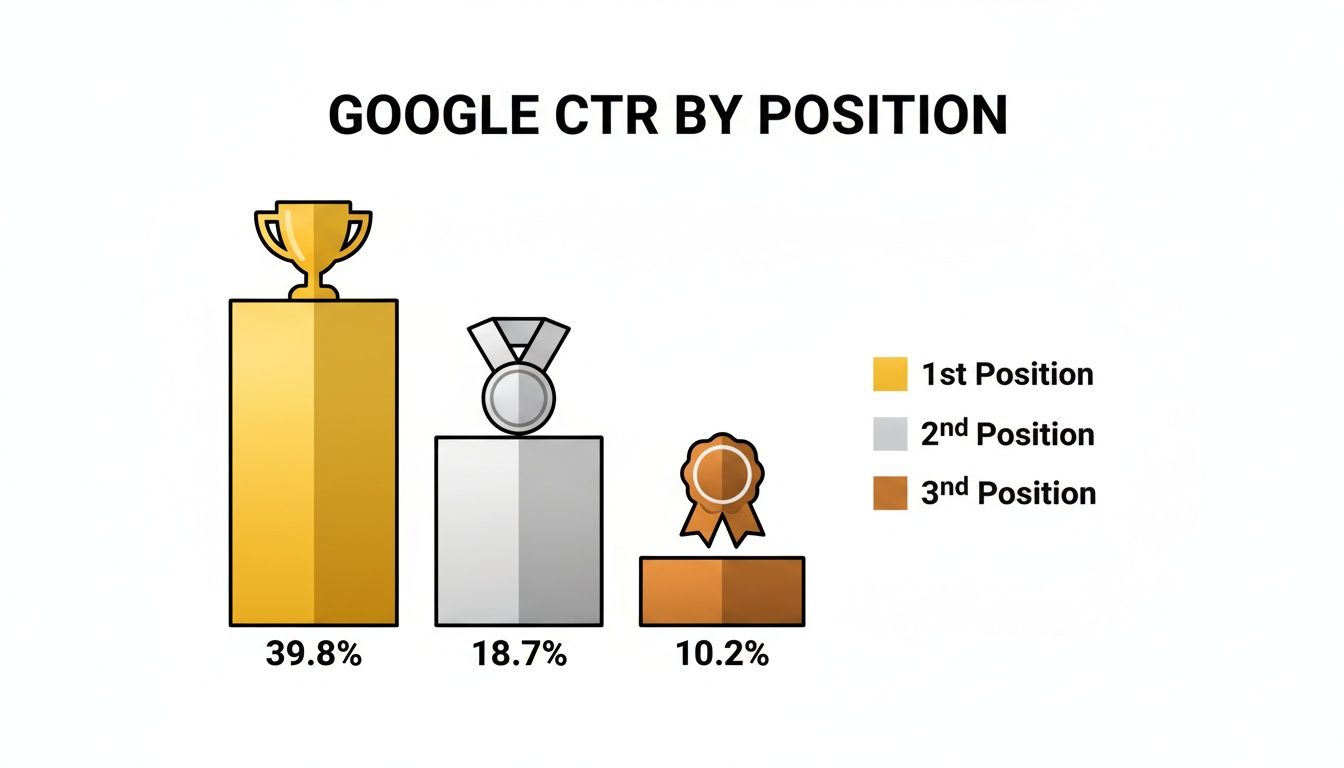
The numbers don't lie. Ranking at the top gives you an exponential advantage over the competition. This table breaks down the click-through rate disparity even further.
The Value of Top Google Rankings by Position
| Google Rank Position | Average Click-Through Rate (CTR) | Benefit Over Lower Positions |
|---|---|---|
| 1 | 39.8% | Captures more than double the clicks of the #2 spot. |
| 2 | 18.7% | Gets nearly twice the clicks of the #3 position. |
| 3 | 10.2% | Still pulls in significantly more traffic than anything below it. |
| 4 | 7.2% | Traffic begins to drop off sharply after the top three. |
| 5 | 5.1% | A reminder that being on page one isn't enough; you need to be at the top. |
This data underscores a critical point: getting to the first page is just the start. The real prize is in those top three positions.
The Three Pillars of Organic Growth
So, how do you get there? It’s not about finding a secret hack. Real, lasting success comes from a balanced strategy built on three core pillars that all work together.
- A Solid Technical Foundation: Your website needs to be fast, secure, and mobile-friendly. If search engines can't crawl it easily, even the most brilliant content won't be seen.
- Strategic, High-Quality Content: This is about more than just writing blog posts. You need to create content that directly answers your audience's questions, establishes your expertise, and provides real value.
- Authority and Trust: In the eyes of Google, backlinks from other respected websites are like votes of confidence. They signal that your site is a credible and trustworthy source of information.
By focusing on these three areas, you create a powerful synergy that search engines reward. You're not just optimizing for bots; you're building a better, more helpful experience for real people. To dive deeper, you can also explore our guide on what Search Engine Optimization is.
Creating Content That Actually Attracts and Converts
Let's be honest: generic blog posts are a dead end. If you want to see real growth in your organic traffic, you have to stop just writing and start creating strategic assets. These are the pieces that act like magnets for your ideal customers, pulling them in because you’re solving the exact problems they’re searching for.
The whole game changes when you start thinking about user intent—the "why" behind every search. Is someone just gathering information? Are they comparing their options? Or are they ready to pull out their credit card? Nailing this is the difference between getting a casual browser and a genuine lead.
Uncover What Your Audience Really Wants
Modern keyword research isn't about chasing the highest search volume. It’s about being a detective, uncovering the specific questions, frustrations, and pain points your audience has. That's where you find the gold.
A fantastic way to get started is by targeting what I call "bottom-of-the-funnel" keywords first. These are usually longer, more specific phrases that signal someone is close to making a decision. Sure, the search volume might seem low, but the traffic is highly qualified and ready to convert.
For example, instead of going after a massive term like "business software," you’d have much better luck with something like "best accounting software for freelance designers." The intent is crystal clear, and you aren't fighting a thousand other websites for that top spot.
Chasing huge-volume keywords from day one is a classic rookie mistake. Start by picking off low-difficulty, high-relevance keywords. You’ll build momentum and authority, which sets you up to tackle the more competitive terms down the road.
Once you’ve got a solid list of potential topics, it’s time to get organized with topic clusters.
Build Authority with Topic Clusters
A topic cluster is a brilliant way to structure your content. You create one massive, central "pillar" page on a broad topic and then support it with several in-depth "cluster" articles that dive into specific subtopics. This structure screams "expertise" to search engines.
Here’s how it looks in practice:
- Pillar Page: Your comprehensive, all-in-one resource, like "The Ultimate Guide to Email Marketing."
- Cluster Pages: Focused articles on the nitty-gritty, like "How to Write a Welcome Email Series," "Email List Segmentation Strategies," or "A Beginner's Guide to Email Marketing KPIs."
Every cluster page links back to the main pillar page. This creates a powerful web of internal links that proves your site's authority on the entire subject. When done right, this organized approach can rocket your rankings for a whole host of related keywords and is a non-negotiable part of a winning content strategy for your website.
Find Quick Wins by Refreshing Old Content
One of the most overlooked SEO tactics is the content refresh. I guarantee you have old blog posts sitting on your site that are underperforming—maybe they get a trickle of traffic, but they aren't pulling their weight.
These articles are pure low-hanging fruit. They’re already indexed, probably have a few backlinks, and just need a little TLC. Updating an existing post is often way more efficient than creating something brand new from scratch.
Here’s a quick-and-dirty process for finding and refreshing your content:
- Hunt for underperformers. Dive into your analytics and find articles ranking on page two or three of Google. These are the perfect candidates for a boost.
- Update for freshness and accuracy. Is the data old? Are there broken links? Swap out outdated stats and add new, relevant examples to make the content valuable again.
- Beef up the content. See what the current top-ranking articles are doing. Did they cover subtopics you missed? Expand your post to be more comprehensive and thorough.
- Re-optimize the small stuff. Tweak the title tag, meta description, and internal links to reflect the shiny new content.
By regularly auditing and improving your existing content, you can create a steady stream of traffic growth without the constant pressure of pumping out new posts. It’s the perfect high-ROI strategy for busy teams.
Mastering On-Page SEO for Maximum Visibility

Think of your website as a house. On-page SEO is the foundation it’s built on. Get this wrong, and everything else you do—from writing great content to building backlinks—just won't be as effective. Nailing the fundamentals of on-page SEO is one of the most direct ways to see your organic traffic grow.
At its core, on-page SEO is all about optimizing individual pages for both search engines and the people who visit them. You’re sending clear signals to Google about your content's topic while making the page a breeze for a real person to read and understand.
Crafting Titles and Descriptions That Earn Clicks
Your title tag and meta description are your first impression in the search results. They are your one chance to grab a searcher's attention and convince them your page has the answer they're looking for. A weak title or description means even a top ranking won't deliver the traffic it should.
A great title tag is a perfect mix of a target keyword and a compelling hook. Keep it concise—under 60 characters is a good rule of thumb—and make a clear promise.
For example, a generic title like "Our New Running Shoes" won't turn any heads. A much stronger version would be something like: "Lightweight Running Shoes for Maximum Speed | BrandName." It has the keyword and immediately sells a key benefit.
While your meta description isn't a direct ranking factor, it's your sales pitch in the search results. Use this space to expand on your title and give people a compelling reason to click. A well-written one can seriously boost your click-through rate (CTR).
Pro Tip: Always include a call to action in your meta description. Simple phrases like "Discover how," "Learn the secrets," or "Find your perfect fit" nudge users to take that next step and click through to your page.
Structuring Content with Clear Headers
When someone lands on your page, you have just seconds to convince them they're in the right place. That's where a logical header structure (H1, H2, H3, etc.) is invaluable. Headers break your content into scannable chunks, guiding readers through the information.
Think of your H1 as the book's title and H2s as the chapter headings. This creates a clear hierarchy that helps both users and search engines make sense of your content's flow. To truly get ahead, it's essential to implement proven On-Page SEO Best Practices.
The Power of Smart Internal Linking
Internal linking is easily one of the most underrated SEO tactics out there. It’s simply the act of linking from one page on your website to another relevant page on your site. This simple move has a massive impact.
First, internal links help search engines crawl and index all the pages on your site. Second, they distribute authority (often called "link equity") from your powerhouse pages to weaker ones, giving them a ranking boost. Most importantly, they guide your visitors to more useful content, keeping them on your site longer.
Here's how to do it right:
- Link from high-authority pages: Find your top-performing content and add links from those pages to newer articles or pages you want to push up the rankings.
- Use descriptive anchor text: Ditch generic phrases like "click here." Instead, use anchor text that clearly describes the page you're linking to, like "our complete guide to technical SEO."
- Fix broken links: Use a tool to regularly check for and fix broken internal links. This ensures a good user experience and stops you from wasting precious link equity.
By weaving a strategic web of internal links, you build a stronger, more cohesive site architecture that both users and search engines will appreciate. It's a foundational tactic that makes all your other SEO efforts more powerful.
Building Authority with Strategic Backlinks
In SEO, backlinks are the ultimate currency of trust. You can think of them as votes of confidence from other websites. When a reputable site links to your content, it’s a powerful signal to Google that says, "Hey, this is a valuable resource worth paying attention to." This is why a smart backlink strategy is one of the most effective ways to boost your organic traffic.
But this isn't a numbers game where the site with the most links wins. Far from it. A single, high-quality backlink from a respected industry authority is worth exponentially more than a hundred links from irrelevant or spammy sites. Your goal is to build a profile of links that proves your credibility within your niche.
Earning Links, Not Just Building Them
The most sustainable way to get backlinks is to shift your mindset. Stop thinking about building links and start focusing on earning them. This simple change moves you away from just asking for links and toward creating assets so valuable that people naturally want to share and reference them.
This approach is all about creating what we call "link-worthy" content. This isn’t your average blog post. It’s the kind of in-depth, high-value piece that becomes a go-to resource in your industry.
Here are a few types of content that consistently earn top-tier backlinks:
- Original Research and Data Studies: When you publish unique data, survey results, or industry trend reports, you become a primary source. Journalists, bloggers, and other creators will have to link back to your study when they cite your findings.
- Comprehensive Ultimate Guides: Aim to create the single best resource on a specific topic. If your guide is more thorough, better designed, and more helpful than anything else out there, it will naturally attract links over time.
- Free Tools and Calculators: Developing a simple, useful tool—like a mortgage calculator for a real estate site or a calorie counter for a fitness blog—can be a total link magnet. People will link to it as a helpful resource for their own audiences.
The data doesn't lie. Pages with more links tend to get way more traffic from Google. In fact, a staggering 95% of all web pages have zero backlinks. Contrast that with the top-ranking domains, where 92.3% have at least one link. The connection is undeniable. You can dig into more SEO statistics to see just how critical they are.
From Content Creation to Active Promotion
Creating a fantastic piece of content is only half the battle. You can't just hit "publish" and hope for the best; you need a solid promotion strategy to get it in front of the right people. This is where strategic outreach comes in, but it has to be done with care and precision.
Don't fall into the trap of sending generic, mass emails begging for a link. Personalization is everything. You have to show you’ve actually read their content and explain exactly why your resource would be a valuable addition for their specific audience.
A Quick Outreach Example
Let's imagine you're a marketing software company and you’ve just published a groundbreaking study on email marketing open rates. Here’s a simple, effective outreach process you could follow:
- Identify Potential Linkers: Start by finding bloggers, journalists, and industry publications that have recently written about email marketing. You're looking for people who are already talking about your topic.
- Find the Right Contact: Use a tool or just some good old-fashioned digging to find the specific author or editor's email address.
- Craft a Personalized Pitch: Keep your email short, to the point, and focused on providing value. Mention their recent article, briefly introduce your new research, and highlight a specific statistic from your study that would resonate with their readers.
- Make it Easy for Them: Don't just ask for a link. Suggest a specific place in their existing article where a link to your study would add context and value for their audience. This does the heavy lifting for them.
This thoughtful, value-first approach is how you build real relationships and earn the kind of authoritative backlinks that truly move the needle on your organic traffic.
Optimizing Technical SEO for a Flawless Experience
While amazing content and smart link-building often steal the spotlight, technical SEO is the unsung hero of your organic traffic strategy. It’s the behind-the-scenes work that makes sure search engines can actually find, crawl, and understand your website without hitting any walls.
Think of it like this: you could have the most incredible store with the best products in the world, but if the doors are locked and the lights are out, no one is coming inside. Technical SEO is all about unlocking those doors and flipping on the lights for search engines and, in turn, for your future customers.
Prioritize Blazing-Fast Site Speed
In today's fast-paced world, speed isn't just a feature; it's a necessity. A slow website is more than a minor annoyance—it's a roadblock that actively pushes visitors and search engines away. People expect pages to load in the blink of an eye, and Google knows it.
In fact, Google uses site speed as a direct ranking factor. Studies have shown that even a one-second delay in page load time can cause a 7% drop in conversions. That means a sluggish site isn't just hurting your rankings; it's costing you real money.
To get a grip on your site's performance, start with Google's Core Web Vitals. These metrics measure what a real user experiences when they land on your page, focusing on three key areas:
- Largest Contentful Paint (LCP): How fast does the main content show up?
- Interaction to Next Paint (INP): How quickly does the page respond when someone clicks or taps?
- Cumulative Layout Shift (CLS): Does the page jump around as it loads, or is it stable?
You don't need to be a developer to make a real impact here. Simple things like compressing your images before you upload them, enabling browser caching, and choosing a quality web host can make a world of difference. For a deeper dive, check out this guide on website performance optimization.
Embrace a Mobile-First World
The shift to mobile isn't just a trend anymore; it's the reality of how the web works. Google now operates on a mobile-first indexing system. This means it primarily looks at the mobile version of your site to determine its rankings—your desktop version is now secondary.
This is a game-changer. If your website is a pain to use on a smartphone—with tiny text, buttons that are too close together, or elements that just don't work—your rankings will take a hit on all devices, not just mobile.
Your mobile site isn't a scaled-down version of your desktop site. In Google's eyes, it is your site. Every single part of it, from the navigation menu to the checkout process, has to be perfect on a small screen.
Testing your site is easy. Use Google’s Mobile-Friendly Test for a quick pass/fail grade and a list of specific things to fix. A responsive design, which automatically adjusts to fit any screen size, is the gold standard for creating a great experience for every visitor.
Proactively Manage Your Site Health
The final piece of the technical SEO puzzle is all about staying on top of things. This means regularly checking for issues that could stop search engines from properly crawling, indexing, and understanding your content. Your best friend for this task is the completely free Google Search Console.
Think of Search Console as a direct hotline to Google. It’s where Google tells you exactly what problems it's finding on your site so you can fix them.
Here’s a quick rundown of what you should be monitoring:
- Crawl Errors: Head over to the "Pages" report to find any URLs Google couldn't access. Each one is a missed opportunity for traffic.
- XML Sitemap Status: Make sure you’ve submitted your sitemap and that Google is reading it correctly. Your sitemap is basically a roadmap of your website that helps Google find all your important pages.
- Security Issues: The "Security issues" report will alert you to any hacking or malware problems that could get your site penalized or even blacklisted.
To help you stay organized, here's a quick checklist of the most critical technical tasks for any business owner.
Technical SEO Priority Checklist for Business Owners
This checklist breaks down the most important technical SEO tasks, explaining why they're crucial and how to prioritize them for the biggest impact on your organic traffic.
| Technical Task | Why It Matters | Priority Level (High/Medium) |
|---|---|---|
| Fix Broken Links (404s) | Broken links create a frustrating user experience and waste crawl budget. | High |
| Submit an XML Sitemap | Helps Google discover and index all of your important pages efficiently. | High |
| Implement HTTPS Security | Secures user data, builds trust, and is a confirmed Google ranking signal. | High |
| Optimize Page Speed | Slow pages hurt user experience and rankings; speed is critical for conversions. | High |
| Ensure Mobile-Friendliness | Google uses mobile-first indexing, so your mobile site is your primary site. | High |
| Check for Indexing Issues | Use Google Search Console to find pages that aren't indexed and fix them. | Medium |
| Use Structured Data (Schema) | Helps search engines understand your content and can lead to rich results (like stars in search). | Medium |
By taking a proactive approach to these technical details, you're building a strong, reliable foundation for your entire SEO strategy. Spending just 15-20 minutes a month in Google Search Console can help you catch small issues before they turn into major ranking disasters, allowing your great content to get the visibility it deserves.
Answering Your Top Organic Traffic Questions
Even with the best strategy laid out, you're bound to run into some questions. It happens to all of us. This section is all about tackling those common, practical hurdles that pop up for marketers and business owners. Let's get you some direct answers so you can move forward.
How Long Does It Realistically Take to See an Increase in Organic Traffic?
Let's set expectations right away: SEO is a marathon, not a sprint. If you're consistently putting in the work with a smart SEO and content strategy, you'll likely start seeing the first signs of positive movement within 3 to 6 months.
Of course, that timeline isn't set in stone. How competitive is your industry? What’s your website’s current authority? How much effort are you dedicating? These factors all play a huge role. For a brand-new website starting from absolute zero, it’s probably more realistic to think in the 6 to 12-month range before you see major growth.
The most important thing is consistency. Think of SEO as a long-term investment. It builds on itself over time, delivering sustainable results that are far more cost-effective than paid ads down the road.
What's More Important: Content or Technical SEO?
This is the classic SEO debate, but honestly, it's a false choice. It’s like asking if a car needs an engine or wheels. You can’t get anywhere meaningful without both. They are completely codependent.
You could write the most brilliant, helpful content in the world, but it won't matter if technical problems keep Google from finding your pages. Or if your site is so slow that visitors bounce before they even read the first sentence.
On the flip side, a technically pristine website with weak, unhelpful content is just as useless. It will never rank for the keywords that actually bring in customers.
A winning strategy demands a balanced approach. Your compelling content needs a flawless technical foundation to shine. Stop thinking of them as separate priorities and start seeing them as two essential parts of the same machine.
Can I Increase Organic Traffic Without Building Backlinks?
The short answer is… maybe, but it's incredibly difficult. You might see some traffic gains for very niche, low-competition keywords without an active backlink strategy. But for any term that's even remotely competitive? You're fighting an uphill battle.
Backlinks are still a core signal that tells search engines your site is authoritative and trustworthy. Without them, you're at a serious disadvantage.
A better way to think about it is to shift your focus from "building" links to "earning" them.
The best way to do that is by creating content so genuinely valuable that other people want to link to it. Think about creating assets like:
- Original research packed with unique data for your industry
- The ultimate guide on a topic that blows every other resource out of the water
- Free tools or templates that solve a real problem for your audience
When you do this, links become a natural byproduct of creating incredible value, not something you have to chase.
Which Metrics Should I Track to Measure Organic Traffic Growth?
Just watching the main "Organic Traffic" number in Google Analytics is a good start, but it barely scratches the surface. To really understand what’s going on and make smart decisions, you have to dig deeper.
You need to look at a handful of key metrics that show you not just the amount of traffic, but its quality and its actual impact on your business.
Key Performance Indicators for Organic Growth:
| Metric to Track | What It Tells You | Why It Matters |
|---|---|---|
| Organic Keyword Rankings | Your visibility for the search terms you care about. | Are you climbing the ranks for more relevant keywords? |
| Click-Through Rate (CTR) | The percentage of searchers who actually click your result. | Is your title and meta description compelling enough to win the click? |
| New Users from Organic | How many brand-new visitors you're attracting. | Is your strategy expanding your reach to a fresh audience? |
| Conversions from Organic | The leads, sales, or sign-ups coming from search. | Is your traffic actually helping you achieve your business goals? |
By tracking these indicators together, you get a much clearer picture of what’s working, what isn't, and how your SEO efforts are directly contributing to your bottom line.
Ready to stop worrying about website issues and focus on growing your traffic? At OneNine, we specialize in expert website management and development, ensuring your site is fast, secure, and perfectly optimized. Let us handle the technical details so you can get back to business. Explore our services at onenine.com and build a foundation for lasting success.


