

Foundations of Effective Website Content Strategy
A robust content strategy is essential for website success. It's more than just posting randomly; it's a well-defined plan. It involves understanding your audience, aligning your content with your business goals, and creating a system for measurable results. This focused approach sets successful content marketing apart from sporadic publishing.
Aligning Content With Business Goals
Effective content strategies start with understanding your business objectives. What are you trying to achieve? Increase brand awareness? Generate leads? Drive sales? Your content should directly support these goals. For example, if lead generation is key, focus on valuable lead magnets like ebooks or webinars. This ensures your content contributes to your bottom line.
Understanding Your Target Audience
Knowing your audience is crucial. Go beyond basic demographics. Understand their needs, pain points, and motivations. What are their questions? What information are they looking for? By addressing these through your content, you position your brand as a trusted resource, building engagement and loyalty.
Content marketing is a vital strategy for businesses, with 82% of companies using it. Its power lies in building trust and long-term audience relationships. By 2025, 73% of B2B and 70% of B2C marketers will incorporate content marketing. It's highly effective for improving engagement and traffic. In fact, 72% of marketers report increased engagement and traffic, and 76% report increased leads from content marketing. Creating high-quality, resonant content is clearly essential. Learn more: Content Marketing Stats.

Building a Content Framework
A solid framework underpins any successful content strategy. This framework should outline key elements:
- Content Pillars: Core themes or topics your content revolves around.
- Content Formats: Diversify with blog posts, videos, infographics, and other formats.
- Distribution Channels: Where your content will be published and promoted (e.g., social media, email).
This structure provides direction, ensures consistency, and maximizes impact. For further guidance: How to master a Website Content Strategy Template.
B2B vs. B2C Approaches
While core principles are consistent, B2B and B2C content strategies differ tactically. B2B often focuses on valuable information and thought leadership. B2C may prioritize entertainment and emotional connection. Understanding these nuances is key. Tailor your content to the specific needs and expectations of your audience to effectively reach and engage them.
Content Auditing: Turning Data Into Strategic Direction
Before you refresh your website's content strategy, it's important to know what's working well and what isn't. A content audit is like a detailed investigation of your existing content. It can uncover hidden opportunities and identify underperforming content. This process helps successful digital teams gain valuable insights and turn them into a strategic advantage.
Uncovering Hidden Opportunities
A content audit is more than just listing your existing content. It's a deep dive into performance data, identifying your best-performing pieces and areas that need improvement. This data-driven approach helps you understand what topics your audience likes, which content formats are most effective, and what channels drive the most engagement. Knowing this allows you to focus on what's working and strategically adjust what isn't.
Understanding Your Audience: Beyond Demographics
A good content strategy for website engagement depends on truly understanding your target audience. This means looking beyond basic demographics and understanding what motivates them. Think about their pain points, what drives them, and what kind of content they value. Answering these questions helps you create content that truly resonates with your audience, turning casual visitors into loyal followers. The infographic below shows the age distribution of a sample audience.
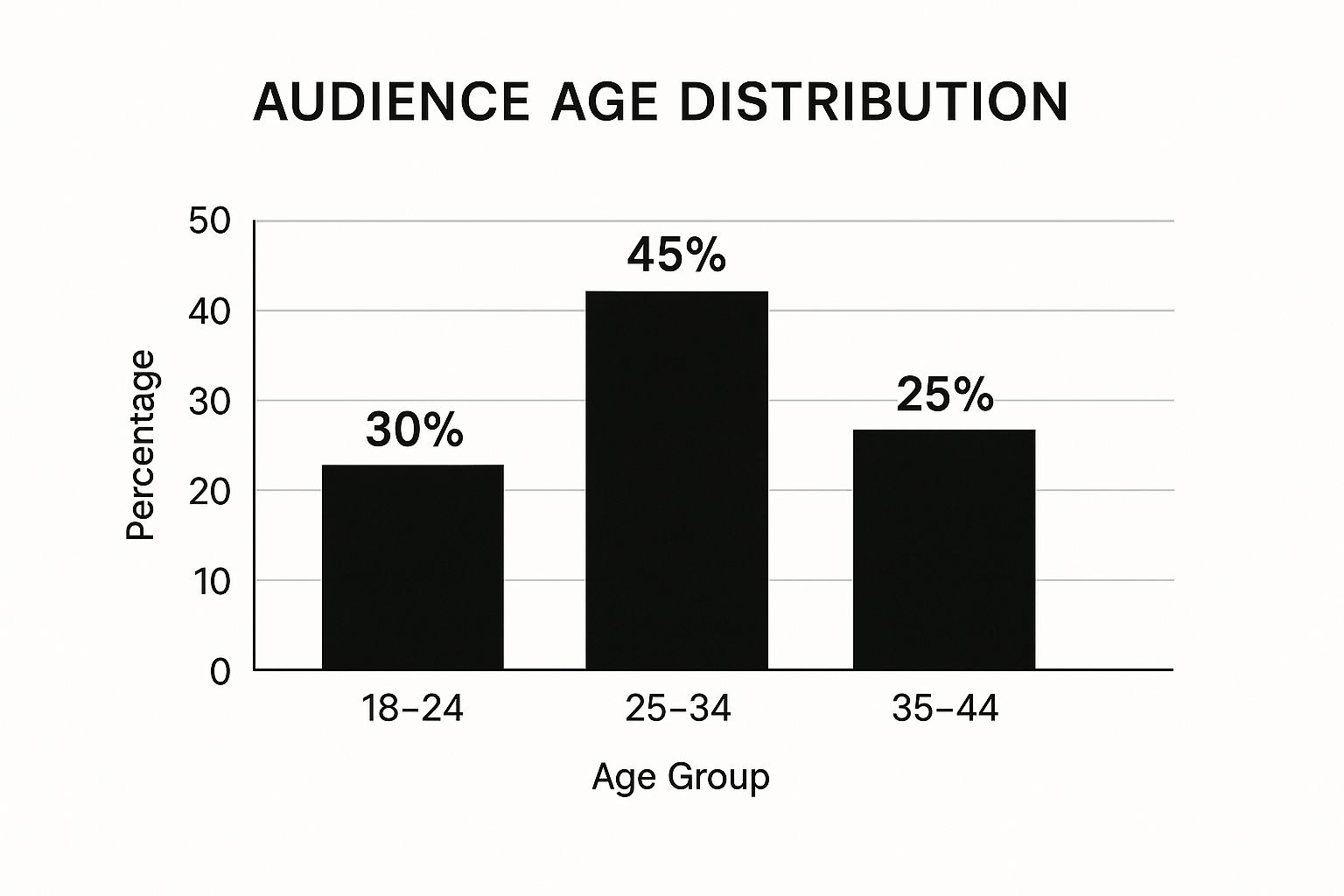
As the infographic shows, the largest segment of this audience is between 25-34 years old (45%), followed by the 18-24 group (30%) and the 35-44 group (25%). This data informs content creation by highlighting the primary target demographic and their potential preferences. This allows you to tailor your content strategy and maximize its impact on the largest segment of your audience.
Turning Insights Into Action
After gathering data from your content audit and audience research, the next step is using these insights to revise your website's content strategy. This could mean repurposing successful content into different formats, updating older content with new information, or creating entirely new content based on what you’ve learned. This process keeps your content relevant, engaging, and aligned with your business goals. Industry trends highlight the increasing importance of data-driven content strategies. By 2025, 46% of B2B marketers plan to increase their content marketing budget, with 61% specifically increasing investment in video content. You can find more detailed statistics here: Content Marketing Strategy Statistics.
Building a Framework for Success
A well-defined framework ensures your website's content strategy is sustainable and scalable. This framework should outline key elements, as detailed in the table below.
To help clarify the key components of a robust content audit, let's explore a helpful framework:
Content Audit Framework Components:
This table outlines the essential elements of a comprehensive content audit and what each component measures.
| Audit Component | What It Measures | Why It Matters | Tools for Analysis |
|---|---|---|---|
| Content Pillars | Core topics and themes | Ensures content aligns with overall brand messaging and target audience interests. | Semrush |
| Content Formats | Types of content (blog posts, videos, infographics, etc.) | Identifies which formats resonate most with the audience and achieve specific goals. | Google Analytics |
| Distribution Channels | Platforms where content is published and promoted | Determines which channels reach the target audience most effectively. | SproutSocial |
| SEO Performance | Keyword rankings, backlinks, organic traffic | Evaluates content visibility and search engine optimization effectiveness. | Ahrefs |
| Content Engagement | Views, shares, comments, time on page | Measures audience interaction and content effectiveness in capturing attention. | Google Analytics |
| Conversion Rates | Leads generated, sales, sign-ups | Assesses how well content contributes to business objectives. | Google Analytics |
This table provides a clear structure for conducting a thorough content audit. By analyzing these components, you can gain valuable insights into your content's strengths and weaknesses.
This framework acts as a roadmap for your content efforts, ensuring consistency and maximizing impact. A strong framework, based on your audit, builds a content engine for growth.
Mapping High-Impact Content to Customer Journeys
A powerful content strategy for website success depends on understanding the customer journey. It's about meeting your audience where they are in their buying process, providing content that addresses their specific needs at each stage. This is much more effective than simply creating content and hoping it resonates. By looking at successful brands, we can learn how to map content to the customer journey and create a more impactful online presence.
Understanding The Stages of The Customer Journey
The customer journey is typically divided into key stages: awareness, consideration, decision, and action. In the awareness stage, the customer realizes they have a problem or need. Consideration involves researching potential solutions. The decision stage is when they choose a specific product or service. Finally, action is the purchase or conversion.
For example, someone might realize they need new running shoes (awareness), research different brands and models (consideration), choose a specific pair (decision), and then buy them online (action). To understand your customer's buying behavior better, consider Ecommerce Customer Journey Mapping.
Content Tailored to Each Stage
Different content formats and topics work best at different stages of the customer journey. During the awareness phase, blog posts, articles, and infographics addressing general pain points are effective. As customers move into consideration, comparisons, case studies, and webinars showcasing your expertise become more relevant.
For the decision stage, product demos, free trials, and testimonials can influence their choice. Finally, in the action phase, clear calls to action, easy checkout processes, and special offers encourage conversion. This targeted approach ensures maximum impact at each step.
Identifying Content Gaps in Your Funnel
Mapping content to your customer journey helps you identify gaps in your conversion funnel. Are you missing content that addresses specific customer questions or concerns at a particular stage? For instance, having plenty of awareness-stage content but lacking detailed product information can hinder conversions. Addressing these gaps creates a seamless and persuasive customer journey.
Prioritizing Content Creation for Maximum Impact
Not all content is created equal. Some pieces will have a greater impact on your business goals than others. Prioritize content creation based on business impact and audience value. Which pieces are most likely to drive conversions or generate leads? Which topics matter most to your audience?
Addressing these questions ensures your content strategy aligns with your business objectives and resonates with your target market. Also, consider the current environment. The content marketing industry is continuously growing, with 92% of brands planning to increase investments in content creators. Content usage has accelerated by 207%. Learn more about content marketing statistics.
Building Content Clusters for Logical Pathways
Effective content strategies often involve creating content clusters. These are groups of related content pieces centered around a core topic. This creates logical pathways for prospects, guiding them through different stages of the customer journey while answering their questions.
For example, a cluster on "website content strategy" might include articles on "content auditing," "keyword research," and "content optimization." This provides a comprehensive resource and establishes your brand as an authority.

Building Your Content Production Machine
A well-defined content strategy is essential for website success, but it's meaningless without proper execution. Even the best plans fall apart if you don't have a consistent production process. This section explores how successful brands create content operations that can keep going strong, balancing ambitious goals with the resources they have available. This includes understanding your team's capacity, developing efficient workflows, and using the right tools.
Creating a Sustainable Content Calendar
Many content strategies fail because of unrealistic production schedules. This often leads to team burnout and inconsistent posting. Learning to develop a realistic content calendar is crucial. This involves honestly assessing your team's bandwidth and prioritizing tasks based on their potential impact. Don't overschedule. Build in extra time for unexpected delays or new opportunities. A sustainable pace is key for long-term success.
Streamlining Your Workflow
Efficient workflows are the foundation of consistent content creation. Think of it as an assembly line for your content. This involves establishing clear processes for every step, from brainstorming and creating briefs to writing, editing, and publishing. Using templates for briefs, having approval processes, and using quality control checklists will ensure consistency and efficiency. This structured approach reduces errors and helps you create more high-quality content.
Leveraging Tools and Technology
Technology can significantly improve your content production. Many tools are available to help with team collaboration, project management, and task automation. Project management software like Asana or Trello helps keep teams organized and focused. Collaboration platforms like Google Docs allow teams to write and edit together in real time. Using these tools boosts efficiency and improves overall team performance.
Prioritizing Content Topics for Maximum Impact
Not every content topic is equal. A strong content strategy for website growth requires prioritizing topics based on key factors:
- SEO Opportunity: Which keywords have high search volume and low competition?
- Business Impact: Which topics directly support your business goals, such as lead generation or sales?
- Audience Demand: What questions are your target customers asking? What information are they looking for?
By balancing these considerations, you can ensure your content efforts focus on areas with the highest potential return.
To help visualize this, the following table outlines effective content formats based on the customer journey stage:
To understand how content supports each stage of the customer journey, let’s examine the different content types that prove most effective.
| Journey Stage | Content Types | Primary Goal | Key Metrics | Example Topics |
|---|---|---|---|---|
| Awareness | Blog posts, infographics, social media updates | Generate interest and brand awareness | Website traffic, social media engagement | Industry trends, common customer questions |
| Consideration | Ebooks, webinars, case studies | Educate prospects and build trust | Lead generation, time on page | Product comparisons, problem-solving guides |
| Decision | Demos, free trials, testimonials | Convert prospects into customers | Sales conversions, customer acquisition cost | Product features, customer success stories |
| Retention | Email newsletters, loyalty programs, exclusive content | Nurture customer relationships and encourage repeat purchases | Customer retention rate, customer lifetime value | Product updates, tips and tricks, community forums |
| Advocacy | Referral programs, social media contests | Turn customers into brand advocates | Customer referrals, social media shares | Customer testimonials, product reviews |
This table helps illustrate the different content formats that are most effective at each stage. From building initial brand awareness to turning happy clients into vocal brand champions, each step relies on strategically deployed content.
Building Your Content Team
A successful content production operation requires a well-rounded team. Consider the skills needed for each part of the process:
- Content Strategists: Develop the overall strategy and content calendar.
- Writers: Create engaging and informative content.
- Editors: Refine the content for clarity, accuracy, and style.
- SEO Specialists: Optimize content for search engines.
- Content Managers: Oversee the entire production process.
Depending on your resources, you may have dedicated individuals for each role or have some team members performing multiple functions. Building a capable team is crucial for lasting success.
This structured approach, combined with a well-planned content calendar and streamlined workflows, turns content creation from a chaotic process into a well-oiled machine. Consistency is key. A regular publishing schedule keeps your audience engaged and shows search engines that your website offers valuable information. By creating a sustainable content production process, you pave the way for ongoing website success.
Optimization Tactics That Drive Traffic and Conversions
Creating high-quality content is only the first step. It's just as important to make sure that content is easy to find and encourages conversions. This means understanding how search engines work, optimizing content for visibility, and creating compelling calls to action. Let's look at how successful brands accomplish this.
Keyword Research: Finding High-Intent Opportunities
Effective keyword research is the foundation of any successful content strategy for website optimization. It's the process of figuring out the words and phrases people use in online searches. This involves understanding search intent: what users are hoping to find when they enter specific keywords. For example, someone searching for "best running shoes for marathon training" has a different goal than someone searching for "how to tie running shoes."
Finding high-intent keywords lets you create content that directly addresses user needs. Tools like Semrush and Ahrefs can help analyze search volume, competition, and keyword relevance. This data-driven approach ensures your content reaches the right people at the right time.
On-Page Optimization: Improving Visibility and Readability
On-page optimization refers to the techniques used to improve a webpage's search result ranking. This includes optimizing elements such as:
- Title tags and meta descriptions: These offer short summaries of your content for search engines and users.
- Header tags (H1-H6): These structure your content and emphasize key points.
- Image alt text: This describes images to search engines and makes your website more accessible.
- URL structure: Short, descriptive URLs are easier for both search engines and users to understand.
While optimizing for search engines is important, maintaining readability is crucial. Avoid awkwardly inserting keywords into your content. Instead, concentrate on creating valuable, engaging content that flows naturally. You might be interested in: How to master Website Performance Optimization.
Creating Content That Converts
Beyond search engine optimization, your content should guide users toward conversion. This means understanding persuasive writing and user psychology.
Here are some important strategies:
- Strategic Storytelling: Captivating stories can draw in your audience and create emotional connections.
- Clear Value Propositions: Emphasize the benefits of your product or service and explain why it's the best choice.
- Effective Calls-to-Action: Use action verbs, create a sense of urgency, and simplify the next steps for users.
Balancing SEO With User Experience
Top brands understand the importance of balancing SEO with user experience. A website focused only on search engines can feel impersonal and dull. On the other hand, a site that prioritizes design over SEO might struggle to attract organic traffic.
The solution is to create content that satisfies both search engines and users. This means providing valuable information, using clear and concise language, structuring content logically, and optimizing for mobile devices. By prioritizing both SEO and user experience, you can create a website that ranks well and offers a positive experience for your audience.

By using these optimization tactics, you can increase website traffic and boost conversions, ultimately reaching your business goals through a strong content strategy.
Measuring What Matters: Beyond Vanity Metrics
A successful website content strategy needs more than just great content. It also needs an understanding of what your audience truly wants and what drives your business forward. This means looking past vanity metrics like page views and social media likes. Instead, we should focus on key performance indicators (KPIs) that directly connect to your business goals. This data-driven method allows your content strategy to constantly grow and improve.
Establishing Meaningful KPIs
The first step in measuring what matters is defining your KPIs. These metrics should be a direct reflection of your business goals. For instance, if your goal is lead generation, your KPIs might include form submissions, ebook downloads, or demo requests. If you’re focused on increasing brand awareness, relevant KPIs might be social media shares, brand mentions, or website traffic from organic search. Choosing the right KPIs provides a clear understanding of your content's impact on your business.
Practical Measurement Frameworks and Tools
After establishing your KPIs, you need a system for tracking and analyzing them. Many tools can simplify this. Google Analytics is a powerful, free platform for tracking website traffic, user behavior, and conversions. Social media platforms usually offer built-in analytics dashboards to monitor engagement. Specialized SEO tools like Semrush offer in-depth insights into keyword rankings, backlink profiles, and competitor analysis. Optimizing website speed significantly affects traffic and conversions. For practical advice on improving site performance, check out this guide: boosting your site performance.
Interpreting Data and Extracting Actionable Insights
Just collecting data isn't enough. You need to understand its meaning. For example, a high bounce rate on a particular blog post might indicate the content isn't relevant to those clicking through from search results. A low conversion rate on a landing page might suggest the call to action isn't clear or compelling. Examining this data reveals areas for improvement in your content strategy. You might find this helpful: How to analyze website traffic.
Systematic Content Experimentation: A/B Testing and Optimization
Continuous improvement requires constant testing. A/B testing is a valuable method for comparing different content versions to determine which performs best. This might include testing different headlines, images, calls to action, or even full page layouts. Analyzing the results helps you identify which elements resonate most with your audience so you can optimize your content accordingly.
Content Performance Reviews: Asking the Right Questions
Regular content performance reviews are crucial for data-driven content strategies. These reviews should go deeper than just reporting on metrics. They should involve asking important questions, such as:
- What content performed best, and why?
- What content underperformed, and how can we improve it?
- Are we reaching our target audience?
- Are we meeting our business objectives?
Asking these questions helps identify areas for improvement and allows you to make strategic adjustments to your content strategy. This ongoing process ensures your content continues to deliver results and aligns with your changing business needs.
Ready to improve your website’s performance? OneNine's expert team can help you develop and implement a data-driven content strategy that delivers measurable results. Visit OneNine today to learn more about our website management and development services.


