

When we talk about improving brand awareness, what we’re really talking about is making your brand unforgettable. It’s about becoming the first name that pops into someone’s head when they have a problem you can solve. This isn't just about plastering your logo everywhere; it’s a long-term game built on three key pillars: a consistent brand identity, valuable content, and a genuine connection with your audience.
Laying the Groundwork for Brand Awareness
Before you even think about launching a marketing campaign, you need to get this foundational piece right. Without it, you're just creating noise, not building a legacy. True brand awareness is the difference between fleeting visibility and lasting impact.
Think about it. When you need a quick answer, you "Google it." When you think of an electric car, Tesla probably comes to mind. That level of recognition doesn't happen by accident. It's the result of a deliberate, long-term commitment to building a brand that connects with people on a deeper level.
Why Consistency is Your Secret Weapon
If there's one thing I've learned over the years, it's that consistency is the engine of a memorable brand. When your messaging, visuals, and tone are the same everywhere—from your Instagram stories to your customer support chats—you build familiarity. People start to recognize you without even thinking about it.
A strong brand is built on meaning. For that meaning to stick, it has to be social and constantly reinforced. It’s the sum of every single interaction a customer has with you.
This constant, repeated exposure is what cements your brand in a consumer’s mind. It's a cycle of building, connecting, and refining.
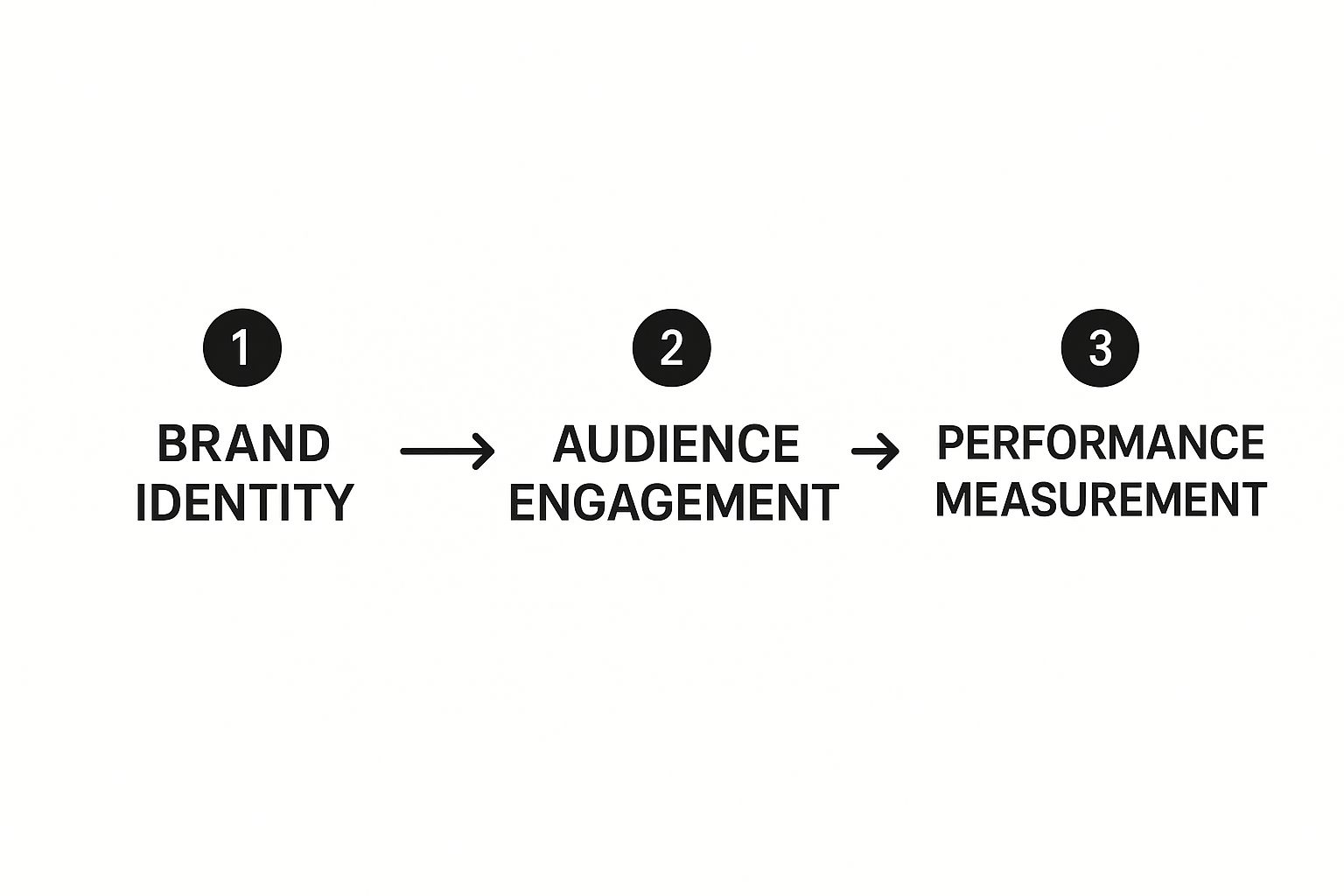
As you can see, it all starts with your identity and flows through to engagement and measurement. It’s not a one-and-done task but a continuous loop where each part strengthens the others.
The Tangible Results of a Cohesive Brand
This isn’t just about looking good—it directly impacts your bottom line. I’ve seen it happen. Maintaining brand consistency can lead to a 10-20% increase in revenue growth. It’s also said that a signature color can boost recognition by up to 80%. And get this: it takes 5 to 7 impressions for someone to even begin to remember your brand.
To help you get started, here is a quick overview of the core strategies we'll be diving into.
Core Strategies for Improving Brand Awareness
This table summarizes the essential strategies we’ll cover, outlining what each approach involves and the impact you can expect.
| Strategy | Primary Goal | Key Channels |
|---|---|---|
| Identity & Messaging | Establish a unique, recognizable brand persona. | Website, Social Media Profiles, Style Guide |
| Content Creation | Attract and engage the target audience with value. | Blog, Video, Social Media Posts, Podcasts |
| Community Building | Foster authentic connections and loyalty. | Social Media Groups, Forums, Events, Email |
| Strategic Outreach | Expand reach to new, relevant audiences. | SEO, PR, Influencer Collaborations, Guest Posting |
Each of these strategies plays a critical role in the bigger picture.
Building this foundation requires a clear plan. In this guide, we'll walk through the practical steps to:
- Craft a memorable identity that truly stands out.
- Create valuable content that people actually want to consume.
- Build authentic connections that turn casual customers into loyal advocates.
This is how you build something that endures. For an even deeper look into this topic, I highly recommend this article on how to build brand awareness that lasts. Getting these fundamentals right is your first real step toward creating a brand people recognize, remember, and rave about.
Crafting an Unforgettable Brand Identity

When people talk about building brand awareness, the conversation often jumps straight to logos and color schemes. But that’s just scratching the surface. A truly memorable brand has a personality—a consistent voice, clear messaging, and core values that connect with people on a human level.
Think about the brands you love. They just feel a certain way, right? That’s not an accident. It's the result of painstaking work to define and protect a unique identity. This personality needs to show up everywhere, from a witty tweet to the way a support agent handles a complaint. It's this consistency that makes a brand feel authentic and trustworthy.
Defining Your Brand Personality
So, how do you build that personality? Start by thinking of your brand as a person. What are they like? Are they a quirky innovator, a wise mentor, or a dependable friend? Nailing this down early is one of the most important things you can do, as it will shape every piece of communication you create.
To get started, ask yourself a few key questions:
- Voice and Tone: How does your brand talk? Is it formal and academic or casual and full of humor? Old Spice, for example, leans into an over-the-top, hilarious tone that you can spot from a mile away.
- Core Values: What does your brand stand for? Things like sustainability, community, or relentless innovation aren't just buzzwords; they are principles that attract customers who see the world the same way.
- Mission: Why do you exist? A clear mission statement is your North Star. It guides your decisions and keeps your messaging focused.
Answering these questions helps you build a character that truly resonates. For a full walkthrough on this, our guide on how to create a brand identity breaks down every step in detail.
Conducting a Brand Audit for Consistency
Once you’ve defined your personality, it's time for a reality check. A brand audit is like a health check-up for your brand. You'll systematically review all your assets and channels to see if you’re actually practicing what you preach. Inconsistencies can seriously confuse your audience.
Comb through everything: your website copy, social media profiles, sales decks, and even your email signatures. Does the tone of voice feel the same everywhere? Do the visuals look like they belong to the same family? Finding these gaps is the first step to creating a unified experience that builds real trust and recognition.
Your brand isn’t what you say it is—it's what your customers feel it is. Every single touchpoint, big or small, shapes that feeling. A consistent identity is your best tool for ensuring those experiences build positive equity.
Developing Practical Brand Guidelines
A brand audit almost always highlights the need for clear rules. That's where brand guidelines come in. This isn’t just a fancy document for designers; it's a practical playbook for your entire organization. A deep understanding of brand identity is critical, and these guidelines make that knowledge easy for everyone to apply.
Keep your guidelines simple and accessible. They should clearly spell out:
- Logo usage: The dos and don'ts for placing your logo.
- Color palette: Your primary and secondary colors, complete with their hex codes.
- Typography: The specific fonts to use for headlines and body text.
- Voice and tone examples: Simple "say this, not that" examples to guide writing.
By creating and sharing these guidelines, you empower everyone on your team to be a brand champion. This cohesion is what turns a business into a beloved brand, making the long-term goal of increasing brand awareness that much easier to achieve.
Using Content Marketing to Attract New Audiences
If you want to reach people who don't know your brand exists, content is your best bet. Forget the hard sell. The idea is to offer genuine value and solve real problems for your target audience before you ever ask for a sale.
Think of it this way: every helpful blog post, engaging video, or insightful podcast you create is a breadcrumb leading new people to your doorstep. This isn't about shouting into the void; it's about building a reputation as a trusted authority. Good content becomes a long-term asset that works for you 24/7, attracting potential customers while you sleep.
Choosing the Right Content Format
So, what should you create? There’s no magic formula here. The best format is the one your audience actually wants to consume. You have to meet people where they already are.
Ask yourself: who is my ideal customer? Are they a busy executive who pops in their AirPods for a podcast on the way to work? Or are they a detail-oriented researcher who wants to dive deep into a data-backed article?
Here are a few popular formats I've seen work time and again:
- Blogs and Articles: The cornerstone of SEO. They are perfect for answering the specific questions your audience is typing into Google and establishing your expertise on a topic.
- Video Content: Nothing beats video for showing, not just telling. It’s fantastic for product demos, step-by-step tutorials, or just sharing compelling brand stories. Plus, it’s highly shareable on platforms like YouTube and Instagram.
- Podcasts: If you want to build a loyal following and a personal connection, podcasts are golden. This format lets you explore topics with nuance and position your brand as a genuine thought leader.
- Infographics: These are your secret weapon for making complex information digestible and fun. They’re incredibly shareable on visual platforms like Pinterest and LinkedIn.
Content marketing isn’t just about creating stuff—it’s about creating the right stuff for the right person at the right time. When you solve someone's problem, they remember who helped them.
A Simple Framework for Content Planning
One of the biggest mistakes I see is creating content on the fly with no real strategy. You'll burn out fast and see little return. To avoid this, a simple framework is all you need.
Start by brainstorming the core challenges and pain points your customers face. From there, you can define your content "pillars"—these are the big, overarching topics you want to own.
For example, a financial software company might choose pillars like "Small Business Budgeting," "Tax Prep for Founders," and "Scaling Your Company." Each pillar can then sprout dozens of specific ideas, like a blog post on budgeting mistakes or a video walkthrough of common tax deductions. This keeps your content focused and consistently valuable.
And please, don't forget to repurpose your work. A single in-depth blog post can be sliced and diced into a week's worth of social media updates, a slick infographic, or even a script for a short video. This maximizes your reach without doubling your workload. To get more strategic, you can dig into these 10 content marketing best practices to help polish your plan.
The proof of this approach is in the numbers of the world’s biggest brands. Long-term tracking shows that tech-focused, disruptive brands are driving most of the growth in global brand value. Apple's brand value, for instance, is now $1.3 trillion, a 28% increase over the previous year. Meanwhile, brands like Nvidia more than doubled their value, showing how staying relevant—often through innovation and great content—directly fuels brand awareness. You can see how top brands are growing their value on Kantar.com.
Earning Audience Trust and Connection

Getting eyeballs on your brand is just the first step. The real magic happens when you earn your audience's trust—that's what turns casual followers into a genuine community. In my experience, trust is the most valuable currency you can have. Without it, even the most visible brand will find it impossible to build real, lasting connections.
This kind of connection isn't something you can buy with ads. It's built through authentic, human interactions. It’s about showing up consistently, being transparent, and proving you care about more than just making a sale.
The Power of Authentic Engagement
Authenticity isn't a buzzword; it's a daily practice. You can't fake it. It shines through in how you engage with people every single day, going far beyond just scheduled posts and automated replies on social media. It means jumping into conversations, thoughtfully answering questions, and letting the human side of your brand show.
For instance, when a customer tags you in a post, a simple "like" is forgettable. But a personalized comment that acknowledges their specific experience? That's memorable. It shows you're actually listening, and it reinforces that their contribution matters. It’s a simple but powerful way to improve your brand awareness organically.
Don't just take my word for it—the numbers back it up. A staggering 81% of consumers say they need to trust a brand before they'll even think about buying from them. And with two-thirds of US shoppers basing purchases on a company's social values, what you stand for is a massive part of the equation.
Turn Customers into Your Best Marketers with UGC
One of the most effective ways I've seen brands build trust is by harnessing user-generated content (UGC). We're talking about the raw, real photos, videos, and reviews created by your actual customers. People simply trust their peers more than they'll ever trust a polished ad campaign.
So, how do you get more UGC?
- Launch a branded hashtag campaign. Come up with a unique, catchy hashtag and encourage customers to use it when they post about your products.
- Run contests and giveaways. Offer a prize for the best photo or video featuring your brand. This makes creating content fun and rewarding.
- Feature your customers. Showcase the best UGC on your social media, website, or in your email newsletters. It's fantastic social proof and makes your customers feel like superstars.
By spotlighting your customers' content, you're not just getting free marketing material; you're building a community around your brand. It sends a clear message: "We see you, we value you, and you are a part of our story."
This approach of creating advocates doesn't just win you new fans; it helps you keep the ones you have. In fact, these trust-building strategies are also key to great client retention best practices.
Using Social Proof to Build Credibility
Beyond UGC, other types of social proof are vital for cementing your credibility. This includes everything from customer reviews and ratings on your site to expert testimonials and detailed case studies.
Make this proof impossible to miss. Add a reviews section to your product pages, share glowing testimonials on social media, and write up in-depth case studies that walk through how you solved a real problem for a real client. Every piece of positive feedback is another brick in your wall of trust, making it that much easier for the next person to believe in what you do.
Team Up: Grow Faster with Smart Partnerships
You don't have to build your brand all by yourself. In fact, some of the quickest wins I’ve seen come from teaming up with others and tapping into the loyal audiences they've already built. Strategic partnerships are a fantastic way to introduce your brand to new, highly relevant customers without having to start from zero.
The whole thing falls apart, though, if the partnership feels forced. A bad collaboration screams "advertisement," but a great one feels natural and genuinely helps everyone involved. It’s all about creating that win-win-win scenario: a win for you, a win for your partner, and—most importantly—a win for the audience.
Who Should You Partner With?
The best partners are businesses or creators who serve the same type of people you do, but aren't your direct competitors. A classic example is a company selling high-end coffee beans partnering with one that makes premium espresso machines. It just makes sense. Their customers want the same thing: a great cup of coffee.
Start by jotting down a list of these non-competing brands. Here’s what to look for:
- Influencers and Creators: Look for people in your niche whose followers are a dead ringer for your ideal customer. Authenticity is everything here; you want their recommendation to feel like it's coming from a trusted friend, not a paid actor.
- Complementary Businesses: Think about what your customers buy before, after, or along with your product. A company selling hiking boots could partner with a brand that makes durable backpacks.
- Local Groups: If you're a local business, getting involved with community events, local charities, or business associations can create incredibly strong roots and word-of-mouth buzz right in your backyard.
Making the Ask (Without Sounding Desperate)
Once you have a list, it's time to reach out. Please, don't send a generic, copy-and-pasted email. A personalized pitch that shows you've actually looked at their work and understand their brand will get you so much further.
The key is to frame your pitch around mutual benefit. Instead of leading with "What can you do for me?", try "I have an idea that I think both of our audiences would love."
The best partnerships are built on shared value, not a one-sided transaction. When you approach a collaboration with the goal of helping your partner succeed, you create a foundation for a strong, long-term relationship that benefits everyone.
For instance, you could suggest a joint webinar, a co-branded ebook, or even a fun Instagram Live where you both share your expertise. Outline a simple, clear idea and make it incredibly easy for them to say "yes."
Laying Down the Ground Rules and Tracking What Works
Before you kick things off, get the details down in writing. It doesn't have to be a 20-page legal document; a simple agreement covering the goals, who's doing what, the timeline, and what you'll create together is enough. This simple step heads off so many potential headaches and keeps everyone on the same page.
After the collaboration wraps up, dig into the numbers. Did you get a bump in website traffic? More social media followers? Did that special discount code you created for the partnership get used? Looking at this data shows you what’s working, so you can fine-tune your strategy and make your next partnership even more successful.
Answering Your Top Brand Awareness Questions
As you dive into building your brand, you're bound to have questions. It’s completely normal. Getting these sorted out early on helps you avoid common pitfalls and put your energy into what actually works. Let's tackle some of the most frequent ones I hear.
How Long Does This Actually Take?
This is always the first question, and the honest-to-goodness answer is, "it depends." Building real, lasting brand awareness is a marathon, not a sprint. Sure, a clever viral video might give you a quick flash of fame, but deep-seated recognition is built brick by brick, through consistent effort over time.
You can often see the needle start to move within a few months of a solid, consistent strategy. You'll notice things like more people visiting your site directly or a jump in social media chatter. But reaching that "top-of-mind" status—where you become the default choice for customers—is a long game. It can take years. Patience and persistence are your best friends here.
How Do I Know If This Is Actually Working?
Measuring brand awareness can feel a bit like trying to catch smoke, but there are concrete metrics you can watch to see if you're heading in the right direction. The trick is to look at a few different indicators together to get the full story.
Here are a few tell-tale signs of progress:
- Direct Website Traffic: Are more people typing your website's address straight into their browser? That's a golden indicator they remember you.
- Social Media Mentions: Keep an eye on untagged mentions. When people talk about you without tagging your official account, it means your brand is part of the organic conversation.
- Branded Search Volume: Fire up an SEO tool and check how many people are searching for your brand name on Google. If that number is trending up, you're doing something right.
The goal isn't just for people to recognize your logo. True brand equity is built when consumers connect with your brand's story, values, and personality, influencing their willingness to choose you over a competitor.
Can I Do This Without a Huge Budget?
Absolutely. You don't need a massive ad budget to make a dent. In fact, creativity, grit, and consistency often matter a lot more than cash. Many of the most powerful brand-building tactics cost more in time and effort than they do in dollars.
Instead of big ad buys, focus on high-impact organic strategies:
- Create genuinely helpful content that solves a real problem for your audience.
- Engage authentically on the social platforms where your customers hang out.
- Encourage user-generated content by celebrating your customers and sharing their stories.
- Team up with complementary brands for smart partnerships that introduce you to new, relevant audiences.
These grassroots efforts build a rock-solid foundation for your brand, creating an authentic connection that money just can't buy.
At OneNine, we understand that a powerful brand needs an exceptional website to back it up. We specialize in custom website development, management, and strategy to ensure your digital presence is as strong and memorable as your brand. Let us help you build a website that drives results.


