

Building a brand identity is more than just a logo and a color palette. It’s the deliberate process of shaping how your business is perceived. It involves defining your mission, knowing your audience inside and out, crafting a message that sticks, and designing visual elements that tell your story at a glance. When all these pieces work together, you build recognition and, more importantly, trust.
Build Your Foundation with a Core Brand Strategy

Before you ever think about fonts or logos, you need to lay the strategic groundwork. This isn't the flashy part of branding, but it's the most critical. Think of it like pouring the foundation for a house—skip this, and everything you build on top will eventually crumble.
Your core strategy is your ‘why.’ It’s the reason your company exists beyond making money. This is what guides every single decision you make, from product development to the way you answer the phone. Getting this right ensures your brand feels authentic and connects with the right people on a deeper level.
Define Your Mission and Vision
Let's start with your mission statement. This answers the simple question, "Why are we here?" It should be a clear, no-nonsense statement that explains your purpose and the value you bring to the table. A solid mission keeps your team aligned and tells customers what you're all about.
Your vision statement is different; it's about the future. It answers, "Where are we trying to go?" This is your North Star, the big, ambitious future you’re working to create. Your mission and vision aren’t just corporate fluff—they're the heart of your brand's story.
Key Takeaway: Your mission is your brand's purpose for today, while your vision is its ambition for tomorrow. These statements are the bedrock of your brand's story and its connection with customers.
Analyze the Competitive Landscape
You have to know what your competitors are doing, but not so you can copy them. The real goal is to find your own unique lane—that gap in the market that only your brand can fill. This is what we call a competitive analysis, and it's basically a deep dive into who your competitors are, what they’re selling, and how they present themselves.
As you research, pay close attention to a few things:
- Messaging and Tone: How are they talking to customers? Are they positioning themselves as the friendly expert, the bold innovator, or something else?
- Visual Identity: Look at their colors, fonts, and imagery. What kind of feeling do you get from their visuals?
- Market Position: Who are they selling to? Are they the cheap option, the luxury choice, or somewhere in the middle?
This analysis will show you the patterns, strengths, and weaknesses out there. But most importantly, it shines a spotlight on opportunities for your brand to be different. Your brand identity has to be a conscious choice to stand out in a way that actually matters to your audience.
Investing in this process is a big deal, and the market reflects that. The global corporate identity design market, currently valued at around USD 9.5 billion, is projected to hit an incredible USD 40 billion by 2032. This just goes to show how critical businesses believe differentiation is for success.
Solidify Your Strategic Foundation
After you’ve nailed down your purpose and sized up the competition, you can start building out the rest of your strategy. This is the perfect moment to think about how your brand will look and feel online, which is why a solid website plan is non-negotiable. For a step-by-step walkthrough, check out our ultimate guide to website planning from concept to launch: https://onenine.com/the-ultimate-guide-to-website-planning-from-concept-to-launch/
For an even deeper look at building your brand from the ground up, this comprehensive guide to creating a brand identity is an excellent resource. This essential prep work ensures every part of your brand identity is built on a solid, purposeful foundation, setting you up for success in the long run.
Connect with Your Ideal Audience
A brilliant brand strategy is just theory until it clicks with real people. Your brand identity only truly comes to life when your target audience feels seen, heard, and genuinely understood.
This is where we move past basic demographics like age and location. We need to build a real connection with the people you exist to serve by digging into their challenges, goals, and what actually drives their decisions. When you do that, you can build an identity that speaks their language and solves their problems.
Build Rich Customer Personas
The key is to create detailed customer personas. Think of these as semi-fictional profiles of your ideal customers, built from real data and research. A well-crafted persona should feel like a real person with a name, a backstory, and a distinct personality.
For example, say you're building a time-management app. A generic persona might be "Busy Professionals, 30-45." That's not very helpful.
A rich persona, on the other hand, would be something like: "Meet Alex, 38, a marketing manager juggling a young family and a demanding career. Alex is overwhelmed by constant notifications and just wants a simple tool to reclaim focus, not add more digital noise."
See the difference? Alex’s specific pain points give you a clear roadmap for your brand’s messaging, features, and overall feel. To build these, you'll need to gather real-world information, not just guess. There are many effective customer feedback strategies out there that can help you get started without feeling overwhelmed.
Gather Authentic Insights
Once you have a clearer picture of who you're trying to reach, it's time to listen. Your goal is to collect honest feedback and observe how your audience behaves in their natural environment. This intelligence will directly shape your brand’s style, voice, and vibe.
Here are a few powerful ways to get those insights:
- Surveys and Questionnaires: Tools like Google Forms or SurveyMonkey are perfect for asking direct questions about your audience's needs, preferences, and what frustrates them about existing solutions.
- One-on-One Interviews: Nothing beats a real conversation. Schedule a few brief calls with potential or current customers and just let them talk. Hearing them describe challenges in their own words is pure gold.
- Social Listening: Keep an eye on social media, forums like Reddit, and other online communities where your audience gathers. What language do they use? What questions do they ask? What products do they love or hate?
Pro Tip: During interviews, ask open-ended questions. Instead of "Is this a problem for you?", try "Can you walk me through your process for…?" You'll get rich stories instead of simple yes/no answers.
By understanding how your audience talks, you learn how to talk back to them. You'll also discover a ton about how your competitors are perceived. A great way to do this is through competitor benchmarking for visual branding. This will show you how others in your space are visually connecting (or failing to connect) with the same people, revealing gaps you can fill with your own unique identity.
Ultimately, this deep dive into your audience's world is what separates a forgettable brand from a beloved one. When customers feel like you "get" them, you become more than just a company—you become a trusted partner. That's the foundation for true, lasting brand loyalty.
Find Your Voice and Craft Your Brand Message

You’ve done the heavy lifting on strategy and figured out exactly who you're talking to. Now for the fun part: deciding how you’ll talk to them. This is the moment your brand stops being an abstract idea on a whiteboard and starts developing a real personality. Your verbal identity is every bit as important as your logo—it's what turns transactions into relationships.
Think about it: your brand's voice is how it shows up everywhere, from a tweet to your website's FAQ page. Consistency is everything. In fact, research shows that maintaining a consistent brand presence can boost revenue by up to 33%. A strong, recognizable voice makes customers feel like they're interacting with the same trusted entity, no matter where they find you.
Define Your Brand’s Personality and Voice
Let's imagine your brand is a person at a party. Who are they? Are they the witty, charismatic storyteller holding court in the corner? Or are they the thoughtful, reassuring friend offering expert advice? Nailing this personality will guide every single word you write.
I always recommend starting with a simple exercise: pick three to five core personality traits. For a fintech startup, these might be empowering, straightforward, and secure. This acts as a filter for all their copy. An email about a new feature would be empowering (“Take charge of your financial future”), straightforward (no confusing jargon), and reassuringly secure.
Key Insight: Your brand voice shouldn't just be what you think sounds cool. It has to be what your audience actually wants to hear. If your customers are looking for guidance and security, a sarcastic, edgy tone will completely miss the mark, no matter how clever it is.
Another trick I love is creating a "This, Not That" chart. It’s a fantastic way to give your team clear guardrails.
- We are: Playful, but not childish.
- We are: Confident, but not arrogant.
- We are: Knowledgeable, but not condescending.
This simple framework keeps your messaging focused and prevents the brand's voice from veering into territory you want to avoid.
Develop Your Core Messaging Pillars
You can't be everything to everyone, and your brand can't talk about everything all at once. That's where messaging pillars come in. These are the two or three big themes your brand will own. Think of them as the foundational topics that all your content—from social media to sales decks—will circle back to.
For a sustainable fashion brand I worked with, the pillars were clear:
- Ethical Production: Talking about their transparent supply chain and the people behind the clothes.
- Timeless Design: Focusing on high-quality pieces that outlast fleeting trends.
- Positive Environmental Impact: Highlighting recycled materials and circular initiatives.
Every blog post, product description, and ad campaign had to tie back to at least one of these pillars. This kind of repetition is what builds a powerful, lasting association in your customer's mind.
Craft a Compelling Brand Story and Tagline
Your story is what makes your brand human. It’s the narrative that connects your mission directly to your audience, explaining the why behind what you do. This isn't just a corporate timeline; it’s the emotional hook that turns casual buyers into loyal fans.
Once that story feels right, you can distill its essence into a short, punchy tagline. A great tagline is a promise and a differentiator all in one. It needs to be memorable, clear, and perfectly capture who you are. Think of Nike’s “Just Do It” or Apple’s “Think Different.” They aren’t just slogans; they're the brand's entire philosophy packed into a few powerful words.
To help tie all these verbal elements together, it's useful to see how they fit into a clear framework.
Core Components of Brand Messaging
This table breaks down the key verbal components of a brand identity, clarifying their distinct purposes and providing examples.
| Component | Purpose | Example (for a fictional eco-friendly coffee brand) |
|---|---|---|
| Value Proposition | Clearly states the #1 benefit you offer customers. | "Sustainably sourced, specialty-grade coffee delivered to your door, so you can enjoy a perfect cup that's good for the planet." |
| Brand Story | Creates an emotional connection by sharing your 'why'. | "Founded by two friends on a trip to Costa Rica, we saw how sustainable farming could change communities. We started 'EarthBean' to bring that positive impact and incredible flavor to your morning ritual." |
| Tagline | A short, memorable phrase that captures your brand essence. | "EarthBean Coffee. Sip Sustainably." |
| Messaging Pillars | The core themes you consistently communicate. | 1. Farmer Empowerment 2. Peak Flavor & Freshness 3. Environmental Responsibility |
With these verbal components clearly defined, you have a powerful toolkit to ensure every word your brand speaks is intentional, consistent, and effective.
Design a Powerful Visual Identity
Once you've nailed down your messaging, it's time for the fun part: translating that personality into something people can actually see. This is where your brand stops being an idea and becomes tangible—the visual cues that will pop up on your website, in a social media feed, or on your product packaging. This isn't just about making things look pretty; it's about making strategic design choices that tell your story at a glance.
A visual identity is way more than just a logo. It's a complete system of design elements that work together in harmony. Think about it: research shows that using a signature color can boost brand recognition by a whopping 80%. That single choice can create a powerful, memorable connection with your audience.
Harness the Power of Color Psychology
Before a customer reads a single word, your colors have already set the mood. Color is one of the most direct and emotional tools in your kit, and the right palette communicates your brand's personality on a subconscious level.
So, what feeling do you want to create?
- Blues often signal trust and professionalism, which is why so many tech and financial companies lean on them.
- Reds can spark feelings of excitement, passion, and urgency. It's no accident that fast-food brands use red to get you feeling hungry and ready to act fast.
- Greens are tied to nature, health, and calm, making them a natural fit for wellness or eco-friendly brands.
- Yellows tend to communicate optimism, affordability, and warmth.
Your goal is to pick a primary color palette (usually one to three main colors) that feels authentic to your brand's core traits. You can then add secondary or accent colors to create contrast and draw the eye where you want it to go.
This infographic breaks down how your brand's foundation informs its messaging, which is the crucial step you need to take before diving into visual design.
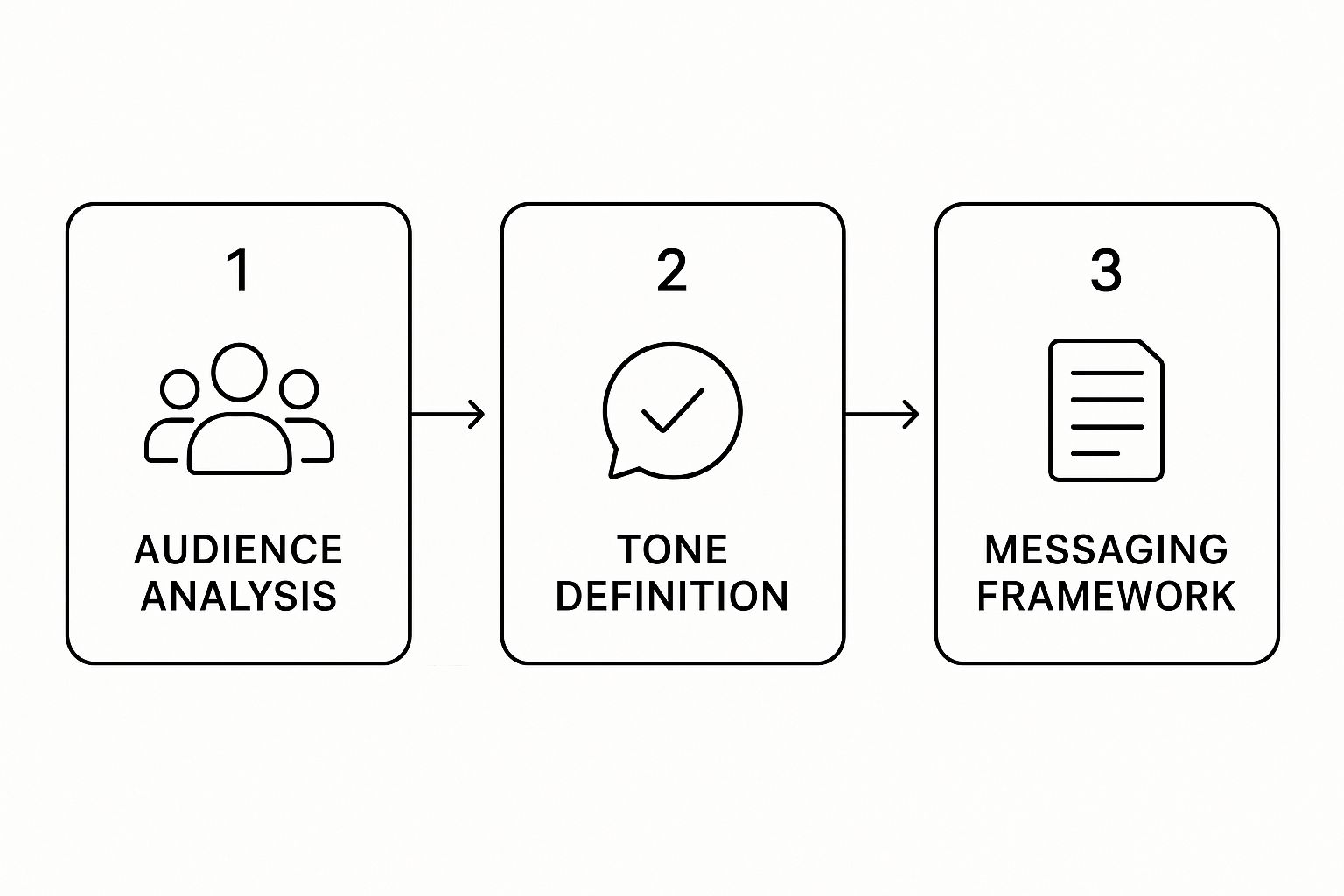
Following this flow ensures every visual choice you make is backed by a solid, customer-focused strategy.
Choose Typography That Speaks Your Language
If color sets the mood, then typography gives your brand its voice. The fonts you choose can make your brand feel modern, classic, friendly, or formal. Just like color, your typography sends a message long before anyone starts reading.
I always recommend keeping it simple with a small, versatile font family.
- A Primary Headliner Font: This one should be distinctive and used for major headings. It’s your chance to really show off your brand's personality.
- A Secondary Body Font: Readability is everything here. This font needs to be crystal clear for longer text on your website or in marketing materials.
- An Accent Font (Optional): You can sometimes use a third font for things like buttons or special callouts, but use it sparingly to avoid a cluttered feel.
A tech startup might pair a clean sans-serif for headlines with another simple, legible one for body text to project a modern, efficient vibe. A luxury brand, on the other hand, might go with an elegant serif font to convey tradition and class. To really get into the weeds on this, check out our ultimate guide to crafting a professional visual branding for more hands-on advice.
Demystify the Logo Design Process
Your logo is the most concentrated shot of your brand's visual identity. It's not the whole brand, but it's the main symbol people will use to recognize you in the wild. A truly great logo is simple, memorable, and versatile enough to stand the test of time.
Key Insight: Don't overcomplicate it. The best logos work just as well on a giant billboard as they do as a tiny favicon in a browser tab. Complexity is the enemy of versatility.
The design process usually starts broad and gets progressively more refined. It all begins with sketching out ideas that connect back to your brand's story. From there, you'll pick a few promising concepts to digitize, playing with color and typography until something clicks.
The final step is to create a complete logo package. This isn't just one file; it includes different versions of your logo (full version, icon-only, black-and-white) in various formats (like SVG, PNG, and JPG) for any use case, from web to print.
This whole process is where many businesses decide to call in the pros. Valued at USD 5.2 billion in 2023, the global branding agencies market is projected to hit USD 8.7 billion by 2032. This boom just shows how critical it is for brands to look consistent and professional everywhere they show up.
Bring Your Brand to Life with Consistency
So, you've done the hard work. You’ve nailed the strategy, honed your message, and designed a killer visual system. But here's the thing: a brilliant brand identity is just a collection of great ideas until it shows up consistently everywhere your customers see you. This final phase—implementation—is where the rubber meets the road.
An amazing identity loses all its power if it's applied inconsistently. The goal is to build a seamless experience. Every touchpoint, from your website to a social media reply, should feel unmistakably like you. This is how you go from just having a brand to building real recognition and earning lasting customer trust.
Create Comprehensive Brand Guidelines
The single most important tool in your arsenal for consistency is a set of brand guidelines. You might hear it called a brand style guide or even a brand bible. Whatever you call it, this document is the official rulebook for using your brand identity correctly.
Think of it as the constitution for your brand. It’s the go-to reference for your internal team, freelancers, agencies, and partners, making sure everyone is on the same page. This isn't about killing creativity; it's about setting clear boundaries so creativity can thrive in a way that strengthens the brand instead of watering it down.
A solid guide should cover every detail of your verbal and visual identity.
- Verbal Guidelines: Document your brand voice, key personality traits, and core messaging pillars. I always recommend including "This, Not That" examples—they provide crystal-clear guardrails for anyone writing for your brand.
- Visual Guidelines: This is where you'll outline logo usage rules (like minimum sizes and clear space), your full color palette with all the necessary codes (HEX, RGB, CMYK), and your complete typography system for headlines, body copy, and everything in between.
A Quick Tip from Experience: Your brand guidelines aren't meant to be set in stone. Treat them as a living document. As your brand grows and evolves, you’ll need to update your guide to reflect new channels or messaging shifts. It should always be the single source of truth.
Roll Out Your Identity Across All Touchpoints
With your guidelines ready, it's time to launch your new identity across every platform. A successful rollout is methodical, not frantic. Start by auditing every single customer-facing asset you have and build a master checklist.
This is your chance to get every detail right. Your website, for instance, needs more than just a new logo slapped on it. Does the copy truly reflect your new brand voice? Do the call-to-action buttons follow your typography rules?
Here are the key areas to focus on during your rollout:
- Your Website: This is your digital storefront. It needs to be the most complete and immersive expression of your brand.
- Social Media Profiles: Update every profile picture, cover photo, and bio. Your first few posts should immediately establish the new look and feel.
- Marketing Materials: This covers everything from your email newsletters and ad campaigns to sales presentations and business cards.
- Product Packaging: If you sell physical products, the packaging is a critical moment. It literally puts your brand right into your customer's hands.
Empower Your Team as Brand Ambassadors
Your brand isn't just a marketing project; it’s a company-wide commitment. Every single person in your organization, from the CEO to the newest customer service rep, shapes how your brand is perceived. The most successful brands I've seen are the ones that empower their entire team to be passionate ambassadors.
Share your new identity internally with the same energy you share it with the world. Explain the "why" behind it all—the strategy, the audience insights, and the vision for the future. When your team truly gets it and believes in it, they'll live those brand values authentically.
This internal alignment is where the real magic happens, and it has a direct financial impact. Brands that are consistent can see an average 20% increase in brand value, proving the power of a unified identity. This is part of a larger trend where digital branding is expected to make up 60% of all marketing budgets. You can discover more about how branding impacts business growth here.
By creating clear guidelines, executing a thoughtful rollout, and turning your team into believers, you ensure your brand identity doesn't just sit in a folder—it thrives out in the wild, building the recognition and trust you need for long-term success.
Navigating Common Brand Identity Questions
Even with the best game plan, building a brand identity can feel like navigating a maze. A few common questions almost always pop up. Let's tackle them head-on so you can move forward with confidence and build something that sticks.
How Much Should I Actually Budget for This?
This is the big one, and the honest answer is: it depends. A solo founder just starting out might lean heavily on free tools and their own design skills, whereas a global company could pour tens of thousands of dollars into a project with a world-class agency. There’s a huge spectrum.
For a small business, a good rule of thumb is to set aside 5% to 15% of your total initial marketing budget for brand identity work. This usually covers getting the essentials done professionally—like your logo, color palette, and a basic style guide. Making this investment upfront can save you from a much more expensive rebrand later on.
How Do I Know When It’s Time for a Rebrand?
This question comes up a lot. A rebrand should be a strategic decision, not just a cosmetic refresh because you're tired of your current look. Getting bored isn't a business case.
So, when is it really the right time? Think about these triggers:
- Your core business has changed. Maybe you started out selling products but have since pivoted to a subscription service. Your brand identity needs to catch up.
- You’re chasing a new audience. The brand that captivated millennials might fall flat with C-suite executives if you're suddenly moving into the B2B space.
- Your brand just looks old. If your visuals feel like a time capsule from a decade ago, customers might assume your business practices are just as outdated.
- You've simply outgrown your first identity. The quirky logo that worked for your local farmers' market stand just won’t cut it now that you’re a national brand.
A rebrand should be the solution to a real business problem. It’s always a response to a strategic shift, not just a whim. Before you do anything, ask yourself: "What problem will this rebrand solve?"
Is It Possible for a Brand Identity to Be Too Niche?
I hear this concern all the time. Will niching down scare away potential customers? It’s a fair question, but the reality is usually the exact opposite. When you try to be everything to everyone, you often end up being nothing to no one.
A sharp, specific brand identity is a magnet for your ideal customer. It sends a clear signal that says, "Hey, you. This is for you." Think about a brand like Death Wish Coffee, which bills itself as "The World's Strongest Coffee." That bold claim will absolutely alienate someone looking for a mild morning brew, but it creates an intensely loyal following among caffeine lovers who want that kick.
Being specific isn't about being small; it's about being focused. That focus builds the kind of powerful, memorable connection that generic, people-pleasing brands can only dream of. Your brand identity should be a confident stake in the ground, declaring exactly who you serve and why you’re their best choice.
Feeling solid about your brand identity is a huge step. Bringing it to life with a beautiful, high-performing website is the next one. The team at OneNine lives and breathes this stuff, turning smart brand strategies into incredible web experiences. Whether you're starting from scratch or need to elevate your existing site, we're here to help. Let's build your digital home together.


