
When we talk about custom website design and development, we're talking about building a website from the ground up, specifically for your business. It’s the difference between buying a suit off the rack and having one tailor-made. The off-the-rack option might fit okay, but the bespoke suit is crafted to fit you perfectly, accentuating your best features. A custom website does the same for your brand.
So, What Is Custom Website Development, Really?

It’s completely normal for businesses to get their start with a template-based site. They're a fantastic way to get a presence online, fast. But when you’re ready to grow, a custom website becomes a real strategic asset. It’s more than just a pretty face; it’s a problem-solver built to handle your unique business challenges, connect with your specific software, and deliver an experience that a generic template just can't touch.
The whole process boils down to two key phases that have to work in perfect harmony: design and development.
The Role of Custom Design
Forget just picking colors and fonts. Custom design is all about mapping out the strategic journey for your visitors. It’s the blueprint for how people will interact with your site and, ultimately, how they’ll feel about your brand. A great designer isn't just making things look good; they're creating an intuitive and compelling experience that gently guides people toward a specific goal, whether that’s buying a product or scheduling a call.
Here’s what that design phase actually looks like:
- User Experience (UX) Design: This is the logic behind the layout. We're talking about mapping user flows and creating wireframes to ensure the site is dead simple to navigate. The entire goal is to make a visitor's interaction feel effortless and logical.
- User Interface (UI) Design: Now we get to the fun part—the visuals. This is where we bring the brand to life with color palettes, typography, and imagery that connect with your target audience and scream "you."
- Brand Integration: This is all about consistency. From the tiniest button to the homepage hero image, every single element needs to feel like it belongs to your brand, reinforcing its personality and values at every turn.
A strong, professional design builds instant credibility. In fact, research shows that a staggering 94% of first impressions are based on your site's design. It’s your first and best chance to build trust.
The Power of Custom Development
If design is what your visitors see and feel, development is the powerful engine humming away under the hood. Custom development means writing clean, efficient code from scratch to bring all the features and functionality from the design phase to life. This is where the magic really happens.
A developer can, for instance, build a direct pipeline to your CRM, create a one-of-a-kind checkout flow for your online store, or even program a special algorithm for a members-only section of your site. This is the kind of control that turns a simple website into a robust business tool—one that’s secure, scalable, and ready to grow right alongside you in a way no template ever could.
Choosing Custom Design Over Website Builders
Website builders like Wix and Squarespace are great for getting a business online quickly. They're affordable, easy to use, and a solid first step. But there comes a time when a growing business hits a ceiling. Your brand, your goals, and your customer needs simply outgrow what a template can offer. That's the moment to seriously consider investing in custom website design and development.
Think of it this way: a website builder is like renting a furnished apartment. It's convenient and has the basics, but you can't exactly knock down walls or add a new wing. A custom website is like designing and building your own home from the ground up—every single room, feature, and finish is built exactly for you and your future plans.
When Templates Limit Your Brand Identity
Your brand isn't just a logo. It’s the whole feeling people get when they interact with your business. Templates, by their very design, try to fit your unique brand into a pre-made box. You can swap out colors and fonts, sure, but the fundamental structure and user journey feel generic. This can water down your brand and make it tough to stand out.
A custom design, on the other hand, starts with your brand. Every visual choice, every interaction, and every layout is intentionally crafted to tell your story and create an experience that is unmistakably yours. It’s no surprise that 92% of first impressions are tied directly to a site's design—a professional, unique look builds instant trust.
This infographic walks through the key questions to ask when you're deciding if it's time to move beyond a template.
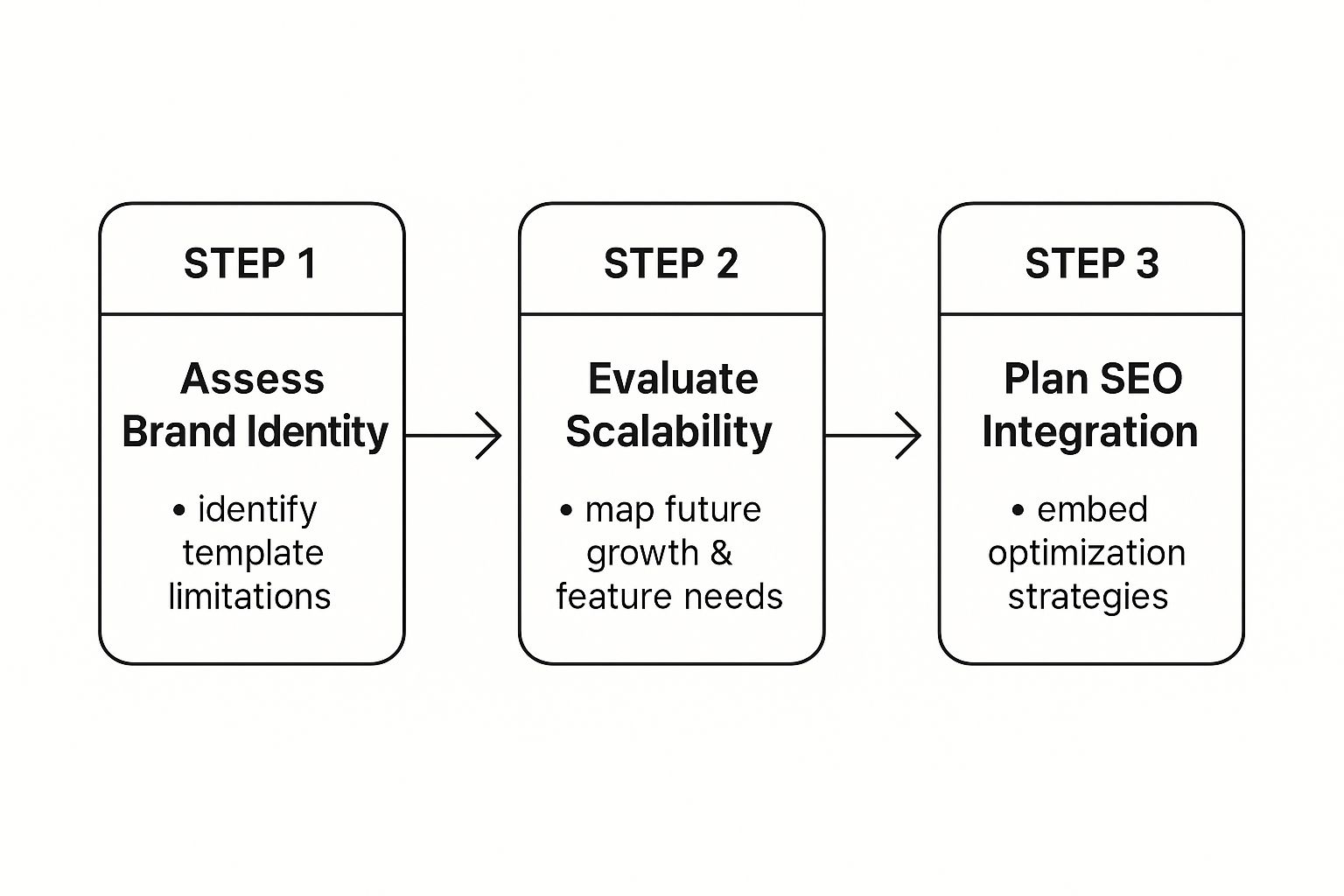
It really clarifies how thinking through your brand, future growth, and SEO needs can point you in the right direction.
To make the choice even clearer, let's break down the differences between a custom build and a template-based builder.
Custom Development vs Template-Based Website Builders
| Feature | Custom Website Design | Template-Based Builders (e.g., Wix, Squarespace) |
|---|---|---|
| Design & Branding | Completely unique, built around your brand identity. No creative limits. | Limited by pre-designed templates. Can look generic. |
| Functionality | Unlimited. Can build any feature or integration you need (e.g., CRM, ERP). | Restricted to the platform's built-in apps and plugins. |
| Scalability | Built to grow with your business and handle high traffic seamlessly. | Can struggle with performance as traffic and complexity increase. |
| SEO | Full control over technical SEO, code, and site structure for top performance. | Basic SEO tools are available, but limited control over technical aspects. |
| Initial Cost | Higher upfront investment. | Low initial cost, often with a monthly subscription. |
| Ownership | You own the code and all assets completely. | You are renting the platform; you don't own the underlying code. |
Ultimately, the table shows a clear trade-off: template builders offer immediate convenience, while custom development provides long-term power and flexibility.
Evaluating Scalability and Future Growth
One of the biggest arguments for going custom is scalability. As your business expands, so do your website's needs. You might need to integrate with specialized software, handle a huge spike in visitors, or add complex features like a customer portal or an interactive pricing tool.
This is where website builders often hit a wall. Their closed systems can make it difficult, if not impossible, to connect with third-party tools, and their performance can start to lag under heavy traffic.
A custom-built website is engineered for growth from the very beginning. Its architecture is flexible, allowing you to add complex features and handle 200% more concurrent users than many template solutions without needing a total rebuild. This ensures your investment keeps paying off for years.
This future-proof approach saves you from the massive headache and expense of having to switch platforms every time your business hits a new level of success.
Achieving Advanced SEO and Performance
While website builders provide basic SEO features, they often can't compete when it comes to the deep technical optimization needed to rank at the top of search results. With custom development, you have total control over your site's technical foundation.
This fine-tuned control allows for:
- Optimized Code: Developers write clean, lightweight code that makes your site faster—a huge factor for search engine rankings.
- Custom Schema Markup: You can implement advanced schema to help Google understand your content better, which can lead to better visibility.
- Superior Site Architecture: A logical site structure can be designed from scratch to be easily crawled by search engines, maximizing your SEO potential.
These technical perks deliver real results. For instance, businesses with custom sites often see 41% lower bounce rates simply because the site loads faster and offers a better user experience. Deciding on a custom website design and development project isn't just about looks; it's a strategic investment in a powerful, scalable, and high-performing asset that will drive your business forward.
The Custom Web Development Journey From Start to Finish
Starting a custom website design and development project can feel massive. But it's really just a logical, step-by-step journey from an idea to a finished website. Think of it like building a custom home—you wouldn't just start throwing up walls without a solid blueprint.
This methodical approach ensures every choice we make is deliberate and tied directly to your business goals. It saves a lot of headaches and expensive re-dos later on, resulting in a site that doesn't just look amazing but actually works for you.
Phase 1: The Discovery and Strategy Foundation
This first phase is, without a doubt, the most important. This is where we pour the concrete foundation for the entire project. It’s all about a deep dive into your business, who you serve, and what you’re trying to achieve.
We get together and ask the big questions: Who are your customers? What problems are they trying to solve? What do you really want them to do when they land on your site? The answers we find here will guide every other decision. Skipping this part is like setting out on a road trip with no map—you’ll get somewhere, but it probably won’t be where you wanted to go.
Here's what this stage typically involves:
- Stakeholder Interviews: Getting everyone on the same page by understanding their goals and expectations.
- Competitor Analysis: Seeing what your competitors are doing right and, more importantly, finding the gaps where you can shine.
- Defining Key Performance Indicators (KPIs): Setting clear, measurable goals, like boosting lead generation by 25% or cutting down bounce rates.
- Technical Specifications: Nailing down every feature and integration needed to create a clear scope of work.
Phase 2: Designing the User Experience and Interface
With a rock-solid strategy, we can now shift our focus to how the website will look, feel, and function. This part breaks down into two tightly connected pieces: User Experience (UX) and User Interface (UI).
UX design is the architecture. We map out the user's journey, creating simple wireframes and prototypes to make sure getting around the site is intuitive and makes sense. The aim is to make the entire experience feel effortless for your visitors.
Then, UI design brings that blueprint to life with visuals. This is where your brand's personality comes out through colors, fonts, and imagery. A great UI doesn't just look pretty; it supports the intuitive flow we established in the UX phase, making the site a genuine pleasure to use. You can see how these pieces fit together by exploring the complete website development stages in more detail.
Phase 3: Building the Engine With Development
This is the construction phase. Our developers take the approved designs and start writing the code that turns them into a real, working website. This work is split into two sides of the same coin: front-end and back-end.
Front-End Development: This is everything your visitors see and click on in their browser. Our developers use languages like HTML, CSS, and JavaScript to build out the visual elements, animations, and interactive features from the UI design.
Back-End Development: This is the "engine room" of the website that runs behind the scenes. It covers the server, database, and the core application logic that handles user accounts, processes data, and connects to other systems like your CRM.
A well-structured development process is essential for long-term success. Clean, documented code makes the website easier to maintain, update, and scale as your business grows, reducing future costs by up to 40%.
Phase 4: Rigorous Testing and Quality Assurance
Before we pop the champagne, the website has to go through some serious testing. This Quality Assurance (QA) phase is a meticulous, top-to-bottom inspection to hunt down and squash any bugs, errors, or glitches.
Our testers go through a long checklist to make sure the launch is silky smooth:
- Functionality Testing: Does every single button, form, and link work exactly as it should?
- Compatibility Testing: Does the site look and work perfectly on Chrome, Firefox, Safari, and on desktops, tablets, and phones?
- Performance Testing: How fast does the site load? Can it handle a sudden spike in traffic without breaking a sweat?
- Security Testing: Are there any weak spots that could be targeted by hackers?
This thorough process guarantees that the final product is stable, secure, and gives every user a perfect experience, no matter how they find you.
Phase 5: The Launch and Beyond
Finally, it's time to go live! We deploy the website to the server, making it available to the world. But a successful launch is more than just flipping a switch. It involves a detailed checklist, like setting up final SEO configurations, installing analytics tracking, and redirecting old URLs to protect your search rankings.
But the work isn't over. A great website is a living thing that needs ongoing care. After launch, we monitor performance, listen to user feedback, and plan for future updates to make sure your site continues to be a powerful tool for your business.
Understanding the Technology That Powers Your Website
Diving into the tech behind a custom website can feel a little intimidating, but the basic ideas are actually pretty simple. The best way I've found to explain it is to think of your website like a high-end restaurant. You've got the part your customers see and experience, and then you have everything happening behind the scenes to make it all work.
In the web world, we call these two sides the front-end and the back-end. Getting a handle on how they work together is the first step to understanding what makes a custom website design and development project so valuable.
The Front-End: The Dining Room Experience
The front-end is everything a visitor sees, clicks, and interacts with on your site. It’s the dining room of our restaurant analogy—the decor, the menu design, the lighting, and the overall ambiance. It’s the visual presentation and the immediate user experience.
This visible layer of your website is built using three core technologies that have to work together perfectly:
- HTML (HyperText Markup Language): This is the skeleton of your website. Think of it as the walls, tables, and chairs of the restaurant. HTML organizes your content, structuring it with headings, paragraphs, and images.
- CSS (Cascading Style Sheets): This is your interior designer. CSS takes that basic HTML structure and makes it look great. It controls all the styling—from colors and fonts to layouts and spacing.
- JavaScript: This is what brings your website to life. It’s like the restaurant staff who take your order and bring your food. JavaScript handles all the interactive elements like pop-up contact forms, sliders, and animations that respond when a user does something.
The Back-End: The Kitchen Operations
If the front-end is the polished dining room, the back-end is the bustling kitchen—out of sight, but absolutely essential. This is where the heavy lifting happens. The back-end is made up of a server, an application, and a database that all collaborate to handle requests and deliver the correct information.
When someone fills out a form or logs into their account, the front-end sends that data to the back-end to be processed, saved, and managed. It’s the powerful engine running the entire show.
Picking the right back-end technology is a huge strategic decision. A solid, custom back-end can often handle 200% more concurrent users than a generic template solution, meaning your site won’t crash or slow down as your business grows.
An experienced development team has a lot of options for back-end languages, and each has its own strengths. You'll often hear about PHP (which runs a massive percentage of the web), Python (famous for its flexibility), or Node.js (great for real-time features). The right choice always comes down to what the project actually needs to do.
Your Tech Stack: The Complete Recipe
The combination of all these technologies, both front-end and back-end, is called a tech stack. A chef chooses the best ingredients and techniques to create a signature dish; a development team chooses the right tech stack to build a high-performing website.
This choice affects everything from your site's loading speed to how easy it is to add new features down the road. A custom project gives you the freedom to pick the perfect stack for your specific business goals, instead of being stuck with the limitations of an off-the-shelf platform.
For a more detailed breakdown of the different tools and frameworks, our guide to website development technologies is a great resource. Building with the right stack from the start is the key to creating a scalable asset that will serve you well for years to come.
How Professional Web Design Drives Business Results
Think of your website as more than just a digital brochure—it’s one of the most powerful tools you have for growing your business. The right design does more than just look good; it actively builds trust, guides visitors where you want them to go, and directly adds to your bottom line. Investing in a professional, custom website is an investment in real, measurable growth.
This all starts the very second a visitor lands on your page. In the blink of an eye, your site makes a first impression that decides whether they stick around or click away.
Building Instant Credibility and Trust
For many potential customers, your website is the very first handshake with your brand. A professional, clean, and easy-to-use design sends a clear message: you’re a credible and trustworthy business. On the flip side, a site that looks dated or is a mess to navigate can create immediate doubt, sending people away before they even read a word.
The research is pretty stark. Users form an opinion about a website in just 0.05 seconds, and a staggering 94% of those first impressions are tied directly to its design. This matters because 38% of visitors will hit the back button if they find the layout unappealing. Meanwhile, businesses that prioritize a great user experience (UX) can see visit-to-lead conversion rates over 400% higher than their poorly designed competitors. You can dig into more of these numbers in these eye-opening web design statistics.
That initial trust is the bedrock for everything else you want to achieve. Without it, even the most amazing products or services will have a hard time getting off the ground online.
Boosting Conversions and Reducing Bounce Rates
Once you’ve earned that split-second of trust, the next step is to guide visitors toward an action—like making a purchase, filling out a contact form, or signing up for your newsletter. This is where strategic user experience design starts making you money. A thoughtfully designed user journey removes roadblocks and makes it simple for customers to do what you want them to do.
A custom website design allows for a user journey tailored specifically to your audience. By optimizing layouts, calls-to-action, and navigation, businesses often report 45% higher conversion rates compared to generic template-based sites.
This improved experience directly influences the metrics that matter most:
- Lower Bounce Rates: When people find a site that’s easy to navigate and looks great, they’re much less likely to leave after seeing just one page.
- Increased Time on Page: Intuitive design encourages people to explore, keeping them engaged with your brand and content for longer.
- Higher Conversion Rates: A clear path from A to B removes confusion and dramatically increases the chances of a visitor becoming a lead or customer.
Professional design has a real impact on business goals, especially for online stores. That's why it's so important to focus on improving e-commerce conversion rates.
Ultimately, every single element of a custom website design and development project should be tied back to a specific business objective. By putting your user at the center of the design, you create a powerful asset that doesn't just represent your brand—it actively helps it grow.
Decoding the Costs of Custom Website Development
Asking "How much does a custom website cost?" is a lot like asking, "How much does a house cost?" The answer really depends on what you're building. A simple one-story ranch is going to have a very different price tag than a multi-level smart home with all the bells and whistles.
The same idea applies directly to custom website design and development.
The final investment really comes down to a few key things. Project complexity is the big one. A straightforward, five-page brochure site for a local consultant is worlds away from a sprawling e-commerce store juggling thousands of products, customer accounts, and a slick, custom checkout experience.
The number of unique page designs also moves the needle significantly. If your marketing site needs a dozen different layouts for various services, case studies, and landing pages, that's going to require a lot more design and coding time than a site where most pages share a similar, consistent template.
Breaking Down the Budget
To give you a better sense of what to expect, most custom website projects tend to land in one of a few common budget ranges. Every project has its own unique needs, of course, but these tiers should help you frame a realistic conversation.
-
Small Business Solutions ($15,000 – $30,000): In this ballpark, you're looking at a professional, beautifully designed website that truly reflects your brand. It'll be built on a solid content management system (CMS) and include all the essential features to establish a powerful online presence.
-
Mid-Market Solutions ($30,000 – $85,000): This is where we start getting into more advanced functionality. Think custom features like interactive calculators, sophisticated booking engines, or integrations with third-party software that runs your business.
-
Enterprise Solutions ($85,000+): These are the heavy hitters. We're talking about large-scale platforms built to handle serious traffic, complex system integrations, custom API development, and the kind of security and performance a major enterprise demands.
For a more detailed look at what goes into these numbers, our full guide on website development cost is a great resource. Getting a handle on these ranges early on helps you match your goals with a practical budget right from the start.
Remember, the initial build is just the first part of the story. Your total investment should also account for the ongoing care and feeding of your site—it's what keeps your new digital asset secure, up-to-date, and working hard for you.
Planning for Ongoing Expenses
A great website is a living thing; it's never really "done." Think of it like a new car—you wouldn't just drive it off the lot and never get an oil change or rotate the tires. Your website needs that same kind of regular maintenance to stay in top shape.
Factoring these recurring costs into your plan is just smart business. It protects your initial investment and sets you up for long-term success.
Here are the usual suspects to budget for:
- Website Hosting: This is the "rent" for your website's space on the internet.
- Security Updates: Regularly patching your site’s software and plugins is non-negotiable for blocking security threats.
- Performance Monitoring: Someone needs to keep an eye on site speed and make sure it's always online and running fast.
- Content Updates: Whether you're adding new blog posts, changing team photos, or updating services, the site needs to evolve with your business.
By planning for these things from day one, you ensure your website remains a powerful and effective tool long after it goes live.
Got Questions About Custom Web Development? Let's Answer Them.
Jumping into a custom website design and development project is a big step, and it's totally normal to have a lot of questions. It’s a significant investment, after all. Before you commit, you want to be sure about what you're getting into.
Let's walk through some of the most common questions we hear from business owners just like you.
How Long Does This Whole Thing Take?
This is usually the first question on everyone's mind. Building a website from the ground up isn't an overnight job, but it shouldn't take forever either. For a typical small to mid-sized business website, you can generally expect the process to take between 12 to 16 weeks.
That timeframe gives us enough breathing room to do things right—from initial strategy and design all the way through development and testing. Rushing these critical steps is a recipe for a mediocre website. Naturally, if your project involves more complex features, like e-commerce or custom software integrations, the timeline will be longer.
What Do You Need From Me?
People often wonder how involved they need to be. The short answer? Your input is everything, especially at the beginning. You know your business, your customers, and your industry better than anyone.
Your insights during the discovery and strategy phase are the most critical ingredient for success. When you provide clear direction and timely feedback, the entire project stays on track and we can be sure the final website truly reflects your vision.
We'll count on you to:
- Provide the Raw Materials: This includes all the text, images, and other content that will live on the site.
- Give Honest Feedback: We'll need you to review wireframes, designs, and development previews and tell us what you think.
- Be Our Expert: You're our go-to for clarifying business goals and understanding what your customers need.
Can I Make Updates Myself After It's Built?
Yes, 100%. In our book, this is non-negotiable. The last thing you want is to be stuck calling a developer every time you need to tweak some text or publish a new blog post.
We build our sites on powerful, yet easy-to-use, Content Management Systems (CMS) like WordPress. This puts you in the driver's seat, giving your team the ability to manage and update content without needing to know any code. We’ll even train you on how to use it so you feel completely confident.
This way, you get the best of both worlds: a high-performance, custom-built website that’s also simple for you to control day-to-day. Your site stays fresh and relevant long after launch day.
Ready to build a website that's as unique as your business? The team at OneNine specializes in creating powerful, custom digital experiences that drive real results. Let's start the conversation about your project today.


