

So, what exactly is a digital transformation strategy framework? Think of it less as a rigid set of rules and more as your company's master blueprint for navigating change. It’s the plan that connects your people, your daily processes, and your technology, making sure they all work together toward the same goals.
This framework is what turns broad ideas like "improving customer experience" into a series of concrete, actionable steps. It ensures that every new tool you adopt actually drives real growth, instead of just adding another layer of complexity.
Your Blueprint for Modernizing Your Business

Too many businesses jump into digital change by grabbing the newest, shiniest software off the shelf and just hoping for the best. This almost always leads to a mess—wasted money, frustrated teams, and a patchwork of systems that don't talk to each other. A solid framework prevents this chaos by giving you a clear, structured path to follow.
It's a lot like renovating a house. You wouldn't just start knocking down walls or ordering expensive appliances without an architect's blueprint. That plan makes sure the plumbing, electrical work, and structural changes all align to create a home that’s both functional and beautiful. A framework does the exact same thing for your business, making sure every move supports one unified vision.
Why a Framework Is Essential
A structured approach is what separates intentional design from expensive guesswork. Without one, you’re just gambling on technology, hoping it solves the right problems. A well-defined framework makes sure your transformation is a cohesive strategy, not just a bunch of disconnected projects.
This is more important than ever. With global spending on digital transformation expected to hit nearly $4 trillion by 2027, the pressure to get it right is immense. A framework forces you to answer the tough questions before you start spending money:
- What specific business goals are we trying to achieve?
- How will this impact our customers and our employees?
- Which of our current processes are holding us back and need a complete redesign?
- How will we even know if this is working? What does success look like?
A digital transformation strategy framework is your North Star. It aligns your entire organization on a shared mission, turning abstract ambitions like "becoming more digital" into a series of coordinated, measurable, and achievable steps.
The Core Benefits of a Strategic Plan
By using a formal framework, you're building a foundation for growth that can actually last. The benefits aren't just theoretical; they hit your bottom line and set you up for success down the road. It’s the difference between reacting to the market and leading it.
The main advantages are crystal clear:
- Clarity and Alignment: Everyone—from the leadership team to the front-line staff—is on the same page. They know the goals and how their work contributes.
- Reduced Risk: A plan helps you spot roadblocks and dependencies early on, which minimizes costly mistakes and frustrating delays.
- Focused Investment: Every dollar you spend on new tech is directly tied to a business goal. No more buying software just for the sake of it.
- Enhanced Agility: With a roadmap in hand, your business can pivot quickly to new opportunities or market changes without losing its way.
To really get a handle on the fundamentals, you should check out our guide on what digital transformation truly means. Think of this framework as your map for a guided, successful journey.
Understanding the Five Pillars of Transformation
A solid digital transformation strategy framework doesn’t just materialize out of thin air; it’s carefully built on a strong foundation. I like to think of it as a five-legged stool. If any single leg is weak or missing, the whole thing becomes wobbly and unreliable. These five essential pillars—People, Process, Technology, Data, and Governance—have to work together to support your entire journey.
Each pillar represents a critical part of your business that needs to evolve. A classic mistake I see all the time is companies pouring resources into one area while completely neglecting another. This almost always leads to stalled projects and wasted money. By giving all five pillars the attention they deserve, you build a balanced, resilient strategy that can actually stand up to real-world challenges.
The Human Element: People
At the end of the day, technology is just a tool. Real change is driven by people. You can roll out the most sophisticated software on the planet, but if your team isn’t bought in, it’s destined to collect digital dust. This pillar is all about nurturing a culture that doesn’t just tolerate change, but actively gets excited about it.
It all starts at the top. Leadership needs to paint a clear picture of the future and communicate the "why" behind every move, not just the "what." It's also about investing in your team through continuous learning and skill development. When you foster a growth mindset, your employees become partners in innovation, not just cogs in a machine.
Instead of just hiring new specialists to fill every gap, focus on upskilling the team you already have. This builds incredible loyalty and ensures all that valuable institutional knowledge sticks around and gets applied in new, powerful ways.
A study by McKinsey found that culture is the single biggest barrier to digital effectiveness. Transformation initiatives are 2.6 times more likely to succeed when leaders champion a supportive and forward-thinking culture.
Redesigning Your Workflow: Process
Process is the "how"—it’s the series of steps you take to get things done, whether that’s bringing on a new client or launching a marketing campaign. Digital transformation forces you to look at these old workflows and ask a simple, powerful question: "Is there a smarter way to do this?"
So many businesses are shackled by clunky, manual processes that create bottlenecks and frustrate everyone involved, from your employees to your customers. The goal here is to streamline and automate wherever it makes sense. For instance, an agency could automate its client intake by using a smart form on its website that collects key information and populates a project brief on its own.
This simple shift frees up the team from mind-numbing data entry, letting them focus on strategic work that actually moves the needle. An effective process redesign really boils down to three things:
- Mapping current workflows to find the real inefficiencies and pain points.
- Prioritizing automation for all those repetitive, low-value tasks.
- Creating feedback loops so your processes are always getting better.
Choosing the Right Tools: Technology
Technology is often the flashiest part of a digital transformation, but it should always serve your people and processes—never the other way around. The trick is to pick tools that are scalable, well-integrated, and truly aligned with where you want to take your business.
Many companies fall into the "technology silo" trap, where different departments use separate, disconnected tools. This is a recipe for messy data and terrible collaboration. A modern tech stack should act more like a central nervous system for your business, connecting everything from your website's CMS to your CRM and analytics platforms.
When you're looking at new technology, don’t just get dazzled by the feature list. Ask yourself how it will plug into your existing systems and if it can grow with your business over the next five years.
Turning Numbers into Strategy: Data
In today's world, data is one of your most valuable assets. But raw, unorganized data is pretty much useless. The real magic happens when you can collect, analyze, and turn that data into actionable insights that guide every single business decision. This pillar is all about becoming a data-driven organization.
This means moving beyond vanity metrics like website traffic and focusing on KPIs that tell the real story. For a small business, this could mean tracking customer lifetime value to figure out which marketing channels bring in the most profitable customers. For an agency, it might mean analyzing project data to see which services have the highest margins.
A strong data strategy means you’re making informed choices instead of just guessing. It’s what allows you to personalize customer experiences, optimize your operations, and spot new opportunities before your competitors even know what’s happening.
Setting the Rules of the Road: Governance
Finally, governance provides the structure and accountability to keep your transformation from veering off course. Think of it as the set of rules, policies, and oversight that manages risk and ensures everyone is rowing in the same direction. Without good governance, even the best-laid plans can descend into chaos.
Governance covers a few critical areas:
- Project Oversight: Defining clear roles, responsibilities, and decision-making authority for every initiative.
- Data Security and Privacy: Putting robust policies in place to protect sensitive information and comply with regulations like GDPR.
- Performance Management: Setting clear metrics and holding regular check-ins to monitor progress and make adjustments.
- Resource Allocation: Making sure your budget and people are assigned to the projects that matter most.
Think of governance as the guardrails on your transformation highway. It keeps you moving forward safely and efficiently, preventing costly detours and making sure you actually reach your destination.
How to Build Your Digital Transformation Roadmap
If your strategy framework is the "why" and "what" of your transformation, the roadmap is the "how" and "when." This is where the big ideas get real. A roadmap turns your vision into a practical, step-by-step plan that people can actually follow. Without one, even the best strategy is just a document that sits on a shelf.
Staring at the gap between where you are now and where you want to be can feel overwhelming. The trick is to break the journey down into manageable phases. This creates a clear path forward that your entire team can get behind, turning ambitious plans into actual results.
The visual below breaks down the five core phases of building a roadmap that works.
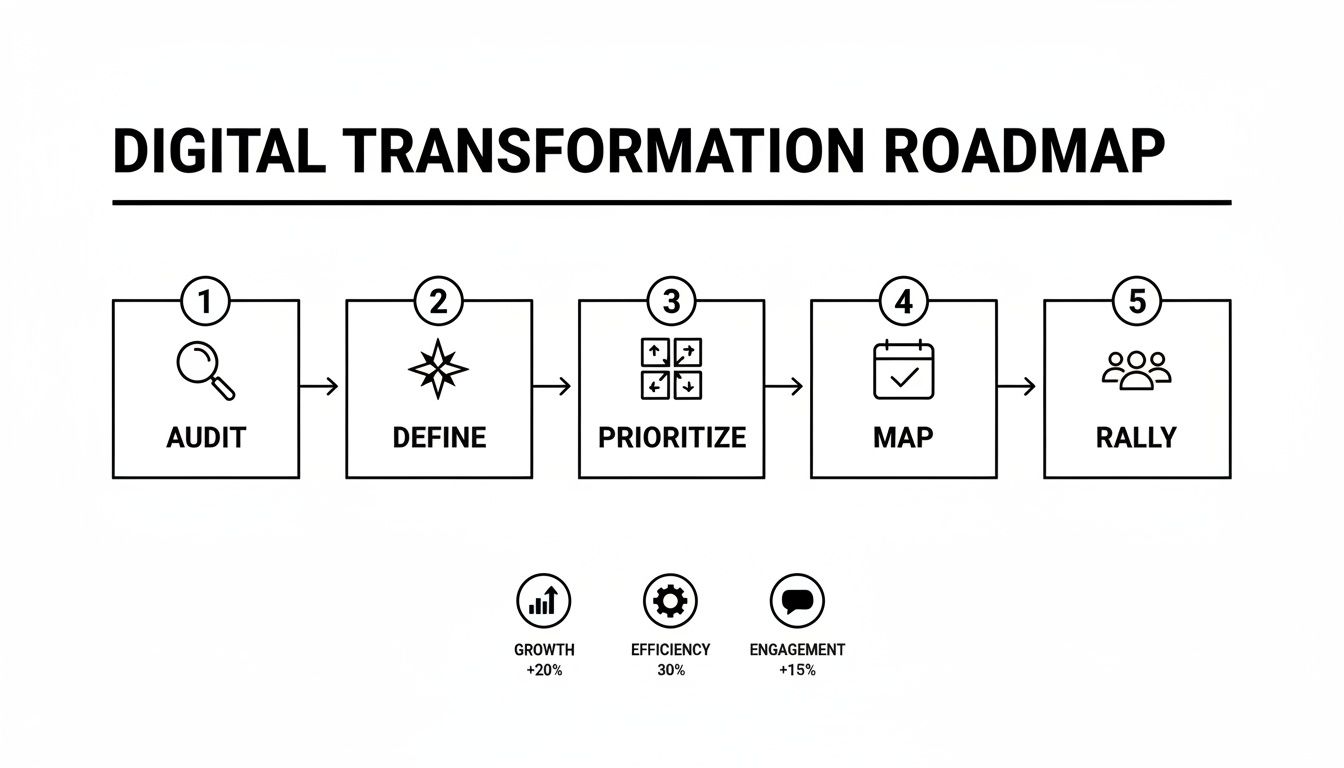
Following this flow helps you move logically from assessment to execution, ensuring you don't miss anything critical along the way.
Step 1: Audit Your Starting Point
Before you can map out a journey, you have to know your exact location. This first step is all about taking an honest look at your current digital capabilities, processes, and tools. Think of it as establishing your "You Are Here" pin on the map.
It's like a health check-up for your business. You need to identify what's working and what's broken. Are your teams drowning in manual data entry? Is your website actually bringing in good leads, or just clicks? Getting clear, honest answers here is the foundation for every decision that comes next.
Ask yourself these questions:
- People: What digital skills does our team have right now? Where are the gaps we need to fill?
- Process: Which of our workflows are slow, clunky, or creating bottlenecks?
- Technology: Are old systems holding us back? Do our current tools even talk to each other?
- Data: How are we collecting data, and are we actually using it to make smart decisions?
Step 2: Define Your North Star
Okay, you know where you are. Now, where are you going? Your "North Star" is the long-term vision—the clear, compelling picture of what success looks like. It answers the simple question: "Why are we even doing all this?"
Your North Star can't be something vague like "be more digital." It needs to be a specific, business-driven outcome. For example, a great North Star would be: "Create a seamless, personalized online customer experience that boosts client retention by 30% in two years." Now that's a target everyone can aim for.
Step 3: Prioritize Your Moves
You can't do everything at once. If you try, you'll stretch your team and budget too thin and end up achieving nothing. The key is to prioritize projects based on how much impact they’ll have versus how much effort they’ll take.
A simple but incredibly effective way to do this is with an impact vs. effort matrix. This helps you sort your ideas into four buckets:
- Quick Wins (High Impact, Low Effort): Do these first. They deliver fast value and get everyone excited.
- Major Projects (High Impact, High Effort): These are the big, strategic moves that need careful planning.
- Fill-Ins (Low Impact, Low Effort): Nice-to-haves you can tackle when you have spare time.
- Time Sinks (Low Impact, High Effort): Avoid these like the plague. They'll drain your resources for little return.
Step 4: Map Out Resources
With your priorities straight, it's time to get down to brass tacks. This is where you create a realistic timeline and budget for each project. You need to figure out who's doing what and what tools and money they'll need to get it done.
A huge mistake people make here is underestimating the time and cost involved. Be realistic. Build in some buffer for those inevitable surprises. This is also where you'll lock in key tech decisions. If you're stuck, our guide on how to select your technology stack can give you a solid framework.
Step 5: Rally Your Team
This might be the most important step of all. A roadmap is useless if your team doesn't understand it, believe in it, or know what part they play. You have to communicate the vision and the plan clearly to get everyone on board.
This isn't just a one-and-done announcement. It means providing regular updates, celebrating the small wins, and keeping the energy high. When your team feels like they are part of the journey, they’ll become the engine that drives real change.
Despite massive spending, digital transformation initiatives have a mere 35% global success rate. However, companies that follow best practices and implement integrated strategies can achieve 3x higher success rates and see a 10.3x ROI, highlighting the critical need for a structured roadmap.
To help get you started, you can use a practical marketing roadmap template as a solid foundation for structuring your own plan.
Measuring What Matters with Transformation KPIs
Trying to steer a digital transformation without the right metrics is like flying a plane blind. You might feel like you're moving, but you have no idea if you're actually on course, gaining altitude, or heading straight for a mountain. You simply can't manage what you don't measure.
This is where so many companies stumble. They get hung up on old-school, superficial numbers instead of focusing on Key Performance Indicators (KPIs) that show the real impact of their efforts. It’s time to move past vanity metrics and start tracking the numbers that prove you’re creating real business value.
Moving Beyond Vanity Metrics
It's easy to get stuck tracking what's familiar. Website traffic, for instance, looks great on a chart, but does it actually tell you anything? More visitors don't mean much if they aren't the right visitors, or if they leave without taking any meaningful action.
Instead of just counting heads, a true transformation KPI would measure something like the conversion rate from a new, personalized customer journey. That single number tells you a much richer story—not just how many people showed up, but how well your new digital experience is turning prospects into customers. It's a direct line from effort to outcome.
A successful digital transformation isn't about the shiny new tech you roll out; it's about the business results you achieve. The right KPIs are the bridge between your actions and your bottom line.
To get this right, you need to track progress across three critical areas of your business.
The Three Pillars of Transformation Measurement
A solid measurement plan gives you a complete picture, ensuring you aren't improving one area while another one suffers. Your KPIs should show how your transformation is affecting your customers, your internal operations, and your company's growth.
-
Customer Delight: Are your digital efforts actually making customers happier? These KPIs track things like loyalty, lifetime value, and overall satisfaction. The goal is to prove you're creating better experiences that keep people coming back.
-
Operational Excellence: This is all about working smarter, not just harder. These KPIs measure internal efficiency gains, showing how new processes and automation are saving money, cutting down on manual work, and freeing up your team to focus on what matters.
-
Business Momentum: These are the numbers that connect your strategy directly to the balance sheet. They measure how your new digital capabilities are opening up new revenue streams and driving real, sustainable growth.
When you track KPIs across all three pillars, you can see the whole story. You can draw a straight line from an improved internal process (Operational Excellence) to a better customer experience (Customer Delight), which ultimately fuels new sales (Business Momentum).
Traditional Metrics vs. Transformation KPIs
The best way to grasp this shift is to see it side-by-side. Old-school metrics are often passive, while transformation KPIs are active measures of real progress.
The table below shows how to evolve your thinking from outdated metrics to ones that truly reflect your progress.
| Business Area | Traditional Metric | Transformation KPI |
|---|---|---|
| Customer Delight | Website Traffic | Conversion Rate from Personalized Journeys |
| Customer Delight | Number of Support Tickets | Customer Lifetime Value (CLV) Growth |
| Operational Excellence | Employee Headcount | Cost Savings from Automated Processes |
| Operational Excellence | Time Spent on Manual Tasks | Reduction in Order Fulfillment Time |
| Business Momentum | Total Revenue | Percentage of Revenue from New Digital Products |
| Business Momentum | Ad Campaign Clicks | Marketing ROI by Channel |
This isn't just about picking new numbers to watch. Choosing the right KPIs is what turns your abstract goals into something you can actually achieve and prove.
It gives you the power to tell a compelling, data-backed story to your entire organization. You're not just making changes for the sake of it—you're building a stronger, more resilient business for the future.
Why Your Website Is Your Digital Transformation Hub
It’s easy to think of your website as a digital brochure or an online business card. But in any real digital transformation, your website is the heart of the entire operation. It’s the one place where your customers, your internal processes, and your technology all converge.

Too many businesses let their site go stale, only touching it when something breaks. That’s a huge missed opportunity. When you treat your website as a living, breathing part of your business, it becomes a powerful catalyst for change across the board.
Connecting Your Site to Your Framework Pillars
A high-performing website doesn't exist in a vacuum. It’s a dynamic engine that should be actively pushing your business goals forward by supporting the core pillars of your strategy: people, process, technology, and data.
Think about what a truly strategic website does:
- People: It delivers an intuitive, seamless experience for your customers, building the trust that turns casual visitors into loyal fans.
- Process: It automates key workflows. Think lead generation, sales funnels, and even customer support, which frees up your team to focus on what they do best.
- Technology: It’s the glue that holds your tech stack together, connecting your CMS with your CRM, analytics software, and marketing platforms.
- Data: It becomes your number one source for valuable first-party data, giving you direct insight into customer behavior that can shape every decision you make.
Your website is the public face of your digital transformation. It’s where your strategy becomes a tangible experience for your customers, turning abstract plans into real-world interactions.
From Static Page to Dynamic Growth Engine
The real magic happens when you start connecting the dots with smart integrations. When your website can talk to your other business systems, it stops being a simple information dump and becomes a proactive tool for growth. For instance, integrating your site with your CRM allows you to see a customer's entire journey, from their first visit to their latest purchase.
That kind of visibility lets you personalize their experience and deliver the right message at exactly the right time. A strong content strategy for your website is the first step, ensuring you’re drawing in the right people from the get-go.
Another powerful tactic is building a pillar page, which consolidates everything you know about a core topic into one authoritative resource. This not only establishes your expertise but also makes life much easier for your users.
The Website as a Single Source of Truth
Ultimately, a well-executed website acts as the central nervous system for your digital operations. It’s where your marketing campaigns send traffic, where your sales team finds new leads, and where you gather the customer data that fuels your next move. This breaks down the silos that often pop up between departments, getting everyone on the same page.
Because it plays such a central role, your website is the most logical and impactful place to start your transformation. By building on this critical asset first, you create a solid foundation for every other digital initiative, ensuring your strategy is cohesive and customer-focused from day one.
Transformation Frameworks in Action
Theory is one thing, but seeing a digital transformation strategy framework work in the real world is where it all clicks. Concepts like "process optimization" and "data-driven decisions" can feel a bit abstract until you see how actual businesses use them to get tangible results.
Let’s look at a couple of realistic examples. These stories show that you don’t need to be a massive corporation to pull this off. In fact, smaller and mid-sized businesses are often more nimble, allowing them to implement change much faster and turn a solid framework into a serious competitive advantage.
The stakes are huge. By 2023, digitally transformed enterprises were projected to make up over half of the global nominal GDP, hitting a staggering $53.3 trillion. You can dig into more of these insights from the World Economic Forum to understand the scale of this shift.
Case Study 1: A Small Retailer Goes Digital
The Problem: Imagine a local boutique with a devoted base of walk-in customers but almost zero online presence. Their inventory was a mess of manual spreadsheets, they had no way to sell online, and their marketing was just a few random social media posts. They were stuck.
The Framework in Action:
- Technology: First, they launched an e-commerce website that synced up with a new cloud-based inventory system. No more guessing what was in stock.
- Process: Manual stock-takes were out. Real-time tracking was in. They also built a simple, clear workflow for fulfilling online orders, from click to shipment.
- Data: With the new site, they started tracking what customers were buying. This data fueled targeted email campaigns that promoted products people actually wanted to see.
- People: The owner and a key employee skilled up by taking online courses in digital marketing and e-commerce basics.
The Result: Just six months after going live, the boutique's overall sales jumped by 40%. Their new online store was already bringing in nearly a quarter of all their revenue.
Case Study 2: A Marketing Agency Boosts Efficiency
The Problem: Here we have a growing marketing agency that was getting bogged down by its own success. Project managers were losing hours every week pulling data from different places to build client reports. Task management was a chaotic mix of emails, chat messages, and sticky notes.
The Framework in Action:
- Technology & Process: The team adopted a single project management platform. This tool pulled in data from their time-tracking and analytics software, automating the painful process of creating weekly client dashboards.
- Governance: They set clear ground rules for how every project would be managed in the new system. This got everyone on the same page and following the same efficient process.
- People: The entire team got trained on the new platform. The focus wasn't just on which buttons to click, but on how it would free them up from grunt work to focus on high-value creative and strategic tasks.
The Result: The agency completely automated its client reporting. This saved the team an estimated 15 hours of manual work every single week. That time went right back into client strategy and landing new business, boosting both retention and growth.
Common Questions We Hear About Digital Transformation
Even with the best plan in hand, taking that first step can feel like a leap of faith. Over the years, we've heard the same handful of questions from business owners just starting out. Let's tackle them head-on.
How Can I Start on a Tight Budget?
You don't need a Silicon Valley-sized budget to get started. Honestly, the smartest way to begin is by thinking small. Focus on high-impact, low-cost changes first.
Find one glaring inefficiency in your business—maybe it's that manual report someone spends hours creating every week. Automating that single task with affordable software can free up time almost immediately, giving you a quick win that proves the concept without breaking the bank.
What Is the Biggest Mistake to Avoid?
The single biggest mistake we see is companies treating this like a one-off IT project. It’s not. Digital transformation is a continuous evolution of your entire business, not just a software installation.
Don't buy new tech just because it's trendy. Instead, make sure every tool and every process change is tied directly to solving a real business problem or making your customers' lives better.
The goal isn't just to install new digital tools, but to build a more agile and customer-focused business culture. This mindset shift is the most critical part of any successful transformation.
How Long Until We See a Real Impact?
You can see an impact much faster than you think, especially if you aim for those "quick wins" we talked about. For example, launching a simple lead-capture form on your website that feeds directly into your CRM could start showing results in a matter of weeks.
While the bigger, more fundamental changes will naturally take longer to pay off, these early successes are crucial. They build momentum, get your team excited, and prove the value of your new digital strategy.
Ready to build a website that acts as the hub for your transformation? OneNine designs, develops, and manages high-performing websites that drive real business growth. Learn how we can build your digital foundation.


