

Think of a white label development agency as the secret weapon in your agency’s arsenal. They are expert-level development teams that build websites and apps for your clients, but here’s the key: all of the work is presented under your brand name. They're your silent, behind-the-scenes technical partner.
Understanding the White Label Partnership

Here's a simple analogy. Imagine you're a brilliant architect known for designing incredible buildings, but you don't actually have a construction crew. Instead of going through the hassle of hiring, training, and managing one, you partner with a top-notch construction company. They bring your blueprints to life, perfectly, while you remain the sole creator in the eyes of your clients and the public.
That’s exactly how a white label development agency works. You own the client relationship, drive the strategy, and get all the credit for the amazing final product. Meanwhile, your partner handles all the heavy lifting—the complex coding, rigorous testing, and smooth deployment.
How the Process Works
This kind of partnership is built to plug directly into your current workflow without skipping a beat. The goal is to let you offer more services without adding more people to your payroll. Suddenly, you can confidently say "yes" to those big, complex web projects you might have turned down before.
The relationship typically works like this:
- Anonymity: Your partner stays completely invisible to your client. All communications, project files, and updates are passed through you.
- Expertise on Demand: You instantly get a full team of specialized developers, QA testers, and project managers without the high costs of salaries, benefits, and new equipment.
- Scalability: Need more development power for a big project? No problem. Things slowing down? You can scale back just as easily, avoiding the cost of a full-time team with nothing to do.
A white label development agency isn't just an outsourcer; they are a strategic partner for growth. This model frees you up to focus on what you do best—be it marketing, design, or client strategy—while their technical experts deliver flawless results.
The Evolving Role of a White Label Partner
This is no longer just about hiring someone to write code. The best white label development agencies have become true strategic assets, helping their partners navigate rapid changes in technology. It's a major shift, and the numbers show it: 85% of digital marketing agencies are now using white label services.
Looking ahead, success in this space is all about five key trends: AI integration, performance-based contracts, niche specialization, full-stack service offerings, and complete reporting transparency. You can dig deeper into the future of white label marketing to see how it's shaping agency partnerships.
Ultimately, choosing a partner today is less about finding a coder and more about finding a forward-thinking technical ally who can help you compete and deliver truly impressive solutions to your clients.
The Strategic Benefits of a White Label Partnership
Bringing on a white label development agency isn't just about offloading work—it's a smart, calculated move for growing your business. This kind of partnership directly solves some of the biggest headaches digital agencies run into, from tight budgets to not having the right technical skills on hand.
The first thing you'll notice is the significant cost savings. Hiring a single senior developer in-house is a huge investment when you factor in salary, benefits, recruiting fees, and equipment. A white label partner gives you a whole team of specialists for a fraction of that, turning a massive fixed cost into a manageable, flexible one.
This financial wiggle room is a real game-changer. Instead of paying a full-time team to sit on the bench during slow periods, you only pay for developers when you have real, billable client work. It makes your agency's cash flow much healthier and more predictable.
Instantly Scale Your Operations
Let's say you just landed the biggest client of your agency's life, but the project needs double your current development muscle. If you rely on an in-house team, you’re looking at a stressful, months-long scramble to hire. With a white label partner, you just tell them you need more hands on deck for the project. Simple as that.
This works both ways. When the big project wraps up, you can scale back down just as easily, without the painful process of layoffs. This kind of elasticity means you can:
- Take on larger, more complex projects that you used to turn away.
- Juggle multiple projects at once without burning out your core team.
- Respond to client needs on a dime, so you never have to miss a great opportunity.
A white label partnership gives your agency the power of a large-scale development department without the financial burden or management headaches. It’s the key to saying "yes" to more work and bigger clients.
Access a Deep Bench of Specialized Expertise
No agency can afford to have an in-house expert for every single technology out there. One client needs a tricky Shopify Plus store, the next wants a custom WordPress plugin, and a third is asking for a complex headless build on Webflow. Trying to build a team that can do it all is next to impossible.
A white label development agency gives you immediate access to a deep pool of talent. Their teams are filled with specialists who do nothing but live and breathe their specific platforms. This lets you confidently sell advanced solutions, knowing you have the technical firepower to back it up and deliver amazing results, every single time. You instantly fill any skill gaps you have and raise the quality of your work.
The numbers back this up. Agencies that partner with a specialized provider can launch projects 6 to 12 times faster than those using traditional methods. It also keeps clients happy—agencies using white label partners report 25% lower client churn.
Increase Profitability and Focus
At the end of the day, all these benefits lead to one thing: making your agency more profitable. When you cut overhead, handle more projects, and deliver better work, you improve your bottom line. You can learn more about how we make this happen with our white label web development services.
This move also frees up your most important asset: your own team's time. When your people aren't stuck managing development timelines or putting out technical fires, they can focus on what they do best—building client relationships, creating brilliant strategies, and bringing in new business.
Key Services Your Agency Can Offer
Bringing a white label development partner into the fold instantly beefs up your service menu. It's like turning your agency into a full-service powerhouse overnight. Instead of turning away technical projects, you can confidently say "yes" to a whole suite of high-demand development work.
This means you can solve more of your clients' problems under one roof. That not only increases the value of each project but also keeps your clients coming back for more. Most of these offerings are built around the most popular and powerful Content Management Systems (CMS) out there today.
Having experts on each platform means you can always recommend the right tool for the job, not just the one you know.
WordPress Development for Unmatched Flexibility
There's a reason WordPress is the king of the web, powering over 43% of all websites. It's open-source, which is a developer's way of saying the sky's the limit. A skilled white label partner can take your design files and turn them into a completely custom, feature-rich website that perfectly captures a client's brand.
This goes way beyond just installing a theme and a few plugins. A true white label development agency brings deep WordPress know-how to the table, including:
- Custom Theme Development: Building a unique, fast, and secure theme from scratch based on your agency's designs.
- Custom Plugin Creation: When an off-the-shelf plugin won't do, they can build specialized tools that give your clients a real competitive advantage.
- Performance Optimization: Making sure the final site is lightning-fast and aces Google's Core Web Vitals—a must-have for both user experience and SEO.
Shopify Development for Robust E-commerce
When clients want to sell online, Shopify is almost always the answer. It’s secure, it can grow with a business, and it’s famously easy for clients to manage once it's built. Your white label partner can help you deliver professional online stores that actually drive sales.
White label e-commerce services are your ticket into the booming online retail market. From a small boutique to a massive warehouse operation, your agency can provide the technical engine they need to succeed.
This includes building custom themes that make a brand pop, integrating third-party apps for inventory or marketing automation, and setting up complex product catalogs with all the variants and options a business could need.
Webflow Development for Visually Stunning Websites
Webflow has become a favorite for designers who want to create jaw-dropping, highly interactive websites without writing a single line of code themselves. It's the perfect choice when the client's top priority is a website that feels like a genuine experience. A partner with serious Webflow chops can bring your most ambitious designs to life, pixel-perfect.
This platform is a natural fit for marketing sites, portfolios, and brand-heavy projects where the "wow" factor is just as critical as the functionality. It frees up your design team to dream bigger, knowing a technical team is ready to build whatever they can imagine.
Comparing Popular White Label Development Platforms
To help you decide which platform is the right fit for your client's next project, let's break down the big three. Each has its own strengths and is built for different kinds of challenges.
| Platform | Best For | Key Strengths | Typical Agency Use Case |
|---|---|---|---|
| WordPress | Virtually any project, from blogs to complex business sites. | Unbeatable flexibility, massive plugin ecosystem, and open-source customizability. | Building a custom-branded marketing site for a B2B service company. |
| Shopify | E-commerce businesses of all sizes. | Secure checkout, powerful inventory management, and a user-friendly backend. | Launching a direct-to-consumer online store for a new fashion brand. |
| Webflow | Design-forward marketing websites and interactive experiences. | Pixel-perfect design control, clean code output, and amazing animations. | Creating an award-worthy portfolio site for a creative agency. |
Ultimately, having access to experts in all these platforms means you're never stuck trying to fit a square peg in a round hole. You can confidently propose the best solution every single time.
Custom Applications and Advanced Integrations
Sometimes, a client's needs are so specific that a standard CMS just won't cut it. This is where a top-tier white label partner really proves their worth. They can build completely custom web applications from the ground up to solve a unique business problem. Think internal dashboards, customer-facing portals, or specialized calculators.
They also handle the tricky work of connecting different systems through API integrations. For instance, they can make a client's website talk to their CRM, accounting software, or marketing platform. This creates a smooth flow of data that saves time and gets rid of manual entry errors.
Some forward-thinking partners are even getting into niche data services, like building actionable AI overview trackers, giving clients a high-tech edge over their competitors.
Ongoing Maintenance for Recurring Revenue
One of the smartest and most valuable services you can sell is ongoing website maintenance. It creates a steady, predictable revenue stream for your agency and delivers huge peace of mind for your clients. Your white label partner can handle all the technical heavy lifting behind the scenes.
This includes things like:
- Security Monitoring and Updates: Keeping the site safe from hackers and threats.
- Performance Checks: Making sure the site stays fast and responsive.
- Regular Backups: Creating safety nets so data can always be restored.
- Content Updates and Fixes: Handling small client requests as they come in.
By offering maintenance packages, you extend the client relationship long after the launch party, cementing your role as their go-to digital partner for the long haul.
How to Choose the Right Development Partner
Picking a white-label development partner is a huge decision. Seriously, it's one of the most critical moves you'll make for your agency. You're not just hiring a contractor; you're handing over your client relationships and your hard-earned reputation to another team. Get it right, and they become a seamless extension of your own crew. Get it wrong, and you're in for a world of technical headaches and broken client trust.
So, how do you make the right call? You have to look past the slick sales pages and dig deeper. A structured vetting process is the only way to make sure a potential partner lines up with your standards for quality, communication, and reliability. It's all about spotting the green flags that signal a great long-term partnership and avoiding the red flags that scream "trouble ahead."
Start With a Deep Dive Into Their Work
The best proof of what a partner can do is what they've already done. A solid portfolio is table stakes, but you need to go beyond just glancing at pretty screenshots. Get into their case studies and look for the nitty-gritty details—what problems did they solve, and what were the actual results?
When you’re looking at their past projects, ask yourself a few key questions:
- Technical Complexity: Are they just cranking out simple brochure sites, or do their projects show a real range of skills, like custom theme development or complex API integrations?
- Platform Expertise: If you sell mostly WordPress sites, does their portfolio prove they're true experts on that platform?
- Performance Focus: Pull up some of their live sites. Are they fast and responsive? Run them through a tool like Google's PageSpeed Insights to see if they're following best practices.
This first step is your best filter. It quickly separates the agencies that just talk a good game from the ones that consistently deliver high-quality, technically solid work. You're looking for a competent white-label development ageny, and this is where you find them.
The goal is to find a partner whose technical standards are as high as your own. Their work is a direct reflection of what they will produce for your clients, so don't compromise on quality.
This visual decision tree helps clarify which platform aligns best with specific project goals, a key consideration when evaluating a partner's expertise.
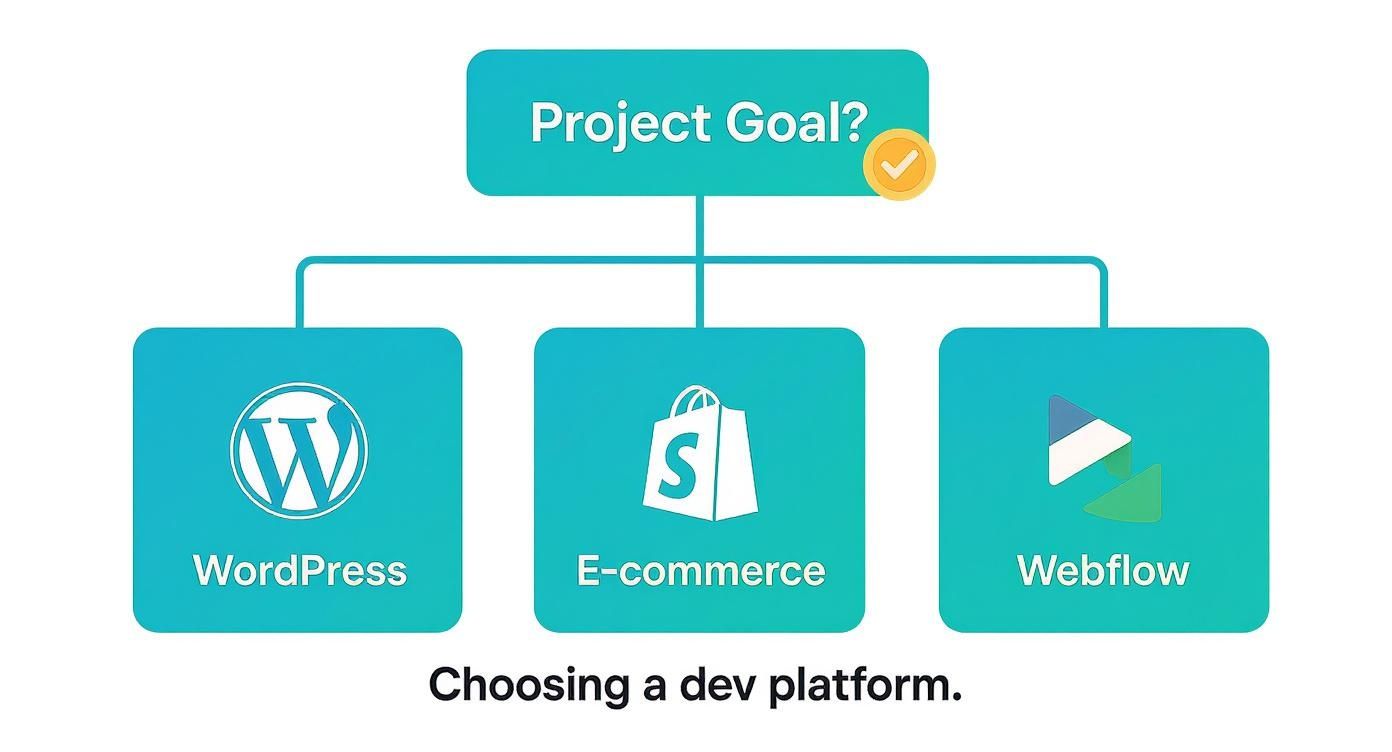
As the infographic shows, it’s crucial that a partner’s platform skills match your clients' specific needs, whether that’s content management, e-commerce, or highly visual, design-focused projects.
Evaluate Their Communication and Processes
Here’s a hard truth: even the most brilliant developers are a terrible partner if their communication is a mess. The workflow between your agency and your white-label team has to be smooth and transparent. This is where you need to ask some pointed questions about how they manage projects.
Find out what tools they use. Do they work in Asana, Slack, or another platform you already use? A shared system is absolutely crucial for keeping everyone on the same page. Also, make sure you know who your dedicated point of contact will be. Having a single project manager to run everything through is so much better than talking to a different developer every day. For a deeper look at this, our guide on https://onenine.com/how-to-outsource-web-development/ lays out a complete framework.
Finally, set clear expectations for response times from day one. When your client has an urgent request, you need to know your dev partner will be there to jump on it. A clear Service-Level Agreement (SLA) can lock in these expectations from the very beginning. For any agency, understanding the fundamentals is key to growth, and insights from an ultimate guide to starting a web development agency can offer valuable perspective.
Look for Transparency and Professionalism
A partner you can trust operates with total transparency. That means clear, upfront pricing with no hidden fees and a professional contract that protects both of you. The agreement should spell out everything—the scope of work, who owns the intellectual property, and confidentiality clauses.
One of the biggest green flags is a real focus on security and confidentiality. Ask them how they handle sensitive client data and make sure they're willing to sign a Non-Disclosure Agreement (NDA). This shows they get their role as a silent partner and respect the trust you're putting in them. If you follow this vetting process, you can confidently choose a partner who will help your agency grow, not hold it back.
Understanding Pricing Models and Contracts
Let's talk money and legal stuff. Getting the financial and contractual side of things right is the bedrock of a solid partnership with a white-label development agency. When everyone knows what to expect, there are no awkward surprises, protecting both you and your clients from unexpected bills or arguments later on.
The way you structure your deal will shape everything—your project budgets, your profit margins, and even your daily workflow. The best model really depends on the kind of work you plan to send their way. A one-off website build is a completely different beast than a long-term support agreement.
Breaking Down Common Pricing Models
Most white-label partners have a few go-to pricing structures. Each has its own sweet spot, so it's good to know which one fits your agency's needs and the project at hand.
Here are the three you’ll run into most often:
- Fixed Project-Based Fees: This is as straightforward as it gets. You agree on a single, all-in price for a project with a very clear scope. It’s perfect for something like a standard five-page WordPress site where you know exactly what’s needed from start to finish.
- Hourly Rates: When a project's scope is a bit fluid or likely to change, an hourly rate makes more sense. This gives you the flexibility to adapt and add features as you go, but you’ll need to keep a close eye on the clock to stay on budget.
- Monthly Retainers: This is the ideal setup for ongoing work like website maintenance, security checks, and regular content updates. You pay a fixed fee each month for a set number of development hours, ensuring your partner is always on standby to help your clients.
Choosing the right pricing model is a strategic decision. A fixed fee offers budget predictability for your agency, while an hourly rate provides the flexibility needed for more complex, evolving projects.
The demand for outsourced digital work is booming. The white-label SaaS market alone is projected to hit $908.21 billion by 2030, growing at a staggering 18.7% CAGR. This massive trend, which you can read more about in this deep dive on the white-label market's growth, shows just how much agencies are relying on specialized partners. And that makes clear, transparent pricing more critical than ever.
Essential Clauses for Every Contract
A handshake is a nice gesture, but a solid contract is what actually builds a professional partnership that lasts. This document is your playbook—it lays out everyone’s responsibilities and protects your agency from getting burned. Any reputable white-label firm will insist on a thorough agreement that leaves nothing to chance.
Before you sign on the dotted line, make sure the contract nails these key points:
- Detailed Scope of Work (SOW): This needs to be crystal clear. It should list every single deliverable, feature, and task the partner is responsible for completing. Think of it as your best defense against scope creep.
- Intellectual Property (IP) Ownership: The contract must state, in no uncertain terms, that your agency (or your client) owns 100% of the final code and all design work. This is an absolute deal-breaker.
- Service-Level Agreements (SLAs): SLAs put real numbers to promises. They should define things like guaranteed response times for support issues, uptime commitments, and firm deadlines for milestones.
- Confidentiality and NDA: A strong non-disclosure agreement is vital. It ensures your partner stays completely behind the scenes and never contacts your clients directly or tries to take credit for the work.
- Termination Clause: This section explains how either side can end the agreement if needed, covering things like notice periods and the process for handing over all project files smoothly.
A well-written contract is the foundation of a healthy, productive relationship. If you need a solid starting point, our guide on crafting a comprehensive website development contract template is a great resource. With this knowledge, you’ll be ready to negotiate a fair agreement that sets you up for success.
Why Agencies Choose OneNine as Their Partner
Finding a white-label partner is easy. Finding one you can actually trust with your clients and your reputation? That’s a whole different story. At OneNine, we’ve built our entire business around being that trusted partner—the team you can rely on to scale your agency without the usual headaches.
We’re not just a ticket-taking service. We've seen firsthand where other outsourced relationships go wrong. That’s why we act as a true extension of your team, proactively spotting issues before they become problems and always looking for ways to make the end product even better for your client.
A Partnership Built on Trust and Expertise
Look, trust isn't built on a sales pitch; it's earned by delivering great work, consistently. Our expertise in WordPress, Shopify, and custom development is more than just a line on our website. It’s backed by a portfolio packed with successful projects we’ve launched behind the scenes for agencies just like yours.
We've handled everything from tricky e-commerce migrations to pixel-perfect marketing sites, all while being the silent technical engine that powers our partners' growth. This lets you offload the technical heavy lifting and focus on what you do best: strategy and client relationships. Think of us as the dedicated dev team you’ve always wanted, but without the payroll and overhead.
Here's what that looks like in practice:
- Deep Platform Knowledge: We don’t just build with WordPress and Shopify. We live and breathe them, understanding the little details that make a site fast, secure, and ready to grow.
- Custom Solutions: When a project needs something unique, our team shines. We're pros at building custom web applications and API integrations from scratch.
- Proactive Problem-Solving: We don’t sit back and wait for you to find a problem. Our developers are trained to anticipate challenges and bring you solutions, not just questions.
Choosing a white label development ageny is about more than technical skill; it’s about finding a partner who is as invested in your agency’s reputation as you are. We treat your clients’ projects with the same care and dedication as if they were our own.
Seamless Communication and Workflow
Even the best partnerships crumble without clear communication. That’s why we’ve obsessed over creating a workflow that’s completely transparent and plugs right into how you already operate. We’ll work in your Asana, your Slack, or whatever tools you use, so you always have a clear view of where things stand.
You get a dedicated point of contact who gets to know your agency, your standards, and your goals. No more being bounced between project managers. Just one person who ensures you get consistent, clear answers from start to finish.
Ultimately, our process is designed to feel less like you’re outsourcing and more like you’re walking down the hall to talk to your in-house team. We meet and exceed the vetting criteria we outlined earlier, making us not just a vendor, but a true partner in your success.
Common Questions About White Label Development
Jumping into a partnership with a white-label development agency is a big step. It's completely normal to have questions about how it all works, especially when it comes to keeping your client relationships secure and making sure projects run smoothly. Let's tackle some of the most common concerns.
The number one question we hear from agencies is about confidentiality. How can you be 100% sure your partner stays behind the curtain? The whole relationship is built on a bedrock of trust and discretion, all locked in with solid legal agreements.
How Is Confidentiality Maintained with My Clients?
Your partner acts as a true, silent extension of your team. This isn't just a casual promise; it's fundamental to how white-labeling works. Right from the get-go, a strict Non-Disclosure Agreement (NDA) is signed, which legally prevents them from ever taking credit for the work or reaching out to your client.
Every communication, file, and final product is branded with your agency’s logo and delivered through you. Your team is, and always will be, the only point of contact. As far as your client is concerned, all that fantastic development work came directly from your in-house experts.
A professional white-label partner gets it: their success is completely tied to yours. Their invisibility is a feature, not a bug. It’s designed to ensure your agency gets all the credit and keeps total control over the client relationship.
What Does a Typical Project Workflow Look Like?
A clear and efficient process is everything. While each project is a little different, the workflow generally follows a well-defined, transparent path that keeps you informed without getting you stuck in the weeds.
It’s all designed for seamless collaboration:
- Project Briefing: You hand over the project scope, the designs your client has already signed off on, and any specific technical needs.
- Quotation and Timeline: Your partner comes back with a detailed quote and a realistic project timeline, complete with key milestones.
- Development and Updates: The coding begins. You'll get regular progress updates through a shared project management tool like Asana or a dedicated Slack channel.
- Quality Assurance (QA): Before you see it, the project goes through some serious testing to squash bugs and make sure everything is pixel-perfect.
- Final Handover: You receive the finished project files, polished and ready to present to your client as your own masterpiece.
Can I Offer Ongoing Website Maintenance to My Clients?
Yes, and you absolutely should! Offering website maintenance retainers is one of the best ways to build a steady, recurring revenue stream for your agency. Any top-tier white-label partner will be more than ready to handle this for you.
They can manage all the critical behind-the-scenes work—things like security updates, performance checks, regular backups, and fixing small issues. This lets you sell valuable support packages that give your clients peace of mind and lock you in as their go-to digital partner for the long haul.
Ready to scale your agency's development chops without the headaches and overhead? At OneNine, we become your silent, expert development team, delivering high-quality websites under your brand. Discover how we can help you grow at https://onenine.com.


