
Think of your website design proposal as more than just a quote. It's your first real chance to show a potential client how you think, how you solve problems, and why you're the perfect partner to help them grow their business. It’s a strategic document, not just a price tag.
Crafting a Proposal That Actually Wins Clients
Let's be honest—most web design proposals are a total snoozefest. They're usually a generic list of services followed by a price, which makes it easy for a client to file yours away with a dozen others just like it.
This guide is about breaking that mold. We're going to walk through how to build a proposal that tells a compelling story. It’s a story about your client's future success and how your work is the key investment that will get them there.
Your proposal is the first tangible piece of work a client sees from you. It’s your opportunity to prove you're not just another designer who builds pretty websites, but a strategic partner who genuinely understands their business goals. The aim is to create a document that makes them feel heard, understood, and confident that hiring you is the best decision they can make.
From Vendor to Valuable Partner
The real secret is to shift the entire conversation from cost to value.
Instead of just listing a generic deliverable like "5-page website," you need to connect it directly to a tangible business outcome. For example: "A streamlined 5-page website strategically designed to increase qualified lead generation by 25%." See the difference? That simple change reframes your fee from an expense into a smart investment.
This approach is more critical than ever. We know that web design drives 94% of first impressions, and a fantastic user experience can rocket conversion rates by up to 400%. Your proposal has to do more than just promise a nice-looking site; it needs to show how your design will deliver real-world results.
A winning proposal doesn't just answer the client's request; it anticipates their unstated needs and presents a clear, confident path to achieving their goals.
To really nail this, you need a solid foundation of information from the client. Our guide on creating a website design brief is the perfect starting point to make sure you have everything you need before you even start writing.
https://onenine.com/website-design-brief-template/
And when you're ready to put it all together, using a dedicated tool like a proposal creator tool can help you streamline the process and create a professional document without starting from scratch every time.
To get started, let's break down the essential pieces that should be in every proposal you send.
Core Components of a Winning Proposal
Every effective website design proposal needs a few key sections to build trust, create clarity, and guide the client toward a "yes." Here’s a quick look at what absolutely must be included.
| Component | Purpose |
|---|---|
| Project Overview | Demonstrates you understand the client's problem and goals. |
| Scope of Work | Clearly lists all deliverables, from wireframes to final launch. |
| Timeline | Sets realistic expectations with key milestones and deadlines. |
| Investment | Breaks down the costs and connects them to the value you provide. |
| About Us/You | Showcases your expertise, experience, and why you're the right choice. |
| Call to Action | Tells the client exactly what to do next to get started. |
With these core components in place, you’re building a document that is both persuasive and incredibly clear, leaving no room for confusion.
Nailing the Project Scope: How to Turn Vague Ideas into a Winning Plan
This part of your proposal is where you either win the project or lose it. It’s that simple. When a potential client throws out a phrase like "we want a fresh, modern design," what does that even mean? If you don't nail down the specifics, that innocent request is a recipe for disaster—think endless revisions, blown deadlines, and an unhappy client. Your real job here is to be a translator, turning their abstract wishes into a rock-solid, actionable plan.

This is where a thorough discovery process becomes your secret weapon. It’s not just about nodding along; it’s about asking smart questions that get to the heart of what they really need. So when they say, "we need better SEO," you should be digging deeper. Ask them, "What business goal are you trying to hit with better SEO?" Suddenly, the conversation shifts. Their answer might be, "We need to increase qualified leads from organic search by 20%." Now that's a target you can build a real strategy around.
From Fuzzy Concepts to Tangible Goals
The magic of a great project scope is its ability to turn those fuzzy ideas into concrete deliverables. Your proposal has to prove that you don't just hear what the client is asking for—you understand why they're asking for it. This small shift in focus elevates you from a simple order-taker to a strategic partner they can’t afford to lose.
Let's look at a classic example I see all the time:
- The Vague Client Request: "Our website just feels old. We need to improve the user experience."
- The Weak Scope: "Redesign the homepage and five internal pages with a new theme." (This tells them nothing.)
- The Strong Scope: "We’ll start with a full UX audit to pinpoint exactly where users are struggling. Then, we'll redesign the main conversion path to cut cart abandonment by 15% and overhaul mobile navigation to drop the bounce rate on key service pages by 20%."
See the difference? The strong scope connects your design work directly to tangible business outcomes. It justifies the cost and gives everyone a shared definition of what success looks like. Getting this right is crucial, and looking at some of the top design brief example templates can give you a great starting point.
Defining Boundaries and Dodging Scope Creep
Ah, scope creep—the silent killer of project budgets and timelines. It always starts innocently, with a small request like, "Can we just add one more page?" Before you know it, those "small" additions have completely derailed the project. A crystal-clear scope is your only real defense.
Think of your project scope as a fortress. It doesn't just define what's inside the walls; it clearly marks what's left outside.
To build this fortress, you need to be meticulous about documenting every single deliverable. One of the best ways to keep everything organized and clear is to use a dedicated scope document. I’ve found this project scope document template to be incredibly helpful for making sure nothing gets missed. Taking the time to set these firm boundaries upfront protects you from headaches down the road and gives the client total clarity, keeping everyone on the same page from day one.
Talking Timelines and Money (Without Making It Awkward)
Let’s be honest, talking about money and deadlines can be the most uncomfortable part of the whole deal. But I’ve learned that in a website proposal, this section is actually where you can build the most trust.
When you lay out your timeline and the investment required with total clarity, it changes the conversation. It’s no longer about cost; it’s about value. The client starts to feel secure, not pressured. Your goal here isn't just to throw numbers on a page, but to connect every dollar to a real outcome we talked about earlier. This kind of transparency is what makes a client confident in their decision to hire you.
How to Lay Out a Realistic Project Timeline
Nothing screams "amateur" like a vague timeline. Don't just give them a single, far-off end date. That just creates anxiety. Instead, break the entire project down into clear, logical phases. Think of it as a roadmap with distinct milestones.
This makes the whole process feel less overwhelming for the client and shows them you have a real plan. It also gives you a natural way to structure payments, which clients always appreciate.
Here’s a simple structure I’ve used that works wonders:
- Phase 1: Discovery & Strategy: Weeks 1-2 (Initial payment due)
- Phase 2: UX/UI Design & Wireframing: Weeks 3-4 (Second payment due)
- Phase 3: Development & Content: Weeks 5-7 (Third payment due)
- Phase 4: Testing, Launch & Training: Week 8 (Final payment due)
A phased approach like this sets clear expectations from day one. If you want to get even more granular, we have a complete guide on creating a web development project timeline that goes much deeper.
Here's a great visual example of how to present your pricing table. It’s clean, simple, and leaves no room for confusion.
A format like this clearly breaks down what’s included in the total investment, so there are no surprises later on.
Justifying the Investment: It's All About Value
Your price isn’t just about the hours you put in; it’s a direct reflection of the value and expertise you bring to the table. The web design services market is huge—it’s projected to hit $47.4 billion in the U.S. alone by 2025.
With custom WordPress sites easily ranging from $3,000 to $15,000, you have to show them why you're worth it. You can find more web design industry stats and trends on wpbeginner.com to understand the competitive landscape.
My advice? Never present a single, flat fee. It’s a take-it-or-leave-it approach that can scare clients off. Instead, offer a few pricing options or packages. This gives the client a sense of control and lets them choose what makes the most sense for their immediate goals and budget.
Pro Tip: Don't just name your tiers "Basic, Pro, Premium." Frame them around the results they deliver. For instance, you could have a "Lead Generation" package for service businesses and a "Conversion-Focused" package for e-commerce stores.
This simple shift changes the client's entire mindset. They stop asking, "How much does this cost?" and start thinking, "Which investment will get me the best business results?" When you connect your price to their success, you're no longer just selling a website. You're selling a business solution.
Laying Out Your Solution and Proven Process
Clients aren't just buying a list of services; they're investing in a predictable, successful outcome. This is where your proposal needs to go beyond a simple checklist. You have to show them how you'll get them from A to B, building their confidence every step of the way.
Think about it: a well-defined process proves you aren't just making it up as you go. It shows you have a structured, repeatable system for delivering great work. This is your moment to put your expertise on display—whether it's in UX research, responsive design, or conversion optimization—and turn vague promises into a concrete plan.
Here’s a look at how we typically break down a project into clear, manageable phases.
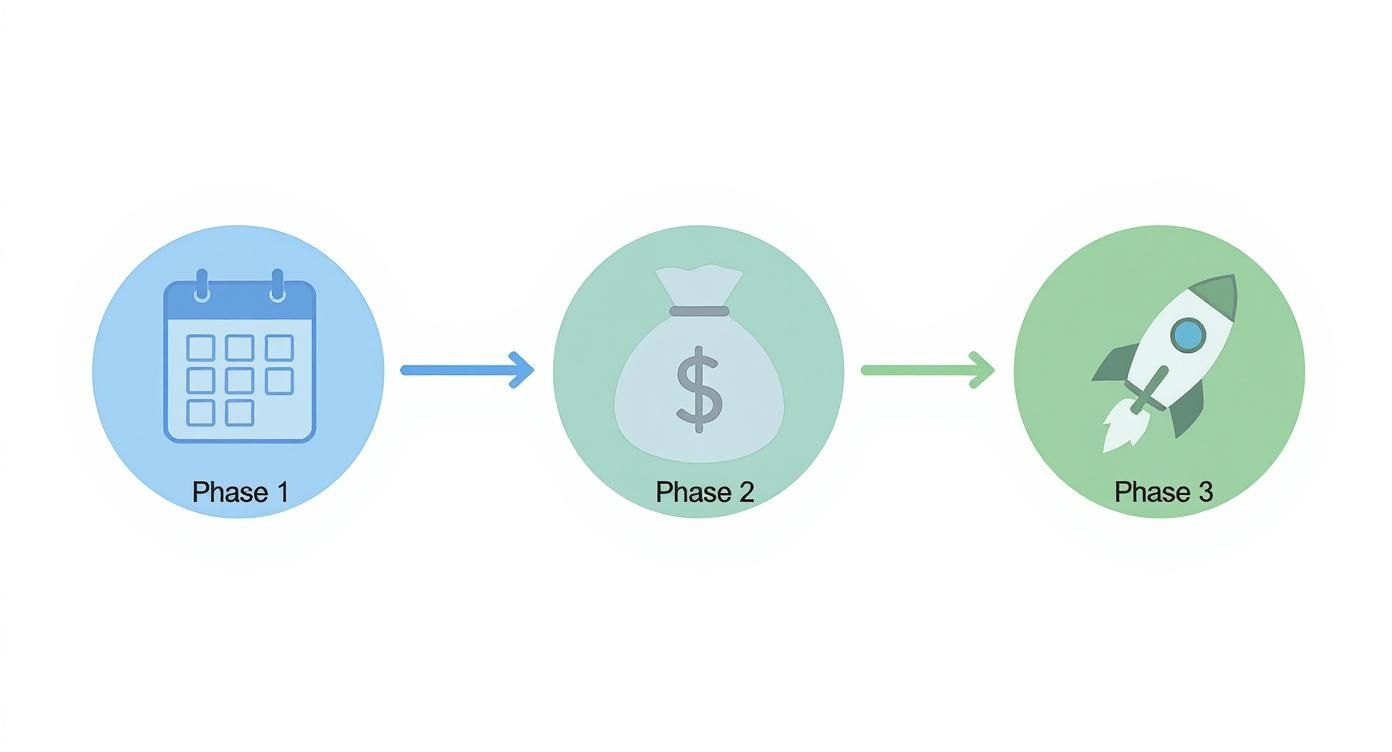
Mapping the project out like this ensures everyone is on the same page about goals, timelines, and what to expect from kickoff to launch.
From Discovery to Deployment
Your process is what makes you different. Start by walking them through your initial discovery and strategy phase, where you’ll dig deep into their brand, their audience, and what their competitors are doing. From there, guide them through your design and development stages.
This is a great spot to specify the key activities involved:
- User Experience (UX) & Wireframing: This is where we create the blueprint for a site that’s intuitive and easy to navigate.
- User Interface (UI) Design: Next, we craft a beautiful, engaging design that truly reflects the client’s brand and connects with their customers.
- Development & Testing: We build a clean, secure, and responsive website, then put it through its paces with rigorous testing on every device imaginable.
Explaining these steps shows you're a thorough professional, not just a freelancer taking a shot in the dark.
Showcasing Your Technical Expertise
So many businesses are fumbling their online presence. Did you know that around 70% of small business websites don't even have a clear call-to-action? That's a massive missed opportunity. This is your chance to connect your process to solving real-world business problems. You can learn more about this and other eye-opening web design statistics on loopexdigital.com.
Your process shouldn't read like a technical manual. Frame it as the strategic journey that turns a client's idea into a powerful, high-performing website that actually gets results.
When you detail how you build SEO-friendly foundations or integrate a simple CMS so they can update content themselves, you stop being just another vendor. You become a trusted partner. This detailed narrative gives the client genuine peace of mind, knowing their investment is in capable, expert hands.
Defining the Terms and Getting Started
https://www.youtube.com/embed/90hoX7G0N78
A great proposal doesn't just fade out at the end. It closes with a firm handshake, laying out the ground rules so both you and the client are protected from any future headaches. Think of this final section as your chance to define the terms of engagement in plain, professional English.
You're not trying to be a lawyer here, so skip the dense legal jargon. The goal is to build trust, not to confuse or intimidate them with paragraphs of fine print. Writing straightforward terms that anyone can grasp shows the client you’re organized, transparent, and ready to be a solid partner. It's the pre-project agreement that keeps things on track.
Key Terms to Include
You don't need a novel here, but you absolutely need to cover the essentials. A few non-negotiable points can prevent the most common project disputes before they even have a chance to start.
-
Payment Schedule: This is just a recap of what you've already discussed, but it's crucial to state it again. Clearly outline when invoices are coming and when they're due. For instance, "50% due upon signing, with the final 50% due before the new site goes live."
-
Revisions Process: You have to set boundaries. Define exactly how many rounds of revisions are included in the price. Being specific, like offering two rounds per major phase (design, development), is a game-changer. It stops the endless cycle of "just one more tweak" and keeps the project from spiraling out of control.
-
Intellectual Property: Make it clear who owns what, and when. The industry standard is fair and simple: the client owns the final website design and all the code as soon as that final invoice is paid.
A proposal's closing is its most critical moment. It must transition seamlessly from explaining the value to making it incredibly easy for the client to say 'yes' and begin the project.
Nailing the Call to Action
Once the terms are laid out, you need to tell the client exactly what to do next. Don't leave them hanging or wondering what the next step is. Your call to action should be direct, simple, and create a sense of forward momentum.
A weak closing like, "Let me know what you think," just invites hesitation. Be decisive.
Give them a clear path forward. Something like, "To get started, please review and sign this proposal by [Date]. Once I receive the signed copy, I’ll send over the initial invoice to officially kick off our project." This prompts a signature, not more questions, and is the final step in turning your proposal into a paying project.
Steering Clear of Common Proposal Pitfalls
Even the most talented designers can trip up at the final hurdle, sending a proposal that just doesn't land right. Before you hit "send" on your next one, it's worth taking a moment to scan for a few common mistakes that can derail an otherwise perfect pitch. These are the kinds of small missteps that can make a great project slip through your fingers, but they're surprisingly easy to fix.
The biggest offender? The generic, copy-paste proposal. When a potential client reads a proposal that feels like it could have been sent to anyone, it sends a clear message: you weren't really listening. They don't feel seen or understood; they just feel like another name on your list. That's an open invitation for them to find someone who took the time to get it right.
Almost as bad is a proposal packed with technical jargon. Tossing around terms like "asynchronous JavaScript" or "headless CMS" might feel like you're showing off your expertise, but it often just confuses and intimidates the client. Your goal is to build trust and confidence, not create a language barrier that makes them feel out of their depth.
Escaping the Jargon Trap
Remember, clarity sells. If a client doesn't fully grasp what you're offering, they're not going to sign on the dotted line. A confused mind almost always says no. The trick is to stop talking about what you're doing and start talking about why it matters to their business.
Let's look at a simple side-by-side.
- The Jargon-Filled Version: "We will implement lazy loading for all below-the-fold media assets to improve the First Contentful Paint (FCP) metric."
- The Clear-Benefit Version: "We'll make your website feel lightning-fast. Images will only load as visitors scroll down the page, which keeps them engaged and dramatically cuts down on the chances they'll click away before seeing your best stuff."
See the difference? One is about your process, the other is about their results. That simple shift in focus is everything.
It's easy to fall into old habits, especially when you're busy. Here’s a quick rundown of common missteps and how to turn them into winning moves.
Proposal Pitfall vs. Winning Strategy
| Common Pitfall | Winning Strategy |
|---|---|
| Sending a generic template. | Personalizing every section to reflect the client’s specific goals, brand, and industry. |
| Using technical jargon. | Translating features into tangible business benefits (e.g., more leads, higher sales). |
| Presenting a long list of features. | Focusing on the 3-5 key solutions that directly solve their biggest problems. |
| Dropping a price without context. | Framing the cost as an investment and tying it directly to the value and outcomes you'll deliver. |
| Making it all about you. | Making it all about them. Use "you" and "your business" far more than "we" and "our services." |
Ultimately, a strong proposal isn't a showcase of your skills; it's a reflection of your understanding of the client's needs.
A great proposal speaks the client's language. It focuses on solving their business problems, not just listing your technical capabilities. When every sentence reinforces the value you bring to their bottom line, you're no longer just a vendor—you're an indispensable partner.
Talking About the Investment
Finally, let's talk about price. Never, ever just drop a number at the end of your proposal without building up to it. A price tag without any justification is a recipe for sticker shock.
Your investment section shouldn't be a surprise; it should be a logical summary of all the value you've already outlined. Connect the cost directly to the outcomes you’re going to help them achieve—more leads, better conversion rates, a stronger brand. When you frame your fee as an investment in their success, it stops being a cost and becomes the obvious next step.
Have Lingering Questions? Let's Clear Them Up
Even with the best plan, you're going to have questions. It’s only natural. This last section is dedicated to answering the most common things we hear from designers and agencies, giving you that final boost of confidence before you hit send.
Think of it as a final gut check.
How Long Should a Website Design Proposal Be?
There's no magic word count. A good proposal is usually somewhere between 5 and 10 pages, but clarity is always more important than length. You need to give them enough detail to feel confident in your abilities, but not so much that they get bored and stop reading.
I've always found it helpful to start with a strong, one-page executive summary right at the beginning. This gives a busy client the quick overview they need, and they can dive into the nitty-gritty details in the later sections if they want to.
Should I Include Multiple Pricing Options?
Yes, you absolutely should. Offering two or three different packages is one of the smartest things you can do. It's a classic "good, better, best" approach that works wonders. It gives the client a sense of control and shifts their mindset from "should I hire them?" to "which of their plans is right for me?"
A pro tip: Don't just list features. Frame your packages around the value and outcomes. For instance, you could have a "Startup" package to get them off the ground, a "Growth" package for businesses ready to scale, and a "Market Leader" package for those aiming to dominate their niche. This ties the investment directly to their business goals.
What Tools Should I Use to Create My Proposal?
You've got a lot of choices here, and it really depends on what you're comfortable with. For a simple, no-fuss document, you can't go wrong with Google Docs or Microsoft Word. They get the job done.
But if you want to step up your game, dedicated proposal software is the way to go. Tools like PandaDoc, Proposify, or Better Proposals are built for this and come with some killer features:
- E-Signatures: Makes getting that "yes" quick and legally binding.
- Analytics: You can see exactly when a client opens your proposal and how much time they spend on each section. It’s a game-changer.
- Templates: Saves a ton of time on future proposals.
How Soon Should I Follow Up After Sending?
This is a delicate balance. You don't want to be a pest, but you can't just send it and forget it. I find that waiting 3-5 business days is the sweet spot.
Keep your first follow-up short and sweet. A simple, friendly email just to make sure they received it and to see if they have any initial questions is perfect. Don't sound desperate or pushy. And if you're using one of those proposal tools with analytics, you have a secret weapon—you can time your follow-up for right after you see they've finished reading it.
Here at OneNine, we know that a solid proposal is where a great partnership begins. If you’re looking for a team that values clear communication and amazing results from the very first conversation, we’re ready to chat. Learn more about our website design and development services.


