

Why Your Startup's Success Hinges On Website Development
In today's competitive market, a strong online presence is essential for any startup. A professionally developed website acts as the cornerstone of your digital strategy. It's often the first impression potential customers, investors, and partners have of your business. This initial interaction can heavily influence their perception of your brand and ultimately determine your startup's trajectory.
Credibility and First Impressions
Did you know 75% of users judge a company's credibility based on its website? A poorly designed or dysfunctional website can instantly damage trust and drive potential customers away. On the other hand, a well-crafted website can establish your startup as credible and professional. This is crucial for attracting investors, building partnerships, and securing customers.
Imagine a startup pitching a groundbreaking fintech solution. A sleek, modern website clearly explaining their technology and robust security features would instill confidence in potential investors. However, a cluttered, outdated website with broken links would raise red flags and hinder their chances of securing funding. This demonstrates the direct link between website development and a startup's perceived credibility.
Customer Acquisition and Conversion
Website development plays a vital role in customer acquisition. A user-friendly website with clear calls to action can guide visitors through the sales funnel and convert them into paying customers. This involves optimizing the user experience (UX), ensuring smooth navigation, and providing valuable content that resonates with your target audience.
A compelling website can attract organic traffic through Search Engine Optimization (SEO) and paid advertising campaigns. This allows startups to reach a wider audience and generate leads more effectively. A well-designed website can also act as a 24/7 sales platform, allowing customers to explore your products or services and make purchases at their convenience. This shows the importance of viewing website development as a strategic investment.
In 2025, the global web development market was valued at $74.69 billion. It's projected to reach $104.31 billion by 2030. This growth emphasizes the increasing recognition of websites' crucial role in customer acquisition and building credibility. Find more detailed statistics here.
Scalability and Future Growth
Finally, your website must be built with scalability in mind. As your startup grows, your website should handle increased traffic, evolving business needs, and new features. This requires planning and investing in technologies that can support future expansion.
Investing in scalable website development early on can save startups significant time and resources. It allows them to adapt to changing market conditions, incorporate new functionalities, and handle increased user demand without performance issues or costly redesigns. This proactive approach to website development sets the stage for sustainable growth and long-term success.
Must-Have Features That Make Startup Websites Convert
Beyond basic functionality, a startup's website needs specific features to turn visitors into customers. These features can determine whether a startup thrives or struggles. Let's explore the essential elements shared by successful startup websites.
User-Centric Design and UX
A website must be user-friendly and intuitive. This means easy navigation, a clean layout, and clear calls to action. Think of your website as a physical store. If customers can't find what they need, they leave. A confusing website will have the same effect, driving potential customers away. Consider learning more about best practices for website development with resources like those available from OneNine.
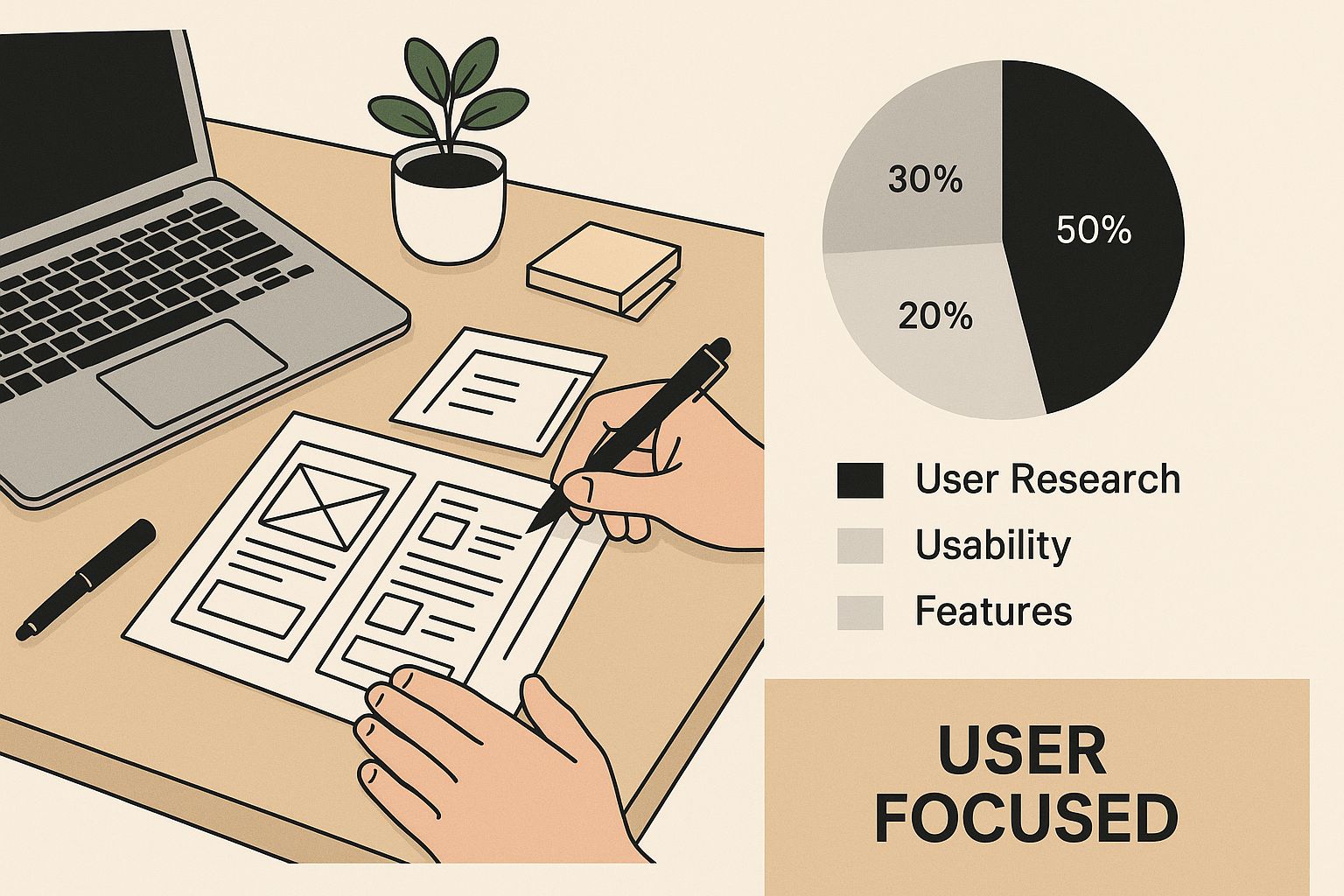
This infographic shows a designer sketching website wireframes, focusing on user experience. The emphasis on "User Focused" highlights the importance of the visitor's needs during website development. Every element, from layout to navigation, should be designed with the user in mind.
Clear Value Proposition and Storytelling
Your website should clearly communicate your value proposition: the problem you solve and why customers should choose you. This involves concise messaging, compelling visuals, and a strong brand identity.
Storytelling can be especially effective for startups. Sharing your founding story and mission can create an emotional connection with visitors, fostering brand loyalty.
Social Proof and Trust Signals
Building trust is crucial for new businesses. Incorporating social proof, like testimonials, case studies, and reviews, builds credibility. Displaying security badges and trust seals further enhances visitor confidence. This reassures them that their data is safe and your startup is legitimate.
For effective conversion strategies, consider exploring resources like Northpeak's best practices for improving website conversion rates.
Seamless Integration With Business Operations
A website shouldn't operate in isolation. It needs to integrate smoothly with your other business operations, such as your CRM, email marketing, and analytics platforms. This lets you collect valuable data, automate processes, and personalize the user experience. For example, integrating your website with a CRM like Hubspot can automatically capture leads and track customer interactions.
Responsive Design and Mobile Optimization
With most internet traffic coming from mobile devices, responsive design is essential. Your website must adapt to different screen sizes, ensuring a consistent user experience across all devices.
This means investing in mobile-first design principles and thorough testing to ensure optimal performance. A poor mobile experience can hurt your brand and significantly impact conversion rates.
To help illustrate the importance of these features, let's look at a comparison table. The table below outlines essential versus nice-to-have features, their development complexity, and impact on conversions.
Essential Startup Website Features Comparison
| Feature | Priority Level | Development Effort | Impact on Conversions | Typical Cost Range |
|---|---|---|---|---|
| User-Centric Design | Essential | Medium | High | $2,000 – $10,000 |
| Clear Value Proposition | Essential | Low | High | $1,000 – $5,000 |
| Social Proof | Essential | Low | Medium | $500 – $2,500 |
| Responsive Design | Essential | Medium | High | $1,500 – $7,500 |
| Business Operations Integration | Essential | Medium | Medium | $1,000 – $5,000 |
| Live Chat | Nice-to-have | Low | Medium | $200 – $1,000 |
| Advanced Analytics | Nice-to-have | Medium | Low | $500 – $2,500 |
| Blog | Nice-to-have | Low | Medium | $500 – $2,500 |
As you can see, focusing on the essential features first offers the highest impact on conversions. While the nice-to-have features are beneficial, they can be implemented later as your startup grows.
Choosing Your Development Path: What Actually Works
So, you’re ready to launch your startup’s website. But where do you even begin? Do you build an in-house team, outsource to an agency, or find some middle ground? Let’s explore the benefits and drawbacks of each path to help you decide what’s best for your startup.
In-House Development: Control and Customization
Building your website in-house gives you maximum control. You choose your team, manage their workflow, and have direct input on every decision. This approach offers the potential for highly customized solutions tailored to your specific needs.
However, it’s important to consider the costs. Salaries, benefits, equipment, and software licenses add up quickly, especially for early-stage startups. Building a skilled team also takes time, potentially delaying your launch.
Agency Partnership: Expertise and Efficiency
Partnering with a website development agency, like OneNine, gives you access to experienced professionals specialized in building high-performing websites. Agencies bring a wealth of knowledge and best practices, often leading to a faster launch.
This frees you to focus on your core business while the agency handles the technical side. However, agencies can have higher upfront costs than in-house development. You’ll also have less direct control over the day-to-day development process.
Hybrid Approach: Balancing Control and Cost
A hybrid approach combines in-house resources with agency support. Maybe your startup has an in-house designer but outsources the development work. This offers a balance of control and cost-effectiveness. You retain control over some aspects while leveraging agency expertise for others.
Coordinating between internal and external teams can present communication challenges. This can cause delays if not managed effectively.
Making the Right Choice for Your Startup
The right development path depends on several factors:
- Budget: How much can you realistically spend?
- Timeline: How soon do you need your website live?
- Technical Expertise: Does your team have the necessary website skills?
- Customization Needs: Do you need highly specialized features or a more standard solution?
Consider your startup’s specific needs and weigh the pros and cons of each path. There’s no single right answer. The best approach aligns with your goals and resources. A startup with limited resources and a tight timeline might choose a template-based website, keeping costs between $1,000 and $20,000. A startup with significant funding and complex needs might choose a custom-built solution by an agency, ranging from $40,000 to over $150,000.
Avoiding Common Pitfalls
No matter which path you choose, watch out for these red flags:
- Unrealistic Timelines: Be wary of promises for quick turnarounds without sufficient planning.
- Poor Communication: Ensure clear communication and regular updates.
- Lack of Scalability: Your website needs to handle future growth.

By carefully considering your options and planning strategically, you can set your startup up for online success. Your website is a key investment. Choosing the right development approach is crucial to maximizing that investment.
Building For Tomorrow: Scalability Without Breaking The Bank
Your startup’s website isn’t just a static online brochure; it's a dynamic tool. It needs to grow with your business. Many founders discover this the hard way, through costly and time-consuming website overhauls. This section explores how to build scalability into your website from day one, helping you avoid over-engineering and overspending.
Planning For Growth: Thinking Big, Starting Small
Scalability in website development means your website can handle increased traffic and changing business needs without any performance problems. Think of it like building a house. You wouldn’t build a one-bedroom house if you plan to raise a family of five. Similarly, you need a strong website foundation built for future expansion.
Choosing the right tech stack early on is crucial for both scalability and efficient development. Articles like this one on tech stack considerations for startups can offer helpful insights. This means selecting technologies that are flexible, adaptable, and can integrate with other systems as your business evolves.
Performance Optimization: The Speed Advantage
Website speed is crucial for both user experience and SEO (Search Engine Optimization). Slow loading times frustrate users and can negatively impact your search engine rankings. This means optimizing images, minimizing code, and using Content Delivery Networks (CDNs) like Cloudflare to ensure fast loading times, even as your user base grows. A CDN is like having multiple warehouses across the country. No matter where a customer is located, the product ships from the nearest warehouse, reducing delivery time.
Hosting Solutions: Choosing The Right Foundation
Your hosting needs change as your website traffic grows. Starting with a shared hosting plan might be budget-friendly initially, but it may not be the best long-term solution. Understanding different hosting options, like cloud hosting and dedicated servers, allows you to choose a scalable solution that meets future demands. Cloud hosting, for instance, is like renting flexible office space. You start small and easily scale up as your team expands, paying only for the space you use.
Future-Proofing Your Architecture: Adapting To Change
Technology changes quickly. Future-proofing your website architecture means using modular design principles. This makes it easier to adapt to new technologies and add new features without a complete website rebuild. Think of it like building with LEGOs. You can add, remove, or rearrange bricks to create new structures without starting over.
Learning From Success: Real-World Examples
Looking at how other startups scaled their web presence offers valuable lessons. Successful startups often made strategic decisions early on about performance optimization, hosting, and website architecture. These early decisions allowed them to handle increased traffic and features without major disruptions or expensive redesigns. Consider Airbnb, which scaled from a small platform for renting air mattresses to a global hospitality giant. Their adaptable architecture and robust infrastructure were key to supporting this enormous growth.
By prioritizing scalability from the start, your startup avoids costly rebuilds and ensures your website remains a powerful engine for growth. This approach helps you adapt to changing markets, incorporate new technologies, and handle a growing user base–all without technical limitations or performance issues. It’s about building a website that’s not just for today, but for the future.
Smart Budget Planning: Maximizing Your Website Investment

Let's talk about website development costs for startups. These costs can range from a few hundred dollars to several hundred thousand. What's a good return on investment (ROI) for startups with limited budgets? By looking at website projects across different industries and funding stages, we can figure out where your money will make the biggest difference.
Understanding the Cost Spectrum
Website development costs depend on several things. The type of website, how complex it is, and how you choose to build it all play a role. For startups, understanding this range of costs is vital for budgeting effectively. For more insights, check out this helpful resource: How to master your budget.
A basic website using a template can cost between $1,000 and $20,000. This option offers essential functions and a simple design, a good starting point for startups with limited funds.
A moderately complex website with more advanced features usually costs between $40,000 and $100,000. At this level, you often see custom design and integrations with business tools.
For a very complex, enterprise-level website with many high-end features, startups can expect to invest over $150,000. This suits businesses with complex needs, like large e-commerce platforms with advanced user management.
Phased Development and Funding Milestones
One smart way to manage website development costs is phased development. This approach connects your website development directly to your funding milestones. Start with a Minimum Viable Product (MVP) and add features as you get more funding. This lets you test your business idea and gain early traction without spending too much on a full website right away.
Scope Creep: The Budget Killer
Scope creep, when project requirements grow beyond the original plan, can wreck your budget. This happens when new features get added during development without adjusting the budget or timeline. Clear communication with your developers and a well-defined project scope are key to preventing scope creep. Project management tools like Trello or Asana can help keep things transparent and manage the project scope.
Strategic Cost Cutting vs. Essential Investments
Knowing where to save and where to invest is crucial for your website budget. Some areas, like custom design, can wait. Others, like user experience (UX) and responsive design, are essential. UX, like a well-organized store, guides visitors and encourages them to buy. Responsive design makes sure your website looks good on any device, essential in our mobile world.
Hidden Costs and Budget Stretching
Watch out for hidden costs in your website budget. These can include ongoing maintenance, hosting fees, security updates, and content creation. Factor these in when you plan. One way to stretch your budget without sacrificing quality is to prioritize must-have features. This ensures your core website functions work well and provide a good user experience. You can always add the "nice-to-haves" later. This lets you launch a functional website within your budget while still planning for future improvements.
To help you understand the potential costs involved in developing a startup website, take a look at the table below:
Startup Website Development Cost Breakdown
Detailed breakdown of typical costs for different types of startup websites, from MVP to enterprise-level solutions
| Development Type | Time Frame | Cost Range | Best For | Key Features Included |
|---|---|---|---|---|
| Basic Website (Template-based) | 2-4 weeks | $1,000 – $20,000 | Startups with limited budgets, launching quickly | Basic design, essential functionalities, simple CMS |
| Moderately Complex Website (Custom Design & Integrations) | 2-3 months | $40,000 – $100,000 | Growing startups needing more advanced features | Custom design, integrations with business tools (CRM, email marketing), more robust CMS |
| Complex, Enterprise-Level Website | 6+ months | $150,000+ | Established businesses with complex needs | Advanced functionalities, e-commerce capabilities, complex integrations, high-end design |
This table provides a general overview and the actual costs can vary based on specific project requirements.
This strategic approach helps startups maximize ROI and build a strong online presence within their budget.
From Launch To Growth: Turning Your Website Into A Customer Magnet
Building a startup website isn't the finish line; it’s the starting point. This section explains how to transform your new website into a powerful tool for gaining customers. We'll cover the crucial steps from pre-launch testing to post-launch optimization, helping your website attract your target audience.
Pre-Launch Testing: Avoiding Embarrassing Mistakes
Before showing your website to the world, thorough testing is essential. This isn’t just about finding broken links. It’s about ensuring a smooth and positive experience for your users.
- Functionality Testing: Does every button, link, and form work correctly? Test across different browsers and devices (like Chrome and Safari) to find any compatibility problems.
- User Experience Testing: Ask real people to use your site. Watch their behavior and get feedback on clarity, ease of use, and overall impression.
- Performance Testing: How fast does your website load? Use tools like Google PageSpeed Insights to find areas for improvement.
Careful testing helps you avoid embarrassing errors and makes a great first impression.
Soft Launch: Gathering Early Feedback
A soft launch means releasing your website to a small group before the official launch. This helps you get valuable feedback and find potential problems in a controlled setting.
- Targeted Audience: Choose a group that represents your target market. Their feedback will be the most useful for understanding your ideal customer.
- Feedback Channels: Give testers easy ways to share their thoughts, like surveys, feedback forms, or a dedicated email address.
- Iterative Improvement: Use the feedback to refine your website. Fix any usability problems or content gaps before the full launch.
This process allows you to improve your website based on how real users behave. You might be interested in: How to master your launch checklist.
Full Launch: Maximizing Initial Impact
Your full launch is your chance to make a big impression. Planning and execution are key to maximizing your website’s initial impact.
- Public Relations: Contact relevant media outlets and influencers to create excitement about your launch.
- Social Media Promotion: Use social media platforms like Facebook and Twitter to announce your launch and drive traffic to your new site.
- Launch Day Offers: Encourage early adoption with special discounts or promotions for a limited time.
A well-executed launch can generate positive PR, attract new users, and even get the attention of investors.
Post-Launch Optimization: Continuous Improvement
Launching your website is just the first step. Ongoing monitoring and optimization are vital for long-term success.
- Website Analytics: Track important metrics like traffic sources, bounce rate, and conversion rates to understand user behavior. Consider using tools like Google Analytics.
- A/B Testing: Try out different versions of your website elements, such as headlines or calls to action, to see what works best for your audience.
- Content Updates: Regularly update your website content to keep it fresh, relevant, and interesting.
This data-driven approach helps you find areas for improvement and constantly refine your website. This way, you can better serve your customers and reach your business goals.


