

Unlocking the Secrets of Successful Websites
Want to build a website that drives real business results? This listicle of website development case studies provides actionable insights from some of the most successful online platforms. Learn how companies like Airbnb, Shopify, and Netflix achieved remarkable growth through strategic design and development. We'll explore key decisions impacting their success, offering valuable lessons you can apply to your own web development projects. Discover how these platforms transformed their industries and gain a competitive edge by understanding the strategies behind their digital dominance. This list examines platform evolution, e-commerce strategies, and the secrets to building thriving online communities. Explore these website development case studies and unlock the potential of your own online presence.
1. Airbnb's Platform Transformation
Airbnb's journey from a simple room-sharing website to a global hospitality giant is a compelling website development case study, showcasing the power of strategic design and development decisions. This transformation involved a complete overhaul of their website architecture, user experience, and booking system, enabling them to handle millions of users and listings worldwide and solidifying their position as a leader in the sharing economy. This case study is invaluable for anyone looking to scale their online platform, offering crucial insights into the complexities and rewards of such an undertaking.
Initially, Airbnb operated on a monolithic architecture, which proved increasingly difficult to scale and maintain as the platform grew. To address these challenges, they transitioned to a scalable microservices architecture. This approach involves breaking down the platform into smaller, independent services, each responsible for a specific function. This modularity allows for greater flexibility, faster development cycles, and improved fault isolation. For instance, separate microservices could handle payments, messaging, search, and user profiles, allowing teams to work on these components independently and deploy updates without affecting other parts of the system.
This architectural shift was coupled with improvements to core functionalities. They implemented dynamic pricing algorithms, leveraging machine learning to adjust prices based on demand, seasonality, and other market factors. An advanced search and filtering system allowed users to easily find accommodations based on their specific criteria, including location, price range, amenities, and more. Multi-language and currency support catered to a growing international user base. A real-time messaging system facilitated communication between hosts and guests, fostering trust and enhancing the booking experience. Finally, robust trust and safety features, such as user verification and secure payment processing, were implemented to build confidence within the community.
These changes were not without their challenges. Migrating from a monolithic architecture to a microservices architecture required significant investment in infrastructure and expertise. The migration process was complex, requiring meticulous planning and execution. Additionally, maintaining multiple services incurs ongoing costs. However, the benefits far outweighed the challenges.
Airbnb’s mobile-first responsive design reflects the increasing importance of mobile devices in the travel industry. By prioritizing the mobile experience, Airbnb ensured seamless booking and browsing for users on any device. This approach is crucial in today's market, as mobile usage continues to surpass desktop usage in many sectors.
The infographic below visualizes key data points highlighting the success of Airbnb's platform transformation. It showcases improvements in uptime, booking time, and user engagement.
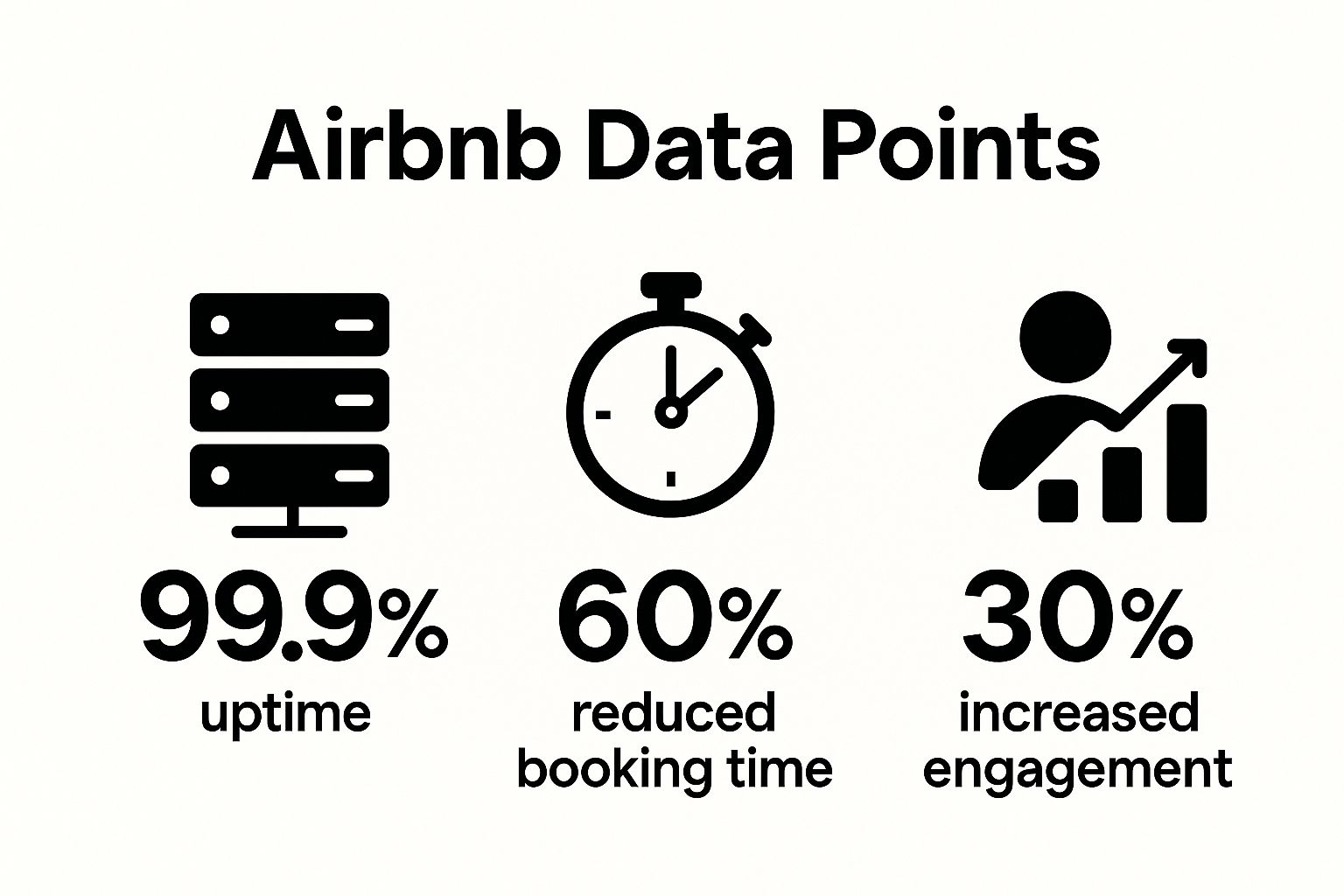
The infographic illustrates Airbnb's achievement of 99.9% uptime, a 60% reduction in booking conversion time, and a 30% increase in user engagement. These statistics underscore the effectiveness of their platform transformation, demonstrating significant improvements in reliability, efficiency, and user experience. Achieving near-perfect uptime is crucial for a global platform like Airbnb, ensuring uninterrupted service for millions of users. The reduction in booking time streamlines the process, making it easier for users to secure their accommodations. The increased user engagement signifies a more compelling and user-friendly platform.
Airbnb's platform transformation provides valuable lessons for businesses seeking to scale their online presence. Key takeaways include investing in comprehensive testing before major migrations, implementing gradual rollouts for new features, focusing on mobile experience early in development, and building trust features to increase user confidence. The company's success, driven by founders Brian Chesky, Joe Gebbia, and Nathan Blecharczyk, underscores the importance of adaptability and a willingness to embrace new technologies in the ever-evolving digital landscape. Their use of a React-based frontend for dynamic user interfaces and a Ruby on Rails backend with Java microservices serves as a practical example of how to effectively leverage different technologies for optimal performance.
This case study deserves a prominent place in any list of website development case studies because it exemplifies how strategic technical decisions can drive significant business growth. Airbnb's transformation demonstrates that investing in robust and scalable architecture, focusing on user experience, and leveraging data-driven insights can lead to dramatic improvements in performance, engagement, and ultimately, success. It provides a roadmap for other businesses navigating the challenges of scaling a digital platform, offering practical strategies and valuable lessons learned.
2. Shopify's E-commerce Platform Evolution
Shopify's journey from a small online snowboarding equipment store to a global e-commerce behemoth serves as a compelling website development case study. It perfectly illustrates how strategic website development can evolve beyond a single online storefront to create an entire ecosystem. This platform now powers over 1.7 million businesses worldwide, demonstrating the power of innovative development practices. This case study offers valuable insights for SMBs, entrepreneurs, marketers, business owners, agencies, CEOs, CMOs, and heads of marketing alike, showcasing the potential of a well-executed platform strategy.
Initially, Shopify's founders needed an online platform to sell their snowboarding gear. Dissatisfied with existing e-commerce solutions, they decided to build their own. This decision, born out of necessity, laid the foundation for what Shopify is today: a robust platform offering a comprehensive suite of tools and services for businesses of all sizes. Shopify's success stems from its ability to adapt to the ever-changing e-commerce landscape, constantly innovating and expanding its features to meet the needs of its growing user base.
The core of Shopify's platform lies in its flexible and customizable architecture. The Liquid templating engine allows merchants to tailor their online stores to their specific branding and functionality requirements. Beyond basic storefront customization, Shopify offers a thriving app ecosystem with over 8,000 applications, extending the platform's capabilities to encompass virtually every aspect of online business management. This includes everything from marketing automation and customer relationship management (CRM) to advanced analytics and shipping logistics. This extensive app ecosystem allows businesses to easily integrate third-party solutions, streamlining their operations and enhancing their online presence.
Shopify's multi-channel selling capabilities are a significant advantage for businesses looking to expand their reach. Merchants can seamlessly integrate their Shopify stores with various online marketplaces like Amazon and eBay, as well as social media platforms like Facebook and Instagram. This unified approach to sales management allows businesses to manage their inventory, process orders, and track performance across multiple channels from a single dashboard. The built-in payment processing system simplifies transactions for both merchants and customers, while the robust inventory management system ensures accurate stock control. Moreover, Shopify offers a suite of SEO optimization tools to help businesses improve their online visibility and attract more organic traffic. The real-time analytics dashboard provides valuable insights into sales data, customer behavior, and other key metrics, empowering businesses to make data-driven decisions.
Learn more about Shopify's E-commerce Platform Evolution
Shopify's platform has proven its ability to handle immense traffic loads, notably during peak shopping periods like Black Friday, where it consistently manages up to six times its normal traffic volume. This scalability and reliability are further underscored by its impressive 99.98% uptime. It's estimated that Shopify's platform has reduced development time for merchants by approximately 80%, allowing them to focus on their core business operations rather than technical complexities. The platform has also generated over $175 billion in sales for merchants, a testament to its effectiveness in facilitating online commerce.
While Shopify boasts numerous advantages, it also has some drawbacks. Its complex architecture requires specialized knowledge for advanced customization and development. The infrastructure costs associated with maintaining a global platform of this scale are substantial, contributing to the pricing structure. Furthermore, the reliance on a third-party app ecosystem, while offering flexibility, can also introduce dependencies and potential integration challenges.
Shopify’s technical implementation provides a compelling look into modern website development best practices. Examples include the use of a GraphQL API for efficient data fetching, Ruby on Rails framework with a React frontend for a dynamic and responsive user experience, Redis for caching and session management to optimize performance, and Kubernetes for container orchestration, enabling scalability and resilience.
For those looking to build a platform with similar scalability and flexibility, Shopify’s approach provides several key takeaways. Designing for extensibility from the very beginning is crucial, anticipating future growth and integration needs. Creating comprehensive developer documentation empowers developers to build upon the platform and contribute to its ecosystem. Implementing robust API rate limiting safeguards the platform's stability and prevents abuse. Finally, building performance monitoring into the core platform allows for proactive identification and resolution of performance bottlenecks. These strategies, popularized by Shopify's founders, Tobias Lütke, Daniel Weinand, and Scott Lake, have contributed significantly to the platform’s success. Shopify's evolution serves as a powerful website development case study, demonstrating the potential of strategic planning, innovative development, and a customer-centric approach. This example is particularly valuable for anyone interested in website development case studies because it demonstrates the long-term impact of building a platform that empowers businesses to thrive in the competitive e-commerce landscape.
3. Netflix's Streaming Platform Revolution
Netflix's journey from a DVD-by-mail service to a global streaming behemoth is a prime example of a successful digital transformation and serves as an inspiring website development case study. This radical shift, driven by a forward-thinking approach to website and platform development, focused on personalization, performance, and global scalability, offers valuable lessons for businesses of all sizes. Netflix's success story demonstrates how a customer-centric digital strategy can disrupt entire industries and redefine user expectations. This case study is particularly relevant for SMBs, entrepreneurs, marketers, business owners, agencies, CEOs, CMOs, and heads of marketing looking to leverage digital platforms for growth and competitive advantage.

At the heart of Netflix's triumph lies its sophisticated technology stack. The platform leverages a machine learning-powered recommendation engine that analyzes user viewing habits to suggest relevant content, drastically reducing content discovery time. This personalized experience is further enhanced by adaptive bitrate streaming, ensuring seamless playback across various devices and internet speeds. A robust content delivery network (CDN) optimized for global reach guarantees high availability and minimal buffering, contributing to an impressive streaming uptime. Furthermore, a rigorous A/B testing framework facilitates continuous optimization of the user interface and features, driving engagement and subscriber retention. Features like offline viewing and multi-device synchronization cater to the evolving needs of a mobile-first audience, solidifying Netflix's position as a leader in the streaming space.
Netflix's success is quantifiable: over 230 million subscribers globally, a 70% reduction in content discovery time, a remarkable 99.97% streaming uptime, and an 80% increase in viewing time attributed to personalization. This website development case study showcases the power of investing in technology to enhance user experience and drive business growth. Their microservices architecture, comprising over 1000 services, allows for independent scaling and development, contributing to the platform's agility and resilience. The use of React for web interface development ensures a dynamic and responsive user experience, while the reliance on AWS cloud infrastructure provides the scalability and reliability needed to serve a global audience.
However, building and maintaining a platform of this scale comes with its challenges. Massive infrastructure costs, exceeding $15 billion annually, are a significant consideration. Complex content licensing agreements and geographic restrictions present ongoing hurdles. Additionally, the demand for high-quality streaming necessitates high bandwidth requirements, posing challenges for users with limited internet access.
Despite these challenges, Netflix's success provides invaluable lessons for other businesses. Implementing a comprehensive A/B testing framework, investing heavily in data analytics and machine learning, and focusing on performance optimization for media delivery are key takeaways from this website development case study. Building chaos engineering practices into the development lifecycle is crucial for ensuring platform reliability and resilience. Netflix’s example, popularized by Reed Hastings and Marc Randolph, demonstrates the transformative potential of a digital-first strategy executed with a focus on user experience and technological innovation.
This case study deserves its place on this list because it exemplifies how a company can leverage website and platform development to revolutionize an industry. Netflix's commitment to personalization, performance, and scalability has set a new standard for online streaming services. By studying their approach, businesses can glean valuable insights into building successful digital platforms that cater to evolving user needs and drive sustainable growth. While not every business operates on the scale of Netflix, the core principles of their success – customer-centricity, data-driven decision-making, and continuous innovation – are applicable across industries and business sizes. This makes Netflix a powerful website development case study for anyone seeking to leverage the power of digital transformation.
4. Spotify's Music Streaming Platform: A Website Development Case Study
Spotify has become synonymous with music streaming, transforming how we discover, listen to, and share music. This website development case study highlights how Spotify leveraged innovative web and mobile platform development to revolutionize an entire industry. Its success provides invaluable lessons for SMBs, entrepreneurs, marketers, and agencies looking to build engaging and scalable digital platforms. This case study underscores the power of user-centric design, robust backend infrastructure, and intelligent algorithms in achieving digital dominance.
Spotify's approach centers around providing seamless and personalized music experiences. Learn more about Spotify's Music Streaming Platform The platform allows users to stream millions of songs on demand, create and share playlists, discover new artists through curated recommendations, and connect with friends through social features. This multifaceted approach caters to various user needs, solidifying Spotify's position as a one-stop shop for music consumption. This case study exemplifies the effectiveness of creating a holistic ecosystem that goes beyond simply delivering a core service.
Several key features contribute to Spotify's success as a website development case study. Real-time collaborative playlists allow multiple users to contribute to a single playlist, enhancing the social aspect of music discovery and sharing. Advanced music discovery algorithms, powered by machine learning, analyze user listening habits to provide personalized recommendations, effectively introducing users to new artists and genres. Social sharing and following features allow users to connect with friends and follow their favorite artists, creating a sense of community within the platform. Offline music synchronization enables users to download music for offline listening, catering to users with limited internet connectivity. Finally, cross-platform continuity ensures a seamless user experience across different devices, from desktops to smartphones and tablets. The integration of podcasts further broadens the platform's appeal, offering diverse audio content within a single application. For artists, Spotify provides an analytics dashboard, allowing them to gain insights into their listener demographics and track their song performance.
This website development case study demonstrates how addressing specific user needs with tailored features can significantly enhance platform engagement. This is a valuable takeaway for any business seeking to build a successful online presence. By understanding and catering to their target audience's unique requirements, businesses can foster loyalty and drive growth.
The pros of Spotify's platform are numerous. The service handles over 4 billion hours of listening monthly, showcasing the robustness and scalability of its backend infrastructure. Their advanced recommendation algorithms have reportedly reduced music discovery time by 60%, demonstrating the effectiveness of personalized content delivery. Spotify boasts an impressive 99.9% uptime for music streaming, ensuring a reliable and consistent user experience. Finally, social features have increased user engagement by 40%, highlighting the importance of incorporating social elements into digital platforms.
However, this website development case study also reveals challenges inherent in the music streaming industry. High royalty payments to artists and record labels significantly impact profitability. Complex licensing agreements across different regions present a logistical hurdle for global expansion. Finally, intense competition from tech giants like Apple and Amazon necessitates continuous innovation and differentiation.
Spotify utilizes a sophisticated technology stack to deliver its services. React and TypeScript form the foundation of their web applications, offering a robust and scalable framework for front-end development. Real-time data processing is handled by Apache Storm, enabling the platform to manage the massive influx of user data. Google Cloud Platform provides the necessary infrastructure for scalability and reliability. Finally, machine learning algorithms drive the personalized music recommendations, shaping the user experience and contributing to Spotify's high engagement rates.
Several key takeaways emerge from this website development case study. Prioritizing real-time user experience is crucial in the fast-paced digital landscape. Implementing sophisticated caching strategies ensures smooth content delivery and minimizes latency. Building social features cultivates a sense of community and boosts user engagement. Finally, investing in machine learning for personalization can significantly enhance user satisfaction and drive platform usage.
Spotify, popularized by Daniel Ek and Martin Lorentzon, exemplifies the power of innovative website and mobile development in transforming an industry. This case study provides valuable insights for anyone embarking on a website development project. By focusing on user experience, leveraging cutting-edge technology, and addressing market challenges strategically, businesses can create digital platforms that resonate with their target audience and achieve sustainable success.
5. Slack's Workplace Communication Platform
Slack's journey from an internal tool for a struggling gaming company to a ubiquitous workplace communication platform exemplifies a powerful website development case study. This transformation showcases how a laser focus on product development, coupled with a deep understanding of user needs, can lead to phenomenal success. Slack's web platform prioritized real-time communication, seamless integrations, and a user-friendly experience, ultimately disrupting the traditional email-centric workflow and redefining how teams collaborate. This case study provides invaluable lessons for anyone involved in website development, from SMBs to large enterprises.

At its core, Slack is a real-time communication platform designed to streamline workplace collaboration. It replaces lengthy email chains with organized channels, allowing teams to discuss projects, share files, and make decisions more efficiently. This is achieved through a combination of features like threaded messaging, which keeps conversations focused, and direct messaging for private conversations. The platform's true power, however, lies in its extensive integration capabilities. With over 2,000 apps available, Slack can connect with a vast array of third-party services, from project management tools like Asana and Trello to CRM platforms like Salesforce. This allows teams to centralize their workflow and access all necessary information within a single platform.
Slack's success can be attributed to several factors. First, its focus on real-time communication drastically reduces email overload, a common pain point for many organizations. Studies show that Slack has reduced email usage by up to 70% in some companies. Second, the platform's intuitive design and user-friendly interface make it easy to adopt and use, even for non-technical users. This contributes significantly to improved team productivity, with some organizations reporting a 32% increase. Finally, Slack's commitment to reliability, boasting 99.99% uptime, ensures that business communication remains uninterrupted. This is critical for organizations that rely heavily on real-time collaboration.
This website development case study demonstrates the power of prioritizing user experience and building a platform that addresses a specific need. Slack's impact is undeniable, serving over 12 million daily active users and ultimately achieving a valuation of $27 billion before its acquisition by Salesforce.
Features that make Slack a standout case study in website development:
- Real-time messaging with threading: This keeps conversations organized and easy to follow, promoting efficient communication.
- Extensive third-party integrations: Connecting with over 2,000 apps allows for seamless workflow integration.
- File sharing and collaboration tools: Facilitates easy sharing and co-editing of documents, fostering teamwork.
- Custom workflow automation: Streamlines repetitive tasks and improves overall efficiency.
- Voice and video calling: Enables quick and convenient communication for remote teams.
- Advanced search capabilities: Allows users to easily find information within the platform.
- Enterprise security and compliance: Provides peace of mind for businesses handling sensitive data.
While Slack offers numerous benefits, it's important to acknowledge its potential drawbacks. The platform can become overwhelming if too many channels are created, leading to information overload. Implementing Slack also requires a cultural shift within organizations, as teams need to adapt to a new way of communicating. Finally, some premium features are necessary for larger teams, which can increase costs.
Examples of the technologies behind Slack's success:
- React: Used for building the responsive and dynamic web interface.
- WebSocket connections: Enable real-time messaging and updates.
- Electron: Facilitates the development of cross-platform desktop applications.
- Microservices architecture: Ensures scalability and allows for continuous development and deployment.
Tips for implementing Slack-like features in your own website development projects:
- Focus on real-time performance optimization: Ensure a smooth and responsive user experience.
- Build a comprehensive integration ecosystem: Connect with relevant third-party services to enhance functionality.
- Implement intuitive onboarding flows: Make it easy for new users to get started and understand the platform.
- Design for both small teams and enterprises: Consider the needs of different user groups and provide scalable solutions.
Slack's journey, spearheaded by Stewart Butterfield, Eric Costello, and Cal Henderson, provides invaluable insights into successful website development. It highlights the importance of understanding user needs, building a product that solves a real problem, and continually iterating based on user feedback. This case study is relevant for anyone involved in website development, offering practical lessons that can be applied to projects of all sizes. Visit Slack to experience the platform firsthand.
6. GitHub's Developer Platform Transformation
GitHub's journey from a simple Git repository hosting service to the world's largest developer platform stands as a compelling website development case study, particularly for SMBs, entrepreneurs, marketers, and agency leaders looking to build scalable and impactful platforms. It perfectly demonstrates how strategic feature development can create powerful network effects, ultimately transforming a niche tool into an industry standard. This case study offers valuable insights into building a platform that fosters collaboration, accelerates development, and attracts a thriving community.
At its core, GitHub's success story revolves around understanding developer needs and continuously evolving to meet them. It began by providing a user-friendly interface for Git, a distributed version control system initially challenging for many developers to adopt. By simplifying the complexities of Git, GitHub opened the doors to a wider audience, fostering collaboration and code sharing on an unprecedented scale. This initial simplification was crucial in establishing the foundation for future growth. Learn more about GitHub's Developer Platform Transformation to gain further insight into their strategic approach.
The platform's evolution didn't stop at simplifying Git. GitHub strategically introduced features that addressed key pain points in the software development lifecycle. The pull request and code review system streamlined the process of contributing to projects, promoting code quality and collaborative development. Issue tracking and project management tools brought organization and structure to development workflows, enabling teams to manage complex projects efficiently. Furthermore, GitHub Actions brought CI/CD automation directly into the platform, further streamlining the development process. Features like GitHub Pages for static site hosting and security vulnerability scanning catered to emerging developer needs, solidifying GitHub's position as a comprehensive development platform.
This strategic feature development created powerful network effects. As more developers joined the platform, the value proposition for both individual developers and organizations increased exponentially. The sheer number of repositories hosted on GitHub – over 200 million globally – became a testament to its widespread adoption. This vast ecosystem fosters open-source collaboration, provides access to a wealth of knowledge and resources, and connects developers with potential employers. GitHub essentially became the de facto standard for open source collaboration, a powerful draw for businesses and individual developers alike.
The platform's success is reflected in its impact on development workflows. GitHub reports a 50% reduction in development workflow time for many users, thanks to streamlined collaboration and automation features. The platform boasts 99.95% uptime for critical developer workflows, ensuring reliability and minimizing disruption to development processes. This stability is crucial for businesses that rely on GitHub for their core development infrastructure.
However, like any platform, GitHub has its drawbacks. Occasional service outages, while rare, can significantly impact global development, highlighting the dependency concerns for critical infrastructure relying solely on the platform. There's also a learning curve for new developers, particularly those unfamiliar with Git and the collaborative workflow GitHub promotes.
Despite these challenges, GitHub's influence on website development is undeniable. Examples of its impact can be seen in the widespread use of Ruby on Rails for web application frameworks, React components for modern UI elements, GraphQL API for efficient data access, and Kubernetes for container orchestration – all projects that have benefited from GitHub's collaborative ecosystem.
For those looking to build successful platforms, GitHub's journey offers valuable lessons. Designing workflows that match developer mental models is crucial for adoption. Investing in robust API design for third-party integrations expands the platform's functionality and encourages a thriving ecosystem. Implementing comprehensive search and discovery features helps users navigate the vast repository of code and projects. Above all, building trust through transparency and reliability is paramount for long-term success. This website development case study highlights the importance of understanding your target audience, providing solutions to their specific needs, and continuously evolving to stay ahead of the curve. The success of founders like Tom Preston-Werner, Chris Wanstrath, and PJ Hyett showcases the power of a developer-centric approach in building a truly transformative platform.
7. Pinterest's Visual Discovery Platform
Pinterest, the online visual discovery platform, stands as a compelling website development case study, demonstrating how innovative web development can reshape an entire industry. Its unique approach to content discovery, centered around images rather than text, carved out a new niche in social media and redefined how users discover, save, and interact with visual content. This case study provides valuable insights for SMBs, entrepreneurs, marketers, and agencies looking to leverage the power of visual engagement.
Pinterest's success stems from its focus on several key features that combine to create a seamless and addictive user experience. At the heart of this platform lies its sophisticated visual search and recognition technology. This allows users to not only search using keywords but also upload images to find visually similar content. Imagine taking a picture of a stylish chair and instantly finding similar furniture pieces on Pinterest – that's the power of visual search. This functionality is further enhanced by computer vision APIs, which analyze images to identify objects, patterns, and even colors.
The platform's distinctive infinite scroll masonry layout is another crucial element. This dynamic layout automatically adjusts to different screen sizes, presenting users with an endless stream of visually appealing pins. This, coupled with board-based content organization, allows users to curate and categorize their discovered content, further personalizing their experience. Users can create boards dedicated to anything from home decor and recipes to travel destinations and DIY projects.
Beyond discovery, Pinterest has seamlessly integrated shopping functionalities with its visual search. Users can now directly purchase items they discover visually, transforming the platform into a powerful visual commerce engine. This integration has been a significant revenue driver for Pinterest, generating over $2.5 billion annually.
Underlying these features is a powerful personalized home feed algorithm driven by machine learning. The algorithm analyzes user activity, including their pins, boards, and searches, to curate a highly personalized feed of relevant content. Rich Pins with metadata further enhance this personalization, providing users with additional information about pinned items, such as pricing, availability, and direct links to purchase. This personalized experience significantly increases user session time, with Pinterest reporting a 40% increase attributed to visual discovery.
From a technical perspective, Pinterest leverages technologies like React for responsive grid layouts, ensuring a smooth user experience across various devices. CDN optimization for image delivery is critical for handling the massive volume of images on the platform, achieving 99.9% uptime for image serving. Machine learning plays a crucial role in powering the personalization algorithms and driving the platform's trend analysis and insights capabilities.
While Pinterest’s platform offers numerous benefits, it also presents specific challenges. The platform handles over 5 billion visual searches monthly, which translates to high storage and bandwidth costs for images. Managing this immense volume of visual data requires a complex computer vision infrastructure. Additionally, content moderation at scale remains a significant challenge, requiring constant vigilance to ensure a positive and safe user experience.
For businesses seeking to implement similar strategies, several key takeaways emerge from Pinterest’s success. Optimizing image loading and lazy loading strategies is essential for delivering a smooth browsing experience. Implementing efficient grid layout algorithms, like the masonry layout, can significantly enhance visual appeal and engagement. Investing in computer vision and machine learning technologies is crucial for personalized recommendations and visual search capabilities. Finally, adopting a mobile-first design approach for visual experiences is paramount in today’s mobile-centric world.
Pinterest's platform, popularized by Ben Silbermann, Paul Sciarra, and Evan Sharp, stands as a testament to the power of visual discovery. Its innovative approach to website development has not only created a successful business model but also transformed how users interact with online content. This website development case study provides valuable lessons for businesses looking to leverage the power of visuals in their online presence. By studying Pinterest’s approach and implementing these strategies, businesses can create engaging online experiences that resonate with their target audience and drive meaningful results. Visit Pinterest to experience this platform firsthand.
Platform Evolution Case Studies Comparison
| Case Study | Implementation Complexity 🔄 | Resource Requirements ⚡ | Expected Outcomes 📊 | Ideal Use Cases 💡 | Key Advantages ⭐ |
|---|---|---|---|---|---|
| Airbnb's Platform Transformation | High: Migration from monolith; microservices | Significant investment in infrastructure and maintenance | 99.9% uptime, 60% reduced booking time, 30% increased engagement | Global scalable marketplace; travel bookings | Scalability, dynamic pricing, trust features |
| Shopify's E-commerce Platform Evolution | High: Complex architecture, extensibility focus | High infrastructure costs, specialized skills | 99.98% uptime, 6x traffic spikes, $175B+ merchant sales | Multi-merchant e-commerce ecosystems | Extensive app ecosystem, SEO, multi-channel |
| Netflix's Streaming Platform Revolution | Very High: 1000+ microservices; global scale | Massive infrastructure & bandwidth investment | 99.97% streaming uptime, 70% reduced discovery time, 80% more viewing | Large-scale media streaming & personalization | Adaptive streaming, ML recommendations |
| Spotify's Music Streaming Platform | High: Real-time data, cross-platform sync | High royalty costs, complex licensing | 99.9% uptime, 60% faster discovery, 40% engagement growth | Music streaming with social and discovery features | Real-time collaboration, ML based discovery |
| Slack's Workplace Communication Platform | Moderate to High: Real-time messaging, integrations | Medium to high (scalable microservices) | 99.99% uptime, 70% email reduction, 32% productivity gain | Enterprise communication & collaboration | Real-time messaging, extensive integrations |
| GitHub's Developer Platform Transformation | High: Version control + CI/CD workflows | Medium to high due to scale & availability | 99.95% uptime, 50% faster workflows, 200M+ repos hosted | Developer tools, open source collaboration | Robust workflows, CI/CD automation |
| Pinterest's Visual Discovery Platform | High: Computer vision, image processing | High storage and bandwidth needs | 99.9% uptime, 5B+ visual searches, 40% longer sessions | Visual search & discovery platforms | Visual search technology, infinite scroll UX |
Building Your Own Success Story
From Airbnb's platform transformation to Pinterest's visual discovery engine, these website development case studies showcase how strategic planning, technical innovation, and a user-centric approach can lead to remarkable online success. We've seen how crucial it is to adapt to evolving technologies, prioritize user experience, and continuously iterate on your platform. These principles aren't just for tech giants; they're the foundation for any successful website, regardless of size or industry. Mastering these concepts empowers businesses to create engaging online experiences that drive growth and achieve their specific objectives.
Building a successful website involves more than just design and development. It requires careful planning, execution, and management. To help you navigate this process effectively, check out these resources on managing web development projects from Iconcept ltd.
By examining website development case studies, we can learn from the triumphs and challenges of industry leaders, gaining invaluable insights to inform our own strategies. These examples demonstrate the transformative power of a well-executed website, illustrating how it can revolutionize industries, connect people, and drive significant business growth.
Inspired by these success stories? OneNine helps businesses of all sizes build and manage websites tailored to their unique goals, drawing inspiration and best practices from proven website development case studies. Visit OneNine today to learn how we can help you create a platform that drives results.


