
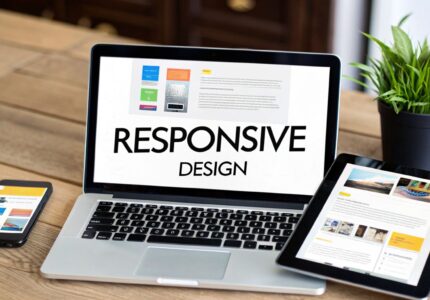
Ever tried to use a website on your phone that was clearly built for a giant desktop monitor? You’re pinching, zooming, and scrolling sideways just to read a single sentence. It’s frustrating, and most people give up.
Responsive web design is the solution to that exact problem.
Think of it like a smart liquid that perfectly fills any container it's poured into. Whether a visitor is on a massive desktop screen, a tablet, or their phone, a responsive website automatically adjusts to give them the best possible experience.
What Are Responsive Web Design Services?

Responsive web design services are offered by professional agencies that build websites using this flexible, device-aware approach. They create a single, intelligent site that works flawlessly everywhere, eliminating the old-school (and expensive) method of building separate websites for desktop and mobile.
It’s all about creating one unified digital presence. Instead of having a clunky m.yourwebsite.com subdomain, you have one site that uses a fluid layout and smart code to refit itself on the fly.
To give you a clearer picture, here’s a quick comparison.
Responsive vs Non-Responsive Websites at a Glance
This table gives you a quick snapshot of the critical differences, helping you understand why a responsive site is the modern standard for business success.
| Feature | Responsive Website (The Modern Standard) | Non-Responsive Website (The Outdated Approach) |
|---|---|---|
| User Experience | Excellent on all devices (desktop, tablet, mobile) | Poor on mobile; requires pinching and zooming |
| Maintenance | One website to manage and update | Multiple websites (e.g., desktop and mobile) to manage |
| SEO | Recommended by Google; boosts mobile rankings | Penalized by Google; hurts search visibility |
| Cost | Higher initial investment, lower long-term cost | Cheaper upfront, but costly to maintain two sites |
| Future-Proofing | Adapts to new screen sizes and devices | Quickly becomes obsolete as new devices emerge |
As you can see, the choice is pretty clear. A responsive website isn't just a "nice-to-have" feature; it's a foundational element for reaching a modern audience.
The Building Blocks of a Modern Website
So, how does it actually work? A professional agency handles all the technical heavy lifting, but it boils down to three key components:
- Fluid Grids: The site's layout is built on a flexible, percentage-based grid. Instead of fixed pixel widths, content elements scale up or down relative to the screen size.
- Flexible Media: Images, videos, and other media are set to resize within their containers, so they never break the layout or look distorted.
- Media Queries: This is the CSS code that acts like a traffic cop. It detects the screen size of the device and tells the browser which layout rules to apply.
Getting this right is a mix of art and science. Following responsive design best practices is crucial to ensure a site is not just functional, but also fast and easy for everyone to use.
More Than Just a Technical Upgrade
This is where it gets really important for your business. A responsive website isn't just a technical feature; it's a powerful business tool. Google's algorithm actively rewards mobile-friendly sites with better search rankings, which means responsive design directly impacts your SEO and how easily customers can find you.
You can take a deeper dive into the core concepts by reading our guide on responsive design principles.
The market data tells the same story. The global market for responsive web design services was valued at around $50 billion in 2025 and continues to grow. Why? Because today, approximately 90% of websites worldwide are responsive. It's the undisputed industry standard.
For any business that wants to compete online, responsive design is no longer a choice—it's an absolute necessity.
The Business Case for a Responsive Website

It’s one thing to know what responsive design is, but the real question is why it matters for your bottom line. A responsive website isn't just a technical upgrade or a nice-to-have; it's a core business strategy with a direct, measurable return on investment.
Think of it this way: if a customer walked into your store and the aisles were too narrow to navigate or the products were on shelves too high to reach, they’d turn around and leave. That’s exactly the experience a non-responsive website creates for someone on a smartphone—and today, that’s most of your audience.
That frustration has a real cost. When someone finds you on Google, clicks to your site, and immediately leaves (a "bounce"), it sends a powerful signal to the search engine that your page wasn't helpful. Too many bounces, and your rankings will start to slide.
Drive More Conversions and Sales
A great responsive design creates a smooth, intuitive path for every single user, no matter their device. This is absolutely critical in e-commerce, where a clunky mobile checkout is one of the top reasons people abandon their carts. Making the journey from product discovery to purchase confirmation feel effortless on a phone can have a huge impact on your sales.
The numbers don't lie. A fantastic user experience built on responsive design can send conversion rates soaring. On the flip side, slow and awkward sites create so much friction that they cost retailers billions in lost sales every year.
Key Metrics That Responsive Design Improves
- Lower Bounce Rate: When your site just works on mobile, people stick around longer. This tells search engines your site has value.
- Higher Conversion Rates: An easy-to-use site, especially on mobile, removes the roadblocks that stop people from buying or signing up.
- Increased Session Duration: If navigating is easy, users will spend more time exploring what you have to offer.
- Better SEO Rankings: Google openly favors mobile-friendly sites. Responsiveness is no longer optional for good search visibility.
The results are tangible. Studies have found that 62% of companies saw a clear increase in sales after making their sites responsive. It’s a global trend: sites that perform well on mobile get more engagement and better conversions, which feeds directly into stronger SEO.
A single investment in professional responsive web design services delivers ongoing returns in leads, customer loyalty, and brand credibility, making it one of the smartest decisions a business can make.
Build Brand Credibility and Trust
Your website is often the very first impression a potential customer has of your brand. A clean, modern site that works flawlessly on any screen instantly communicates professionalism and builds trust. An old site that’s broken or hard to use on a phone makes you look outdated and, frankly, a little careless.
This thinking is at the heart of a mobile-first design strategy. This approach starts the design process on the smallest screen and works its way up, ensuring the core experience is perfected for the majority of users from the very beginning. To learn more about this, check out our guide on the benefits of mobile-first design for business websites.
Ultimately, a responsive website isn't an expense—it’s an asset that works for your business 24/7. It attracts and keeps customers, makes you more visible to search engines, and solidifies your brand’s reputation in a crowded marketplace.
What You Actually Get From a Design Agency
When you hire a professional agency for responsive web design services, what are you really paying for? It’s not just a website that shrinks to fit a phone. You're getting a whole suite of technical and strategic work designed to make your site perform flawlessly on any device your customers might use.
Knowing what’s under the hood helps you understand an agency’s proposal and spot a quality product. This isn't just about aesthetics; it’s about building a flexible foundation. That requires a team with distinct roles, and it's helpful to know the difference between a web developer vs web designer. Together, they create the tangible assets that make your site work everywhere.
The Technical Building Blocks
At the heart of any responsive project are a few core components that control how your website adapts. These aren't just buzzwords—they are the concrete deliverables you should expect to see.
- A Mobile-First Design Strategy: We start by designing for the smallest screen first: the smartphone. This approach forces us to prioritize the most critical content and features, leading to a cleaner, faster experience for the majority of users who visit on mobile.
- A System of Breakpoints: Think of breakpoints as triggers. They're specific screen widths where the website's layout automatically shifts to a more optimal arrangement. A good agency won't just design for "phone, tablet, and desktop." They'll define several breakpoints to ensure the layout never looks awkward or broken on in-between screen sizes.
- Fluid Grids and Flexible Images: Instead of a rigid layout with fixed dimensions, your site will be built on a flexible grid. It’s like giving your website an elastic skeleton. This allows content and images to stretch or shrink proportionally to fit the screen perfectly, keeping everything balanced and looking sharp.
Essential Compliance and Quality Assurance
A truly professional job doesn’t end when the site is built. The next step is making sure it’s usable by everyone and works perfectly, no matter what. This is where top-tier agencies really earn their stripes.
A responsive site isn’t finished when it looks good on the designer's monitor. It's finished when it has been rigorously tested to perform flawlessly on the dozens of real-world devices your customers actually use.
This phase includes two critical deliverables you should always look for. When you're ready to start talking to agencies, our guide on crafting a website redesign request for proposal can help you ask all the right questions.
Accessibility Compliance (WCAG)
Your website has to be usable for people with disabilities. We handle this by following the Web Content Accessibility Guidelines (WCAG). This means:
- Adding proper descriptions to images (alt text) so screen readers can interpret them.
- Ensuring there's enough color contrast between text and its background.
- Making sure the entire site can be navigated using only a keyboard.
Cross-Device and Browser Testing
Your agency should put the site through its paces to find and squash bugs. This is way more than a quick check on an iPhone and a laptop. It’s a formal process where the site is tested across:
- Multiple Devices: A mix of popular iPhones, Android phones, iPads, and other tablets.
- Different Browsers: The latest versions of Chrome, Safari, Firefox, and Edge.
- Operating Systems: How the site looks and feels on iOS, Android, Windows, and macOS.
Ultimately, investing in responsive web design services means you walk away with a complete, future-proof digital asset. It’s technically sound, inclusive for all users, and tested to death to ensure a perfect experience, every single time.
Your Project Journey From Kickoff to Launch
Hiring an agency for responsive web design services might feel like a huge leap, but a good partner will guide you through a clear, predictable process. Knowing what to expect demystifies the whole thing and makes for a much smoother collaboration.
Think of it like building a house. You wouldn't just hire a crew and hope for the best. You'd start with a detailed blueprint, lay a solid foundation, build the structure, and then do a final walkthrough. A website project follows the same logical steps to make sure what gets built is exactly what you need.
Phase 1: Discovery and Strategy
This is the blueprinting stage. Before anyone even thinks about design or code, we need to get to the heart of your business. This is more than a quick chat; it's a deep, strategic dive.
We’ll work together to:
- Align on Goals: What does "success" actually look like for you? Is it generating more qualified leads, boosting online sales, or simply making your brand look great?
- Profile Your Audience: We need to know who your customers are. What devices are they using to find you? What problems are they trying to solve on your website?
- Analyze the Competition: We’ll look at what your competitors are doing right (and wrong). This helps us find opportunities to make your website the clear winner.
Getting this first phase right is everything. It makes sure we're all on the same page and chasing the same goals from day one. This strategy then informs all the technical decisions we make.

The core principles you see here—using breakpoints, fluid grids, and a mobile-first mindset—are how we translate your business strategy into a functional, great-looking website.
Phase 2: UX and UI Design
With a solid strategy locked in, the creative work can finally begin. This is where your website starts to come to life, visually speaking. It's a two-step dance between User Experience (UX) and User Interface (UI).
- Wireframing (UX): First, our designers will create simple, black-and-white layouts of your site. These are the bare-bones blueprints. They focus entirely on structure, how content is organized, and how a user will move through the site, without any distracting colors or fonts.
- Mockups (UI): Once the wireframes are approved, we start painting the picture. This is where your brand's colors, fonts, photos, and icons come into play. We’ll create high-fidelity mockups that look just like the final product, showing you exactly how the site will appear on a phone, tablet, and desktop.
Phase 3: Development and Coding
Now for the fun part: bringing the designs to life. The development team takes those pixel-perfect mockups and transforms them into a real, working website. This is where all the clean, efficient code gets written to make your site fast, secure, and perfectly responsive.
By 2026, responsive design isn’t just a good idea—it’s essential, with 90% of the world's 1.2 billion websites expected to be responsive. The market’s incredible growth—from $61.23 billion in 2025 to an estimated $92.06 billion by 2030—shows just how critical a well-built site is for SEO, user retention, and brand trust. To see more data on this trend, you can discover more web design statistics on Hostinger.com.
Phase 4: Quality Assurance and Testing
Before we even think about launching, the site has to go through a gauntlet of testing. Our Quality Assurance (QA) team acts as your site’s toughest critic, meticulously checking every single link, button, and form. They test on dozens of different devices and browsers to find and squash any bugs before your users do.
A project isn’t done when the code is written. It’s done when it works perfectly for every user, on every device, every time.
Phase 5: Launch and Ongoing Support
Once the site passes every test with flying colors, it’s go time. We handle all the technical details of the launch to ensure a seamless transition. But our job isn't over. A good agency sticks around, offering ongoing support and maintenance to keep your new website secure, up-to-date, and running smoothly long after launch day.
How to Choose the Right Web Design Partner
Picking an agency for your responsive web design services is a huge deal. You’re not just hiring someone to write code; you're looking for a partner who gets your vision and is genuinely invested in your business's success. Get it right, and your online presence can soar. Get it wrong, and you're looking at missed deadlines, a broken site, and a lot of wasted money.
So, how do you make the right call? You need to look past the slick sales pitches and dig into what really matters: their work, their process, and their actual expertise. Let’s walk through how to do that.
Start with Their Portfolio
An agency’s portfolio is the obvious starting point, but don’t just scroll through the pretty pictures. A beautiful screenshot tells you nothing about whether a site actually works well on different devices.
It’s time to do a little detective work.
- Visit Their Clients' Websites: Go beyond their case study page. Pick 3-5 of their recent clients and open up their live websites on your desktop.
- Test on Your Phone: Now, grab your phone and pull up those same sites. Does the layout automatically reflow? Can you read the text without pinching to zoom? Are the buttons big enough for your thumb to tap?
- Check Performance: Pay attention to how quickly these sites load, especially on your mobile data connection. A slow-loading site is a huge red flag.
This simple, hands-on test gives you a real feel for the quality they deliver. It shows you if they actually practice the responsive design they preach.
Vet Their Technical Expertise and Process
A flashy portfolio is one thing, but you need to know how they get those results. This is where you start asking questions about their technical skills and how they manage projects. A solid, professional agency will have confident, straightforward answers.
When you get them on a call, have these questions ready:
- What platforms do you specialize in? Make sure they have deep experience with the platform you need, whether that's WordPress, Shopify, Webflow, or a fully custom solution.
- Can you walk me through your testing process? You're listening for a thorough quality assurance (QA) plan. They should be talking about testing across multiple devices, browsers, and operating systems—not just a quick check on their own computer.
- How do you handle project management and communication? Look for structure. You want to hear about regular check-ins, a dedicated point of contact, and a system for tracking progress.
Vague answers or a "we just wing it" attitude are serious warning signs. Their process reveals their professionalism and commitment to quality.
Align on Goals and Success Metrics
The best client-agency relationships are built on a shared definition of success. Before you even think about signing a contract, you have to be sure you're both aiming for the same target.
A true partner is invested in your long-term growth, not just delivering a one-off project. They should be just as focused on your business goals as you are.
Finding an agency that thinks this way is crucial. To help you spot the good ones and steer clear of the bad, use this simple checklist during your evaluation.
Agency Evaluation Checklist
Use this checklist to compare potential web design agencies and make an informed decision.
| Evaluation Criteria | What to Look For | Red Flags to Avoid |
|---|---|---|
| Project Success | They ask what business metrics matter to you (e.g., leads, sales, bounce rate). | They only focus on finishing the project on time and on budget. |
| Communication Style | Proactive, transparent, and regular updates through a defined channel. | Unresponsive, vague answers, or chaotic communication. |
| Technical Fit | Proven expertise on your specific platform with portfolio examples. | They claim to be experts in everything but have little proof. |
| Long-Term Support | They offer clear options for ongoing maintenance, security, and updates. | They have no post-launch plan or their support options are unclear. |
In the end, choosing the right partner for your responsive web design services comes down to doing your homework. When you take the time to thoroughly check their work, understand their process, and confirm they share your strategic goals, you set yourself up to find a team that will build more than just a website—they’ll help you build your business.
A Few Common Questions About Responsive Design
If you're exploring responsive web design services, you probably have a few questions. It’s a big step. Here are the straight answers to the most common things business owners ask us.
How Much Do Responsive Web Design Services Cost?
Let's get right to it—the budget. The honest answer is that it varies, but you should think of it as a long-term investment in your business, not just a line-item expense. For a typical small business website redesign, you can expect the cost to be somewhere in the $5,000 to $20,000 range. If you're running a large e-commerce store or need a lot of custom functionality, that number will naturally go up.
Most agencies structure their pricing in one of three ways:
- Project-Based: A single, fixed price for the whole project. This is the most common and helps you know exactly what you're spending.
- Hourly: You pay for the time spent, which works well for smaller updates or ongoing help.
- Retainer: A set monthly fee for a block of hours. This is perfect if you need continuous support and want a team on standby.
How Long Does a Responsive Redesign Project Take?
From our first kickoff meeting to launching the new site, a standard responsive redesign usually takes between 8 and 16 weeks. The final timeline really depends on a few things. The size and complexity of your site, how many unique page layouts are needed, and any special features all factor in.
It's also a two-way street. The project's pace often depends on how quickly you can provide feedback at key stages and whether your content, like text and images, is ready to go.
Can My Current Website Just Be Made Responsive?
Sometimes it’s possible to patch an older site to make it responsive, but honestly, it’s often smarter and more cost-effective to rebuild it from the ground up. Think of it like deciding whether to do a major renovation on a house with a shaky foundation or just building a new one. Starting fresh is almost always the better long-term play.
A complete rebuild lets you start with a "mobile-first" approach and clean, modern code. This isn't just about looks—it means better performance, tighter security, and much stronger SEO than you'd get from just patching up an old site.
Isn't Responsive the Same as Mobile-Friendly?
This one trips people up all the time, but the difference is huge. While every responsive website is mobile-friendly, not all "mobile-friendly" sites are truly responsive.
You might have seen older sites that send you to a totally separate mobile version, often on a subdomain like m.yourwebsite.com. That’s an outdated approach that leaves you with two separate websites to manage. Responsive design is different—it uses one URL and one set of content that fluidly adjusts to any screen. It's the method Google recommends and it creates a far better, more consistent experience for your visitors.
Ready to invest in a website that just works, no matter the device? The team at OneNine specializes in creating high-performance, responsive websites that help businesses grow. We handle everything from strategy and design to launch and beyond. Learn how we can build your future-proof digital presence on onenine.com.


