

Think of your local business as a hidden gem in your neighborhood. Without the right directions, how will anyone find you? Local business digital marketing is the modern-day treasure map that guides nearby customers straight to your physical storefront or your website. It’s all about making your business the go-to, trusted choice for people right in your community.
Why Your Business Needs a Digital Map
It wasn't that long ago when a good location and some word-of-mouth recommendations were all you needed. But things have changed. Today, the path to purchase almost always starts with a screen. Before anyone decides where to eat, shop, or get a haircut, they’re on their phone—searching, comparing, and checking reviews. This shift means having a solid digital presence isn't just a nice-to-have; it's essential.
This new reality is all about proximity and convenience. We see this in the massive surge of "near me" searches, which have jumped by an incredible 500% over the last few years. The connection between online searching and in-person buying is crystal clear: a staggering 88% of people who look up a local business on their phone will visit a store within 24 hours. The line from a Google search to your cash register has never been more direct.
From Online Search to In-Store Sale
Getting started with local digital marketing doesn't mean you need to become a tech wizard. It’s simply about showing up where your community is already spending its time online. This means using a few key strategies to connect with people in your specific geographic area, making your business easy to find and impossible to ignore for those who are close enough to become regulars.
To get a clearer picture, let's break down the essential channels that form the backbone of any solid local marketing plan.
The Core Channels of Local Digital Marketing
This table shows the main tools in your local marketing toolkit and what each one helps you accomplish.
| Marketing Channel | Primary Goal | Example Tactic |
|---|---|---|
| Local SEO | Get found in "near me" searches | Optimizing your Google Business Profile |
| Social Media | Build a community and engage | Posting daily specials on Facebook or Instagram |
| Local Ads | Reach specific local audiences fast | Running geo-targeted ads on Google or social media |
| Email & SMS | Nurture relationships directly | Sending a weekly newsletter with offers for subscribers |
| Online Reviews | Build trust and social proof | Encouraging happy customers to leave Google reviews |
Each channel plays a unique role, but they work best when they work together, creating a powerful system for attracting and keeping local customers.
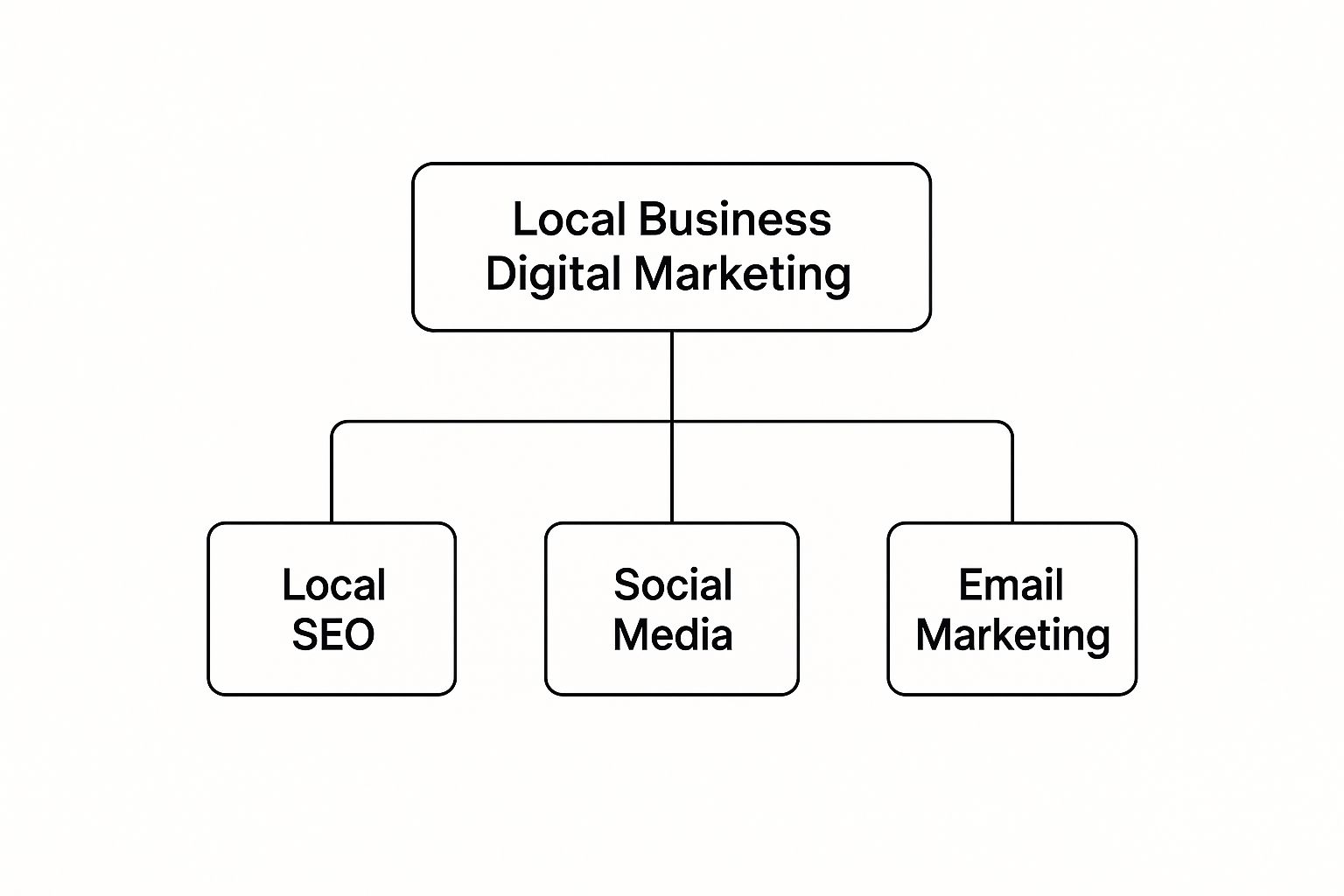
As you can see, a winning strategy is more than just being online—it's about weaving your business into the digital life of your town.
A successful strategy is not just about being online; it's about being integrated into the digital fabric of your local community. It bridges the gap between a customer's online search and their offline purchase.
To make these channels truly effective, you need great customer engagement solutions to build lasting relationships that turn one-time visitors into loyal advocates. This whole approach is a fundamental piece of your company's evolution. To see how it fits into the bigger picture, you can read more in our guide on https://onenine.com/small-business-digital-transformation/.
At the end of the day, local digital marketing is what turns online interactions—like a search on Google Maps or a 'like' on Instagram—into real, measurable growth for your business.
Become the Top Choice with Local SEO
When someone in your neighborhood pulls out their phone and searches for "best pizza near me" or "emergency vet open now," how do they decide where to go? That’s where Local Search Engine Optimization (SEO) comes in. It’s the art and science of making sure your business is the best, most visible answer.
Think of it as earning the top recommendation in your digital neighborhood. It's hands-down the most powerful way to get in front of customers who are actively looking for what you offer, right now.
To win at local SEO, you need to prove three things to search engines like Google: relevance, proximity, and prominence. You have to show that your business is the right fit for the search (relevance), that you're physically close to the person searching (proximity), and that you’re a trusted, well-regarded choice in the community (prominence). Nail these three, and you won’t just be found—you'll be chosen.
The image above gives you a peek behind the curtain at a Google Business Profile dashboard. This powerful, free tool is the absolute cornerstone of any local SEO strategy. It’s your digital storefront on Google, giving you control over how you appear in both Search and Maps.
Your Digital Front Door: Google Business Profile
Your Google Business Profile (GBP) is the single most important piece of the local SEO puzzle. It’s that rich, interactive business card that pops up in Google’s “Local Pack” map results. For many potential customers, it's the very first impression they'll have of your brand. Optimizing it isn't just a good idea; it's essential.
First things first, you need to claim or create your profile. Once you're in, the goal is to fill it out with as much accurate, detailed information as you can. A complete profile signals trust to Google. Make sure you cover:
- Business Name, Address, and Phone (NAP): This information must be perfectly accurate and consistent everywhere it appears online. No exceptions.
- Business Category: Be specific. Instead of just "Restaurant," choose "Italian Restaurant" or "Mexican Restaurant."
- Hours of Operation: Keep them updated! This is especially critical for holidays or special events.
- Photos and Videos: Bring your business to life with high-quality pictures of your space, your products, your team, and your happy customers.
- Services and Products: Clearly list what you offer so people know exactly how you can solve their problem.
This isn’t just busywork—it’s a real competitive advantage. In a market like the U.S., a remarkable 94% of high-performing local brands have a dedicated local marketing strategy, compared to only 60% of average ones. That gap is where you can pull ahead. And with Google holding around 90% of the global search market, mastering its tools isn't really negotiable for growth. You can dig into more eye-opening numbers in this report on local SEO statistics.
Build Trust with Online Reviews and Citations
Beyond your GBP, two other elements have a huge impact on your local ranking: what your customers say about you (reviews) and where you’re mentioned online (citations).
Think of online reviews as the digital version of word-of-mouth. A steady stream of positive, recent reviews sends a powerful signal to both customers and search engines that your business is active, valued, and trustworthy.
Make it a habit to ask your happy customers for feedback. Just as importantly, respond to all reviews, good and bad. It shows you’re listening and that you care about the customer experience.
Next up are citations. A citation is simply any online mention of your business's name, address, and phone number (NAP). These pop up in local business directories, on industry-specific websites, and across data hubs.
- Consistency is Key: Your NAP information has to be identical across every single platform. A tiny difference like "St." versus "Street" can confuse search engines and hurt your visibility.
- Build Relevant Citations: Get your business listed in the big directories like Yelp and Apple Maps, but also seek out niche sites relevant to your industry, like a contractor directory for a plumber.
By meticulously managing your Google Business Profile, encouraging reviews, and keeping your business information consistent everywhere, you build an incredibly strong foundation. It’s how you transform your business from just another pin on the map into the obvious, top choice for local customers.
Build Community with Local Social Media
If local SEO is how new customers find you, social media is how they get to know you. Think of it as your digital town square—the place where you stop being just another business and start becoming a real part of the local fabric. This is where you build genuine relationships that turn first-time visitors into loyal fans who rave about you to their friends.
Platforms like Facebook and Instagram are your direct line to the people in your neighborhood. The goal isn’t to shout about sales or push generic ads. It’s about creating a space for real conversations and making people feel like they belong.
This kind of local business digital marketing goes way beyond just being seen. It's about creating a magnetic presence that keeps people engaged and coming back for more.
Create Content That Truly Connects
The secret to winning at local social media is authenticity. Your content should feel like it comes from a neighbor, not a corporation. Drop the stiff, formal tone and focus on posts that are personal, helpful, and uniquely local.
Here are a few simple ideas to get you started:
- Spotlight Your Customers: With their permission, of course, share a photo of a happy customer using your product or service. It's a fantastic way to show appreciation and provides powerful social proof.
- Go Behind the Scenes: Post a quick video of your team setting up for the day or a snapshot of a new product shipment arriving. It pulls back the curtain and makes your business feel more human.
- Partner with Neighbors: Team up with another local business for a joint giveaway or event. This gets you in front of their audience and strengthens the whole community.
- Ask for Input: Use polls on Facebook or Instagram Stories to let your followers weigh in. A restaurant could ask about potential new menu items, or a boutique could ask which color of a new dress to stock.
These aren't just tricks to fill your feed; they are invitations for your audience to become part of your story. This is what builds a dedicated local following. For more great ideas, check out these powerful social media tips for small businesses.
Platform-Specific Local Strategies
While the big idea is all about community, how you do it will change depending on the platform. The good news? You don't have to be everywhere. Just pick the platforms where your customers hang out and tailor your content to fit right in.
Social media for local businesses isn't about being on every single platform. It's about being somewhere that matters to your community and showing up consistently with content that makes their day a little better.
Let's break down how this works on the two most popular platforms for local businesses.
Facebook for Local Connection
Think of Facebook as the central hub for your local community. It’s perfect for sharing information and bringing people together.
- Events: Are you having an in-store sale, a workshop, or a live music night? Create a Facebook Event. It makes it incredibly easy for people to see what's happening, RSVP, and invite their friends.
- Local Groups: Join and participate in relevant community groups (where the rules allow). A local bakery could pop into a neighborhood group on a Saturday morning to announce that the sourdough is fresh out of the oven.
Instagram for Visual Storytelling
Instagram is all about capturing the look and feel—the vibe—of your business.
- Geotags: Always, always tag your location in posts and Stories. This makes your content pop up when people search for your specific town or even your street.
- Local Hashtags: Use hashtags that locals actually search for, like #dallasfoodie or #brooklyncoffee. This puts your posts directly in front of a super-targeted audience.
By focusing on real interaction and community-first content, your social media profiles become more than just marketing tools. They transform into lively hubs for your neighborhood, driving not just likes and shares, but repeat business and priceless word-of-mouth.
Drive Immediate Traffic with Local Ads
While SEO and social media are fantastic for building a long-term foundation, sometimes you just need to get customers in the door now. That’s where paid local advertising comes in. It’s your business’s express lane, letting you jump right to the front of the line to catch customers who are ready to buy.
Think of it like this: instead of putting a flyer on every car in the parking lot, you get to hand-pick the person who’s actively looking for what you sell and give it to them at that exact moment. Traditional ads cast a wide, expensive net. Local digital ads are all about precision. You can decide exactly who sees your message, which means you’re not wasting your budget on people who live too far away to ever become a customer. This is the magic of geotargeting.
Geotargeting is the secret sauce of effective local ads. It lets you draw a virtual boundary around your business—whether it’s a single mile or the entire city—and show your ads only to people inside that area. This hyper-local approach makes your ads incredibly relevant and ensures every penny you spend is working as hard as possible.
Mastering Local Ad Platforms
When it comes to local ads, two platforms are the heavy hitters: Google Ads and Facebook Ads. They both serve a different, yet equally important, role in your local business digital marketing strategy. Knowing when to use each one is the key to getting the best bang for your buck.
Google Ads are brilliant for capturing intent. You’re reaching people who are literally typing their problems into a search bar, looking for a solution you can provide. When someone searches for "emergency plumber near me," they have a pressing need. A great Google Ad puts your business right at the top, offering an immediate answer.
Facebook Ads, on the other hand, are all about generating awareness and connecting with specific types of people. You can target users by their interests, age, and location, even if they aren't actively looking for you. It's the perfect tool for telling the right local crowd about a weekend sale, a new menu item, or a community event you’re hosting.
Choosing the Right Local Ad Platform
So, where should you put your ad dollars? This quick comparison breaks down the top advertising platforms to help you decide what’s right for your business.
| Platform | Best For | Key Targeting Feature |
|---|---|---|
| Google Ads | Capturing immediate, high-intent search traffic | Keyword and location-based targeting |
| Facebook Ads | Building brand awareness and reaching specific demographics | Interest and behavior-based targeting within a radius |
| Yelp Ads | Reaching customers ready to make a purchase decision | Targeting users actively searching on a review platform |
| Nextdoor Ads | Hyper-local targeting to specific neighborhoods | Sponsoring posts in verified neighborhood feeds |
The goal of a local ad isn't just to get a click; it's to drive a real-world action. Your ad copy and call-to-action should be incredibly direct and helpful.
Forget vague promises. Focus on clear instructions that make the customer’s next step a no-brainer. Use action-packed phrases like "Get Directions," "Call Us Today," or "Book Your Appointment Now."
These simple calls-to-action close the gap between seeing an ad and walking through your door. This is critical, especially when you learn that around 97% of consumers check a company's online presence before visiting in person. You can explore more about how customers behave online with these digital marketing insights from WebFX. With a small, targeted ad spend, you can drive a powerful and measurable return.
Turn Customers Into Loyal Fans with Email and SMS
If ads are how you get noticed and SEO is how you get found, then email and SMS are how you build real, lasting relationships. These channels are so much more than just a way to blast out sales announcements. Think of your subscriber list as your own private club—a direct line to your most engaged and valuable local customers.
The secret to making email and SMS work is to provide genuine value. People are fiercely protective of their inboxes and phone numbers, so you have to give them a really good reason to let you in. This is what effective local business digital marketing is all about: earning trust, not just grabbing attention.

How to Build Your Subscriber List the Right Way
The fastest way to grow your list is to offer something truly compelling right up front. Forget those generic "sign up for our newsletter" pop-ups; they just don't cut it anymore. You need to create an offer that feels like a fair trade for their contact info.
Here are a few proven ways to build your list:
- In-Store Offers: Place a simple sign at your register offering 15% off their purchase today if they sign up for your email list. It’s immediate and tangible.
- Website Pop-Ups (Done Right): Instead of a bland prompt, get specific. A local bakery could offer a free guide titled "The 5 Best Local Coffee Pairings for Our Pastries." Now that's useful.
- Contests and Giveaways: Run a giveaway that’s only for your email or SMS subscribers, like a chance to win a gift card or a brand-new product.
This approach ensures you’re building a list of people who actually want to hear from you, which means better engagement later on. Of course, this all relies on your site running smoothly. It's smart to look into a professional website maintenance service to make sure your sign-up forms and other features are always working perfectly.
Delivering Value That Creates True Loyalty
Okay, so someone trusted you with their email. Great. Now it's your job to prove they made a smart choice. The goal is to send content so helpful and interesting that they actually look forward to hearing from you. Don’t just sell—serve.
Think of each message not as an ad, but as a personal note to your best customers. It's a chance to make their day a little easier, save them a bit of money, or just bring a smile to their face.
Here’s how you can use these channels to turn subscribers into your biggest fans:
Email Marketing Ideas:
- The Neighborhood Insider: Send a weekly email that’s about more than just your business. Feature an upcoming local farmers' market, a charity 5k, or a new exhibit at the town museum. This makes you a valuable community resource, not just a store.
- Exclusive Early Access: Give your email list a 24-hour head start on a big sale or a new product launch before you post it on social media. This rewards them for their loyalty and makes them feel like insiders.
SMS Marketing Ideas:
- Hyper-Local Flash Sales: Text messages are instant, making them perfect for timely deals. A quick text like, "Rainy day? Show this text for a free coffee with any pastry in the next 2 hours!" can drive immediate foot traffic.
- Convenient Reminders: If you run a service business like a salon or auto shop, sending appointment reminders via SMS is a huge help to your customers and dramatically cuts down on no-shows.
By using these channels thoughtfully, you create an amazing feedback loop. You build a core group of loyal customers who not only spend more but also become your most powerful advocates, spreading the word about your business to their friends and family.
Know What Works by Measuring Your Success
So, you've put a local digital marketing plan into action. That’s a great start, but how do you know if it's actually working? Pouring time and money into different channels without tracking what comes back is like shouting into the wind. You need to know if your efforts are really bringing in more customers and boosting your revenue.
The good news is you don't need a fancy analytics degree to figure this out. The trick is to tune out the "vanity metrics"—things like raw follower counts or impressions—that look nice on a report but don't actually impact your business. Instead, you need to focus on the numbers that connect directly to your bottom line.
Key Metrics That Matter for Local Businesses
For a local business, success isn't about going viral worldwide; it's about getting someone from the next neighborhood to walk through your door. Free tools like your Google Business Profile dashboard and Google Analytics are your command centers for seeing what's resonating with people. Don't get overwhelmed—just zero in on the handful of metrics that show a customer is ready to act.
These numbers tell a clear story about what potential customers are doing online right before they decide to visit you or make a purchase.
- Clicks to Call: This is simple: how many people tapped the "Call" button on your Google profile? Every single click is from someone who wanted to talk to you right then and there.
- Direction Requests: This one is huge. It shows you how many people asked for directions to your physical location. It’s one of the best signs that online interest is turning into real-world foot traffic.
- Website Clicks: This tracks how many people clicked from your Google profile over to your website. It means they were interested enough to want to learn more about what you offer.
- Local Keyword Rankings: Where do you show up when someone searches for "plumber in [your city]"? Tracking this tells you how visible you are to the people who are actively looking for your services.
The most powerful data for a local business owner is data that proves a digital interaction led to a real-world transaction or visit. Measuring direction clicks is more valuable than measuring thousands of impressions from users who live 500 miles away.
By keeping an eye on these key performance indicators (KPIs), you get a clear, honest picture of which strategies are actually bringing people to you. Of course, managing all of this—from tracking analytics to making sure your website forms work correctly—takes time. That's why having a solid partner for your website management can be a game-changer, freeing you up to do what you do best: run your business.
Turning Data into Actionable Decisions
Once you start gathering this data, you can stop guessing and start making smart, informed decisions. Your metrics will give you clear answers to your biggest marketing questions.
Let's walk through a simple example. Imagine you run a local Italian restaurant. You notice that your "Clicks to Call" numbers jump every Tuesday. After a little digging, you realize that's the day you always post your weekly specials on your Facebook page.
That insight is pure gold. It tells you your Facebook posts are directly driving phone calls, which are likely for reservations or takeout orders. With this information, you could decide to:
- Double Down: Maybe you post about the specials more often or put a small ad budget behind that Tuesday post to reach even more local foodies.
- Expand the Strategy: You could try a similar post on Instagram to see if you get the same great results on another platform.
- Optimize the Offer: Perhaps you could test different specials. Does lasagna get more calls than ravioli? Now you can find out.
This is the cycle at the heart of all successful local marketing: act, measure, and refine. When you pay attention to what the data is telling you, you can confidently put your resources where they’ll make the biggest difference, making sure every dollar you spend is a smart investment in your growth.
Your Local Marketing Questions Answered
Jumping into local business digital marketing can feel overwhelming, and it’s natural to have a lot of questions. Business owners I talk to are often thinking about the same things: "How much will this cost?", "Where do I even start?", and "What happens when I get a bad review?"
Let's clear the air and tackle these common concerns head-on. The answers are usually more straightforward than you’d think, and getting them right will help you build a solid plan and sidestep the pitfalls that trip up other businesses.
How Much Should I Budget for Marketing?
There's no magic number here, but a reliable rule of thumb is to set aside 5-10% of your total revenue for marketing. If you're just getting started or the budget is tight, begin with the high-impact activities that don't cost a dime.
Start by completely filling out your free Google Business Profile. Then, make a habit of asking customers for reviews and posting regularly on one or two social media channels where your customers hang out. Once you see a return from these foundational steps, you can start reinvesting that income into things like paid local ads to really kickstart your growth.
Which Marketing Channels Should I Focus on First?
For almost any local business, your first priority should be Local SEO. And the absolute heart of Local SEO is your Google Business Profile (GBP). Think of it as your digital storefront—it's the main tool local customers use to find and choose businesses, so getting it right is non-negotiable.
After you’ve optimized your GBP, pick one social media platform to master. Find out where your ideal customers spend their time—for most local businesses, that's going to be Facebook or Instagram. The trick is to get really good at these two core channels before you stretch yourself too thin trying to be everywhere.
Responding thoughtfully to a negative review can sometimes be more powerful than receiving a positive one. It shows prospective customers that you are engaged, professional, and genuinely committed to providing excellent service, turning a potential negative into a display of your company's integrity.
How Do I Handle Negative Online Reviews?
First, don't panic. Take a deep breath and resist the urge to fire back a defensive reply or, even worse, ignore it completely. A negative review isn’t a catastrophe; it’s an opportunity to show everyone what your business is made of.
Your game plan is simple: respond quickly, publicly, and professionally. Acknowledge their frustration and apologize that their experience wasn't up to par—you don’t have to admit fault. Then, immediately offer to take the conversation offline to find a solution.
Something as simple as, "We're sorry to hear your experience didn't meet your expectations. Please give us a call at [phone number] so we can make this right," works perfectly. It shows you care, and it shows you're proactive about fixing problems.
At OneNine, we simplify the complexities of your digital presence so you can focus on running your business. From custom web design to ongoing management, we are your dedicated partner in digital success. Learn more at https://onenine.com.


