

Improving your business's efficiency boils down to a pretty simple idea: streamline your processes, get the right tech on your side, and empower your people. It’s all about working smarter, not just piling on more hours. By cutting out the waste and zeroing in on activities that actually drive growth, you can turn your daily operations from a cost center into a real competitive advantage.
What Business Efficiency Really Means Today
For a long time, the conversation about business efficiency was stuck on one thing: cutting costs. While saving money is definitely a nice perk, modern efficiency is about so much more. It's about building an organization that's resilient, agile, and runs on smart workflows and data-backed insights. We're not talking about quick fixes; we're talking about building a foundation for sustainable growth.
This isn't just about doing more with less. It's about doing the right things with the resources you have. It means moving from a reactive mode—always putting out fires—to a proactive one where you're constantly optimizing.
Moving Beyond Outdated Ideas
The old way of thinking about efficiency often meant top-down orders to squeeze every last bit of productivity out of a department, which usually tanked morale and quality. The modern approach is much more collaborative and holistic. It’s built on a few key pillars that work together to create real, lasting value.
To get a clearer picture, I've broken down these core strategies into what I call "The Four Pillars of Modern Business Efficiency." This table shows you exactly what actions to take and what you can expect in return.
The Four Pillars of Modern Business Efficiency
| Pillar | Key Actions | Expected Outcome |
|---|---|---|
| Intelligent Automation | Use tools to handle repetitive, low-value tasks like data entry or scheduling. | Frees up your team for creative, strategic, and customer-facing work. |
| Data-Driven Decisions | Replace guesswork with real-time analytics for marketing, inventory, and strategy. | More accurate forecasting, reduced waste, and higher ROI on investments. |
| Team Empowerment | Create a culture where employees are encouraged and equipped to find and fix bottlenecks. | Faster problem-solving, higher engagement, and continuous, ground-up improvement. |
| Long-Term Sustainability | Integrate practices that reduce waste and improve resource management. | Lower operational costs and a stronger, more responsible brand reputation. |
By focusing on these four areas, you're not just making small tweaks. You're building a fundamentally stronger, more capable business from the inside out.
The impact of these initiatives is significant. This chart breaks down the average savings, time recovered, and productivity boosts you can realistically expect.
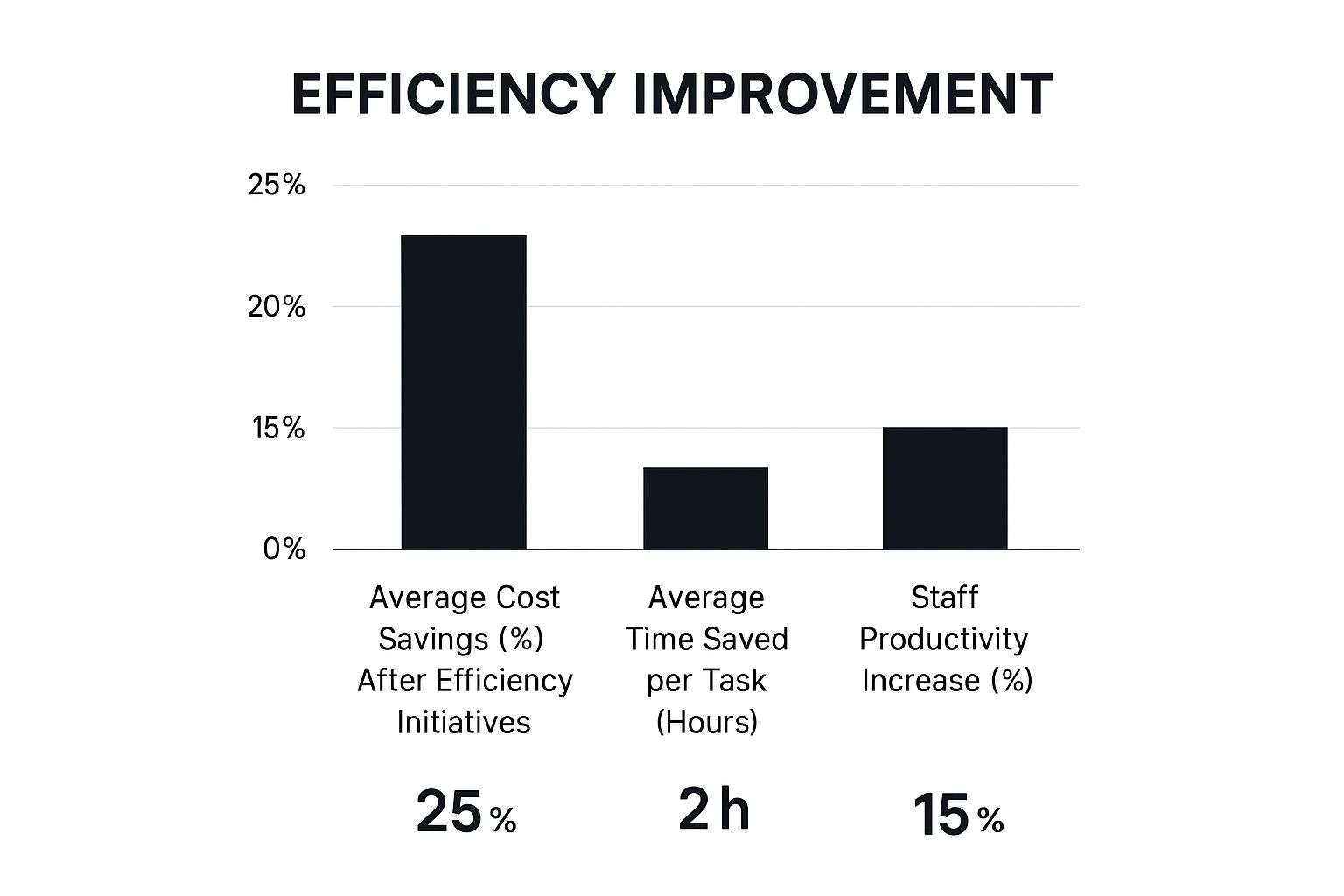
As you can see, the gains aren't just marginal—they directly impact your time, money, and overall output in a big way.
The Strategic Shift to Smarter Operations
This push for a smarter way of operating isn't just a niche idea; it's a major trend. A recent survey found that half of all business leaders plan to increase their spending on automation and better data analytics. And the results speak for themselves. The top-performing companies that grew their profit margins by 5% or more were 1.3 times more likely to have a highly engaged and productive workforce. This shows a clear link between efficiency, profitability, and employee satisfaction. You can explore the full findings on business leader priorities at HLB.global to dig deeper into the data.
By framing efficiency as a core strategy, you move it from a one-time project to a continuous cycle of improvement. It becomes part of your company's DNA, creating a competitive edge that is difficult for others to replicate.
Ultimately, learning how to improve business efficiency is about creating a system where every part of your organization—your people, your processes, and your technology—works in perfect harmony. The following sections will give you a clear roadmap to make that happen.
Streamline Operations with Intelligent Automation

One of the best ways to boost your business's efficiency is to win back the hours lost to tedious, manual tasks. Just think about the daily grind—all those little repetitive jobs that chip away at your team's energy and focus. Intelligent automation is how you reclaim that precious time.
This isn't about replacing your people. It's about freeing up your talented team to do what they do best: creative, strategic work that requires a human touch. Let automation handle the predictable, rule-based stuff so your employees can solve bigger problems and push the business forward.
Pinpointing Your Biggest Time Drains
Before you can automate anything, you have to figure out where the friction is. The easiest way to do this is with a simple workflow audit. Don't worry, this isn't some massive undertaking. It's just a practical look at how work actually gets done.
Get your team together and ask some straightforward questions:
- What tasks do you do every single day or week that feel like you're on autopilot?
- Where are you spending the most time just copying and pasting information between systems?
- Which processes have the most steps and are the most likely to cause errors?
The answers will shine a spotlight on your biggest bottlenecks. You’ll probably spot common culprits right away. For instance, your marketing team might be spending hours manually scheduling social media posts, while the finance department is drowning in individual invoice processing.
Your goal is to identify low-value, high-frequency tasks. Automating a task that takes 15 minutes but is done 20 times a day delivers a much bigger impact than automating a complex task that only happens once a month.
Once you have a list, you can start prioritizing. The best place to start is with tasks that are both time-consuming and follow a clear, predictable pattern. These quick wins build momentum and show everyone on the team the real-world value of automation.
Practical Automation Examples Across Departments
Automation isn’t just a buzzword; it's a hands-on tool you can use in nearly every part of your business. The idea is to create a "before and after" where processes become faster, more accurate, and less of a headache for everyone.
Here’s how automation can transform different departments:
- Marketing: Instead of posting on every platform by hand, you can use a tool to schedule a month's worth of content in one sitting. To really get a handle on this, you can use specific social media automation tools that match your strategy.
- Sales: Manually sending follow-up emails is a recipe for missed opportunities. A good CRM can trigger a timed email sequence to nurture leads based on their behavior, ensuring no one falls through the cracks.
- Finance: Processing invoices manually is a classic time sink. Automation software can pull data from incoming invoices, check it against purchase orders, and send it for approval without anyone lifting a finger.
Each of these examples is a direct upgrade to your business efficiency, saving time while also cutting down on the risk of expensive human errors.
Choosing the Right Automation Tools
The market for automation tools is huge, but you don't need a complex or pricey system to get started. The trick is to pick tools that fit your specific needs and budget.
Here’s a look at the common types of tools and how to approach them:
- Workflow Connectors (Zapier, Make): These are the perfect starting point. They act like a bridge between the apps you already use, creating simple "if this, then that" workflows. For example, if a customer fills out a website form (the "this"), their info is automatically added to your CRM and email list (the "that").
- Department-Specific Software (CRMs, ERPs): These are more powerful, all-in-one solutions. A Customer Relationship Management (CRM) system can automate your entire sales pipeline, while an Enterprise Resource Planning (ERP) system centralizes data across finance, inventory, and operations to improve accuracy and slash manual work.
- AI-Powered Assistants: Newer tools are using AI to tackle more complex jobs, like automatically categorizing customer support tickets or drafting replies to common questions.
When you're ready to pick a tool, start small. Run a pilot program with a single team or process. Measure the time saved and errors reduced to see the "before and after" impact. This data-driven approach ensures you’re investing in solutions that deliver a real return and truly make your business run better.
Make Smarter Decisions with AI and Data
The image above really gets to the heart of a major shift in business: we're no longer just collecting data. We’re putting it to work with AI to get a real competitive edge. Moving away from gut-feel decisions toward choices backed by solid data is a game-changer for business efficiency.
It’s not just about automating a few tasks, either. AI and data analytics are fundamentally changing how we make decisions. These tools help you see what’s coming, understand your customers on a much deeper level, and put your resources exactly where they need to go. And the best part? You don't need a team of data scientists to start.
Today's AI solutions are surprisingly accessible, built to help businesses of all sizes turn a confusing flood of data into a strategic advantage. It's all about making smarter, faster decisions that directly improve how your business runs.
From Reactive to Predictive Operations
The real magic of AI isn’t just seeing what's happening now—it’s about predicting what’s likely to happen next. By digging through historical data, AI models can spot subtle patterns that a person would easily miss. This lets you shift from constantly reacting to problems to proactively predicting them.
Think about the practical applications across your business:
- Sales Forecasting: Go beyond just looking at last quarter's numbers. AI can analyze market trends, seasonal demand, and even what your competitors are doing to create incredibly accurate sales forecasts. This makes managing inventory and staffing so much easier.
- Supply Chain Optimization: Machine learning can predict potential bumps in your supply chain, suggesting alternate suppliers or adjusting stock levels before a delay ever happens.
- Personalized Customer Experiences: AI can analyze customer behavior to figure out what they truly want, letting you serve up personalized recommendations or marketing that actually resonates and drives sales.
This forward-thinking approach is a direct path to better efficiency. You’re preventing problems before they start, which saves an incredible amount of time, money, and headaches.
By anticipating future needs and challenges, you can allocate your resources much more effectively. Instead of constantly reacting to problems, you’re strategically preparing for opportunities, which is a far more efficient way to run a business.
Putting Accessible AI Tools to Work
The thought of implementing AI might sound daunting, but many of today's best tools are surprisingly user-friendly. They often plug right into the systems you already use, giving you actionable insights without needing any coding knowledge. For a closer look at how these technologies are shaping business, it’s worth exploring the latest AI technology and innovation trends.
The numbers speak for themselves. In 2025, AI adoption among companies shot up to 72%. An incredible 92.1% of businesses using AI reported real productivity gains in key areas like maintaining data accuracy (48%), optimizing production (24%), and even boosting cybersecurity (23%).
Data as Your Most Valuable Asset
At the end of the day, every good business decision comes down to having the right information at the right time. AI-powered tools are the perfect filter, helping you zero in on the data that truly matters for business efficiency.
Just look at these real-world examples:
- A retail store uses an AI-powered system to manage inventory. It analyzes sales data, local weather forecasts, and upcoming holidays to recommend exactly how much of each product to stock. This simple change drastically reduces waste from overstocking and lost revenue from stockouts.
- A service company analyzes customer support tickets with an AI tool. The tool spots recurring issues and gives the support team ready-made, effective solutions, cutting down response times and flagging areas where the service itself needs improvement.
- A manufacturing plant puts AI-powered sensors on its equipment to predict maintenance needs. Instead of a machine breaking down and halting the entire production line, the system flags a potential problem ahead of time so maintenance can be scheduled during off-hours.
In every case, data and AI are teaming up to make operations smoother, smarter, and more cost-effective. These aren't futuristic ideas; they're practical tools you can use today to see a real jump in performance. Learning about different business process improvement methods can also give you a great framework for putting these data-driven strategies into action. When you treat your data like a key asset and use AI to unlock its potential, you build a more resilient and efficient company ready for growth.
Empower Your Team to Drive Productivity

Smart software and slick automation are fantastic, but they're only half the story. The real engine of business efficiency? Your people. Any lasting improvement you make to your business is built on the foundation of an empowered, engaged, and motivated team. Investing in your people isn’t just a nice-to-have; it's a direct investment in your company’s performance.
When employees feel trusted and valued, they stop being just participants and start acting like owners of their work. That shift is everything. An empowered team is one where individuals feel confident enough to point out bottlenecks, suggest a better way to do things, and solve problems without waiting for a command from the top. It’s this ground-up innovation that creates a culture of continuous improvement—something technology alone can't buy.
Foster a Culture of Ownership and Transparency
Building an empowered team begins with an environment of trust. When your team has a clear line of sight to project goals and company objectives, they can connect their day-to-day tasks to the bigger picture. That context is a powerful motivator.
This is where project management tools like Asana or Trello really shine. They do more than just track tasks; they create a central hub where everyone can see progress, understand how their work affects others, and contribute ideas. This kind of transparency breaks down the walls between departments and gets everyone pulling in the same direction.
When your team members see themselves as problem-solvers rather than just task-doers, your organization's capacity for innovation and efficiency grows exponentially. They become your eyes and ears on the ground, spotting opportunities for improvement that leadership might miss.
To really make this stick, leaders have to actively encourage feedback. It can be as simple as a dedicated Slack channel or a weekly "what can we do better?" meeting where people can share insights without fear of criticism. And when an employee’s idea leads to a real improvement, celebrate that win publicly. It reinforces that their contributions matter and inspires others to speak up.
Set Clear Goals and Provide the Right Tools
Empowerment doesn't mean a free-for-all. It's about giving people clear direction and the right resources to get the job done. One of the best frameworks I've seen for this is setting Objectives and Key Results (OKRs).
OKRs provide a simple but powerful structure:
- Objective: The high-level, inspiring goal. For example, "Become the gold standard for customer satisfaction in our industry."
- Key Results: The specific, measurable outcomes that prove you hit the objective. Things like, "Reduce average customer response time by 25%" or "Increase our Net Promoter Score from 40 to 55."
This approach gives teams autonomy over how they achieve their goals while making sure their efforts align with the company's priorities.
Alongside clear goals, you have to provide the right tools and training. Equipping your team with new skills doesn't just improve their performance; it shows you’re invested in their growth. That investment pays you back in higher engagement and lower turnover. As your business scales, your team's skills should scale right along with it.
For instance, if your website is central to your business, helping your team understand its performance can lead to huge wins. Our detailed guide on website performance optimization is a great place to start, empowering your marketing and tech teams to make smarter, data-driven improvements.
The Real-World Impact of an Empowered Workforce
The link between an engaged team and an efficient business is crystal clear. Companies that trust their people and give them the right resources consistently run circles around their competition.
I once worked with a company drowning in customer support tickets. Instead of just hiring more agents, they empowered their existing team. They gave them better training and the authority to issue credits up to a certain amount without needing a manager's approval.
The results were immediate. Customer issues were resolved in a single call, satisfaction scores went through the roof, and the support team felt more fulfilled in their roles. This simple shift in trust and autonomy created a far more efficient operation. By focusing on the human side of the equation, you don't just fix a workflow; you build a more resilient, innovative, and productive organization from the inside out.
Think Sustainably for Long-Term Wins
When we talk about improving business efficiency, our minds usually jump to new software or automation. But one of the most powerful and often overlooked strategies is weaving sustainability into your daily operations. This isn't just about good PR—it's about making smart financial moves that slash costs and strengthen your bottom line.
If you start looking at sustainability as an efficiency play, you'll uncover a ton of opportunities. Instead of treating it like a separate "green" initiative, see it for what it really is: a direct route to using resources more wisely, cutting waste, and building a more resilient business.
The Financial Upside of Going Green
At its heart, sustainability is the ultimate form of resource management. When you reduce waste—whether it’s energy, raw materials, or even time—you directly lower your operating expenses. It's a clear win-win, delivering benefits for both the planet and your profit margin.
This mindset is quickly becoming mainstream. In fact, for 2025, embedding sustainability and ESG (Environmental, Social, and Governance) principles is a core strategy for top-performing companies. We’re seeing more businesses embrace circular economy models, where reusing resources is incentivized. Leaders like Patagonia and Levi's have built buy-back programs that cut down on raw material costs while creating entirely new revenue streams from pre-owned goods. You can dive deeper into these 2025 business trends at Quantive.com.
The smartest environmental decisions are very often the smartest financial ones. Every kilowatt of energy saved, every bit of packaging eliminated, and every piece of equipment repaired instead of replaced drops directly to your bottom line.
This approach shifts your business from a linear "take-make-dispose" model to a circular one. Keeping resources in play for as long as possible isn't just a trend; it's a cornerstone of modern business efficiency.
Practical Steps to Sustainable Efficiency
You don't need a massive, budget-busting overhaul to get started. Real change often begins with small, practical steps that yield tangible results. Many of these initiatives are surprisingly easy to implement and can pay for themselves faster than you'd think.
Here are a few ideas you can act on right away:
- Run an Energy Audit: Pinpoint where your electricity is really going. Simple fixes like switching to LED lighting, installing smart thermostats, and making sure equipment is fully powered down overnight can make a serious dent in your utility bills.
- Trim Supply Chain Waste: Take a good, hard look at your packaging. Can you use lighter materials? Can you redesign boxes to be more compact? Reducing packaging not only saves on material costs but often lowers your shipping expenses, too.
- Optimize Your Routes: If you have a logistics arm, it's time to get smarter with your routes. Route optimization software ensures your delivery vehicles use the most efficient paths, saving fuel, time, and emissions.
These are the kinds of foundational steps involved in a small business digital transformation, where you use simple tech to build smarter, more efficient workflows.
From Cost Center to Revenue Stream
True sustainability moves beyond just cutting costs and into generating new revenue. This is where the circular economy model gets really exciting. By rethinking what "waste" is, you can create new income from things you used to throw away.
Here’s how it looks in the real world:
- Retail Take-Back Programs: A clothing shop could offer customers a discount on a new item when they bring in old clothes. Those used garments can then be repaired and sold in a special pre-owned section, creating a brand-new revenue stream from existing products.
- Equipment Repair & Refurbishment: Instead of defaulting to replacement, a manufacturing firm could build a solid repair and maintenance program. This extends the life of expensive machinery, dramatically cutting capital expenditures over the long run.
When you adopt these circular strategies, you're not just plugging financial leaks—you're building new pipelines for profit. You're turning a smart cost-saving measure into a core part of your business model, all while building a brand reputation that today's conscious consumers will love.
Got Questions About Business Efficiency? We’ve Got Answers.
As you start putting these ideas into practice, you're bound to have some questions. That's a good thing. Improving how your business runs is an ongoing process, not a one-and-done task. Hitting a few snags along the way is just part of the journey.
Think of this section as a quick-reference guide for those common "what now?" moments. We’ll cover where to begin, how to figure out if a new tool is actually worth the money, and that classic debate: do you go for an all-in-one platform or pick and choose the best tools for the job? Let's dive in so you can move forward with confidence.
Where Should a Small Business Start?
When you're a small business, looking at all the ways to improve efficiency can feel like trying to drink from a firehose. My advice? Start small. Forget about trying to fix everything at once.
Instead, kick things off with a simple workflow audit. Sit down with your team and pinpoint the single most frustrating, time-sucking task you do every week. Maybe it's manually copying data from one spreadsheet to another, or perhaps it's answering the same five customer questions all day, every day.
Your goal is to find that one high-impact task and streamline it first. Getting a quick win on the board shows your team that this stuff actually works, builds momentum, and frees up your time and money to go after the next bottleneck.
This focused approach gets you a real, tangible return fast, which makes it much easier to justify spending more on efficiency down the road.
How Do I Measure the ROI of a New Tool?
Spending money on new software is a big decision, and you have to know if it's paying off. To really measure the return on investment (ROI), you need to get a clear picture of what things look like "before" and "after."
Before you roll out anything new, benchmark your current process. Pick a few key performance indicators (KPIs) that directly relate to the problem you're trying to solve.
- Time Spent: How many hours a week does this task really take? Be honest.
- Error Rate: How often do mistakes happen that require a do-over?
- Cost Per Action: Can you put a rough dollar amount on what it costs to complete the task once?
Once the new tool is in place, track those exact same numbers for at least a month, maybe even three. The ROI is the value you gained (like hours saved multiplied by your team's hourly rate) minus what the tool costs. Don't forget the "soft" benefits, either—things like happier employees and more satisfied customers are huge long-term wins.
All-in-One Systems vs. Specialized Tools: Which is Better?
This is a crossroads every growing business faces: do you buy one big system that does everything, or assemble a toolkit of specialized apps? There’s no single right answer—it really comes down to your business's complexity right now and where you see it going.
An all-in-one system, like a big Enterprise Resource Planning (ERP) platform, keeps all your data in one place and ensures everything talks to each other perfectly. That’s powerful, but these systems can be a serious investment, hard to customize, and often come with a monster learning curve.
On the flip side, using a handful of specialized, best-in-class tools—think Slack for team chat, Asana for projects, and Xero for accounting—gives you incredible flexibility. It's usually cheaper to start, and you get the best possible solution for each part of your business. You can then use a service like Zapier to make them work together.
For most small and medium-sized businesses, I find that starting with specialized tools is the most practical way to go. You can always graduate to a bigger, all-in-one system later on if your operations get complex enough to need it.
Ready to stop worrying about website management and start focusing on growth? At OneNine, we handle the design, development, and maintenance so you can get back to what you do best. Let us build and manage a high-performance website that drives your business forward. Learn more about our services.


