

Ever wondered how some agencies seem to do it all, offering top-tier web development alongside their other services without a massive team? The secret is often white label website development.
Think of it like the generic brand at the grocery store. A big-name manufacturer produces the product, but the store puts its own label on it and sells it as their own. In the agency world, this means you can sell website creation services that are actually built by a specialized, third-party partner. You get to offer expert web development to your clients under your own brand, without the headaches and costs of hiring an in-house team.
Understanding the Core Business Model
At its heart, this is a strategic partnership built for growth. It lets your agency shine at what it does best—managing client relationships, nailing down strategy, and closing deals—while a dedicated partner handles all the technical heavy lifting behind the curtain.
This relationship works because of three key players, each with a very clear role.
First, there's your agency. You're the face of the project. You manage the client, define the strategy, and act as the single point of contact. From your client's perspective, you and your team are building their website from scratch.
Next up is your client. They have a business need and a vision for a new website, and they've come to you for your expertise. They provide the requirements and feedback, but their entire experience is with your agency, which builds trust and reinforces your brand's authority.
Finally, there's the white label partner—the silent engine. This expert team of developers and designers builds the website based on the exact specs you provide. They are completely invisible to your client, working as a seamless extension of your own team.
The Key Players and Their Roles
This model only succeeds when everyone knows their part.
- Your Agency: You own the client relationship. You handle all communication, project scoping, and the final sign-off and delivery.
- The White Label Partner: They are the builders. Their job is to execute the technical side of things, from writing the first line of code to pushing the site live.
- The Client: They provide the initial brief and have the final say on approving the finished website.
This structure allows you to instantly add a highly-skilled development department to your agency without the immense cost and time associated with hiring. You bypass recruitment, salaries, benefits, and training, immediately gaining the ability to take on more complex and profitable projects.
The opportunity here is massive. The global web development market is on track to hit USD 134.17 billion by 2031, and partnerships like these allow smaller agencies to grab a piece of that pie. In fact, agencies that use white label services often cut their operational costs by up to 35% while simultaneously growing their revenue. You can dive deeper into the web development market trends to see the full picture.
This strategic delegation is what makes white label development such a powerful tool for scaling. It lets you expand your service offerings overnight, turning what used to be a bottleneck into a real opportunity for growth.
White Label Partner vs In-House Team At a Glance
Making the decision between building an in-house team and working with a white label partner can be tough. This table breaks down the key differences to help you see which path makes more sense for your agency's goals.
| Factor | In-House Team | White Label Partner |
|---|---|---|
| Cost | High upfront & ongoing (salaries, benefits, overhead) | Lower, predictable, project-based or retainer costs |
| Speed to Market | Slow (hiring, onboarding, training can take months) | Immediate (access to a skilled team from day one) |
| Scalability | Difficult (scaling up or down requires hiring/firing) | Easy (scale project volume up or down as needed) |
| Expertise | Limited to the skills of your current employees | Access to a wide range of specialists (devs, designers, QA) |
| Management | High (direct supervision, HR, resource management) | Low (partner manages their own team and workflow) |
Ultimately, a white label partner gives you the power and expertise of a full development team without the long-term commitment and financial burden, offering a more flexible and often more profitable path to growth.
What You Really Gain from a White Label Partnership
Think of a white label partnership less as outsourcing and more as a strategic power-up for your agency. It's a calculated move to grow faster, make more money, and broaden what you can offer clients—all without the usual headaches of expansion. You stop being just a service provider and start becoming a more formidable, strategic player in your market. The benefits aren't just theoretical; they can genuinely reshape how you operate, almost overnight.
The most obvious win is saving a ton of money. Building a good in-house dev team is incredibly expensive. You’re on the hook for recruiter fees, six-figure salaries, benefits, new laptops, and constant training just to keep their skills sharp. A white label partnership wipes those costs right off your balance sheet.
Your financial model flips from a fixed overhead to a variable one. You only pay for development when you’ve got a client paying you for it. This simple shift turns a huge financial burden into a manageable, project-by-project expense, freeing up cash you can pour back into what really grows your agency: sales and marketing.
Scale Your Agency at a Moment's Notice
Ever passed on a huge, exciting project because you knew your team was already swamped? That’s a frustratingly common ceiling for growing agencies. A white label partner doesn't just raise that ceiling; it completely shatters it.
Suddenly, it doesn’t matter if you land one new website project or ten in a month. Your partner has the team and the processes to handle the surge. This kind of agility changes everything.
- Go after bigger fish: You can confidently pitch those enterprise-level clients, knowing you have the technical firepower to deliver on your promises.
- Ride the revenue waves: Effortlessly manage the natural ebb and flow of project work without the stress of hiring for a rush and firing in a lull.
- Stop saying "no" to money: Your capacity to take on new work is no longer a bottleneck, so you can convert more of your leads into paying clients.
This flexibility means your growth is finally tied to your ability to sell, not your ability to hire. You can scale your revenue without having to scale your payroll.
A white label partnership transforms your business from a company with a fixed capacity to an agency with limitless potential. You get to operate like a big-name shop but keep the lean, agile structure of a small one.
Get Instant Access to Niche Experts
The web development world moves fast. One minute everyone wants WordPress, the next it’s all about complex Shopify builds or slick Webflow animations. Expecting your in-house team to be masters of everything is a recipe for burnout and mediocre work.
Working with a white label partner is like having a deep bench of specialists on speed dial. Their entire business is staying on top of these platforms. This means you can sell a complex Shopify Plus migration or a highly technical custom build with total confidence, knowing the team executing it has done it a hundred times before.
This isn't just about offloading work; it's about elevating your role. You become the trusted advisor who can recommend the absolute best solution for your client's problem, backed by a team that can build it perfectly.
Speed Up Timelines and Pad Your Margins
Faster delivery means happier clients and healthier cash flow. It’s that simple. White label teams live and breathe development; their workflows are fine-tuned machines built from experience on hundreds of projects. They can almost always build and launch a site faster than an in-house developer who’s also juggling client calls, marketing tasks, and internal meetings.
This efficiency goes straight to your bottom line. Agencies that partner with a white label provider can slash the recruitment and HR costs that often eat up 35% of their operational budget. This model allows for healthy 60-100% markups on the wholesale development cost, with many agencies seeing an average revenue jump of 47% in their first year. For a closer look at the numbers, check out these web design industry statistics.
By letting the experts handle the technical heavy lifting, your team is free to focus on its core strengths: strategy, client relationships, and winning the next deal. It’s a powerful formula for building a more profitable, sustainable agency.
How the White Label Development Process Works
Think of a white label website project like a perfectly executed relay race. You, the agency, run the first and last legs—handling all the client communication and strategy. Your white label partner takes the baton for the technical middle leg, sprinting through the build before handing it back to you for the final delivery.
This setup lets you maintain complete control over the client relationship while tapping into specialized development expertise behind the scenes. The whole process typically breaks down into four key stages, keeping the project on track and preventing the dreaded "scope creep" that can sink even the best-laid plans.
Stage 1: You Run the Client Discovery and Scoping
This is your time to shine. As the client-facing expert, your job is to get inside your client's head. You're not just asking about their favorite colors; you're digging deep to understand their business goals, who their customers are, and exactly what the website needs to do.
Your main goal here is to craft a comprehensive project brief. This document is the blueprint, the single source of truth for the entire build. A solid brief nips misunderstandings in the bud and gets everyone rowing in the same direction.
A great brief usually nails down these key areas:
- Business Goals: What's the point of the site? Is it to generate leads, sell products, or act as an information hub?
- Target Audience: Who are we building this for? What do they need and expect?
- Functional Requirements: A checklist of all the must-have features, like contact forms, e-commerce functionality, or a blog.
- Design Inspiration: Examples of websites the client likes, plus all their brand assets—logos, fonts, and color palettes.
Stage 2: The Seamless Handoff to Your Partner
Once the client has signed off on the brief, it's time to pass the baton. This isn’t just about forwarding an email. A clean, organized handoff is what sets an efficient project in motion.
You’ll likely use a shared project management tool like Asana, Trello, or Jira for this. You'll set up the project, upload all the assets—the brief, brand guidelines, content, and images—and officially assign the work. This creates one central place for all communication and progress tracking.
The quality of your handoff directly impacts the project's timeline and budget. A thorough brief and organized assets allow your partner to start development immediately, avoiding delays caused by back-and-forth questions.
Stage 3: Your Partner Executes the Design and Development
With the blueprint in hand, your partner gets to work. This is where the technical magic happens as they turn your client’s vision into a real, working website. While they're deep in the code, your role shifts to project manager and quality control lead.
They'll follow a pretty standard workflow:
- Wireframing and Mockups: First, they’ll create the initial designs for you to review. You’ll get client feedback and approval before a single line of code is written.
- Development: Once the designs get the green light, the developers build the site on a private staging server.
- Internal QA: Their team will then put the site through its paces, testing for bugs, checking browser compatibility, and making sure it looks great on all devices.
You act as the single point of contact, the bridge between your client and the dev team. You’ll present the mockups, gather feedback, and relay it back. It keeps communication clean and reinforces your role as the project leader.
This diagram shows how this partnership provides key strategic advantages for your agency.
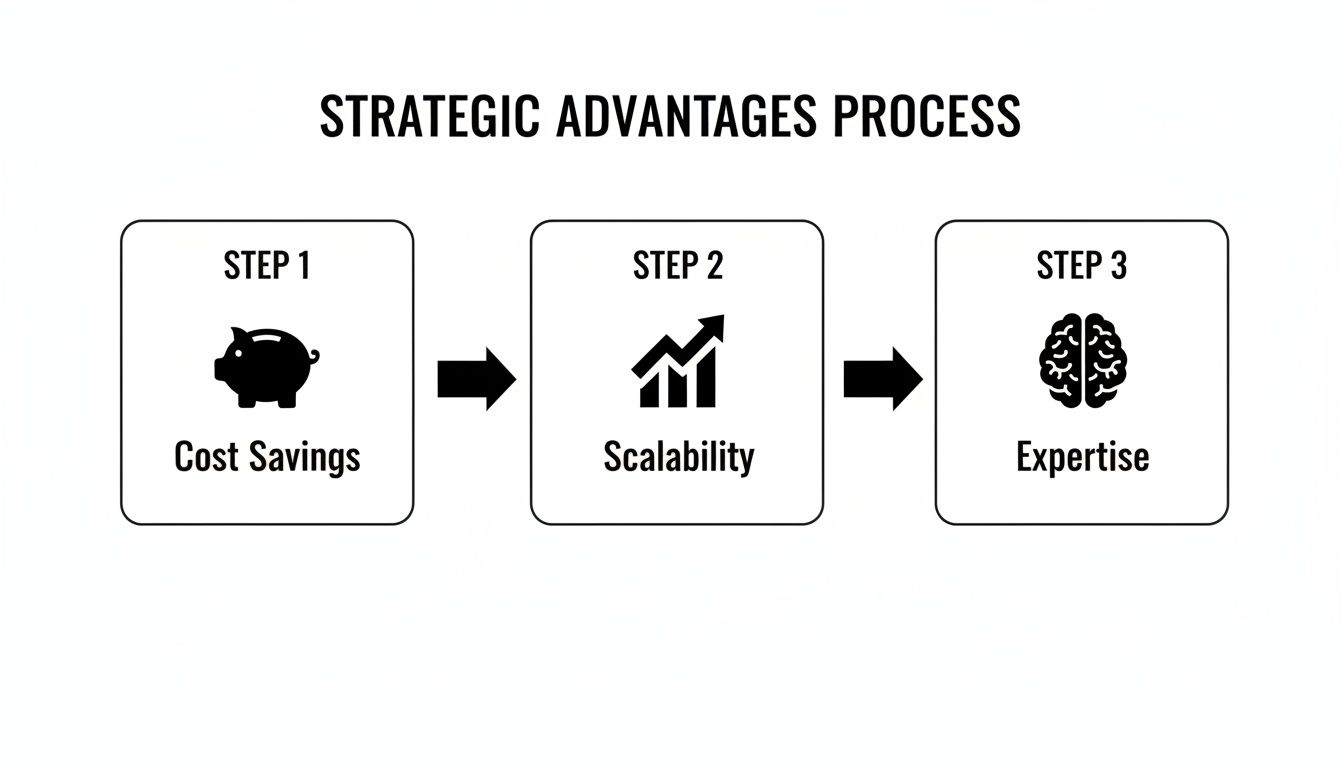
As you can see, the process creates a powerful growth engine, where cost savings lead to easier scalability, all fueled by specialized expertise.
Stage 4: The Final Launch and Handover
We're on the home stretch. This final stage is all about review, approval, and going live. Your partner will give you a link to the finished website on a staging server for your final inspection.
You'll do a thorough click-through, making sure every last detail matches the project brief. Once you’re happy with it, you present it to your client for their final sign-off.
After they give the thumbs-up, your partner handles the technical side of migrating the site to the live server. And just like that, the website is live. The project is complete, and you can now transition your client to a monthly maintenance plan—opening up a whole new recurring revenue stream for your agency.
Picking the Right Tech for Your Client's Website
Think of choosing the right technology for a client's website like a chef picking the right knife—the tool has to be perfect for the job. As an agency, your guidance here is what elevates you from a simple order-taker to a true strategic partner. Your white label team can build on almost any platform, but it’s your job to connect the client’s business goals to the best possible technology.
This decision goes far beyond aesthetics. It's about setting them up for long-term success. The right Content Management System (CMS) can make or break a project's budget, timeline, and ability to grow in the future. That’s why getting a solid grasp on the most popular platforms is so important.
WordPress: The King of Flexibility
There's a good reason WordPress powers a massive chunk of the internet. It's open-source, which means the customization possibilities are practically endless. Imagine a massive box of high-quality building blocks—you can build anything from a simple five-page brochure site to a sprawling membership portal or a detailed e-learning platform.
This adaptability makes it a safe bet for many agencies. A skilled white label partner can build custom themes and plugins from the ground up, giving your client a truly unique site that isn’t boxed in by the limitations of a pre-made template.
- Best for: Content-heavy sites like blogs, news portals, corporate websites, and any business that needs very specific, custom-built features.
- Key Advantage: A massive ecosystem of plugins and a huge developer community mean you can add almost any functionality you can dream up.
- Potential Limitation: With great power comes great complexity. It needs proper management and security to stay safe, making a knowledgeable partner absolutely essential.
Shopify: The E-commerce Powerhouse
When the main goal is selling products online, Shopify is almost always the answer. It’s more than just a website builder; it’s a complete, all-in-one commerce platform built specifically to handle products, inventory, payments, and shipping right out of the box.
For agencies, recommending Shopify gives clients a rock-solid, secure, and incredibly scalable e-commerce engine. Your white label team can then come in and create a beautiful, custom-branded storefront that makes your client stand out, while Shopify’s backend does all the heavy lifting.
Choosing the right platform is the first step in a larger strategic process. For agencies looking to refine their approach, understanding how to select a technology stack provides a valuable framework for making these critical decisions.
Webflow: Where Design Takes Center Stage
Webflow is a designer's paradise. It gives developers the freedom to build visually stunning, highly custom websites with complex animations and interactions, all without being stuck inside the rigid lines of a typical template. It strikes a perfect balance between a structured builder and the total creative freedom of coding from scratch.
This makes it perfect for design-focused brands, creative portfolios, and marketing sites where making a strong visual first impression is everything. A white label team that knows their way around Webflow can turn a designer’s wildest ideas into a reality, creating a website that feels polished, bespoke, and genuinely high-end.
It's also worth keeping an eye on emerging technologies. For example, Progressive Web Apps (PWAs) are quickly gaining ground, with a projected 13.45% CAGR and delivering 68% higher engagement than standard mobile sites. Since 75% of users admit to judging a business’s credibility by its website design, offering app-like experiences can be a game-changer. These can be built into white label packages on platforms like WordPress or as custom projects.
Comparing Platforms for Your White Label Projects
To help you guide your clients, here's a quick breakdown of where each platform shines. This isn't about which one is "best" overall, but which one is best for a specific project's needs.
| Platform | Best For | Key Advantage | Potential Limitation |
|---|---|---|---|
| WordPress | Content-driven websites, blogs, corporate sites, and projects requiring deep customization. | Unmatched flexibility with a massive library of themes and plugins for any feature imaginable. | Can be complex to manage and requires diligent security and maintenance. |
| Shopify | E-commerce businesses of all sizes, from startups to large enterprises. | An all-in-one, secure platform built specifically for selling online, with a user-friendly backend. | Customization can be limited and transaction fees can add up without Shopify Payments. |
| Webflow | Design-forward marketing sites, creative portfolios, and brands that need a unique visual identity. | Total design freedom with a powerful visual editor that produces clean, high-quality code. | Can have a steeper learning curve and is less suited for complex backend functionality. |
Ultimately, the goal is to make an informed recommendation that aligns with your client’s budget, technical skill, and, most importantly, their business goals. Having a clear understanding of these platforms positions you as the expert they need.
How to Find and Vet the Right White Label Partner

Choosing your white label partner is easily the most critical decision you'll make in this entire process. Think of it like hiring a co-pilot for your agency—you need someone you can trust implicitly, who communicates clearly, and has the skills to handle any turbulence that comes your way.
The right partner becomes a silent, seamless extension of your team. The wrong one can do real damage to your reputation and your bottom line. This isn't just about finding a team that can code; it's about finding a team that gets your standards, understands your workflow, and respects your commitment to your clients.
Start With Their Portfolio and Technical Skills
Before you even jump on a call, their past work should do the talking. A strong portfolio is your first look into what they can actually do. Don’t just scroll through looking for pretty designs; you need to dig deeper and really assess the quality of their technical work.
Look for a diverse range of projects that show they know their way around the platforms you sell, whether that’s WordPress, Shopify, Webflow, or completely custom builds. Do their sites load fast? Are they easy to use on a phone? This initial look will help you weed out the contenders from the pretenders pretty quickly.
For a deeper dive into what a good development process looks like, our guide on how to outsource web development breaks down the key things to consider when working with any external team.
Assess Their Communication and Project Management
Top-notch technical skills mean nothing if your partner is a terrible communicator. As you start talking to potential partners, pay close attention to how they operate. Are they responsive? Do they answer your questions clearly?
A partner who takes three days to reply to your first email will probably be just as slow when a client project is on the fire.
A great white label partner over-communicates. They send regular updates without you having to ask, flag potential issues before they blow up, and have a clear system for handling your feedback.
Ask them to walk you through their project management process. What tools do they use? How do they handle the feedback you pass along from your client? A well-defined workflow is a sure sign you’re dealing with a professional and organized team.
Ask the Right Questions During the Interview
The interview is your chance to get past the sales pitch and see how they really think. This is where you can test their expertise, their process, and their ability to solve problems on the fly. Don't be afraid to ask tough, specific questions.
Here are a few essential questions to get you started:
- "Can you describe your process for quality assurance and testing before a site goes live?" This tells you if they have a real system for catching bugs or if they just cross their fingers and hope for the best.
- "Walk me through a past project that went off the rails. How did you handle it?" You want to hear how they perform under pressure, not just when things are going smoothly.
- "How do you handle scope creep when a client asks for 'just one more thing' mid-project?" Their answer will show if they have a professional process to protect your budget and timeline.
- "What's your standard procedure for project handoffs and communication?" This helps you picture exactly how they’ll fit into your existing workflow.
Watch Out for These Critical Red Flags
Knowing what to look for is important, but knowing what to avoid is crucial. Certain red flags can signal a nightmare partnership waiting to happen. If you see any of these signs, it's probably best to walk away.
- Vague or Opaque Pricing: If they can't give you a clear, itemized breakdown of costs, run.
- Slow Response Times: The way they communicate before you sign a contract is the best it's ever going to be. If it’s slow now, it will only get worse.
- A Cookie-Cutter Portfolio: Do all their sites look suspiciously similar? It might mean they just recycle templates and lack true custom development skills.
- No Clear Process: If they can’t explain their workflows for communication, revisions, and project management, you’re signing up for chaos.
Pricing Models and How to Mark Them Up Profitably
Let's talk about the money side of things. Profitability in white label web development isn't magic; it's just smart math. The first step is to get a crystal-clear understanding of how your partner prices their services, because that number is the foundation for what you'll charge your clients. Getting this right is what turns a new service offering into a reliable, predictable source of revenue.
Most white label providers stick to a few common pricing models. Each one is built for different kinds of projects, so you can pick the structure that makes the most sense for your client's budget and your agency's cash flow.
Common Pricing Structures
Choosing the right pricing model from your partner is the first major decision you'll make, and it sets the tone for the whole project.
- Project-Based Fees: This is the most straightforward and common approach. You get a single, fixed price for a specific scope of work. It’s clean and predictable, which is perfect for most standard website builds where you know exactly what the client needs.
- Monthly Retainers: Got a client who needs ongoing work? Retainers are your best friend. They're ideal for continuous development, regular updates, or site maintenance. This model creates steady, recurring income for you and keeps your client’s site running smoothly.
- Hourly Rates: This model works best for small, quick tasks, bug fixes, or projects where the scope is a bit fuzzy. It offers a ton of flexibility, but you have to manage it carefully to make sure the hours don't get out of hand and blow the budget.
Think of your Service Level Agreement (SLA) as the rulebook for your partnership. It’s a formal document that lays out everything: project timelines, how many revisions are included, communication channels, and support terms. This isn't just a piece of paper; it's your #1 tool for keeping everyone on the same page and avoiding headaches later.
By getting these details hammered out upfront, you protect your agency from scope creep and make sure you and your partner are aligned from the very beginning. A solid SLA is what separates a casual handshake deal from a professional, legally-sound partnership.
Calculating Your Markup for Maximum Profit
Okay, you have the wholesale cost from your partner. Now what? It's time to add your markup. A healthy, standard markup in this space is anywhere from 60% to 100%. This isn't just pure profit; that margin covers your time spent on project management, client calls, sales, and strategy. For a deeper dive into what drives project costs, our guide on website development pricing is a great resource.
Here’s a simple example: your partner quotes you $3,000 for a project. You should be quoting your client somewhere in the $5,000 to $6,000 range. That buffer gives you a healthy profit and fairly pays you for the crucial role you play as the strategic lead and client manager.
Never sell yourself short. You’re not just a middleman reselling a service. You are the one managing the entire client relationship, steering the project, and ensuring the final website actually helps their business succeed. Your price should reflect that massive value.
Common Questions About White Label Development
Thinking about a white label partnership is a big step, so it's completely normal to have a few questions. Getting straight answers is the best way to feel confident about moving forward. Let’s tackle some of the most common things agency owners ask about white label website development.
How Do I Maintain Quality Control When Outsourcing?
Great question. Quality control really boils down to two things: picking the right partner and having rock-solid processes from the get-go. Your homework upfront is your best defense—if a partner has a killer portfolio and isn't afraid to show you how they work, you're already on the right track.
Once a project kicks off, it's all about the brief. Give them everything: brand guides, design mockups, and a crystal-clear list of what the site needs to do. Then, you need to build in review points at critical stages, like after the wireframes are done or before the site goes live on a staging server. A good partner expects this; they want to be an extension of your team and nail your standards.
Think of yourself as the director of a movie. You have the vision, and you approve the final cut. Your white label partner is your expert production crew, handling the technical side to bring your vision to life. This teamwork ensures the final product is exactly what you and your client imagined.
Who Is Responsible for Client Communication?
That’s an easy one: you are. Always. In a true white label setup, your development partner is a ghost—your client will never even know they exist. You own the client relationship from start to finish, acting as their one and only point of contact.
This is a huge plus, not a burden. It keeps your agency's brand front and center and cements your position as the expert they trust. You become the critical link, translating client feedback into technical direction for your development team. This keeps communication simple and puts you firmly in control.
What Happens If a Client Requests More Work Mid-Project?
Ah, the classic "scope creep." It happens to everyone. The key is to manage it with a formal change order process, which should be something you agree on with your partner in your Service Level Agreement (SLA) before any work starts.
When a client asks for something new that wasn't in the original plan, you just go to your partner. They'll tell you how much extra time and money it will take. You then take that "change order" back to your client for their sign-off. This simple process keeps everyone on the same page about timelines and budgets, ensuring the project stays profitable.
Ready to scale your agency without the overhead? At OneNine, we provide expert white label website development that integrates seamlessly with your team, allowing you to deliver exceptional results under your brand. Learn how we can help you grow.


