
The first moments a customer spends with your product are the most critical. A confusing or generic welcome can lead to immediate churn, while a thoughtful, guided experience builds the foundation for long-term loyalty and success. This initial interaction sets the tone for the entire customer relationship, making it one of the highest-leverage opportunities you have to prevent churn and increase lifetime value.
Effective onboarding is not just a checklist of features to show off. It's a strategic process designed to deliver tangible value as quickly and efficiently as possible, guiding users to their first "aha!" moment. When customers see how your product solves their specific problem right away, they are far more likely to stick around. This is where implementing proven customer onboarding best practices becomes a game-changer for your business.
This article breaks down the essential strategies that top companies use to turn new users into dedicated advocates. We'll explore actionable techniques that go beyond the basics, providing you with a clear framework to create an onboarding experience that not only retains customers but delights them from day one. You will learn how to:
- Personalize the welcome journey for different user segments.
- Introduce features progressively to avoid overwhelming users.
- Implement quick wins to demonstrate immediate value.
- Use data to continuously optimize your onboarding flow.
While this article focuses on customer onboarding, many of the underlying principles for creating a positive initial experience and setting the stage for long-term success are universal. For insights into optimizing internal processes with similar strategies, explore these 9 Employee Onboarding Best Practices for 2025. By implementing the following proven techniques for your customers, you can significantly improve activation rates, boost feature adoption, and ensure your customers achieve their desired outcomes faster.
1. Personalized Welcome Journey
A personalized welcome journey moves beyond a one-size-fits-all approach, creating a tailored onboarding experience based on who your customer is and what they want to achieve. Instead of showing every new user the same generic tour, this strategy adapts the content, messaging, and even the sequence of steps to fit individual needs. This is a cornerstone of modern customer onboarding best practices because it makes the user feel understood from the very first interaction.
This process starts by gathering key information, often during signup. For example, Canva asks new users if they are a student, small business owner, or large company to customize their template suggestions. Similarly, Spotify learns your music taste by asking you to pick favorite artists, ensuring its recommendations are relevant immediately. The goal is to guide each user to their specific "aha!" moment as quickly and efficiently as possible.
How to Implement a Personalized Journey
Getting started doesn't require complex AI. You can begin with basic segmentation based on data you already have, such as the user's role, industry, or the plan they signed up for.
- Use progressive profiling: Don't overwhelm users with a long questionnaire at signup. Instead, ask one or two key questions at a time as they explore your product.
- Create distinct paths: Design different onboarding flows for different user segments. An administrator will need a different introduction than an end-user.
- Maintain a fallback: Always have a default, generic onboarding experience ready for users who don't fit neatly into a predefined segment.
To effectively design these distinct paths, it's crucial to understand each segment's unique motivations and goals. A great way to visualize these different paths is through user journey mapping. You can learn more about how to create a user journey map on onenine.com.
The following infographic highlights key metrics to track the success of your personalized onboarding efforts.
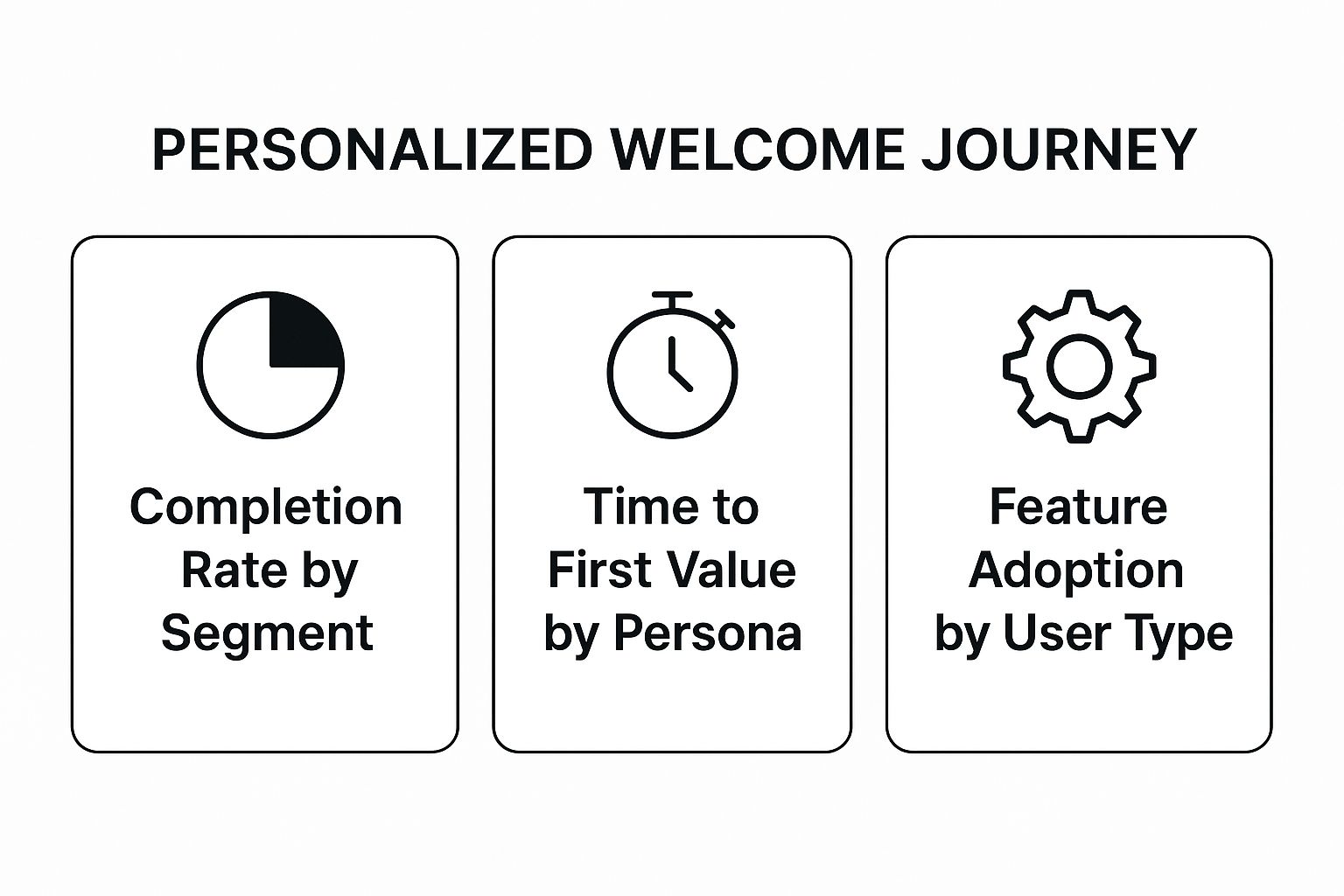
Tracking these specific metrics helps you see not just if users are completing onboarding, but how different types of users are finding value, allowing for continuous refinement.
2. Progressive Disclosure
Progressive disclosure is a design technique that reveals information and features gradually, preventing cognitive overload by showing only what is necessary at each step. Instead of presenting every tool and option at once, this strategy breaks down complex processes into smaller, manageable chunks. This approach is a core part of customer onboarding best practices because it guides users through a learning curve, building their confidence and competence incrementally without overwhelming them.
This method works by layering information. For example, Duolingo doesn't show you advanced grammar on day one; it starts with simple words and builds from there. Similarly, Slack's setup wizard walks you through creating channels and inviting team members one step at a time, rather than dropping you into a fully-featured but empty workspace. The goal is to manage complexity and guide the user's focus to the most relevant action at any given moment.
How to Implement Progressive Disclosure
Implementing this strategy is about sequencing information logically to match the user's learning journey. You can start by mapping out the core tasks a new user must complete to find value in your product.
- Map user mental models: Before designing, understand how users expect to learn your product. Break down the onboarding process into logical stages that align with their goals.
- Allow users to accelerate: Provide options for experienced or power users to skip introductory steps. A "Skip Tour" or "I know what I'm doing" button respects their time.
- Use clear progress indicators: Show users where they are in the process with progress bars or step counters (e.g., "Step 2 of 5"). This manages expectations and reduces abandonment.
To implement progressive disclosure effectively, it's vital to test your information hierarchy with real users. This ensures the steps you've designed are intuitive and helpful, not confusing. You can find more on the principles of this technique from the Nielsen Norman Group's article on progressive disclosure.
By introducing features as they become relevant, you create a smoother, more focused learning experience that helps users master your product one piece at a time.
3. Interactive Product Tours
An interactive product tour is a guided walkthrough that teaches users about key features by having them perform actions directly within your product. Instead of passively watching a video or reading a help doc, users learn by doing. This hands-on approach is one of the most effective customer onboarding best practices because it builds muscle memory and helps users experience the product's value firsthand.
For example, a project management tool like Asana might guide a new user to create their first task, assign it to a team member, and set a due date. Each step is prompted by an in-app tooltip or highlight, ensuring the user succeeds. This method transforms the initial learning curve from a potential obstacle into an engaging, confidence-building experience, directly connecting features to real-world outcomes.
How to Implement Interactive Product Tours
The key to a successful interactive tour is focusing on the core actions that lead to a user's "aha!" moment. Rather than showing off every single feature, guide them through the one or two workflows that solve their primary problem.
- Prioritize high-value features: Start the tour with the functionalities that deliver the most immediate value.
- Make them optional and resumable: Always give users the option to skip a tour and come back to it later. Forcing a tour can lead to frustration and abandonment.
- Use actual user data where possible: If you can, populate the tour with the user's own project names or data to make the experience more relevant and contextual.
- Keep them updated: Ensure your tours evolve with your product. An outdated tour that points to non-existent buttons is worse than no tour at all.
To see how companies like Appcues structure these experiences, check out the video below. It offers insights into creating tours that are helpful, not intrusive.
Tracking tour completion rates and identifying where users drop off is crucial. This data reveals which steps are confusing or unengaging, allowing you to refine your onboarding flow for better user activation.
4. Value-First Quick Wins
A value-first quick win strategy prioritizes delivering tangible value to customers within their very first session. Instead of focusing on exhaustive feature education, this approach identifies the shortest path to a meaningful outcome that proves your product's core benefit. This is one of the most critical customer onboarding best practices because it hooks the user by solving an immediate, small problem, building momentum and trust right away.
This method is about engineering an "aha!" moment as quickly as possible. For example, Loom lets a new user record and share a video with a single click, instantly demonstrating its value for communication. Similarly, Typeform provides ready-to-use templates, allowing users to create and publish a beautiful form in minutes. The goal is to make the user feel productive and successful immediately, which strongly encourages deeper engagement.
How to Implement Value-First Quick Wins
Focus on removing friction between signup and the user's first successful outcome. This means de-emphasizing complex setup tasks and highlighting a single, high-impact action.
- Identify the "aha!" moment: Pinpoint the one action that makes a user think, "Wow, this is useful." Is it creating their first design, correcting their first grammar mistake, or launching their first poll?
- Reduce steps to first value: Audit your onboarding flow and eliminate every non-essential step. Can you pre-populate data or use templates to accelerate the process?
- Use sample data: For more complex products, provide sample data or a pre-built project. This allows users to explore features and see the end result without a lengthy setup.
- Celebrate the achievement: Acknowledge the user's first win with a positive message, like a pop-up or a celebratory animation. This reinforces their accomplishment and encourages them to continue.
This approach transforms the user's first impression from a learning chore into a rewarding experience. It's a powerful way to demonstrate your product’s promise, turning passive new users into active, engaged customers from the very first interaction.
5. Omnichannel Onboarding
Omnichannel onboarding creates a unified and consistent customer experience by integrating multiple communication channels. Rather than treating in-app messages, emails, SMS notifications, and support calls as separate interactions, this approach weaves them together into a single, seamless journey. This strategy is a crucial part of modern customer onboarding best practices because it meets customers where they are, providing support and guidance through their preferred channels at the right time.
This cohesive process ensures that messaging and support remain consistent, whether a user is following a product tour, reading a welcome email, or speaking to a support agent. For instance, Shopify excels at this by combining in-app setup checklists for merchants with timely email tips on marketing their first product and proactive phone support for high-value accounts. The goal is to create a fluid conversation that transitions smoothly between touchpoints, reinforcing value and building user confidence at every step.
How to Implement Omnichannel Onboarding
A successful omnichannel strategy requires careful planning and coordination across different teams, including marketing, sales, and customer support. It starts with understanding how and when your customers interact with each channel.
- Map the cross-channel journey: Identify all potential touchpoints a new user might have, from their first email to their first support ticket, and map out the ideal sequence of interactions.
- Ensure message consistency: The tone, branding, and core message should be the same across all platforms. An email promoting a feature should align perfectly with the in-app guide for that same feature.
- Allow channel preferences: Give users control over how they receive communications. Some may prefer SMS alerts for critical updates but emails for weekly digests. For a comprehensive approach to integrating all customer touchpoints, explore this Omnichannel Contact Center Success Guide.
Designing a journey that spans multiple platforms can be complex, but it pays off by creating a more supportive and less fragmented user experience. You can learn more about how to develop a multi-channel strategy on onenine.com.
6. Data-Driven Optimization
Data-driven optimization transforms customer onboarding from a set-it-and-forget-it process into a living, evolving system. It involves systematically using customer analytics, feedback, and testing to continuously refine the user journey. Instead of relying on assumptions, this approach uses hard data to identify friction points, understand user behavior, and improve key outcomes. This is a critical customer onboarding best practice because it ensures your process gets more effective over time.
This strategy hinges on collecting both quantitative and qualitative data. For example, Dropbox famously optimized its signup flow by analyzing user drop-off points and A/B testing different layouts to reduce friction. Similarly, LinkedIn runs constant experiments on its profile completion prompts to see which messages best motivate users to add more information. The goal is to make informed decisions that guide users toward activation and long-term value based on real-world behavior.
How to Implement Data-Driven Optimization
Getting started means treating your onboarding flow like a scientific experiment where you continuously hypothesize, test, and learn. You don't need a massive data science team; you just need a clear process for measurement and iteration.
- Define key metrics upfront: Before you launch, decide what success looks like. Is it completing a specific task, inviting a teammate, or reaching a certain usage threshold?
- Implement event tracking early: Use tools to track how users interact with your onboarding steps. Knowing where they click, hesitate, or exit is crucial.
- Test one variable at a time: When A/B testing, change only one element, like a headline, button color, or step order, to accurately attribute any change in performance.
- Balance quantitative data with user feedback: Numbers tell you what is happening, but user surveys, interviews, and session recordings can tell you why.
By systematically testing and refining your onboarding, you create a powerful feedback loop that consistently improves user success. This is a core principle of conversion rate optimization. You can discover more about how to apply these techniques in our guide to conversion rate optimization best practices on onenine.com.
7. Human-Assisted Onboarding
Human-assisted onboarding is a hybrid model that blends automated, self-service guidance with strategic, high-touch human intervention. Instead of relying solely on in-app tours or email sequences, this approach ensures that a real person, like a customer success manager or onboarding specialist, steps in at critical moments. This is one of the most effective customer onboarding best practices for complex products or high-value accounts, as it provides a safety net and personalized support where automation falls short.
This strategy acknowledges that some challenges require a human touch to resolve. For instance, HubSpot offers dedicated onboarding consultants to help new customers integrate the platform into their specific marketing stack, while Salesforce provides implementation specialists to guide large enterprises through complex setups. The goal is not to hand-hold every user but to deploy human expertise strategically to build confidence, tackle major roadblocks, and strengthen the customer relationship from the start.
How to Implement Human-Assisted Onboarding
Implementing this model requires defining clear triggers for when a human should intervene, ensuring the right customers get the right level of support without sacrificing scalability.
- Define clear criteria for intervention: Determine which users or accounts receive human support. This could be based on their subscription tier, company size, or specific actions (or inactions) they take within the product.
- Create standardized playbooks: Equip your customer success or support teams with clear playbooks for common onboarding scenarios. This ensures consistency and efficiency in how they guide new users.
- Use technology to trigger touchpoints: Configure your CRM or customer success platform to automatically create a task for a specialist when a user hits a predefined trigger. For example, a task could be generated if a high-value account hasn't configured a key feature within their first week.
This approach is heavily influenced by the customer success methodology popularized by platforms like Gainsight, which emphasizes proactive engagement. By combining automation's efficiency with the empathy and problem-solving skills of a trained expert, you create a robust onboarding experience that drives long-term loyalty and reduces churn.
8. Gamification Elements
Integrating gamification elements introduces game-like mechanics into the onboarding process to make it more engaging and motivating. This strategy leverages principles of human psychology, such as the desire for achievement and reward, to encourage users to complete key setup tasks. By turning onboarding into a series of rewarding challenges, you can significantly boost completion rates and user satisfaction.
This approach works by providing immediate, positive feedback for desired actions. For instance, LinkedIn's profile completion bar visually encourages users to add more information, creating a sense of progress. Similarly, Duolingo uses streaks, points, and leaderboards to motivate daily language practice, transforming a potentially tedious task into an addictive game. The core idea is to guide users through necessary steps by making the process intrinsically rewarding, which is a key component of effective customer onboarding best practices.
How to Implement Gamification Elements
You don't need a complex system to start. Simple, well-placed elements can have a major impact on user motivation and behavior.
- Start with progress indicators: A simple progress bar or a checklist of setup tasks is one of the easiest and most effective gamification tools. It shows users how far they've come and what's left to do.
- Introduce badges or achievements: Reward users with badges for completing important milestones, such as setting up their first project, inviting a team member, or using a key feature. Make these achievements shareable to add a social element.
- Align rewards with meaningful actions: Ensure that points, badges, or other rewards are tied to actions that genuinely help the user find value in your product. Avoid rewarding trivial tasks that don't contribute to their success.
To be effective, gamification should feel like a natural part of the user experience, not a gimmick. It should enhance the journey toward the "aha!" moment rather than distract from it. A great starting point is to identify the most critical user actions for long-term retention and build a simple reward system around them.
9. Continuous Learning Paths
A continuous learning path extends onboarding beyond the initial setup, transforming it into an ongoing educational journey. Instead of ending after the first week, this approach provides a structured curriculum of advanced feature introductions, skill development resources, and deeper product insights. This is a critical component of modern customer onboarding best practices because it recognizes that user mastery is a long-term process, not a one-time event.
This strategy nurtures users from novices to experts, increasing their investment in your platform over time. For example, Salesforce’s Trailhead platform offers gamified learning modules that guide users through complex functionalities, while HubSpot Academy provides free certifications that turn customers into proficient marketing professionals. The goal is to consistently deliver value and reveal new capabilities as users grow, preventing churn and fostering deep product loyalty.
How to Implement a Continuous Learning Path
Building a learning ecosystem doesn't have to be complex at the start. You can begin by curating existing help articles, webinars, and tutorials into structured pathways that align with user goals or roles.
- Create clear learning pathways: Group content into logical sequences based on user roles (e.g., "Admin Track") or specific goals (e.g., "Mastering Analytics"). This gives users a clear roadmap for what to learn next.
- Trigger advanced content based on usage: Once a user masters a basic feature, use in-app prompts or emails to introduce them to a related, more advanced function.
- Provide multiple content formats: Cater to different learning styles by offering a mix of videos, articles, interactive tutorials, and live workshops.
- Recognize and reward achievements: Use badges, certificates, or other forms of recognition to motivate users and celebrate their learning milestones.
To learn more about how to structure these types of educational programs, exploring platforms like HubSpot Academy can provide excellent real-world inspiration. This long-term educational approach ensures your product remains essential to a customer's success long after their initial onboarding is complete.
9 Key Customer Onboarding Practices Compared
| Onboarding Method | Implementation Complexity 🔄 | Resource Requirements ⚡ | Expected Outcomes 📊 | Ideal Use Cases 💡 | Key Advantages ⭐ |
|---|---|---|---|---|---|
| Personalized Welcome Journey | High – data-driven, adaptive workflows | High – extensive data collection & maintenance | Increased engagement, faster time-to-value | Products with rich feature sets and diverse users | Tailored experience, better feature adoption |
| Progressive Disclosure | Medium – layered info design | Medium – careful content prioritization | Reduced cognitive load, clear learning path | Complex tools needing gradual feature reveal | Builds confidence progressively, prevents overwhelm |
| Interactive Product Tours | High – interactive tooltips and overlays | High – ongoing maintenance and updates | Improved feature familiarity, hands-on learning | Feature-rich products requiring demonstration | Engaging, high retention, practical experience |
| Value-First Quick Wins | Low – focus on immediate value with simple setup | Low to Medium – sample data/templates | Rapid activation, strong first impression | Products needing quick activation and ROI proof | Quick value demonstration, builds trust quickly |
| Omnichannel Onboarding | High – multi-channel coordination | High – cross-channel systems and content | Consistent engagement across touchpoints | Enterprises needing comprehensive onboarding | Reinforced learning, accommodates preferences |
| Data-Driven Optimization | High – analytics, A/B testing, iterative | High – analytics infrastructure, expertise | Continuous improvement, higher conversion rates | Products emphasizing growth via data insights | Evidence-based, scalable optimization |
| Human-Assisted Onboarding | High – hybrid automation plus human touch | Very High – staffing and training costs | Personalized guidance, stronger relationships | Complex, high-value customer onboarding | Addresses unique needs, immediate problem solving |
| Gamification Elements | Medium – integration of game mechanics | Medium – design and motivation strategy | Higher engagement, increased completion | Products seeking motivation through rewards | Fun, motivating, encourages continued use |
| Continuous Learning Paths | High – extended content and progression setup | High – content development and management | Deeper adoption, long-term engagement | Products with evolving features and skill growth | Builds expertise, reduces churn |
Turning Onboarding into Your Competitive Advantage
The journey from a curious prospect to a loyal advocate begins with a single, critical phase: onboarding. As we've explored, creating a world-class customer experience isn't about a single magic bullet. It's about strategically combining a series of thoughtful, user-centric best practices that guide, educate, and empower your new customers from the very first click.
Your onboarding process is far more than a simple checklist of setup tasks. It's your first, best opportunity to prove your product's value, build trust, and set the foundation for a long-term, profitable relationship. Neglecting this stage is like building a skyscraper on a shaky foundation; eventually, cracks will appear in the form of churn, low engagement, and missed revenue opportunities.
From Good to Great: Key Takeaways
Reviewing the nine essential customer onboarding best practices, several core themes emerge. Success hinges on making the user feel seen, supported, and successful as quickly as possible.
- Personalization and Proactivity: Moving beyond a one-size-fits-all approach is no longer optional. A Personalized Welcome Journey and Human-Assisted Onboarding create a tailored experience that speaks directly to individual user needs and goals.
- Clarity and Focus: Overwhelming users is a surefire way to lose them. Techniques like Progressive Disclosure and focusing on Value-First Quick Wins ensure users learn what they need, when they need it, building momentum and confidence along the way.
- Engagement and Reinforcement: Onboarding should be an engaging dialogue, not a boring lecture. Interactive Product Tours and Gamification Elements make learning active and enjoyable, while Continuous Learning Paths ensure that education doesn't stop after day one.
- Data-Informed Evolution: The most effective onboarding programs are living, breathing systems. A commitment to Data-Driven Optimization allows you to identify friction points, understand user behavior, and continuously refine the journey for maximum impact.
Your Actionable Next Steps
Transforming your onboarding can feel like a massive undertaking, but progress starts with a single step. You don't need to implement all nine strategies at once. Instead, adopt a methodical approach to build momentum and see tangible results.
- Audit Your Current Flow: Before you build, you must understand. Map out your existing onboarding process from the customer's perspective. Where is the friction? Where do users drop off? Use analytics and user feedback to identify the biggest opportunity for improvement.
- Prioritize One "Quick Win": Choose one best practice that addresses your most significant pain point. Is your initial setup too complex? Focus on implementing a Value-First Quick Win to get users to their "aha!" moment faster. Are users getting lost? An Interactive Product Tour could be the solution.
- Measure and Iterate: Implement your chosen change and define clear success metrics. Track metrics like time-to-value, feature adoption rates, and 30-day retention. Use this data to validate your changes and inform your next move. This cycle of implementing, measuring, and iterating is the core of building a truly exceptional customer onboarding process.
Ultimately, mastering these customer onboarding best practices is about shifting your perspective. Stop seeing onboarding as a cost center or a simple setup wizard. Start seeing it for what it truly is: your most powerful engine for customer activation, retention, and long-term growth. It's your promise to the customer, and a well-executed onboarding journey is how you deliver on that promise, turning new users into your most passionate fans.
Ready to transform your website's user journey but need an expert partner to bring your vision to life? The team at OneNine specializes in designing and implementing sophisticated, user-centric web experiences that make a lasting first impression. Visit OneNine to see how we can help you build the seamless digital platform your customers deserve.


