
Think of your request for proposal for website development as more than just a list of what you want. It's the blueprint for your entire project. This document is where you lay out your goals, define the scope, and set clear expectations, making it the single most important tool for finding and vetting the right development partner.
Your RFP Is a Strategic Tool, Not Just a Document
Let's be honest—writing an RFP can feel like a chore. It’s often seen as just another box to check before the real work begins. But if you can shift that mindset, you're already on the path to a much better outcome. A well-thought-out RFP isn't just about getting bids; it forces you to get crystal clear on your own vision and business goals before a single dollar is spent or a line of code is written.
This document is your best defense against the classic project killers: scope creep, mismatched expectations, and budgets that spiral out of control. Without it, you're basically asking agencies to read your mind, which results in a stack of proposals that are impossible to compare apples-to-apples.
From Vague Ideas to Concrete Plans
I see this all the time. A company sends out a vague RFP asking for a "modern and user-friendly e-commerce site." They get back three proposals with wildly different price tags, ranging from $20,000 to $100,000. Why such a huge gap? One agency heard "user-friendly" and quoted for basic navigation. Another envisioned advanced product filtering, personalized recommendations, and a custom checkout flow. The project stalls before it even starts, all because the initial request was just as fuzzy as the company's internal vision.
Now, imagine a competitor who wrote a detailed RFP. They outlined their target user personas, mapped out the ideal customer journey, and listed critical integrations, like their inventory management system. This level of clarity didn't just bring in proposals with similar pricing; it attracted agencies that offered genuine strategic insights on how to hit those specific goals.
The Foundation of a Strong Partnership
Ultimately, your RFP is a core component of your IT outsourcing development strategy. It sends a powerful signal to potential partners that you're organized, serious, and know what you're doing. Top-tier agencies are drawn to clients who have done their homework because it promises a smoother, more collaborative project for everyone involved.
A great RFP isn't a list of demands. It's an invitation to collaborate. It tells the story of your business, your customers, and your vision, inspiring agencies to bring their A-game.
Putting in the effort now saves you a massive amount of time, money, and frustration down the road. This is especially true when you consider the market you're competing in. The global web development industry was valued at a staggering USD 65.35 billion in 2023 and is expected to nearly double by 2032. In a space this competitive, a clear RFP is your ticket to standing out and getting exactly what you need.
Crafting the Core Components of Your RFP

Alright, let's get into the heart of it—actually building your request for proposal for website development, section by section. Forget those generic templates that only attract cookie-cutter responses. A truly effective RFP tells a story and paints a clear picture of your vision, getting high-caliber agencies genuinely excited to partner with you.
Think about it from their perspective. The best agencies are picky. They see dozens of RFPs and can spot a low-effort, copy-and-paste job from a mile away. If you want to attract top-tier talent, your document has to prove you’ve done your homework and are a serious, organized client they’d want to work with.
This is how you build an RFP that makes your project the one they can't wait to bid on.
Tell Your Company Story
This is your first impression, so make it count. The introduction and company background shouldn't be a dry history lesson. It's your shot to hook the reader and explain why this project is so important right now. Why are you building or redesigning this website? What market opportunity are you trying to seize, or what business pain are you trying to eliminate?
A compelling narrative gives potential partners critical context. For example, instead of a flat "we are a B2B software company," try framing it with a story: "For the past five years, our software has helped over 1,000 small businesses streamline their invoicing. But our current website doesn't reflect our industry leadership and fails to capture qualified leads, costing us an estimated 20% in potential annual growth."
That simple reframe immediately tells an agency three crucial things:
- Your Mission: You’re dedicated to helping small businesses succeed.
- The Problem: Your website is a weak link that's holding you back.
- The Stakes: There's a real, tangible business cost to doing nothing.
This shifts the project from a simple website build into a strategic business initiative—and that’s far more interesting for a potential partner.
Define Business-Centric Project Goals
This is where so many RFPs go wrong. Companies often just list features they think they need, like "we need a blog and an e-commerce store." That’s a start, but it completely misses the why. The best proposals tie every single requirement back to a specific business outcome.
You need to get crystal clear about what success actually looks like. Make your goals measurable and connect them directly to your company’s key performance indicators (KPIs).
A goal is not a feature. A feature is a tool to achieve a goal. Your RFP should focus on the goals, allowing agencies to propose the best features to get you there.
Look at the difference this makes:
- Vague Request: "We want a better user experience (UX)."
- Specific Goal: "We aim to reduce our bounce rate by 30% and increase the average time on page for key service pages by 90 seconds within six months of launch."
Here’s another one:
- Vague Request: "We need an e-commerce platform."
- Specific Goal: "We need to increase online sales by 40% year-over-year by simplifying the checkout process and slashing cart abandonment from 70% to under 50%."
Focusing on outcomes gives agencies the creative breathing room to propose the best solutions, rather than just ticking boxes on a feature list you provided.
Bring Your Audience to Life with Personas
Who is this website actually for? If your answer is "everyone," you need to dig deeper. A detailed description of your target audience is absolutely essential. Without it, agencies are just taking a shot in the dark on design, tone of voice, and functionality. The best tool for this job? User personas.
A user persona is a short, semi-fictional bio based on market research and real data from your customer base. Give them a name, a job, goals, and frustrations.
Example User Persona: "Marketing Maria"
- Role: Marketing Manager at a mid-sized tech company.
- Demographics: 34 years old, lives in a major city, very tech-savvy.
- Goals: She needs a reliable software partner to help her team automate reporting and prove ROI to her CMO. She’s looking for efficiency and crystal-clear data.
- Frustrations: Her current tools are clunky and require manual data exports. She wastes hours every week just compiling reports instead of analyzing them.
With a persona like Maria in hand, an agency immediately knows the website needs to highlight efficiency, data visualization, and compelling case studies. The primary call-to-action should probably be a demo or a free trial, not a generic "contact us" form.
Outline a Detailed Project Scope and Deliverables
Now we get to the nuts and bolts. This is where you translate your goals into tangible requirements. You want to be as detailed as humanly possible here to prevent scope creep down the road. It helps to break everything down into clear categories. As you draft this section, it's a good idea to start understanding common features offered by development platforms so you have a solid baseline for your project's scope.
This is your chance to turn vague wishes into concrete specs.
| Vague Requirement | Specific Requirement |
|---|---|
| "We need a modern design." | "The UI must be mobile-first, responsive on all major devices, and adhere to WCAG 2.1 AA accessibility standards." |
| "The site should be fast." | "The website must achieve a Google PageSpeed Insights score of 90+ on both mobile and desktop." |
| "We need CMS access." | "The site must be built on WordPress with a flexible page builder like Elementor Pro, allowing our marketing team to create new landing pages without developer assistance." |
This level of detail is critical. It ensures every agency is bidding on the exact same project, which makes comparing their proposals fair and straightforward. It also shows that you’ve thought through your needs, and it respects the agency’s time by giving them everything they need to create a realistic, thoughtful quote.
Setting a Realistic Budget and Timeline
Let's talk about the two things that make or break any project: money and time. It can feel a little awkward to lay your cards on the table, but being upfront about your budget and timeline is one of the most important parts of a website development RFP.
If you're vague here, you’ll get proposals that are all over the map. Some will be way too high, and others will be based on a complete misunderstanding of what you actually need. A clear budget and timeline set the stage for a great partnership from day one.
How to Handle the Budget Question
Many people worry that if they name a price, agencies will just max it out. I get it, but in my experience, good agencies don't work that way. They use your budget as a critical piece of information to craft the best possible solution within your means. A realistic range shows you're a serious client who has done their homework, which immediately helps you filter out the wrong partners.
Being transparent here is more important than ever. The web development market is expected to reach USD 125.4 billion by 2030, and a persistent talent shortage is pushing development costs up by 10–15% every year. Without a clear budget, you’re just guessing. To get a feel for what things cost these days, it's a good idea to look at a detailed breakdown. You can get more specifics from our guide on understanding website development costs.
Website Development Pricing Model Comparison
When you're thinking about budget, you also need to think about how you'll pay. The pricing model you prefer tells agencies a lot about your project's flexibility. Let's look at the most common options.
| Pricing Model | Best For | Pros | Cons |
|---|---|---|---|
| Fixed-Price | Projects with a very clear, locked-in scope. Think of a standard brochure site or a simple e-commerce store. | Budget is predictable from the start. Great for financial planning and getting stakeholder approval. | Inflexible. Any changes or new ideas (scope creep) will require a new contract or change order, which can be slow and costly. |
| Time & Materials (T&M) | Complex, evolving projects where the scope isn't fully defined. Good for agile development or projects with an R&D component. | Highly flexible. You can pivot, add features, and change direction as you learn more. | Budget is not fixed, so it requires close monitoring. You need a lot of trust in your development partner. |
| Retainer | Ongoing work, maintenance, and continuous improvement after the initial site launch. | Guarantees you have a dedicated team available each month. Predictable monthly costs. | You pay for the time whether you use it all or not. Can be inefficient for sporadic needs. |
For a first-time website build based on a detailed RFP, a Fixed-Price model is often the way to go. It gives you cost certainty. But if you know you'll be figuring things out as you go, Time & Materials might be a better fit.
Key Takeaway: A fixed-price model protects your budget, while a T&M model protects your flexibility. Choose the one that best matches your project's level of uncertainty.
Mapping Out a Practical Timeline
An unrealistic deadline is a huge red flag for any decent agency. It signals a lack of understanding of the web development process and often leads to rushed work, cut corners, and a frustrating experience for everyone.
A good timeline isn’t just a launch date. It’s a series of clear milestones that account for everything from initial strategy to post-launch support. Critically, it must include time for your team to review work and provide feedback. Rushed feedback is one of the top reasons projects go off the rails.
This visual gives you a sense of where the effort (and cost) typically goes, which should inform how you structure your timeline.
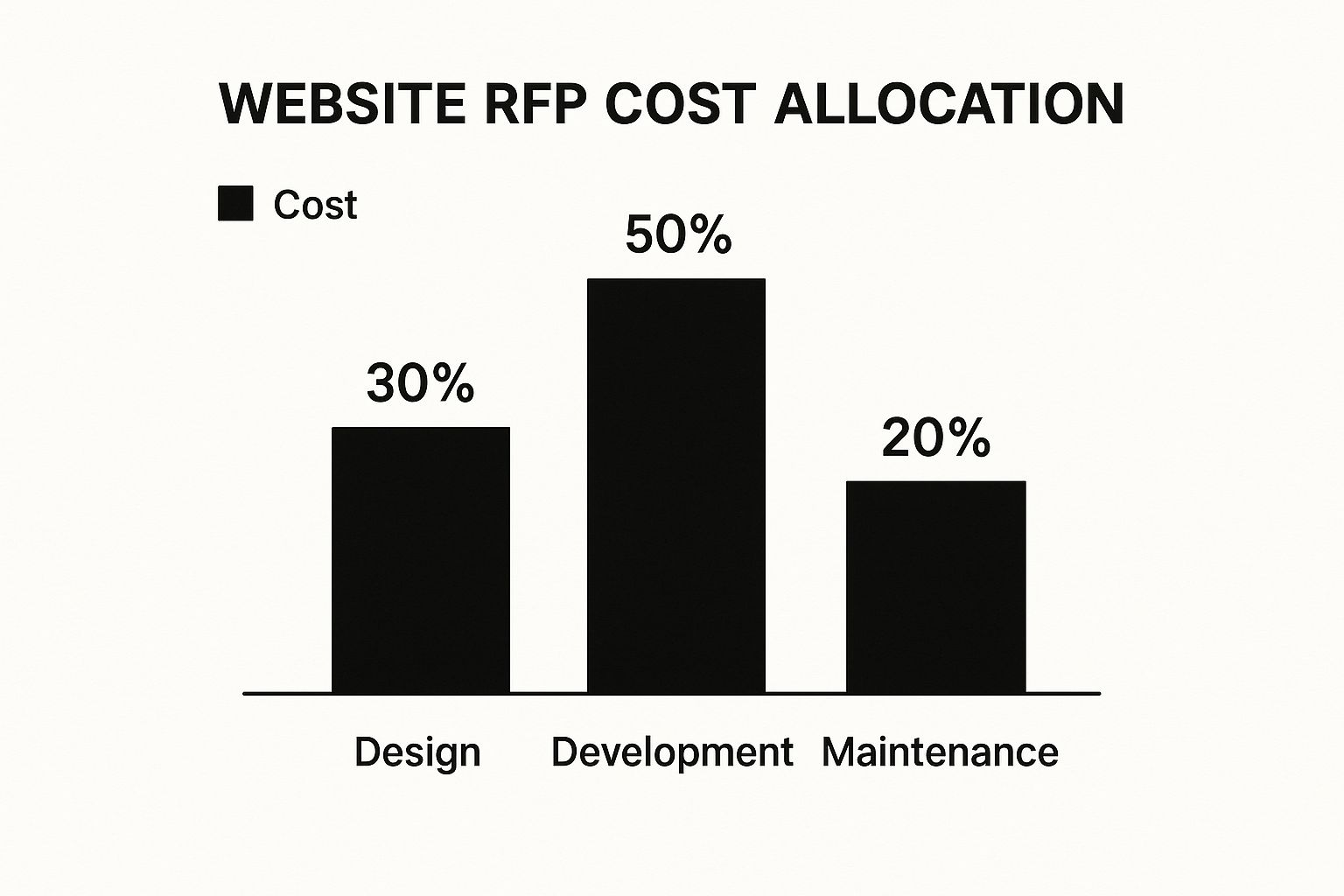
As you can see, the actual development phase is the biggest piece of the pie. Don't shortchange it.
Here’s a sample milestone structure you can adapt for your RFP:
- Discovery & Strategy: Kicking things off with workshops and research to nail down the final requirements.
- UX/UI Design: Creating and getting approval on wireframes and visual designs.
- Content Population: Your team’s turn to provide all the text, images, and other media.
- Development & Integration: The fun part—coding the site and plugging in any necessary systems.
- Quality Assurance & Testing: A thorough check for bugs, browser issues, and overall functionality.
- Launch: The big day when the site goes live.
- Post-Launch Support: A defined period for fixing any immediate issues that pop up.
A pro tip? Always build in a buffer. Adding an extra 15-20% to your timeline for unexpected delays or extra feedback rounds shows agencies you're pragmatic and serious about a high-quality result.
Deciding How You'll Judge the Proposals
Once you’ve sent your website development RFP out into the world, the real work begins. You poured a ton of effort into creating a clear, detailed document. Now, you need an equally clear and fair way to pick the right partner from the responses you get back.
Trust me, relying on gut feelings or getting wowed by the slickest presentation is a recipe for a bad partnership. A structured evaluation process is what separates a smart decision from a costly mistake. It takes the guesswork out of the equation and helps you focus on what really matters.
First, Figure Out Your Evaluation Criteria
Before a single proposal hits your inbox, your team needs to agree on what a "winning" proposal actually looks like. Trying to define this while you're staring at five different documents is a classic misstep. It opens the door to personal bias and makes it impossible to compare your options fairly.
Get your key stakeholders in a room and hammer out your evaluation criteria. These are the pillars you'll use to measure every single submission. While the exact points will be unique to your project, most solid frameworks include a mix of the tangible and the intangible.
Here are a few essential criteria I always recommend starting with:
- Portfolio and Relevant Experience: Have they actually built sites for businesses like yours? Do they have case studies that prove they can solve your specific problems?
- Technical Approach and Expertise: Does their proposed tech stack make sense for your long-term goals? Is their plan for building, testing, and launching the site sound and well-thought-out?
- Project Management and Process: How will they keep you in the loop? What’s their process for handling feedback, scope changes, and the inevitable roadblocks?
- Team Composition and Culture Fit: Who, specifically, will be working on your project? Do their skills line up with your needs? Just as important, does their company culture seem like a good fit for yours?
- Cost and Value: Does the price tag fit your budget? More importantly, does the proposal offer real value for the money, or is it just the lowest bid?
Defining these upfront gets everyone on your team reading from the same playbook.
Next, Create a Proposal Scoring Matrix
A scoring matrix is your secret weapon here. It’s basically a simple spreadsheet that turns your subjective criteria into an objective scoring system. This little tool is the key to making a transparent and defensible decision.
Your goal isn't just to pick an agency; it's to select a long-term partner. A scoring matrix helps you look past superficial details and focus on the substance that predicts a successful partnership.
Start by listing your criteria down the first column. In the next column, assign a "weight" to each one based on how important it is. For example, maybe relevant experience is your top priority, so you give it a weight of 30%. Technical chops might be next at 25%, while something like cultural fit could be 10%. Just make sure all your weights add up to 100%.
Then, make columns for each agency that submits a proposal. As your team reviews each one, score them on every criterion using a simple 1-to-5 scale.
- 1: Poor / Doesn't meet requirements
- 3: Average / Meets basic requirements
- 5: Excellent / Goes above and beyond
Once you've scored each category, a little spreadsheet magic gives you a final weighted score for every proposal. Suddenly, you have a clear, data-backed ranking of your contenders. This system is a huge part of learning how to choose a website developer who can actually bring your vision to life.
What to Specifically Ask For in the Proposal
To make this scoring system work, you need agencies to give you specific, comparable information. Your RFP needs to explicitly ask for the following items—this is how you feed your scoring matrix the data it needs.
-
Relevant Case Studies: Don't just ask to see their portfolio. Insist on 2-3 detailed case studies for projects that are similar to yours in scope, industry, or complexity. A great case study won't just show pretty pictures; it will outline the problem, the solution, and the measurable results they achieved.
-
Proposed Technical Approach: Push for specifics. What CMS are they recommending and why? How do they plan to handle integrations with your other business software? What’s their game plan for security, site speed, and accessibility?
-
Project Team Bios: You’re not hiring a faceless company; you’re hiring a team of people. Ask for short bios of the key players who will be assigned to your project, like the project manager, lead designer, and lead developer.
-
Detailed Project Timeline: A good partner will provide a realistic timeline with key phases and milestones, from discovery all the way to launch. This proves they've actually thought through the work involved.
-
Transparent Cost Breakdown: A single number isn't good enough. Ask for a detailed breakdown that separates one-time costs (like design and development) from ongoing expenses (like hosting, maintenance, and support).
By setting up a clear evaluation framework from the very beginning, you turn a potentially chaotic selection process into a structured, strategic exercise. That rigor is what ensures you choose a partner who isn’t just capable, but is genuinely the right fit for your business.
Common RFP Mistakes to Avoid
One of the best ways to get your RFP right is by learning from where others have gone wrong. A request for proposal for website development is a powerful tool, but a few common mistakes can easily send your project off the rails before it even gets started. If you can steer clear of these pitfalls, you’ll attract better partners and get proposals that are actually useful.
The trick is to give agencies enough detail to work with, but not so much that you box them in and stifle their creativity. A great RFP invites experts to solve your problem, not just tick off a list of demands. Let’s walk through the most common errors we see and how you can avoid them.
Finding the Sweet Spot Between Vague and Overly Prescriptive
This is a balancing act, and it’s probably the hardest part of writing an RFP. On one end, you have the hyper-specific document that dictates every tiny technical detail—from the exact JavaScript library to use down to the specific WordPress plugins. This approach basically tells an agency, "I already know how to do your job," which can scare off top talent who might have a better, more modern solution.
On the flip side, you have the RFP that’s painfully vague. We’ve all seen them: "Build an engaging website." This kind of request forces agencies to guess what you actually want. The result? You get a stack of proposals that are impossible to compare because every firm interpreted your needs completely differently.
The Fix: Focus on the "what" and the "why," and let the experts come back to you with the "how." For instance, instead of demanding a specific technology, define the outcome you need. Say, "The website must achieve a Google PageSpeed Insights score of 90+ on mobile."
Setting Unrealistic Timelines and Budgets
Nothing sends a good agency running faster than an impossible deadline. It’s a huge red flag that signals you don’t quite grasp what goes into a complex web project. It often leads to rushed work, cut corners, and a partnership that starts off on the wrong foot. Any timeline that doesn't account for proper discovery, feedback rounds, and thorough testing is setting itself up for failure.
The same goes for your budget. Being coy about what you can spend—or worse, setting an unrealistically low number—will either attract low-quality vendors or make the best agencies decide you’re not a serious client. Being transparent about your budget range allows firms to propose the best possible solution within your means.
This is especially true right now. North America captured over 36.8% of the global web development market in 2024, and large enterprises—which make up 68.4% of that share—are driving up costs for secure, scalable platforms. You can learn more about these global web development market trends on Market.us.
Forgetting to Define What Success Looks Like
How will you know if your new website is actually a success? If you can't answer that question, your RFP isn't ready. Too many companies get caught up in listing features and deliverables, completely forgetting to define the key performance indicators (KPIs) that matter to the business.
Without clear success metrics, you have no real way to measure the project's return on investment. It all just becomes subjective.
-
Don't say: "We want more traffic."
-
Instead, try: "Increase organic search traffic by 40% within six months of launch."
-
Don't say: "We need to generate more leads."
-
Instead, try: "Achieve a 5% conversion rate on our main service pages and generate 200 qualified leads per month through the new contact forms."
Overlooking Life After Launch
Your project doesn’t end the day the site goes live. A website is a living, breathing asset that needs ongoing care to stay secure, functional, and effective. A classic mistake is writing an entire RFP without once mentioning what happens after launch.
You absolutely need to ask agencies to detail their plans for:
- Ongoing Maintenance: How do they handle software updates, security patches, and backups? What does their process look like?
- Support & Training: What kind of support is included for bug fixes? Will they train your team on how to actually use the new CMS?
- Future Enhancements: What happens when you need a new feature in six months? What is their process for handling new requests after the initial launch?
Getting these details upfront helps you avoid surprise costs down the road and ensures you have a solid plan to keep your investment performing well. Thinking ahead like this is one of the core website development best practices that truly sets successful projects apart.
Answering Your Top RFP Questions
Even after you've polished your RFP, some questions will inevitably pop up. It happens to everyone. Based on my experience guiding clients through this process, I've pulled together the most common ones to give you some quick, practical answers.
How Long Should a Website Development RFP Be?
There's no magic number here. Clarity is always more important than page count. That said, a solid RFP usually lands somewhere between 10-20 pages.
You want to give agencies enough detail to understand your goals, what you need built, and any constraints they need to know about. But you don't want to bury them in so much information that they can't see the forest for the trees. Just stick to the essentials: who you are, what the project is, the technical must-haves, your budget, and your timeline. A well-organized document will always beat a long, rambling one.
How Many Agencies Should I Send My RFP To?
This is a classic case of quality over quantity. Aim to send your RFP to 3-5 agencies that you've already vetted. The real work happens before you even hit send. You should be digging into portfolios, reading case studies, and checking client reviews to build a very intentional shortlist.
Blasting your RFP out to a dozen agencies might seem like a good way to get options, but it usually just leads to a pile of generic or mismatched proposals. You end up creating more work for yourself sifting through the noise. A smaller, hand-picked list ensures you get thoughtful responses from agencies that are genuinely excited about your project.
What Should I Do If All Proposals Are Over Budget?
First, don't panic. This is a surprisingly common situation, and it's almost always fixable. If every proposal comes in over your budget, it's a strong sign there's a mismatch between the scope of your project and the funds you've allocated.
Take a hard look at your list of requirements. Are there any "nice-to-have" features you could push to a later phase? Then, have an honest conversation with yourself: was the initial budget realistic for what you're asking for in today's market?
An over-budget proposal isn't a "no." It's the beginning of a negotiation. Think of it as an invitation to have a strategic conversation about priorities.
Reach out to your top-choice agencies. See if they're open to discussing a phased approach where you build the core functionality now and add the bells and whistles later. How an agency handles this conversation tells you a lot about their creativity and willingness to be a true partner.
Is It Okay to Use a Standard RFP Template?
Absolutely. A template is a fantastic starting point. It saves time and acts as a checklist to make sure you don't forget any key sections. However, you should never just fill in the blanks and send it off.
Your business has unique goals, a specific audience, and its own brand personality. Your RFP needs to reflect that. The more you customize the template with your specific details, the better your proposals will be. Remember, a generic RFP gets you a generic proposal. Put in the effort to make it yours, and you'll attract partners who are genuinely invested in your success.
At OneNine, we specialize in turning your vision into a high-performing website. Whether you're starting with an RFP or just have an idea, our team is ready to help you build, manage, and grow your online presence. Let us handle the complexities of web development so you can focus on your business. Learn more about our services and get started today.


