

The Four Pillars of Successful Transformation
To really get a grip on digital transformation, you have to stop thinking of it as a single tech project. It's much bigger than that. A truly successful transformation is a whole-of-business strategy, and it stands firmly on four interconnected pillars. Each one is crucial for building a company that can not only weather future storms but also seize new opportunities.
If you look at your strategy through these four lenses, you'll naturally create a more balanced plan. It’s easy to get fixated on the shiny new technology, but that often means neglecting the people, processes, and business models that actually make it all work.
Pillar 1: Business Process Transformation
This is usually where most businesses dip their toes in the water first. Business Process Transformation is all about looking at your core operations—the day-to-day workflows—and completely rethinking them to be faster, cheaper, and better. We're not just talking about swapping paper forms for digital ones. It's about using technology to invent entirely new, smarter ways of getting work done.
The real goal is to automate what you can and use data to guide your decisions. Think about a manufacturer that always did maintenance on a fixed schedule. With a bit of process transformation, they could install Internet of Things (IoT) sensors to monitor their machines in real-time. These sensors can predict a failure before it happens, so maintenance only gets scheduled when it's actually needed. That simple shift saves a ton of money, cuts downtime, and makes expensive equipment last longer.
Pillar 2: Business Model Transformation
While process transformation is about improving how you do business, Business Model Transformation changes what your business actually does. This pillar is all about using digital tools to offer new kinds of value and open up completely different ways to make money. It means questioning everything you thought you knew about your industry and finding new ways to delight your customers.
A classic example is a local shop moving online. That’s a start. But a much deeper change happens when that same retailer launches a subscription box service. Suddenly, they've shifted their entire revenue model from one-off sales to predictable, recurring income. This not only stabilizes their cash flow but also builds incredible customer loyalty and gives them a goldmine of data on what people love.
The infographic below shows how these changes tie directly back to what every business owner wants.
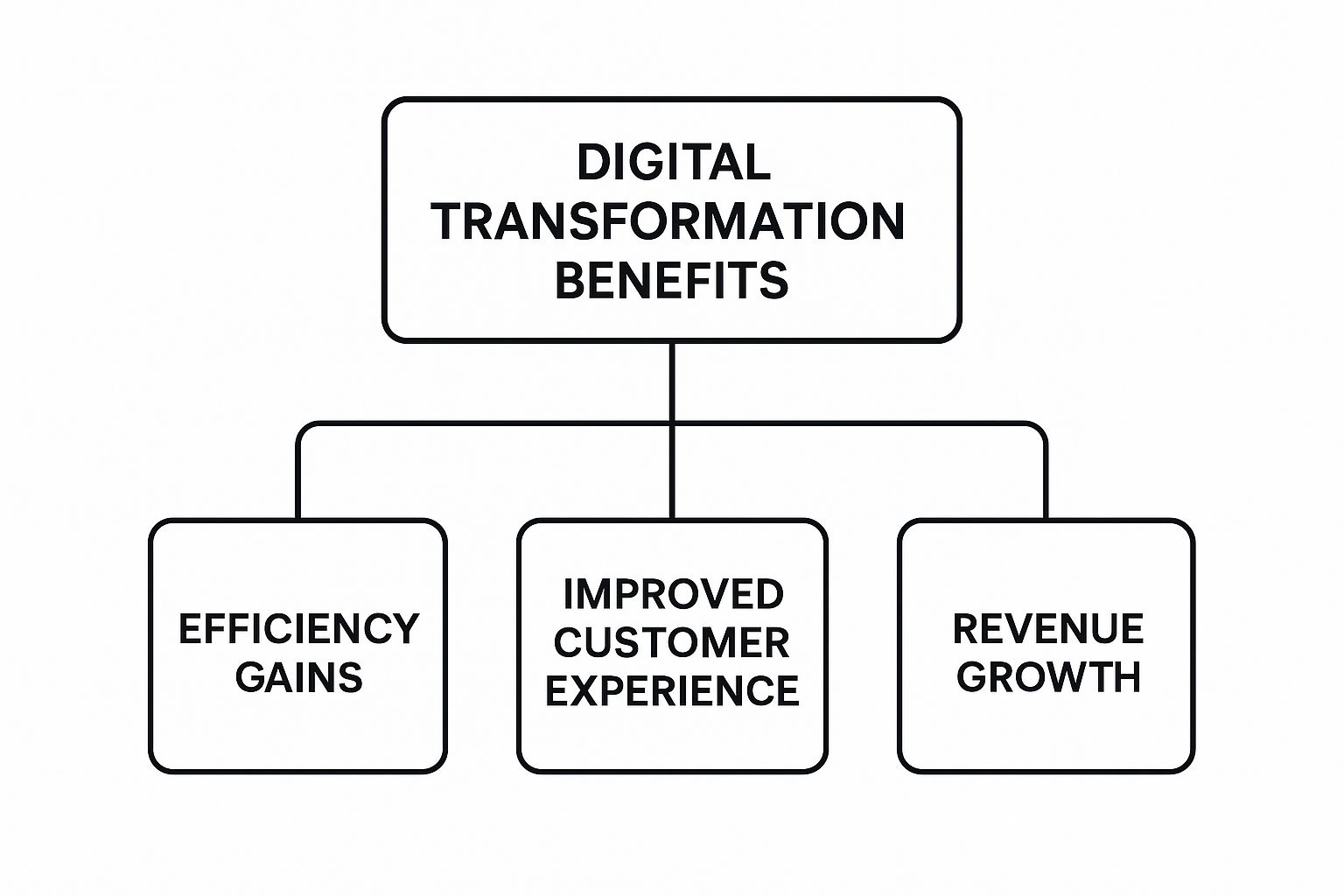
As you can see, the end goals are always things like greater efficiency, happier customers, and ultimately, more revenue.
Pillar 3: Domain Transformation
This one is the most ambitious of the four. Domain Transformation is when a company uses its unique know-how and technology to jump into entirely new markets. It happens when a business builds something amazing for itself and then realizes that other industries could use it, too. It’s about completely redrawing the lines of what your business is and what it can be.
Amazon is the poster child for this. They started as an online bookstore. To run that store, they had to build a ridiculously powerful and scalable cloud infrastructure. Then, they had a lightbulb moment: what if they sold access to that infrastructure? And just like that, Amazon Web Services (AWS) was born, catapulting them into a brand-new, wildly profitable market. That's a perfect example of domain transformation.
Pillar 4: Cultural and Organizational Transformation
This might be the most important pillar—and almost always the hardest to get right. Cultural and Organizational Transformation is about people. Without a team that’s on board with change, even the most brilliant strategy and technology will fall flat.
This means building a workplace that embraces new ideas, encourages constant learning, and values data over gut feelings. It's about breaking down the walls between departments so everyone can work together.
A perfect case study is Microsoft's famous shift under CEO Satya Nadella from a "know-it-all" to a "learn-it-all" culture. This fundamental change was absolutely necessary for the company to fully embrace the cloud and AI. When your culture is right, your entire team becomes the engine driving transformation, not a roadblock standing in its way.
4 Key Technologies That Power Modern Business

Technology is the engine behind any real digital transformation. But it’s not about chasing every shiny new tool that comes out. The trick is to be selective, choosing technologies that solve your specific problems and open up new possibilities.
Let's look at the core tools that are the foundation of business today. Think of them less as separate items and more like LEGO bricks—they connect and work together to build a smarter, more nimble, and customer-first company.
The Power Of The Cloud
Cloud computing is the launchpad for most digital projects. It’s like renting access to a supercomputer with endless storage and power that you can tap into from anywhere. You get all the benefits without having to buy and maintain your own expensive servers.
This gives you incredible flexibility and scalability. An online store can easily handle a massive holiday sales rush because the cloud automatically provides more resources when needed. This freedom lets businesses try new things and grow without being boxed in by their own hardware.
Big Data And Analytics For Smarter Decisions
Businesses are swimming in data—from sales figures and website clicks to customer reviews and social media mentions. By itself, it's just a lot of noise. Big Data and Analytics are what help you find the meaningful signal in that noise, giving you a clear picture of what customers actually want and how your business is really doing.
This is much deeper than just looking at sales reports. Good analytics can uncover hidden trends, like which products people tend to buy together or which ads bring in the most loyal customers. You start making decisions based on solid evidence instead of just gut feelings.
"A well-designed digital architecture is the plumbing of the business. Prioritizing technologies like the cloud and data analytics ensures that information can flow seamlessly, enabling AI to streamline operations and support sustained transformation."
Artificial Intelligence And Machine Learning
If analytics show you what happened, Artificial Intelligence (AI) and Machine Learning (ML) help you predict what will happen next. These tools can automate repetitive work, create personalized experiences for customers, and spot opportunities a person might easily overlook.
For instance, an AI chatbot can offer 24/7 support, which frees up your human team to handle the really tricky questions. An ML model can look at a customer's past purchases and suggest other products they might love, which is a great way to boost sales and learn how to improve customer experience.
The Internet Of Things Connecting The Physical World
The Internet of Things (IoT) connects your physical operations to your digital ones. It’s all about a web of smart sensors and devices that gather and send real-time data from the real world. Think of a shipping company using IoT sensors to track its trucks, optimize delivery routes on the fly, and even monitor fuel efficiency.
The impact of these technologies is huge. The World Economic Forum estimates that digital transformation could create $100 trillion in value by 2025. This growth is fueled by tools like IoT, a market that's on track to be worth nearly $2.75 trillion by 2026.
These core technologies also help businesses use social media more effectively for building their brand. As you develop your strategy, it can be useful to assess the value of your social media channels to see what's really working.
How To Build Your Transformation Roadmap

Alright, let's get practical. Moving from big ideas to real-world action is where most businesses stumble. A good transformation roadmap is what separates success from failure. Think of it less as a rigid, unchangeable plan and more like a GPS for your business—it shows you the destination and helps you navigate the best route, even if you need to take a detour.
The goal isn't to create a giant, complicated document that no one ever looks at. It's to build a living strategy that grows and adapts as you learn what works. The whole process follows a pretty logical flow, starting with a hard look in the mirror and ending with results you can actually measure.
Step 1: Assess Your Starting Point
Before you can figure out where you're going, you need to know exactly where you are. This means taking a brutally honest look at your company's digital capabilities right now. This isn't just about what software you own; it's about how you use it—or don't use it.
First, figure out your company's digital maturity. Are your operations still stuck in a world of paper files and spreadsheets, or have you already embraced some cloud tools and automation? From there, you can pinpoint your biggest pain points.
- Do your teams struggle to share information because they're working in separate, disconnected systems?
- Is a clunky website or a frustrating checkout process costing you customers?
- How many hours are your people wasting on repetitive, manual tasks that a machine could do in seconds?
Answering these questions gives you a clear baseline. It shines a light on the most urgent problems that a digital shift can fix.
Step 2: Define Your Vision and Secure Buy-In
Once you have a clear picture of the "now," you can start painting a picture of the "future." Your vision can't just be a fuzzy goal like "we want to be more digital." It needs to be anchored to specific, tangible business outcomes.
For every project on your wishlist, ask one simple question: "How will this help us achieve our main business goals?" A powerful vision connects every tech investment to a real-world result, like boosting customer retention by 15% or slashing operational costs by 20%.
With that outcome-focused vision in hand, your next job is to get your leadership team on board. True transformation has to be driven from the top. Frame your vision as a solid business case, showing the expected return on investment and how it directly tackles the pain points you uncovered. An IDC report found that 53% of organizations already have a company-wide digital strategy, which tells you that getting leadership's backing is quickly becoming standard practice.
Step 3: Prioritize Initiatives and Create a Phased Plan
Here's a hard truth: you can't do everything at once. Trying to boil the ocean is a surefire way to get overwhelmed and fail. The key is to prioritize projects based on their potential impact and the effort required. Always be on the lookout for the "quick wins"—those high-impact, low-effort tasks that deliver visible results fast.
"Instead of launching it like a great big bang and running the risk of a huge failure, you take it more step by step. So it’s building up digital capability, but in a very step-by-step kind of way. And that allows the organization to much more readily absorb the change." – Rita McGrath, Columbia Business School Professor
This approach builds momentum. It gets people excited and shows them that change is not only possible but positive. Your roadmap should be broken into distinct phases, each with its own goals and timeline.
- Phase 1 (Foundational): Start by getting your house in order. This might mean moving key systems to the cloud or implementing a CRM like Salesforce to get a single, unified view of your customer data.
- Phase 2 (Optimization): Now you can start making things better. This is where you introduce automation for tasks like invoicing or use analytics to personalize your marketing efforts.
- Phase 3 (Expansion): With a solid foundation, you can explore new ways to grow. This could be the perfect time to launch an e-commerce store or even develop a brand-new digital product or service.
To help you visualize this, here's a simple template for what a phased roadmap could look like.
Digital Transformation Roadmap Template
| Phase | Key Initiatives | Primary Goal | Success Metric |
|---|---|---|---|
| 1: Foundation | – Cloud Migration – CRM Implementation |
Centralize data and create a single source of truth. | 100% of customer data in CRM. |
| 2: Optimization | – Automate Invoicing – Email Marketing Automation |
Reduce manual effort and improve marketing ROI. | 50% reduction in time spent on invoicing. |
| 3: Expansion | – Launch E-commerce Store – Develop Mobile App |
Create new revenue streams and improve customer access. | 20% of total revenue from online sales. |
This table is just a starting point, but it shows how you can organize your thoughts and turn a big vision into manageable, measurable steps.
Step 4: Implement, Measure, and Adapt
Finally, and this is crucial, your roadmap is not a stone tablet. Digital transformation is a continuous cycle of doing, checking, and adjusting. You need to adopt an agile mindset. This means implementing changes in small, manageable chunks, getting feedback, and then tweaking your plan based on what you've learned.
For every project you kick off, define your key performance indicators (KPIs) before you start. These numbers are your compass; they'll tell you if your efforts are paying off. If an initiative isn't delivering the results you hoped for, don't be afraid to change course or even scrap it.
This constant loop of build-measure-learn is what separates transformations that succeed from those that just fade away. It’s what keeps you on track and ensures you’re delivering real, meaningful value every step of the way.
How to Get Past the Hurdles of Digital Transformation
Starting a digital transformation project is exciting, but let’s be honest—it’s never a simple, straight path. The road is almost always bumpy, with obstacles that can slow you down or, in some cases, stop the whole project cold. Knowing what these common problems are ahead of time is your best defense.
Interestingly, most projects don't fail because the tech is bad. They fail because of people problems. We’re talking about things like employees digging in their heels, fuzzy goals from the top, not enough money in the bank, or real worries about keeping data safe.
Let's unpack these roadblocks one by one and talk about real, practical ways to get around them.
Getting Your Team on Board
One of the biggest hurdles you'll face has nothing to do with software or servers—it's your company culture. People naturally resist change. They might worry that new technology is coming for their jobs, feel swamped by having to learn new systems, or just be perfectly happy with the way things have always been done. You can't just force change on people; you have to get them to want it.
This is where transparent communication becomes absolutely critical. You have to explain the why behind it all, focusing on how the new tools will make their jobs easier or better, not how they'll be replaced. Think of it as an upgrade for their skills, not a threat to their role.
- Offer Real, Hands-On Training: Set up training sessions that are specific to what each person does. The goal is to build confidence, not just tick a box.
- Find Your "Digital Champions": Look for those few enthusiastic people on your team who get it. Make them your advocates who can help their coworkers and spread positivity.
- Actually Listen to Feedback: Create a way for employees to share their concerns and ideas. When you act on their feedback, it shows you respect their input.
From a Fuzzy Vision to a Clear Plan
Another place where things fall apart is a weak strategy. Kicking off a transformation project without a clear vision is like setting sail without a map or a destination. If leaders can't clearly state what winning looks like, teams won't know what to work on first or how to tell if they're even making progress.
Your strategy needs to connect every single digital project to a real business result. So instead of saying, "We're getting a new CRM," your goal should be something like, "We're implementing a new CRM to boost our customer retention by 15% in the next year." For more on this, our guide to small business digital transformation provides some great frameworks for setting these kinds of clear, measurable goals.
What to Do About Tight Budgets and a Skills Gap
Of course, big ideas have a habit of running into two very real-world problems: not enough money and not enough people with the right skills. Many businesses feel stuck, knowing they need to change but feeling like they don't have the resources. The trick is to be smart and resourceful.
The skills gap is no joke. A massive 90% of companies admit they don't have the internal talent to pull off their digital plans. At the same time, money is tight, with 23% of businesses saying budget limits are a major roadblock. You can see the full story in the 2025 State of Digital Transformation report from TEKsystems.com.
Here's how you can tackle these issues head-on:
- Go for Quick, High-Impact Wins First: Look for projects that deliver the biggest bang for your buck with the least amount of effort. Nailing a few of these early on builds momentum and proves the value, which makes it much easier to get more funding later.
- Train the Team You Already Have: Before you start looking for new hires, see who on your current team can be trained up. It's usually cheaper and builds incredible loyalty.
- Break It Down into Phases: You don't have to do everything all at once. Split massive projects into smaller, more manageable stages. This spreads out the cost and lowers the risk if something goes wrong.
By thinking about these challenges from the start, you can build a plan that’s both ambitious and realistic. Success isn't about having a problem-free journey—it's about being prepared to solve the problems as they come up.
Your First Steps on the Transformation Journey
Okay, we've covered a lot. But remember, digital transformation isn’t some monolithic project you complete and check off a list. It’s a continuous journey.
The secret is to balance the right technology with a clear strategy and a team culture that’s ready to adapt. The best way to get there? Don't try to boil the ocean. Start with small, smart moves that build momentum.
To get you started, here's a simple checklist with three things you can literally do this week. These are small wins designed to get the ball rolling without needing a huge budget or a grand, complicated plan.
Three Actionable First Steps
-
Identify One Manual Process to Automate: Think about the repetitive, time-sucking tasks your team dreads. Is it manually building reports every Friday? Or maybe chasing down invoices? Find just one of those bottlenecks to automate. It’s a fantastic starting point that gives you a quick, tangible win.
-
Pinpoint a Key Customer Pain Point: Get your team in a room for 30 minutes. Ask one simple question: "What's one frustrating thing our customers deal with that technology could fix?" Maybe it's a clunky checkout or slow customer service replies. Focusing on the customer keeps your efforts grounded in creating real value.
-
Explore Ways to Boost Operational Efficiency: Sometimes a small tweak can create a huge ripple effect on productivity. For more on this, our guide on how to improve business efficiency is packed with ideas to help you find that perfect first initiative.
By taking these small, focused actions, you turn the big idea of what is digital transformation into something you can actually do. This step-by-step approach builds confidence and skill across your organization, making it much easier to tackle bigger challenges down the road.
Frequently Asked Questions About Digital Transformation
Even with a solid plan in place, it's natural to have questions about what digital transformation actually looks like day-to-day. Let's tackle some of the most common questions we hear from business leaders, offering straightforward answers to help you move forward.
How Is This Different From Just Digitization?
This is a fantastic question, and the distinction is critical. Think of it in three steps.
First, you have digitization. This is the simple act of converting something physical into a digital format. Scanning a paper invoice to create a PDF is a perfect example. You've gone from analog to digital.
Next comes digitalization. This is where you use digital tools to improve an existing way of working. Instead of a paper form, you create an online form that people can fill out on your website. You're not changing the process, just making it more efficient with technology.
But digital transformation is a whole different ballgame. It's about fundamentally rethinking how you do business and deliver value to your customers. It’s not about tweaking old processes; it's about creating entirely new ones. The classic example is moving from buying CDs (digitization) to inventing a service like Spotify (transformation). One is just a format change; the other is a brand-new business model.
"Instead of launching it like a great big bang and running the risk of a huge failure, you take it more step by step. So it’s building up digital capability, but in a very step-by-step kind of way."
As this idea highlights, true transformation isn't a single, massive project. It's a gradual, strategic buildup of your company's digital muscle.
What Is the Best First Step for a Small Business?
For any small business, the best place to start is with a real, nagging problem. Forget about the technology for a moment and focus on your biggest bottleneck or source of frustration.
Here are a couple of great starting points:
- Tackle a Customer Headache: Pinpoint one thing that constantly annoys your customers. Is your online checkout a pain? Do people wait too long for support responses? Fixing that single issue delivers immediate value and shows customers you're listening.
- Fix an Internal Time-Waster: Look for a repetitive, manual task that eats up your team's valuable time. Automating something like creating weekly reports or sending invoice reminders can be a quick win that frees up people for more important work.
Starting small lets you prove the concept, build momentum, and get your team excited for what's next.
How Can I Measure the ROI of Transformation Efforts?
Measuring the Return on Investment (ROI) for digital transformation goes way beyond just looking at cost savings. You have to tie every initiative back to a clear business goal.
The trick is to define your Key Performance Indicators (KPIs) before you even start a project. What does success look like? It might be measured by:
- Customer Metrics: An increase in Customer Lifetime Value (CLV), a better Net Promoter Score (NPS), or higher customer retention rates.
- Operational Metrics: A reduction in the time it takes to complete a process, a lower error rate, or a jump in employee productivity.
- Revenue Metrics: Growth in online sales, a higher average order value, or new revenue from digital services you've launched.
When you track these specific numbers, you get a clear, data-driven story about the value your efforts are creating.
Can My Company Do This on a Small Budget?
Absolutely. In fact, a tight budget can be a secret weapon. It forces you to be smart, focused, and resourceful instead of just throwing money at problems.
You don't need a massive, six-figure investment to get started. The key is to prioritize low-cost initiatives that deliver a high impact. This could mean using simple cloud-based tools, setting up basic automation, or just getting more out of the software you already pay for.
Focus on making small, incremental changes that solve real problems. Each one will deliver its own ROI, building a powerful case for investing more down the road.
Ready to build a powerful online presence that drives your business forward? The team at OneNine specializes in creating custom websites and providing the strategic support you need to succeed. Let's build your digital future together.


