

Improving customer experience isn't about one single, grand gesture. It's the sum of all the small moments—every single interaction someone has with your business. The journey starts when you learn to see your company through your customers' eyes, map out their path, spot the friction, and then truly listen to what they're telling you.
Why Customer Experience Is Your New Competitive Edge
In a market flooded with options, your product features and pricing can be copied in a heartbeat. What can’t be replicated is how you make your customers feel. That feeling, the total customer experience (CX), is where the real competition happens now. It’s not some soft, fuzzy metric anymore; it's a powerful driver of revenue and growth.
For many small businesses and agencies, pouring resources into CX can feel like a luxury you can't afford. The truth is, it’s a necessity for survival. Today’s customer has endless choices and zero patience for a clunky process or feeling ignored. Just one frustrating moment can erase years of loyalty.
The Real Cost of a Bad Experience
The stakes are higher than you might think. Did you know that over 50% of customers will jump ship to a competitor after just one bad experience? That number climbs dramatically after a second or third slip-up, which shows you just how thin customer loyalty is these days.
Even more startling is the gap between how companies see themselves and how customers see them. While a whopping 80% of companies believe they deliver an "excellent" experience, only a tiny 8% of their customers actually agree. This disconnect is a silent killer, causing customers to walk away for reasons you never even knew existed. If you want to dig deeper, you can explore more data on this customer experience gap and its impact on retention.
Key Takeaway: The biggest risk isn’t just losing one customer. It’s the quiet churn happening under the surface from experiences you're not even aware of. Your competitor isn’t just winning a sale—they're gaining the customer you couldn't keep.
The Business Impact of Customer Experience
The decision to improve your customer experience isn't just about making people happy; it’s about tangible business results. Great CX builds a healthier, more profitable company. On the other hand, poor CX actively hurts your bottom line.
This table breaks down exactly what's at stake.
| Metric | Impact of Poor CX | Impact of Excellent CX |
|---|---|---|
| Customer Retention | Higher churn rates, increased acquisition costs to replace lost customers. | Increased loyalty, higher customer lifetime value (CLV). |
| Revenue | Reduced sales, customers hesitate to make repeat purchases. | Customers spend more and are 52% more likely to pay a premium. |
| Brand Reputation | Negative word-of-mouth, poor online reviews deter new customers. | Positive reviews and referrals, becoming a trusted brand. |
| Operational Costs | Higher volume of support tickets, time spent on damage control. | Reduced support queries, more efficient and proactive service. |
When you invest in CX, you're directly investing in your company's future. It transforms your customer base from a simple list of transactions into a loyal community of advocates. These are the people who will choose you again and again—not because you're the cheapest option, but because you're the best to do business with.
Mapping Your Customer's Entire Journey
If you want to genuinely improve your customer experience, you have to learn to see your business through your customers' eyes. It’s a simple truth: you can't fix a problem you don't even know exists.
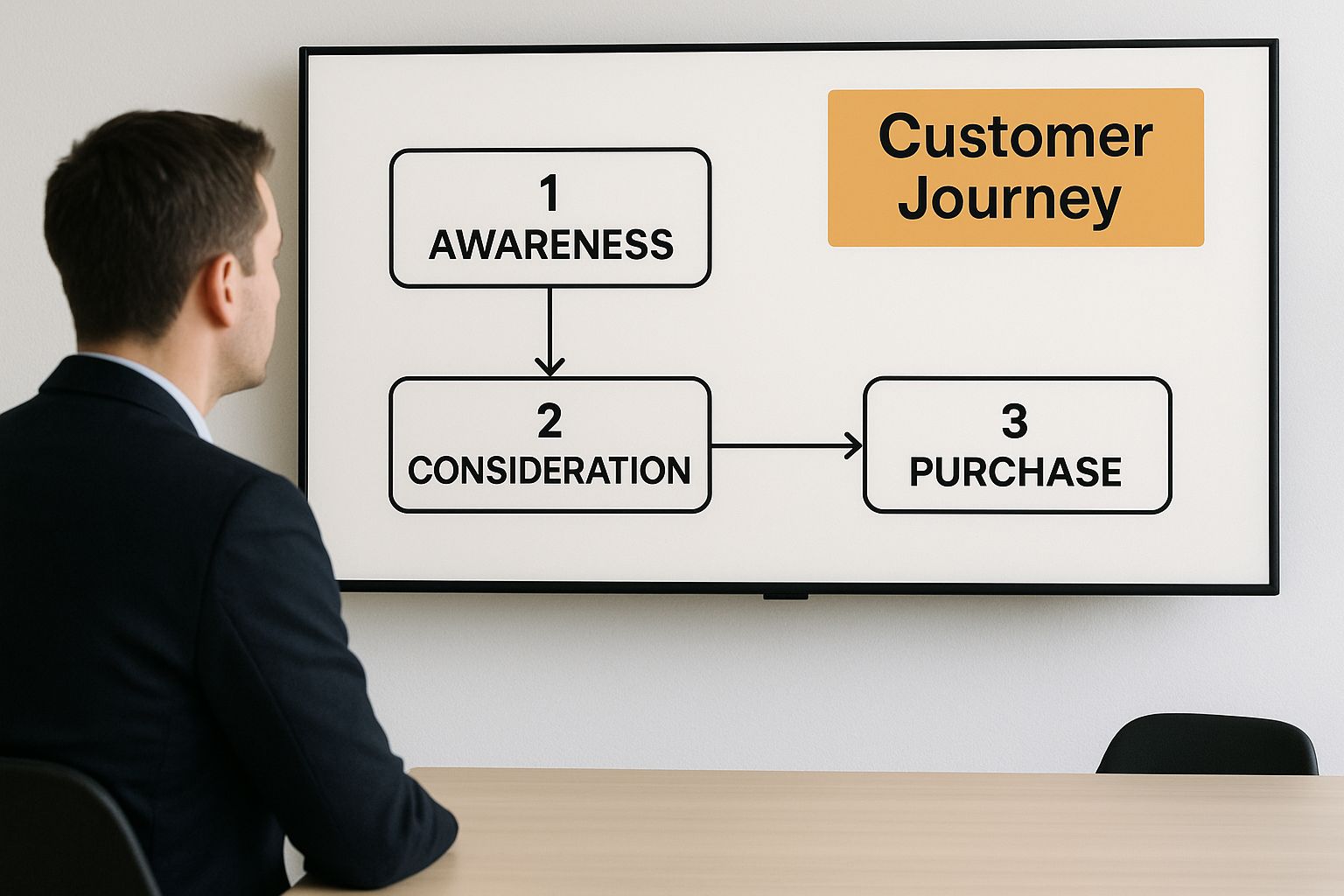
This means you need to stop guessing. It's time to piece together every single interaction someone has with your company, from the moment they first hear about you to long after they’ve made a purchase. We call this customer journey mapping.
Think of a journey map as the story of your customer's experience, told visually. It helps you get inside their head to understand their goals, their frustrations, and what makes them happy. Without this map, you're just flying blind, maybe pouring money into a fancy new feature nobody asked for while a simple bug in your checkout process quietly kills sales every single day.
This flowchart really drives home how foundational this process is.
As you can see, improving the experience isn't a one-and-done task. It's a continuous cycle of understanding your customer, pinpointing the real issues, and then rolling out smart, targeted solutions.
Gathering Your Raw Materials
The best journey maps are built on a solid foundation of real data, not just what you think happens in a conference room. To get the full picture, you need to blend hard numbers with human stories.
First, let's start with the quantitative data—the cold, hard facts.
- Website Analytics: Dive into tools like Google Analytics. Where are people coming from? Which pages do they linger on? And most importantly, where are they leaving? A high exit rate on a key page is a massive red flag screaming, "Something is wrong here!"
- Support Tickets: Your help desk is a goldmine. Look for patterns in the tickets. Are people constantly asking the same questions or reporting the same problems? That’s not a customer issue; that’s a friction point in your process.
- Sales Data: Check your CRM. Where do deals consistently stall? If prospects go silent after seeing your pricing page or receiving a proposal, you might have a problem with clarity, value perception, or even follow-up speed.
Adding the Human Element
Numbers tell you what is happening, but they rarely tell you why. This is where you absolutely must get qualitative feedback. You need to hear directly from your customers to understand the emotions and motivations driving their actions.
For instance, your analytics might show a high cart abandonment rate. But only a customer can tell you it's because the shipping costs were a nasty surprise at the end, or the discount code field was broken.
A study by McKinsey found that focusing on the entire customer journey, rather than individual touchpoints, is 30% to 40% more strongly correlated with customer satisfaction. This proves that a holistic view is not just helpful—it’s critical for success.
So, how do you get this crucial human insight?
- Run Short Surveys: Use simple post-purchase or post-support surveys. A one-question Customer Effort Score (CES) survey asking, "How easy was it to resolve your issue?" can tell you so much.
- Actually Talk to People: Pick up the phone and have a real conversation with a few of your best customers (and maybe a few who left). Ask open-ended questions like, “Can you walk me through the last time you interacted with our company?”
- Read Online Reviews: Don't ignore what's being said on Google, Yelp, or industry forums. This is unfiltered, raw feedback about what you’re doing right and, more importantly, what you’re doing wrong.
Assembling Your Journey Map
With your data in hand, you're ready to start building the map itself. The goal is to outline the distinct stages of the journey, the specific touchpoints within each stage, and what the customer is thinking and feeling along the way. For a great deep-dive, check out this guide on how to create a customer journey map that really breaks down how to visualize every touchpoint.
A solid map usually includes these elements for each stage:
| Component | Description | Example (For an E-commerce Site) |
|---|---|---|
| Stage | A distinct phase in the customer lifecycle. | Awareness, Consideration, Purchase, Service, Loyalty |
| Customer Goal | What the customer is trying to accomplish. | "I need to find a durable pair of running shoes." |
| Touchpoints | Where the customer interacts with your business. | Sees an Instagram ad, visits the product page, uses live chat. |
| Pain Points | Moments of frustration or friction. | "The website is slow to load on my phone." |
| Opportunities | Ideas for making the experience better. | "Optimize mobile site speed." "Add a shoe-finder quiz." |
Once completed, this map becomes your blueprint for action. You're no longer just randomly trying things to improve CX. Now, you have a clear, evidence-based guide showing you exactly where to focus your energy for the biggest possible impact.
Crafting a Proactive and Personalized Experience
Once you’ve mapped out the customer journey, you have a clear picture of what your customers go through today. That’s the "as-is." Now, the real work begins: designing the future. A truly effective customer experience strategy doesn't just put out fires; it predicts where they might start and makes every single touchpoint feel like it was created just for that customer.
This means getting away from the generic, one-size-fits-all emails and support scripts we’ve all seen. The goal is to deliver the right guidance at the right moment, showing customers you actually understand their needs and what they're trying to accomplish. This is the difference between decent service and an experience they’ll remember and recommend.
Shifting from Reactive to Proactive Support
Most businesses live in a reactive world. A customer has a problem, they reach out, and you solve it. A proactive approach flips that entire model on its head. It’s about spotting and solving problems before they even become problems for your customer.
Think about it this way: imagine a software company sees a new user has just started using a particularly tricky feature. Instead of waiting for a frustrated support ticket to come in, they could automatically send a quick email with a link to a two-minute video tutorial. It’s a small gesture, but it heads off frustration at the pass and makes the customer feel seen and supported.
Here are a few ways to start thinking proactively:
- Offer Post-Purchase Guidance: Right after a sale, send something helpful. If someone buys a new camera from you, follow up with a guide on "5 Tips for Amazing Photos with Your New Camera."
- Use Usage-Based Triggers: Keep an eye on how people are using your product. If a customer is getting close to their data limit, a friendly heads-up email can prevent a service interruption and a bigger headache later.
- Flag Problems Before They Do: A shipping company could see a storm is about to cause delays and notify customers immediately, rather than waiting for them to call wondering where their package is.
This isn’t just about making customers happier; it’s also incredibly efficient. Every problem you solve proactively is one less support ticket your team has to handle, freeing them up for more complex issues. For more on this, check out our guide on how to improve business efficiency.
The Power of Smart Personalization
Let's be clear: personalization is so much more than just sticking {{first_name}} in an email subject line. Real personalization uses customer data to create experiences that feel genuinely relevant and helpful, not invasive or creepy.
This is quickly becoming the baseline expectation. We’re headed for a world where 89% of businesses will compete mainly on the experience they provide. Personalization is at the heart of this shift, with 65% of consumers already expecting it. The payoff is huge—companies that get it right see a 40% increase in revenue. You can dig into more of these trends by reading about customer experience statistics and their business impact.
Expert Insight: Gartner predicts that by 2025, proactive customer interactions will outnumber reactive ones. This really drives home how urgent it is for businesses to build systems that anticipate what customers need instead of just waiting for them to ask.
When done right, personalization feels natural and adds real value. It’s all about using a customer's history and current context to offer something they’ll actually appreciate.
Here are a few practical examples of what this looks like:
- For an e-commerce store: Don't show every visitor the same generic homepage. Instead, highlight products related to what they’ve bought or browsed before.
- For a service-based business: If a client mentioned they were interested in a specific service a few months ago, send them a personal note when you have a new case study or a special offer related to it.
- For a B2B agency: After hitting a major project milestone, send a thank-you note that mentions a specific success or a great moment you shared during the collaboration.
This kind of attention to detail shows you’re listening. It helps turn a simple transaction into a real relationship built on trust and understanding—and that’s the foundation for any long-term improvement in customer experience.
Gathering and Acting on Customer Feedback

It’s one thing to have a plan, but it’s another thing entirely to know if it’s actually working. To really improve your customer experience, you have to get out of your own head and listen to what your customers are actually saying and feeling. This isn't about sending a survey once a year; it's about building a system to constantly listen and, more importantly, respond.
The companies that nail this see incredible results. We're talking 43% better customer retention and 33% higher profitability for businesses that are truly customer-obsessed. A huge part of that comes from their dedication to collecting and acting on feedback.
Interestingly, about one in four CX leaders say this is their main focus. While most still lean on surveys, the sharpest companies are also using voice and text analytics to dig into what's really being said in support calls and chats. You can find more details on these digital customer experience statistics and trends.
Go Where Your Customers Are
The best feedback isn't requested, it's captured. You need to meet customers where they are, right in the middle of their experience with you, not by asking them to jump through hoops later on. Think about those key moments of truth.
This means embedding feedback opportunities right into your touchpoints. For example, when a live chat ends, pop up a simple one-click CSAT (Customer Satisfaction) rating. It’s instant and painless. After someone buys something, send a short email asking one simple question about the checkout. You might uncover friction points you never even knew you had.
Get creative with your channels:
- Point-of-Service Prompts: Quick, in-the-moment questions that capture immediate reactions.
- Social Media Listening: Keep an eye on brand mentions and DMs. The public conversation is a goldmine.
- Review Site Analysis: Don't just read reviews on Google or Yelp—track them. Look for the patterns and themes that keep popping up.
- Text and Voice Analytics: Use tools to scan support calls and chat logs for keywords, sentiment, and emotion.
The whole point is to make giving feedback completely effortless. The easier you make it, the more you'll get.
Key Insight: Stop asking, "How did we do?" Get specific. Instead of a vague survey, ask, "How easy was it to find the shipping info on our website today?" That's how you get feedback you can actually use.
Closing the Feedback Loop
Collecting feedback is just the start. The part that most businesses stumble on—and where you can really stand out—is acting on it and letting customers know you did. This is what we call "closing the feedback loop."
Think about it. A customer tells you something is confusing on your site. A few weeks later, they see it's been fixed. That’s how you build real loyalty. It shows you aren't just collecting data to fill a spreadsheet; you're actually listening and trying to be better.
Let's say a customer leaves a review saying your shipping policy is buried. You could just say thanks. Or, you could thank them, fix the issue, and then follow up with a quick note: "Hey, just wanted to let you know we took your suggestion and added a 'Shipping Details' link to every product page. Thanks again for the help!"
You just turned a complaint into a major win. That customer now feels heard, valued, and like they have a personal stake in your success.
From Individual Feedback to Systemic Change
While fixing one-off issues for individual customers is powerful, the real goal is to turn that stream of feedback into bigger, system-wide improvements. One person struggling with checkout is an anecdote. Twenty people struggling is a fire you need to put out.
Here’s a simple way to think about turning feedback into action:
- Tag Everything: As feedback comes in, categorize it. Use simple tags like "website bug," "pricing confusion," or "feature request."
- Spot the Patterns: On a regular basis, look at your tags. What are the top 3-5 issues people mention over and over?
- Prioritize & Assign: Figure out which issues are causing the most pain and assign them to the right person or team to get fixed.
- Announce the Fix: When you solve a common problem, shout it from the rooftops! Post it in your newsletter or on social media. Let everyone know you’re making things better because you heard them.
This process turns customer service from a reactive task into a strategic engine for your business, making sure you're always evolving to meet your customers' needs.
Measuring the Success of Your CX Initiatives
Improving customer experience feels good, but feelings don't get budget approval. If you want to make a real impact, you have to prove that a better experience leads to a healthier bottom line. Measuring your CX initiatives is about connecting those "feel-good" improvements to the hard numbers your leadership team actually cares about.
This is how you turn your CX work from a "nice-to-have" expense into a core revenue driver. When you can walk into a meeting and say, "Our new checkout flow cut cart abandonment by 10%," you’re suddenly speaking a language everyone understands.
Choosing Your Core Experience Metrics
Before you can tie experience to revenue, you have to measure the experience itself. I've found it's best not to overcomplicate things, especially at the start. Three core metrics will give you a powerful, at-a-glance view of how customers feel.
-
Net Promoter Score (NPS): This one is all about loyalty. It boils down to a single question: "How likely are you to recommend us to a friend or colleague?" NPS is a fantastic barometer for long-term brand health and future growth.
-
Customer Satisfaction (CSAT): Think of CSAT as an in-the-moment snapshot. You use it right after a specific interaction, like a support call or a purchase, by asking, "How satisfied were you with your experience today?" It gives you immediate, actionable feedback on individual touchpoints.
-
Customer Effort Score (CES): This metric gets right to the heart of friction. It asks, "How much effort did you personally have to put forth to handle your request?" A low-effort experience is one of the strongest predictors of customer loyalty I've seen. People stick with companies that are easy to do business with.
The trick is using the right tool for the job. NPS gives you the big picture, CSAT zooms in on specific interactions, and CES tells you how easy you are to work with. For instance, a clunky website directly hurts your CES. Digging into website performance optimization strategies for business growth is a great place to start reducing that customer effort.
Connecting CX Data to Business KPIs
Now for the crucial part: linking those experience scores to the financial metrics that run the business. This is how you demonstrate a clear return on investment (ROI) for all your hard work. You have to show that a happy customer is a profitable one.
Start by tracking your experience scores alongside your key business performance indicators (KPIs). Look for the patterns. Do customers with a high NPS also have a higher Customer Lifetime Value (CLV)? If they do, you've just proven that loyalty directly translates to more money over time.
Key Takeaway: Experience metrics like NPS tell you what happened (customers are happy). Business KPIs like churn rate tell you so what (how that happiness impacts revenue). Your job is to build the bridge between the two.
Here are the most critical connections I always recommend focusing on first:
| Experience Metric | Connects To Business KPI | What This Tells You |
|---|---|---|
| Net Promoter Score (NPS) | Customer Lifetime Value (CLV) | Your biggest fans (Promoters) stay longer and spend more, increasing their total value to the business. |
| Customer Satisfaction (CSAT) | Repeat Purchase Rate | A customer who is satisfied after a purchase or support ticket is far more likely to come back again. |
| Customer Effort Score (CES) | Churn Rate | When customers have to work hard to solve a problem, they're more likely to give up and leave for a competitor. |
By tracking these pairs, you build an undeniable business case for investing in customer experience. You’re no longer just asking for resources—you're presenting a data-backed plan for growth. You're proving that every improvement you make for the customer is a step toward a stronger, more profitable company.
Common Customer Experience Questions Answered

As you start diving into customer experience, a lot of questions come up. It's totally normal. While CX can feel like a big, complex world, the core ideas are actually pretty simple. Let's walk through some of the most common questions we get and give you clear answers to get you moving.
What Is the First Step to Improve Customer Experience?
Before you buy any fancy software or overhaul your company policies, the most important first step is to simply understand what your customers are really going through. You have to see their journey through their eyes.
This means mapping out every single touchpoint, from the moment they first hear about you to long after they’ve made a purchase. Talk to them. Dig into your support tickets. Look at your website analytics to see where people are getting stuck or dropping off. This groundwork prevents you from guessing and makes sure your efforts are focused on what actually matters to them.
How Can a Small Business Improve CX with a Limited Budget?
You absolutely do not need a massive budget to create a stellar customer experience. For small businesses, the biggest wins often come from high-impact, low-cost actions that build incredible goodwill.
A great place to start is by empowering your frontline team. Give them the freedom to solve customer problems right away, without needing to run up the chain of command for every little thing. It shows you trust your people and gets your customers what they need, faster.
Also, just be present. Actively ask for and respond to feedback on Google, Yelp, and social media. A simple, thoughtful reply shows you're listening and that you genuinely care. It's amazing how powerful that can be.
Think about this: a study found that 1 in 3 customers will leave a brand they love after just one bad experience. That statistic really drives home how critical every interaction is, especially when you're a small business and every customer counts.
These kinds of actions are more about time and effort than money, but they pay huge dividends in customer loyalty.
What Is the Difference Between Customer Service and Customer Experience?
This is a really common point of confusion, but the difference is crucial. The easiest way to think about it is that customer service is just one piece of the much bigger customer experience puzzle.
Customer service is typically reactive—it's what happens when a customer has a specific problem and reaches out for help. It’s a single moment, a single touchpoint.
Customer experience (CX), on the other hand, is the customer’s entire perception of your company. It’s the sum of every interaction they've ever had with you, including:
- Their first impression of your website.
- How simple (or difficult) it was to buy something.
- The quality of the product or service itself.
- The support they get if an issue pops up.
A great CX strategy makes all those touchpoints feel positive and seamless, which in turn reduces the need for reactive customer service. This proactive mindset is a key part of strong client retention best practices because it builds satisfaction into the entire journey from the start.
How Do I Measure the ROI of CX Improvements?
Measuring the ROI of your CX efforts is all about connecting the dots between happier customers and better business results. You need to prove that a better experience directly leads to a healthier bottom line.
Start by tracking well-known CX metrics like Net Promoter Score (NPS) or Customer Satisfaction (CSAT). The key, though, is to correlate changes in those scores with your business KPIs. For instance, if you see a 10-point jump in NPS for a certain group of customers, do you also see a lower churn rate or more repeat purchases from that same group?
By linking your CX data to hard financial numbers like revenue and customer lifetime value, you can build a rock-solid case that shows every dollar you invest in a better experience is an investment in your company's growth.
Managing your website is a critical part of your overall customer experience. At OneNine, we simplify website management with expert design, development, and ongoing support, ensuring your digital presence is always strong and effective. Learn more about how we can help you succeed online.


