
Your website is your digital first impression. It's that simple. It’s the very first thing people see, and it instantly shapes how they feel about your business. A great design builds trust and shows you're credible. A poor one? It can send potential customers running before they even read a single word.
Your Website Is Your Digital Handshake
Think about walking into a physical store. If it’s clean, organized, and inviting, you feel comfortable. If it’s messy, confusing, and run-down, you’ll probably walk right back out. Your website works the same way—it’s your digital storefront, your first handshake with a new customer.
This isn’t just a feeling; it's backed by data. An incredible 94% of a user's first impression comes directly from your website's design. That one statistic shows why good design isn't just a "nice-to-have" cosmetic touch—it's a core business investment. A clunky, slow, or confusing website tells visitors you don't really care about their experience, and they'll take their business elsewhere.
How Design Elements Shape First Impressions
Every single choice on your website, from the colors you pick to the fonts you use, sends a message. A clean, professional look instantly communicates that your business is legitimate and trustworthy. It builds confidence from the moment the page loads.
To really get why web design is so important, it helps to break down how specific choices create either a positive or negative experience.
The table below shows how different design elements can make or break that crucial first impression.
| Design Element | Positive Impact (Good Design) | Negative Impact (Poor Design) |
|---|---|---|
| Color Scheme | Creates a professional, on-brand feeling. | Feels jarring, unprofessional, or hard to read. |
| Typography | Easy to read, clean, and reinforces brand personality. | Difficult to read, inconsistent, or looks outdated. |
| Layout | Organized, intuitive, and guides the eye naturally. | Cluttered, confusing, and overwhelming. |
| Imagery | High-quality, relevant photos that build trust. | Cheesy stock photos or low-res images that look cheap. |
| White Space | Makes content digestible and looks modern and clean. | Dense blocks of text that feel intimidating and cramped. |
As you can see, these aren't just minor details. They're fundamental choices that work together to tell a visitor whether they should stick around or hit the back button.
At the end of the day, designing engaging and user-friendly websites is about capturing attention and pointing visitors in the right direction.
Your website is your hardest-working salesperson. It has to instantly answer three questions for every visitor: Who are you? What do you do? And why should I care?
A strategic redesign can have a massive impact on your business goals. Just look at the difference it can make.
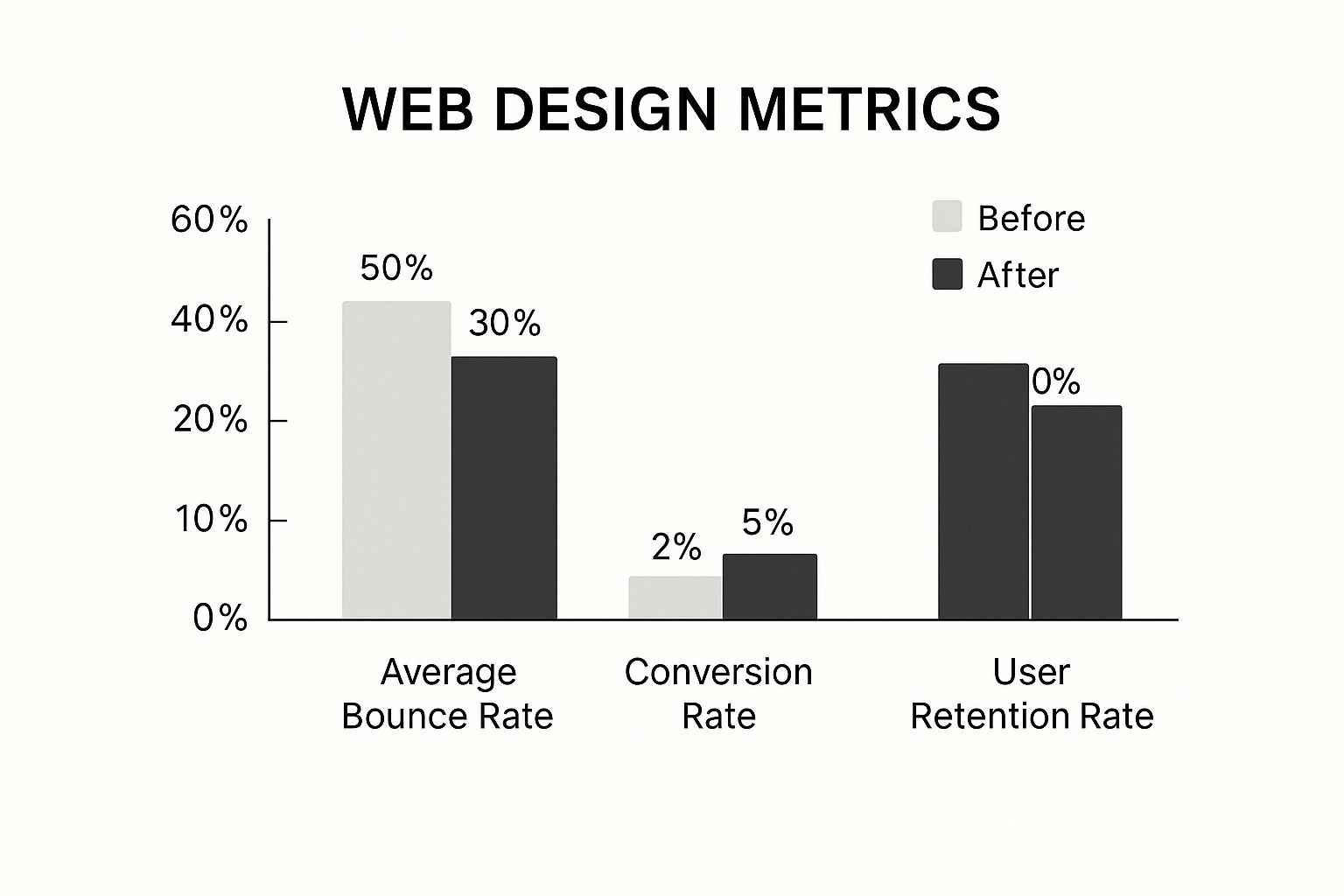
The numbers don't lie. A well-executed design overhaul dramatically lowers bounce rates while boosting conversions and keeping users on your site longer. For smaller companies, these improvements are everything—they lead directly to more leads, more sales, and sustainable growth. This is why professional https://onenine.com/website-design-small-businesses/ is one of the smartest investments a business can make.
How Great Design Builds Unbreakable Brand Credibility
It’s about more than just a good first impression. Great web design plays a deep, almost psychological role in building the kind of brand credibility that lasts. Your website isn't just a digital brochure; it's a direct reflection of your company’s professionalism, your attention to detail, and how much you care about your customers.
A polished, cohesive, and thoughtfully designed site sends a powerful, unspoken message: "We're legitimate, we know our stuff, and you can trust us."
This trust doesn't happen by accident. It's the direct result of deliberate design choices that tell a story of a reliable, authoritative business. When a visitor sees consistent branding—the same colors, logos, and fonts they've seen elsewhere—it creates a comforting sense of stability. That consistency is a huge part of building brand recognition.
On the flip side, a site that looks outdated, is riddled with broken links, or is just a pain to navigate immediately plants seeds of doubt. People start to wonder, "If their website is this neglected, what about their products or services?" This isn't just a guess; 75% of consumers admit to judging a company's credibility based on its website design. A sloppy digital presence can literally scare potential customers away.
The Anatomy of a Trustworthy Design
So, what are the specific ingredients that build this essential trust? It really boils down to a mix of visual consistency and functional reliability. Every little piece should work together to reassure visitors that they’re in good hands.
A few elements are particularly crucial for establishing credibility:
- Professional Visuals: Using high-quality, original photos and custom graphics shows you're invested in your brand. Relying on cheap, generic stock photos can make your whole operation feel cheap and untrustworthy.
- Clear Contact Information: A physical address, a phone number, and an email address that are easy to find are massive trust signals. It proves you're a real business with real people behind it, not some faceless entity hiding online.
- Intuitive Navigation: When people can find what they’re looking for without a struggle, it gives them a sense of control and makes you look competent. A confusing menu just leads to frustration and kills their confidence in your brand.
"Credibility is a core component of user experience. A professional and intuitive design directly reinforces a brand’s authenticity, which has a measurable impact on whether a user decides to engage, purchase, or subscribe."
From Suspicion to Confidence
Think of your website as your top salesperson. A well-designed site is like a sharp, confident representative who puts people at ease, anticipates their questions, and smoothly guides them to a solution.
An outdated site? That’s the disheveled, unprepared salesperson who mumbles and avoids eye contact. You wouldn't buy from them, would you?
When you invest in professional web design, you're not just getting a pretty layout. You're building a solid foundation of trust that turns skeptical visitors into loyal customers who believe in what you do.
The Critical Link Between Web Design and SEO
A lot of business owners treat search engine optimization (SEO) and web design as two completely separate projects. They see SEO as a technical game of keywords and backlinks, but that's a huge mistake. The truth is, your website's design is one of the most powerful—and most overlooked—factors that determines whether you'll rank on Google. The two are deeply connected.
Here’s an easy way to think about it: SEO gets people to your website. Your web design is what convinces them to stay.
Search engines like Google pay very close attention to what people do after they click on your link. If they land on your site and immediately hit the back button (this is called a "bounce"), it sends a crystal-clear signal to Google: "This page wasn't helpful." That's a red flag that can really hurt your rankings.
A great design has a direct impact on the key user engagement metrics that Google measures, like bounce rate, time on page, and pages per session. This is why web design is much more than just looks; it’s a core piece of any smart SEO strategy. A beautiful website that’s a pain to use will always struggle to get to the top of the search results.
How Design Choices Impact Google Rankings
So, how does Google "see" your design? It couldn't care less about your color palette. What it does evaluate are the technical and structural elements that are a direct result of your design choices. A logical site layout and clean navigation don't just help your visitors; they help search engine crawlers understand and index your content much more efficiently.
Several design-driven factors have a direct impact on your SEO performance:
-
Mobile-Friendliness: Google now uses mobile-first indexing, which means the mobile version of your site is what it primarily uses for ranking. If your site isn't responsive or is clunky on a phone, you're going to get penalized. Hard.
-
Page Speed: Nothing sends visitors running faster than a slow-loading page. Design decisions, like using huge, uncompressed images or heavy scripts, can absolutely kill your page speed—and your search rankings right along with it.
-
Site Architecture: A clear, intuitive structure makes it simple for search engines to crawl through all your pages and understand how they relate to one another. This helps spread authority (or "link equity") throughout your site and boosts its overall credibility.
A well-designed website guides both humans and search algorithms seamlessly. When your design prioritizes user experience, you are inherently optimizing for the very signals Google uses to determine quality and relevance.
Designing for Humans and Algorithms
At the end of the day, the single best SEO practice is to create a fantastic user experience. When you design for your visitors, you are, by extension, designing for search engines. This means creating layouts that are easy to read, navigation that feels natural, and content that’s accessible to everyone.
A professional designer doesn't just make things look good. They build a site that loads quickly, works perfectly on any device, and effortlessly guides people to the information they need. These aren't just "nice-to-have" features; they are foundational SEO elements.
Investing in a solid design from the very beginning is far more effective and less expensive than trying to bolt on SEO fixes later. As you start planning, getting a handle on a typical website design cost can help you budget for what is truly a critical investment in your online success.
Why Mobile-First Design Is No Longer Optional
It wasn't that long ago that businesses would build a beautiful, sprawling website for desktop computers and then, almost as an afterthought, try to cram it onto a tiny phone screen. That whole approach has been flipped on its head. Today, smart design starts small. We call it mobile-first design, and it means you build your site for the phone first, then scale it up for tablets and desktops.
This isn’t just a passing fad. It’s a direct response to how the world now browses the internet. A bad mobile experience isn’t a minor annoyance anymore; it's like hanging a "Closed" sign on your front door for the majority of your potential customers. Honestly, understanding this is the key to surviving in today's market.
The data tells the story loud and clear. Mobile devices now drive about 64.35% of all website traffic worldwide. That’s a massive slice of the pie. Google saw this coming and switched to mobile-first indexing, which means its search engine primarily looks at your mobile site to decide how to rank you. If your mobile site is a mess, you're practically invisible. The fallout is real: 74% of users say they’re not likely to come back to a site if it gave them trouble on mobile.
The Business Cost of Ignoring Mobile Users
Overlooking your mobile audience isn't just a design mistake—it's a direct hit to your brand and your revenue. A clunky mobile site doesn’t just lose you a single sale; it chips away at the trust you've built.
Think about it from your customer's perspective. They pull up your site on their phone, ready to buy, but they’re met with microscopic text, buttons they can't tap, and images that take forever to load. They won't just leave—they’ll remember that frustration. In fact, a staggering 57% of users admit they won't recommend a business that has a poorly designed mobile site.
A mobile-first approach is no longer about catering to a specific audience; it's about designing for the default user. Your mobile site is now your primary site in the eyes of both customers and search engines.
Foundational Elements of Mobile-First Success
Shifting to a mobile-first strategy forces you to focus on what truly matters on a small screen. The interesting part is that this often results in a cleaner and more effective desktop site, too. For a closer look, we put together a guide on the essential elements for mobile-first design success.
Here are the core ingredients for getting it right:
- Simplified Navigation: Think clean and obvious. Menus often hide behind a "hamburger" icon to save precious screen real estate without making things hard to find.
- Thumb-Friendly Design: People navigate with their thumbs. Buttons and links need to be big enough and have enough space around them to prevent frustrating, accidental taps.
- Performance and Speed: Mobile connections can be slow. Your images have to be optimized and your code needs to be lean to ensure your site loads fast.
- Readable Content: No one wants to pinch and zoom just to read a sentence. Fonts should be clear and large, with short, scannable paragraphs.
When you build from the ground up with mobile in mind, you're guaranteeing that every single visitor gets a great experience, no matter what device they're on. That's not just good design—it's just plain smart business.
Turning Visitors Into Customers with Smart Design
Let's be honest. A beautiful website that doesn't bring in leads, sales, or sign-ups is just a pretty picture. It’s like a brand-new sports car without an engine—it might look impressive, but it’s not taking your business anywhere. This is where strategic web design truly shines. It’s the engine that drives your website, turning casual browsers into loyal customers.
This whole process is about guiding people to take a specific, valuable action. We call this a conversion.
Think of your website as your best salesperson, working 24/7. Every single element, from the headline they first see to the button they click to buy, is part of a carefully choreographed sales pitch. A confusing layout or a hidden "Buy Now" button is like a salesperson mumbling or walking away mid-sentence. It breaks the flow, and you lose the sale. This is precisely why web design is so important for actually growing a business.
Guiding the Eye with Clear Calls-to-Action
One of the most direct ways to guide users is with a strong call-to-action (CTA). This is simply a button or link that tells someone exactly what you want them to do next—"Buy Now," "Sign Up," or "Request a Quote." But making a great CTA is about more than just the words.
Smart design makes these buttons almost impossible to ignore. Here’s how:
- Contrasting Colors: A bright button that pops against the background is a visual magnet for the user's attention.
- Clear, Action-Oriented Text: "Submit" is weak. "Get Your Free Trial" is a compelling command that promises value.
- Strategic Placement: Placing your CTA right where a user’s eyes naturally land after reading about a key benefit can make a massive difference in how many people click.
A frictionless user journey is the shortest path between a visitor's interest and a business's goal. Every design choice should be made with the sole purpose of removing obstacles and making that path as smooth as possible.
Making It Easy: Smooth Navigation and Simple Steps
Beyond the buttons, the entire experience has to feel effortless. If people have to dig around to find your products or fight with a complicated checkout form, they won't stick around. They'll just leave. In fact, studies consistently show that unnecessarily long or confusing checkout processes are a top reason people abandon their shopping carts.
A truly great design makes everything simpler. It uses intuitive navigation so finding information feels natural, not like a scavenger hunt. It streamlines forms, asking only for what's absolutely necessary. Each little simplification removes a point of friction, building momentum that carries the user right through to the final "thank you" page.
By constantly testing different layouts, button colors, and form fields, you can uncover what really works for your audience. This is how you transform your website from a static online brochure into a machine that consistently generates revenue.
Why Human Designers Still Matter in the Age of AI
With all the powerful AI tools popping up, it’s a fair question to ask: are human web designers on their way out? While AI can spit out layouts and color schemes in seconds, it simply can’t replicate the soul of great design. At its core, design isn't just about arranging pixels; it's about understanding people.
Think of AI as an incredibly capable assistant. It’s brilliant for handling tedious tasks, crunching data, and sparking new ideas. But it doesn't have the human intuition that transforms a merely functional website into a memorable experience. This is where strategic web design shines—it demands empathy, cultural savvy, and a knack for creative problem-solving.
The Irreplaceable Human Touch
AI operates on logic and rules, but it can't feel. A human designer dives deep into your brand's story and translates it into a visual language that truly connects with your audience on an emotional level. They make design choices that build real trust and a lasting bond.
Here are a few things that are still firmly in the human designer's court:
- Psychological Connection: Understanding what drives a user, what makes them hesitate, and what builds their confidence is a uniquely human skill. Designers tap into this empathy to create layouts that just feel right.
- Strategic Brand Storytelling: An AI can't grasp the subtle nuances of your company's mission or the small details that cultivate a loyal following. A person crafts a complete journey that tells your story with every single click.
- True Accessibility and Inclusivity: AI can run a technical checklist, but a human designer thinks about the diverse experiences of all users. They ensure the site is welcoming and easy to use for people with different abilities and backgrounds.
"An AI can build a house, but a human designer makes it a home. It’s the difference between a technically correct layout and a digital space that feels inviting, intuitive, and genuinely helpful."
This human-centered approach is actually becoming more valuable, not less. The U.S. Bureau of Labor Statistics projects an 8% growth in web designer employment from 2023 to 2033—that's double the average for all jobs. This surge is fueled by users who demand higher quality and better functionality, proving that expert human oversight is more critical than ever. You can read more about why web designers are still in high demand at Sortlist.com.
Since skilled designers are here to stay, knowing how to lead them is key, especially as remote work becomes standard. Learning the ins and outs of remote team management for design teams helps ensure creativity and collaboration flourish, no matter where your people are. For any business that's serious about its online presence, investing in professional designers isn't just a good idea—it's a future-proof strategy.
Common Questions About Web Design
Even when you know why good design is so important, the practical questions still pop up. Business owners are often thinking about the real-world side of things—the investment, the timeline, and the best way to get it done. Let's tackle some of the most common questions we hear every day.
How Much Does Professional Web Design Cost?
This is a bit like asking, "How much does a house cost?" The answer really depends on what you need. A simple, informational website might land in the low thousands, while a complex e-commerce site with custom features could easily run into the tens of thousands.
The key is to stop thinking of it as a cost and start seeing it as an investment. A great website that turns visitors into customers and makes your brand look rock-solid will pay for itself many times over. It’s a strategic move, not just an expense line on a spreadsheet.
Can I Just Use a Website Template Instead of Hiring a Designer?
Website builders like Squarespace or Wix offer templates that can seem like a great deal, especially if your budget is tight. They can be a decent starting point.
But here’s the trade-off: templates often look, well, like templates. Your brand can end up looking generic and forgettable. More importantly, a template wasn't built with your specific customers or business goals in mind.
A professional designer doesn’t just make things look pretty. They build a strategic tool from the ground up, designed specifically to solve your business challenges and connect with your audience. That custom-built approach almost always wins in the long run.
How Often Should I Redesign My Website?
The old rule of thumb was a complete overhaul every 2-3 years to keep up with design trends and tech. While that’s not a bad guideline, a much smarter approach is continuous, iterative improvement.
Think of your website as a living, breathing part of your business. It should evolve as you do. By constantly looking at user data and listening to feedback, you can make small, regular tweaks that keep your site performing at its best. This way, it never feels stale or out of touch with what your customers need.
Ready to build a website that doesn't just look good, but actually gets results? At OneNine, we specialize in creating custom web solutions that build credibility and grow your business. Learn how we can help you succeed.


