

Why Your Website Desperately Needs a Content Audit

Many websites are like digital graveyards, filled with outdated content. Instead of helping, this old content can actually hurt your website's performance. For example, outdated product information can mislead your customers. Old blog posts offering inaccurate advice can damage your brand’s credibility. So why are so many businesses skipping a content audit for website?
The Hidden Costs of Neglected Content
Businesses avoiding content audits are losing money. One of the biggest hidden costs is the loss of potential customers. Outdated information creates a poor user experience. This drives visitors away and negatively impacts your conversion rates. Outdated content might not connect with your current target audience or marketing objectives, wasting your resources.
Another cost is damage to your search engine rankings. Search engines like Google prefer fresh, relevant content. Neglecting your website’s content can lower your rankings and make your site less visible. This means fewer potential customers will find you through organic searches.
Warning Signs Your Website Needs a Content Audit
Several warning signs indicate your website needs a content audit right now. A sudden increase in your bounce rate suggests visitors aren't finding what they need and are leaving quickly. Declining organic traffic means your content isn’t connecting with search engines or users.
If your competitors outrank you for keywords you used to dominate, that's another sign. Finally, low conversion rates might indicate your content isn't effectively guiding visitors toward taking action. Learn more about website audits in this helpful article: How to Master Your Website Audit.
The Financial Impact of Content Audits
Putting off a content audit could cost you thousands in lost revenue. The financial benefits of content audits are significant, especially with content marketing’s growing importance. Content marketing revenue is expected to reach $107 billion by 2026. This shows how much companies are investing in digital content.
A content audit helps businesses maximize their content ROI. It identifies high-performing content to replicate and underperforming content to improve or repurpose. You can find more detailed statistics about content marketing here: Content Marketing Stats.
Successful companies use regular content audits to maintain their online presence. They know that consistently reviewing their online content keeps it relevant, engaging, and optimized for both users and search engines. This proactive approach boosts traffic, increases conversions, and ultimately, generates more revenue.
Essential Tools That Actually Deliver Results
A successful website content audit hinges on using the right tools. Choosing the best ones can feel overwhelming, but this section offers clear insights from agencies conducting numerous audits every year. We'll explore which tools deliver real value versus those that just create pretty reports with limited actionable information.
Free Tools: Powerhouses for Initial Analysis
Even free tools offer a wealth of information for your website content audit. Google Analytics and Google Search Console are invaluable for understanding content performance. Google Analytics reveals which pages attract the most traffic, how users behave on your site, and your conversion rates. This data helps pinpoint top-performing content and identify underperforming pages needing attention. Google Search Console shows how your site performs in search results, highlighting keyword rankings, click-through rates, and crawling errors.
Advanced Tools: Deep Dives for Technical SEO
Free tools are a great starting point, but advanced tools like Screaming Frog and SEMrush offer deeper insights for a comprehensive audit. Screaming Frog is a website crawler that identifies technical issues like broken links, missing metadata, and slow page speeds. Scanning up to 500 URLs for free, Screaming Frog helps identify broken pages, broken links, and duplicate content – issues that negatively impact SEO. Learn more about content audits. SEMrush provides a suite of SEO tools, including keyword research, competitor analysis, and backlink auditing, enabling a thorough evaluation of your content’s SEO performance.
Combining Tools for Maximum Impact
Experienced auditors often combine tools for maximum insight. For example, they might use Screaming Frog to find technical issues and then Google Analytics to understand how those issues affect user behavior. SEMrush’s keyword research capabilities, combined with Google Search Console data, can identify opportunities to optimize existing content for better search rankings. This integrated approach provides a holistic view of your website’s content and its performance.
Visualizing Tool Efficiency
The infographic below visualizes tool efficiency during a website content audit, comparing total pages audited, average time per page, and the percentage of pages requiring updates.
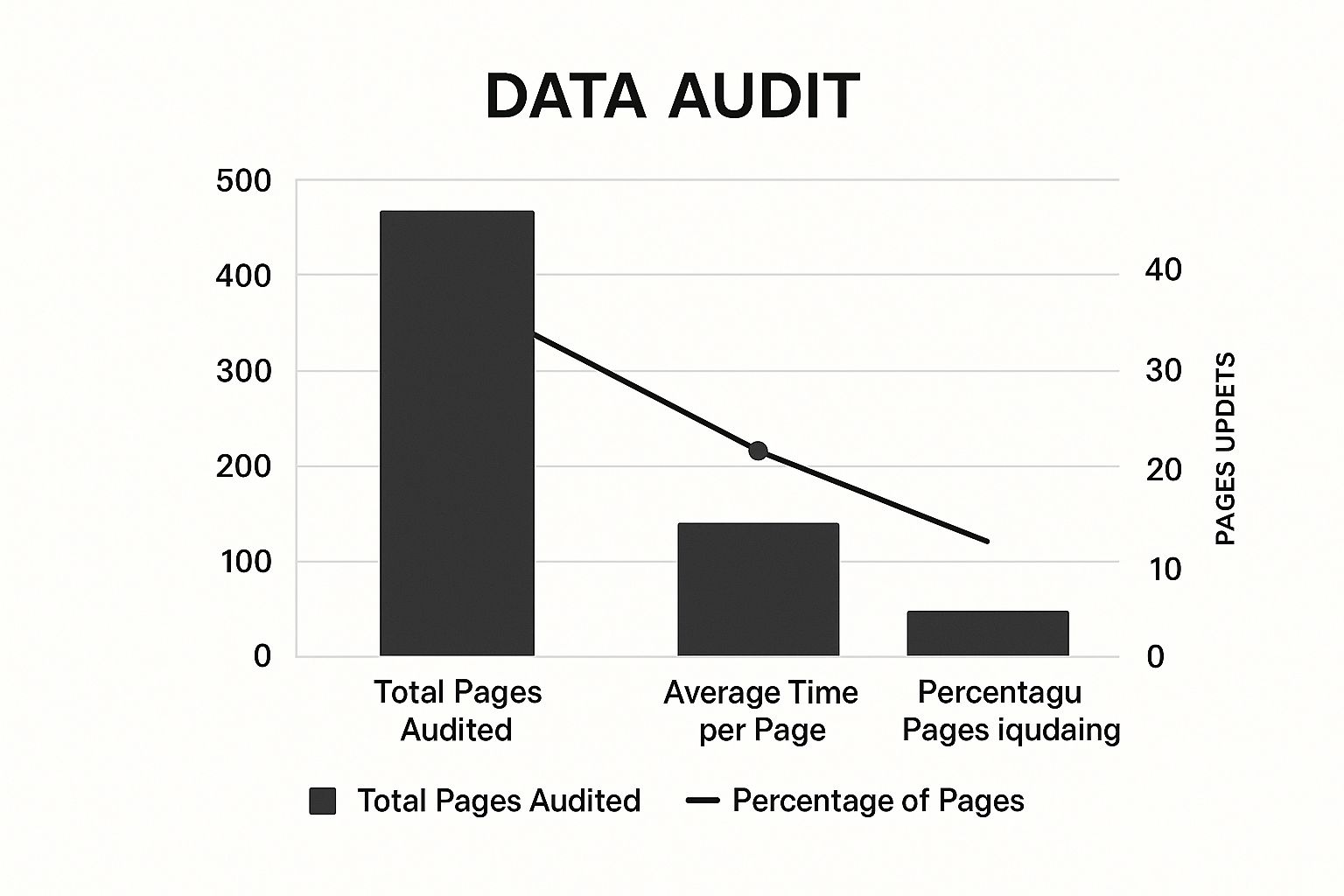
As shown, some tools process many pages quickly, but updating those pages can take significant time. Choosing tools strategically, based on your website’s size and audit objectives, optimizes your time and resources.
Building a Cost-Effective Toolkit
A comprehensive website content audit doesn’t require a huge investment. Combine free tools like Google Analytics and Search Console with free versions of advanced tools for substantial insights without significant upfront costs. As your business grows and your audit needs become more complex, consider investing in premium versions or exploring specialized platforms. This scalable approach ensures a cost-effective toolkit that still delivers the data you need.
To help you choose, here's a comparison of some popular content audit tools:
Content Audit Tools Comparison: Comparison of popular content audit tools showing features, pricing, and best use cases
| Tool Name | Free Features | Premium Price | Best For | Key Limitations |
|---|---|---|---|---|
| Screaming Frog | Crawls up to 500 URLs, identifies broken links and errors | Starts at £149.00/year | Technical SEO audits, identifying website structure issues | Limited content analysis capabilities in the free version |
| SEMrush | Limited free access to site audit, keyword research, and competitor analysis | Starts at $119.95/month | Comprehensive SEO audits, keyword research, competitor analysis | Free version offers very limited data |
| Google Analytics | Website traffic analysis, user behavior tracking, conversion tracking | Free | Understanding content performance and user behavior | Doesn't provide technical SEO insights |
| Google Search Console | Keyword ranking data, crawl error reports, sitemap submission | Free | Monitoring website performance in search results | Limited content analysis capabilities |
This table highlights some key differences in the tools available. While free tools offer valuable data, investing in premium tools unlocks more powerful features for deeper analysis. Choose the best combination based on your specific needs and budget.
Proven Methodology That Busy Marketers Actually Use

Forget those overwhelming 50-point checklists. This is a practical methodology for a content audit for your website, used by marketers who audit sites of all sizes, from small businesses to large enterprises. We'll guide you through each phase, from inventory to optimization.
Phase 1: Content Inventory and Initial Analysis
The first step is creating a content inventory. This involves compiling all your website’s URLs and essential information, like taking stock of everything you have. Screaming Frog can automate this process, making quick work of large websites.
Integrating data from Google Analytics is also key. This data reveals which content is performing well and where users are spending their time. This initial analysis forms the basis for strategic prioritization.
Phase 2: Prioritization and Evaluation Criteria
With your inventory complete, prioritization is next. Not all content needs equal attention. Focus on high-traffic pages with declining performance—these offer the greatest potential for improvement. For example, a blog post that previously ranked well but is now slipping deserves immediate attention.
Establish clear evaluation criteria based on your business goals. Are you aiming for conversions, brand awareness, or lead generation? This focus will guide your optimization efforts. Your criteria might include metrics like conversion rates, time on page, or social shares.
Phase 3: In-Depth Content Analysis and Optimization Recommendations
This phase involves deep diving into individual pieces of content. Analyze your top-priority content using your established criteria. Are titles and meta descriptions optimized? Is the content still relevant and accurate? Are there sufficient internal links to other related pages?
Develop optimization recommendations based on this analysis. This might include updating content, improving SEO, adding clear calls to action, or consolidating similar content to avoid keyword cannibalization. For instance, combine two similar blog posts into a single comprehensive resource.
Phase 4: Implementation and Ongoing Monitoring
Finally, put your recommendations into action. Create a realistic timeline, considering available resources. Treat your audit as a marathon, not a sprint. Track progress and monitor essential metrics.
Establish a system for ongoing monitoring and continuous improvement. Regularly review content performance to maintain a healthy website that delivers results. Consider setting recurring reminders for quarterly content reviews to ensure your website continues performing optimally.
Spotting Your Content Winners and Revenue Killers
A crucial part of any content audit involves transforming raw analytics data into actionable insights. This means digging deeper than simple page views to uncover the metrics that truly reflect content performance. We'll explore how to identify your content superstars, the pieces driving traffic and conversions, and pinpoint your revenue killers, the underperforming content holding your website back.
Identifying Your Content Superstars
High-performing content deserves more attention. But what exactly does "high-performing" mean? It’s not just about high traffic. A blog post might attract thousands of visitors but generate zero leads. On the other hand, a less popular page could have a much higher conversion rate. This highlights the need for a comprehensive approach to content analysis.
-
Engagement Metrics: Go beyond page views. Examine metrics like time on page, bounce rate, and scroll depth. These metrics provide insights into how users interact with your content. High engagement often signifies valuable, relevant information.
-
Conversion Metrics: Focus on conversions related to your business goals. This could include lead form submissions, product purchases, or newsletter sign-ups. Determine which content pieces contribute most to these valuable actions.
-
Social Sharing: Content frequently shared on social media usually resonates with your audience. Track share counts and comments to understand audience sentiment and identify shareable content.
Recognizing Your Revenue Killers
Identifying underperforming content is just as important as recognizing winners. These are the pages that need improvement or removal.
-
Low Traffic and Engagement: Pages with consistently low traffic and poor engagement are prime candidates for a revamp. Consider whether the content is still relevant and aligns with your current target audience.
-
High Bounce Rate: A high bounce rate suggests visitors aren't finding what they're looking for. This could indicate poor content quality, confusing website navigation, or a mismatch between user intent and content.
-
Outdated Information: Outdated content can damage your credibility and mislead users. Regularly review and update your content, particularly for time-sensitive topics.
Content Performance Metrics Framework
Before diving into your content analysis, a structured framework can help. The table below, "Content Performance Metrics Framework," outlines key metrics, benchmarks, and optimization triggers to guide your audit.
To effectively analyze your content's performance, a well-defined framework is essential. The following table, "Content Performance Metrics Framework," outlines the key metrics to track during a content audit, providing benchmarks and suggesting actions based on performance.
| Metric Category | Primary KPIs | Good Benchmark | Poor Benchmark | Action Required |
|---|---|---|---|---|
| Traffic | Page Views, Unique Visitors | Varies by industry | Consistently low traffic compared to other pages | Investigate content quality, keyword targeting, and promotion |
| Engagement | Time on Page, Bounce Rate, Scroll Depth | High time on page, low bounce rate, high scroll depth | Low time on page, high bounce rate, low scroll depth | Improve content quality, readability, and relevance |
| Conversions | Leads, Sales, Sign-ups | Meeting or exceeding targets | Consistently below targets | Optimize calls to action, improve user experience, and refine targeting |
| SEO | Keyword Rankings, Organic Traffic | High rankings for relevant keywords, steady or increasing organic traffic | Low rankings, declining organic traffic | Improve on-page SEO, build backlinks, and refresh content |
This framework allows you to benchmark your content's performance against industry standards and identify areas needing improvement. By analyzing these metrics, you can gain a clear understanding of your content landscape.
This data-driven approach empowers you to make informed decisions about which content to optimize, repurpose, or remove, ultimately maximizing your website’s effectiveness and driving revenue growth.
SEO Breakthroughs Through Strategic Content Auditing

A content audit isn't about deleting everything. It's about finding hidden opportunities to improve your existing content for SEO. Think of it like a home renovation. You’re strategically improving what’s already there, not starting from scratch. This process can transform your content into a powerful SEO engine.
Advanced Keyword Optimization: Speaking the Search Engine's Language
Keyword optimization is key to a successful content audit. It's not about keyword stuffing. Instead, it's about strategically using keywords to help search engines understand your content.
For example, if you sell blue widgets, targeting "widgets" might be too broad. Focusing on long-tail keywords like "best blue widgets for gardening" attracts a more specific audience. This targeted approach can significantly improve your search visibility.
Internal Linking: Connecting the Dots for SEO Power
Internal linking is another important factor. Think of your website as a network of roads. Internal links are the paths connecting different pages.
A content audit reveals opportunities to create these pathways. This guides both users and search engines through your site, improving site authority and rankings. Linking a blog post about "blue widget maintenance" to your "blue widget cleaning solution" product page provides helpful context.
Technical SEO Improvements: Laying the Foundation for Success
Technical SEO is the foundation of a well-performing website. A content audit helps identify technical issues that might be hurting your rankings, such as broken links, slow loading times, or missing metadata.
Addressing these problems significantly boosts website performance. It’s like fixing the essential systems in a house—vital for functionality and long-term value. For more on website performance, check out this resource: How to Master Website Performance Optimization.
Content Consolidation and Future-Proofing: Streamlining for Long-Term Growth
Content audits can also identify opportunities for content consolidation. This involves merging similar content pieces to avoid keyword cannibalization, where multiple pages compete for the same keywords. This weakens your overall SEO efforts.
Optimizing existing content for featured snippets and voice search is also important. Search engines prefer fresh, relevant content. Updating older posts with current keywords, metadata, and internal links improves search rankings and organic traffic. Learn more about maximizing your content with a comprehensive audit: Learn more about content audits. This proactive approach prepares your content for the future and ensures continued organic growth.
Converting Audit Insights Into Measurable Revenue
A content audit is more than just website housekeeping. It's a powerful tool for boosting revenue. This section explains how to turn your audit findings into real business results. We'll cover prioritizing recommendations, building a solid business case, and showing the financial impact of your work.
Prioritizing Recommendations: Focusing on High-Impact Opportunities
After your content audit, you'll have a list of recommendations. Tackling everything at once isn't efficient. Prioritize based on potential impact and the resources you have.
-
High-Impact, Low-Effort: These are your quick wins. Think fixing broken links or improving meta descriptions. These are quick to do and show noticeable results.
-
High-Impact, High-Effort: These need more investment, but the payoff is significant. Examples include creating a major piece of content or revamping a core landing page.
-
Low-Impact, Low-Effort: Handle these if you have extra time, but they shouldn't be your focus.
-
Low-Impact, High-Effort: Skip these. They won't give you enough return for the work involved.
Building a Compelling Business Case: Securing Buy-In for Your Strategy
To get the resources you need, you'll have to make a strong case for investing in content optimization. Explain the potential return on investment (ROI). Show how your recommendations will help reach key goals, like generating leads or increasing sales.
-
Quantify the Problem: Use your audit data to show current issues. For example, explain how old content is leading to a high bounce rate.
-
Propose a Solution: Clearly describe your optimization strategies and how they'll fix the problems you've identified.
-
Project the Impact: Estimate the potential improvements, like more organic traffic and better conversion rates.
Measuring the Financial Impact: Demonstrating Value to Stakeholders
As you optimize your content, track key performance indicators (KPIs). Show how your work affects revenue. This might mean tracking increases in leads, sales, or customer lifetime value.
-
Content Repurposing: Get the most from your content by using it in different formats. Turn a blog post into an infographic or social media posts.
-
Conversion Optimization: Focus on converting website visitors into customers. This might involve improving calls to action, optimizing landing pages, or using A/B testing.
-
Sales Alignment: Make sure your content matches your sales goals. Your content should address customer needs and support the sales funnel.
Tracking your progress helps you refine your strategy and get the best ROI. You might find this helpful: How to master content marketing. Continuously improving your content is key to long-term success and makes your website a valuable business asset.
Key Takeaways
A content audit is essential for website success. This section provides a practical roadmap for conducting your audit, including checklists, timelines, and key metrics. These actionable steps, paired with clear performance indicators, will help you track your progress and measure success. This allows for quick identification of what's working and what needs adjustment in your overall content strategy.
Prioritizing Your Content Audit: Where to Begin
Not all content carries the same weight. A content audit helps pinpoint high-return elements and avoid common pitfalls. Before you begin, understand your goals. Are you aiming to increase conversions, improve brand awareness, or boost SEO performance? This clarity will focus your efforts. Think of it like planning a road trip—knowing your destination ensures you're heading in the right direction.
-
High-Impact Elements: Start by focusing on core website pages, such as your homepage, key product or service pages, and top-performing blog posts. These areas have the highest potential to make a difference to your bottom line.
-
Low-Hanging Fruit: Tackle easily fixed issues first. These might include broken links, missing metadata, or outdated information. These quick wins provide immediate improvements and build momentum for the larger audit.
-
Long-Term Strategy: Create an ongoing content audit process. Regular reviews, even quarterly, keep your content fresh and your website optimized. This consistency is key to maintaining a high-performing website.
Establishing Realistic Timelines and Resources
A website content audit is an ongoing journey, not a one-time sprint. Establish realistic timelines and dedicate resources accordingly. A comprehensive audit for a small website might take a few weeks. Larger websites with thousands of pages could require several months.
-
Phased Approach: Break your audit into smaller, more manageable phases. Begin with a complete content inventory. Then, prioritize based on potential impact and the effort required. Finally, implement optimization recommendations and track the results.
-
Resource Allocation: Clearly define who will be responsible for each phase. Assign specific roles and responsibilities to ensure accountability and efficient execution. For instance, one team member might focus on technical SEO, while another focuses on content quality and readability.
-
Tool Selection: Select tools that align with your budget and technical capabilities. Free tools like Google Analytics and Google Search Console provide valuable data. Premium tools, like SEMrush and Screaming Frog, offer more in-depth analysis.
Defining Success: Metrics That Matter
How do you measure the success of your content audit? Track key performance indicators (KPIs) that align with your initial goals. This data-driven approach measures the true impact of your efforts. For instance, if your goal is increased conversions, track conversion rates, lead generation, and sales. If SEO improvement is your priority, monitor keyword rankings, organic traffic, and backlink profiles.
-
Baseline Metrics: Establish baseline metrics before you start your audit. This creates a benchmark to measure your progress and demonstrate the value of your work.
-
Regular Monitoring: Don't just check your results once. Regularly monitor KPIs to track progress, identify trends, and make adjustments to your strategy. This allows for quick adaptation to changing user behavior or search engine algorithms.
-
Benchmarking: Compare your site's performance against industry benchmarks and your competitors. This provides context and helps identify areas for improvement. It also helps you understand where you stand in the competitive landscape.
Maintaining Momentum: Ongoing Content Audits
A content audit isn't a one-time fix. It's a continuous cycle of evaluation and improvement. Schedule regular content reviews, even if it's a quick check-in each quarter.
-
Content Calendar Integration: Include content audits in your content calendar. This guarantees regular review and keeps your content fresh. For instance, dedicate time each quarter to review and refresh existing content.
-
Automated Tools: Leverage automated tools to make your content audit process more efficient. Tools like Screaming Frog can automate tasks such as identifying broken links, missing metadata, and duplicate content.
-
Continuous Improvement: Adopt a mindset of continuous improvement. Regular content audits offer insights into user behavior and content performance. This allows you to refine your strategy and achieve greater results over time.
OneNine helps businesses manage and maintain their websites effectively, offering ongoing support and optimization. Learn more about how OneNine can help you with your website content audit. We offer custom website solutions, ongoing maintenance, and personalized support for all major platforms. From stunning designs to complex development features, we work with you to achieve your digital goals.


