
A strategic plan for your small business isn't some hundred-page document that gathers dust on a shelf. Think of it more as a practical compass—a guide you'll actually use to make smart decisions day in and day out.
This is what gives you the clarity to put your limited resources where they’ll make a real difference and build a business that can roll with the punches. It’s a living framework that ties everything you do back to your biggest goals.
Why You Need a Strategic Plan (It’s Your Business Compass)
Ever feel like you’re being pulled in a dozen different directions at once? That’s small business life.
Picture this: you run a small retail shop. You're juggling rising inventory costs, sales that go up and down without warning, and that constant pressure to do more with less. One day, you're pouring all your energy into social media. The next, you're convinced you need to overhaul your entire pricing strategy. By Friday, you’re just trying to keep the lights on. It’s an exhausting cycle, and it kills your momentum.
This is exactly where a strategic plan can change everything. It’s your chance to step back from the daily grind and map out a clear, intentional path forward. It forces you to answer the most important questions: Where are we right now? Where do we want to be in a year? And, critically, how are we actually going to get there?
Stop Reacting and Start Being Proactive
Without a plan, most of our decisions are made under pressure. We go with our gut or just tackle whatever fire is burning brightest. A strategic plan gives you a framework so you can start making proactive choices instead.
For example, instead of running a last-minute 20% off sale just because foot traffic is slow, your plan might point you toward a more sustainable goal. Maybe you invest that energy into building a customer loyalty program to boost repeat business. The plan lets you measure new opportunities against your core objectives, making sure every move you make has a purpose.
The real magic of a strategic plan is the clarity it brings. It turns those fuzzy, big-picture dreams into a concrete roadmap. It gives you the confidence to say "no" to distractions and a clear "yes" to the right opportunities.
Putting Your Most Valuable Resources to Work
Time and money. For any small business, those are the two things you never have enough of. A solid plan makes sure you invest them where they’ll give you the biggest return.
It stops you from blowing your budget on a fancy marketing campaign that doesn't even reach your ideal customer. It keeps you from wasting weeks developing a new service that nobody was asking for.
Here’s where a plan really helps you focus your resources:
- Financial Budgeting: It helps you build a realistic budget that lines up with what you’re trying to achieve, whether that's upgrading essential equipment or hiring your first key employee.
- Team Focus: It gets your whole team on the same page—even if that’s just you and a part-timer. Everyone knows the goals and is pulling in the same direction.
- Time Management: It shines a spotlight on the tasks that will actually move the needle, so you don't get stuck in the weeds on low-impact activities.
At the end of the day, strategic planning for a small business is your best defense against the unknown. No, it can't predict the future. But it will give you the focus and resilience to navigate whatever comes your way. It's not a one-and-done task; it’s a dynamic tool that helps you build a stronger, more adaptable business ready for anything.
Get an Honest Look at Where You Stand Today

Before you can chart a course for the future, you need to know exactly where you are right now. A truly honest self-assessment is the bedrock of any solid strategic plan. It gives you a clear-eyed view of your business as it is today—the good, the bad, and the untapped potential.
This isn’t about going with your gut. It's about grounding your strategy in reality. When you dig into your actual performance and market position, you swap guesswork for data-backed insights, ensuring the goals you set later are both ambitious and achievable.
Using SWOT to Map Your Landscape
One of the most effective tools for this is a classic for a reason: the SWOT analysis. It's a simple framework that helps you organize your thinking around four critical areas: Strengths, Weaknesses, Opportunities, and Threats.
Think of it this way: Strengths and Weaknesses are internal factors that are within your control. Opportunities and Threats are external forces you need to respond to.
Let's make this real. Say you run a small, local landscaping company. A quick SWOT analysis might look something like this:
- Strengths: You have a loyal base of long-term clients and a stellar reputation for personalized service. Plus, your crew is experienced and reliable.
- Weaknesses: Your equipment is aging and needs frequent, costly repairs. You’ve relied solely on word-of-mouth for new business and have almost no online presence.
- Opportunities: A big new housing development is going up nearby, creating a whole new market of potential customers who need landscaping from the ground up.
- Threats: A cheap, "gig economy" lawn care app just launched in your area, and a couple of new competitors are undercutting your prices.
Just like that, your situation becomes crystal clear. You see that you need to leverage your reputation (Strength) to capture that new development (Opportunity) while figuring out how to deal with your aging equipment (Weakness) to fend off new competitors (Threats).
A SWOT analysis isn't just a stuffy business school exercise. It's a high-impact way to get a 360-degree view of your business, forcing you to be honest about what’s holding you back and what could propel you forward.
To get started, a structured table can help organize your thoughts and make the process more concrete.
SWOT Analysis Framework for a Small Business
| Category | Guiding Questions | Example (Local Coffee Shop) |
|---|---|---|
| Strengths | What do we do better than anyone else? What unique assets do we have? | Highly-trained baristas, prime downtown location with high foot traffic, strong local brand recognition. |
| Weaknesses | Where are we falling short? What internal resources are we lacking? | Inconsistent afternoon staffing, limited food menu, no online ordering system. |
| Opportunities | What market trends can we capitalize on? Are there underserved customer segments? | Growing demand for plant-based milk alternatives, local offices are reopening, nearby farmers market on weekends. |
| Threats | Who are our new and existing competitors? What economic or market shifts could hurt us? | A new Starbucks is opening two blocks away, rising cost of coffee beans, shift to remote work reducing weekday morning rush. |
Mapping out your business this way turns vague feelings into actionable intelligence, providing a solid foundation for the rest of your strategic plan.
Look Beyond the Obvious with Key Metrics
While a SWOT analysis gives you a great qualitative snapshot, you also need hard numbers to understand your business's true health. Tracking the right Key Performance Indicators (KPIs) tells the real story behind your day-to-day operations. The key is not to get buried in data, but to focus on the few metrics that matter most.
A forecast looking toward 2025 really drives this point home. It advises small businesses to pair their SWOT analysis with a deep dive into performance metrics like monthly revenue trends and customer lifetime value. This practice allows you to benchmark your performance and spot hidden gaps in your strategy. You can find more insights on small business growth trends over at ClarifyCapital.com.
Here are a few essential KPIs that nearly every small business should be watching:
- Customer Acquisition Cost (CAC): How much do you spend on marketing and sales to land one new customer? If your CAC is creeping up, it’s a sign your marketing is losing its punch.
- Profit Margins: What percentage of your revenue is actual profit? Knowing both your gross and net profit margins is crucial for smart pricing and cost control.
- Customer Lifetime Value (CLV): On average, how much revenue does a single customer bring in over their entire relationship with you? A high CLV is a fantastic indicator of customer loyalty and retention.
- Sales Conversion Rate: What percentage of your leads actually become paying customers? This single metric tells you volumes about the effectiveness of your sales process.
These numbers aren't just for your accountant—they're vital signals. A low conversion rate might point to a pricing issue or a weak sales pitch. A low CLV could signal problems with your customer service. Combining this data-driven perspective with your SWOT insights gives you a complete, honest starting point for building a strategy that will actually work.
Define Your North Star and Set Clear Goals
Alright, you’ve got a solid handle on where your business stands today. Now for the fun part: deciding where you’re going. This is where you connect the daily hustle to your biggest ambitions. It’s about creating a future that genuinely gets you and your team fired up to come to work every morning.
First things first, let's clear up two terms that get confused all the time: your mission and your vision. These aren’t just corporate buzzwords; they’re your guiding stars.
Your mission statement is your “why.” It’s the reason you exist, who you serve, and the fundamental value you bring to the table. Think of it as your anchor in the here and now.
Your vision statement is your “where.” It’s a bold, inspiring snapshot of the future you’re working to build. It’s the destination on your map.
Crafting Your Mission and Vision
A great mission statement is grounded and direct. For a local bakery, it might be something like: “To be a welcoming community hub by serving handcrafted pastries made from locally sourced ingredients.” It’s clear, focused on the present, and nails down their purpose.
A vision statement, on the other hand, should feel aspirational. For that same bakery, a vision could be: “To become the most beloved morning ritual in our city, known for exceptional quality and a deep commitment to our neighborhood.” This paints a picture of their ultimate impact.
Here's a simple way to think about it: Your mission is the engine that powers your boat every day. Your vision is the lighthouse on the horizon that you’re always sailing toward. You need both to make a successful journey.
Don't let this intimidate you. Just grab a notebook and spend 15 minutes jotting down answers to these prompts:
- For your mission:
- What problem do we really solve for our customers?
- Who are our customers, really? Get specific.
- What makes us different from the shop down the street?
- For your vision:
- If we were wildly successful in five years, what would that look like?
- What mark do we want to leave on our community or our industry?
- What are we creating that will outlast any single product we sell?
Once you’ve got that North Star in place, it’s time to break that big dream into a manageable roadmap. That’s where goals come in.
Turning Vague Dreams into Actionable Goals
How many times have you said, "We need to improve our marketing"? It’s a common thought, but it’s not a goal—it’s a wish. It has no clarity, no direction, and no finish line. To turn those fuzzy ideas into real results, we need to get SMART.
This simple framework is a game-changer because it forces you to create goals that are actually useful. A SMART goal is:
- Specific (What, exactly, are you trying to do?)
- Measurable (How will you track it and know when you’ve won?)
- Achievable (Is this realistic with the team and budget you have right now?)
- Relevant (Does this actually help you get closer to your big-picture vision?)
- Time-bound (When does this need to be done?)
Let’s take that vague marketing wish and put it through the SMART filter.
The Before: "Improve marketing."
The After (SMART Goal): "Increase website lead conversions by 20% within six months by redesigning our primary landing page and running three A/B tests on the call-to-action button."
See the difference? The second one is a mini-project. You know exactly what to do, how to measure it, and what the deadline is. Crafting an effective multi-channel marketing strategy is the key to making goals like this happen, as it ensures all your efforts are pulling in the same direction.
Real-World Examples of SMART Goals
Let’s see how this works for a couple of other typical small business scenarios.
-
For a Service Business (e.g., IT Consultant)
- Vague Idea: "Get more retainer clients."
- SMART Goal: "Sign three new clients on our $1,500/month retainer package by the end of Q3 by sending personalized outreach to 50 qualified local businesses and following up with a case study."
-
For a Retail Store (e.g., Boutique Clothing Shop)
- Vague Idea: "Increase our average sale amount."
- SMART Goal: "Increase the average transaction value (ATV) from $85 to $100 within 90 days by training all staff on a new 'style with' upselling technique and creating bundled product displays."
This structured thinking is critical. Research has shown that a staggering 50% of small businesses struggle to connect their day-to-day work with their long-term goals. The SMART framework closes that gap. It ensures that every task you and your team tackle is a deliberate step toward your vision, stopping the cycle of being busy and starting the process of being truly productive.
Build Your Roadmap from Vision to Action
You’ve got your North Star and some clear, measurable goals. Great. Now comes the part where the rubber meets the road: building the actual roadmap to get you there. This is how your big-picture strategy translates into the day-to-day work your team will actually do.
A common place small businesses get stuck is picking the right strategic path. You have limited resources, so you can't chase every shiny object. Your SWOT analysis and the goals you just set should be your guide here.
Let's imagine a small software-as-a-service (SaaS) startup. Their SWOT analysis shows they have a small but very loyal user base (a strength) and they've spotted a whole new market segment they could serve (an opportunity). They're facing a classic fork in the road with two main options:
- Market Penetration: Go all-in on their current market. This might look like aggressive ad campaigns or referral programs designed to poach customers from direct competitors.
- Product Development: Build a new suite of features specifically to attract that new market segment. This is a bigger bet—it requires R&D money—but it could open up an entirely new revenue stream.
Neither path is wrong, but they demand completely different action plans. The "right" choice depends entirely on their cash on hand, how much risk they can stomach, and what their long-term vision is. This is the heart of strategic planning for a small business—making deliberate choices that connect every single action back to your ultimate destination.
From Strategy to Actionable Tasks
Once you’ve decided on a direction, the real work starts. It’s time to break down those big, ambitious objectives into a concrete action plan. This is the step that keeps your strategy from becoming another document gathering dust on a shelf.
A good action plan doesn't have to be complicated. For every major objective, it just needs to answer four simple questions:
- What exactly needs to be done? (The specific tasks)
- Who is on the hook for it? (Clear ownership)
- When does it need to be done by? (Realistic deadlines)
- What resources will it take? (The budget)
This process takes a lofty goal like "Increase website lead conversions by 20%" and turns it into a series of bite-sized steps. Suddenly, each step is its own mini-project with an owner and a timeline, and the big goal doesn't seem so intimidating anymore.
This flow chart shows exactly how to turn your high-level objectives into a real-world action plan for your small business.
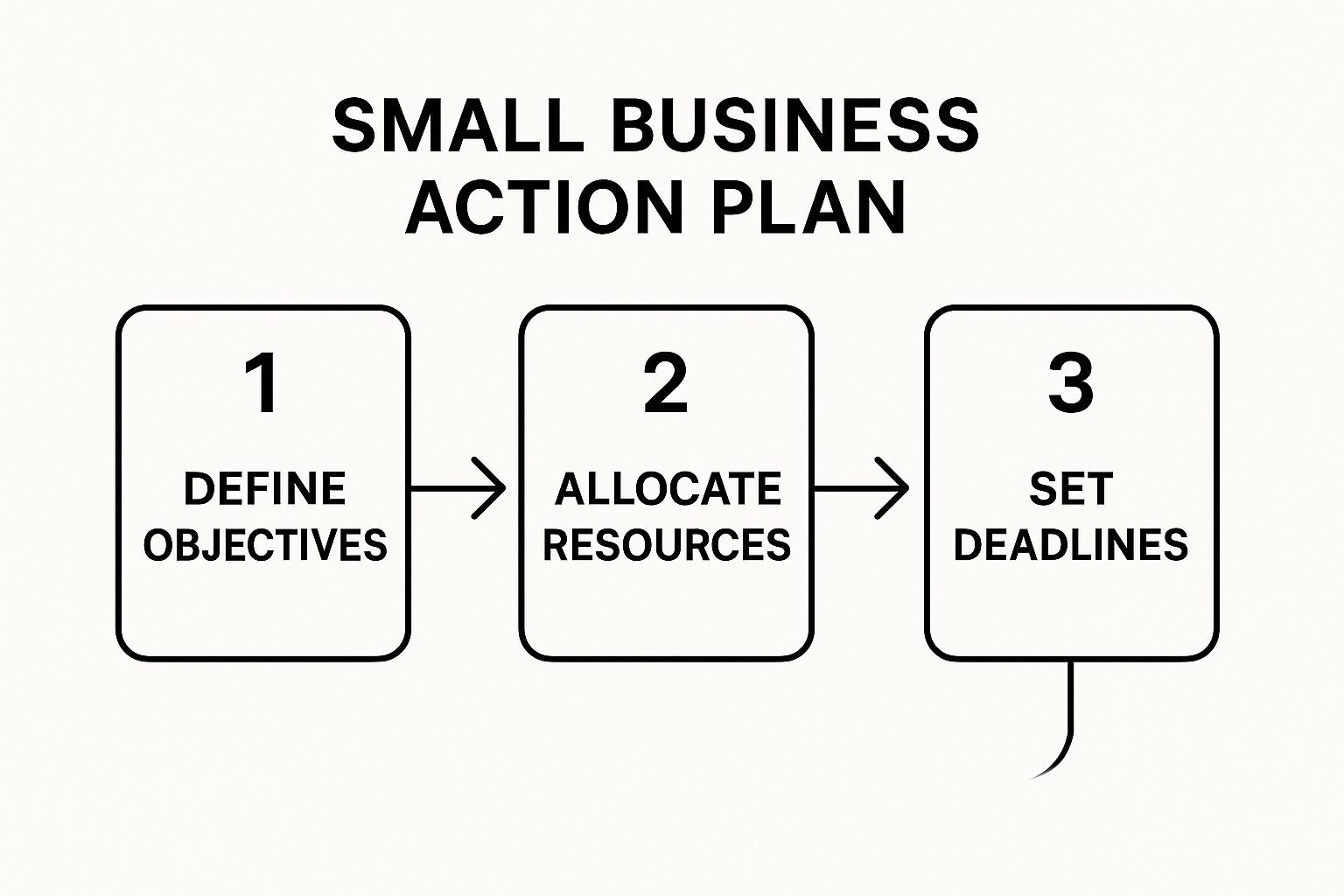
It’s a simple, three-part framework that makes sure every goal is backed by the right resources and has a clear schedule for getting it done.
Assigning Ownership and Setting Deadlines
On a small team, it's way too easy for responsibilities to get fuzzy. That’s why it is absolutely critical to assign a single owner to each major task. This doesn't mean that one person has to do all the work, but they are the one ultimately responsible for seeing it through.
Accountability is what makes a plan work. When someone's name is next to a task, it's just far more likely to get done. This simple act can dramatically increase your plan's odds of success.
Deadlines are just as crucial, but you have to be realistic. Your team is already wearing multiple hats. Build in some buffer room and don't be afraid to adjust your timelines if needed. The point isn't to create a rigid, stressful schedule; it's to maintain forward momentum and keep everyone on the same page about key milestones.
Budgeting for Success
Finally, let's talk money. Every single initiative in your action plan needs a budget. This is where you put your precious cash to work to support your goals. Get specific.
Going back to our goal of increasing website leads, the action plan might look something like this:
- Task: Redesign the main landing page.
- Owner: Sarah (Marketing Lead)
- Deadline: End of Q1
- Budget: $2,500 for a freelance designer and copywriter.
- Task: Run three A/B tests on the call-to-action button.
- Owner: Tom (Web Specialist)
- Deadline: End of Q2
- Budget: $500 for a testing software subscription.
This level of detail transforms your budget from a boring expense sheet into a powerful strategic tool. It ensures your money is being spent on things that directly push your goals forward. Having a clear plan like this is also a cornerstone of any effective website development for small business, because it ties your online presence directly to real business outcomes.
By breaking your vision down into strategic choices, then into actionable tasks with clear owners, deadlines, and budgets, you create a roadmap that actually works. This detailed plan is what gives your team the clarity and focus to turn your big ideas into a reality.
Bring Your Strategy to Life and Measure What Matters

A strategic plan collecting dust in a folder won’t do anyone any good. The real magic happens when you turn those well-thought-out goals into your team's day-to-day reality. This is where the rubber meets the road—transforming your plan from a static document into a living, breathing guide for your business.
First things first, you need to get your team on board, whether that's a crew of ten or just you and a key contractor. It's not enough to just hand them a to-do list; you have to share the "why." When people see how their work connects to the bigger picture, they're not just completing tasks—they're contributing to a shared vision.
This isn't a one-and-done presentation. Weave your strategy into regular conversations, team huddles, and one-on-one check-ins. Make the plan visible and accessible, not some secret document locked away.
Integrating Strategy into Daily Operations
Trying to shoehorn a new strategy into your existing workflow can feel like changing a tire on a moving car. The trick is to avoid overwhelming your team with a sudden avalanche of new tasks.
Instead, break down your big objectives into smaller, bite-sized actions that can slot into weekly or bi-weekly sprints.
Let’s say a key goal is to improve customer retention by 15%. Don't just add "Improve Retention" to everyone's plate. Roll it out piece by piece:
- Weeks 1-2: Start by implementing a system for personal follow-up emails after every purchase.
- Weeks 3-4: Next, introduce a small surprise gift for every third-time customer.
- Weeks 5-6: Then, launch a simple feedback survey to pinpoint common frustrations.
This step-by-step approach makes the plan feel doable, not disruptive. It helps your team build new habits and see progress without derailing their core responsibilities.
Choosing the Right Tools to Track Progress
You can't manage what you don't measure. As your strategy unfolds, you need to keep a close eye on what’s working and what isn’t. This is how you’ll understand your Return on Investment (ROI) and make sure your efforts are actually paying off.
The good news? You don't need a complicated or pricey system to do this well.
For many small businesses, a well-organized spreadsheet is all you need to track your KPIs. But as you grow, other tools can offer deeper insights. Here are a few solid options, from simple to more sophisticated:
- Google Sheets or Microsoft Excel: Perfect for getting started. You can create a simple dashboard to track your main KPIs weekly or monthly.
- Project Management Tools (Asana, Trello, Monday.com): These are fantastic for assigning specific tasks from your action plan, setting deadlines, and visually tracking progress.
- KPI Dashboard Software (Databox, Geckoboard): These tools can automatically pull data from different sources—like your website analytics and sales software—into one central, easy-to-read dashboard.
No matter which tool you choose, the goal is to make your data visible and easy to understand at a glance. Good website management for small business often involves integrating these tools to see how your online presence directly impacts your strategic goals.
To get you started, here’s a look at some common metrics you might want to track.
Key Metrics for Tracking Strategic Plan Success
This table outlines sample KPIs for different strategic goals, helping businesses measure their progress effectively.
| Strategic Goal | Primary KPI | Tracking Frequency |
|---|---|---|
| Increase Brand Awareness | Website Traffic, Social Media Engagement Rate | Monthly |
| Improve Customer Retention | Customer Churn Rate, Repeat Purchase Rate | Monthly |
| Boost Profitability | Gross Profit Margin, Net Profit Margin | Quarterly |
| Enhance Operational Efficiency | Cost per Acquisition (CPA), Project Completion Rate | Monthly |
| Grow Market Share | New Customer Acquisition, Market Penetration Rate | Quarterly |
The specific metrics you choose will depend entirely on what you're trying to achieve, but this should give you a solid foundation to build from.
Your strategic plan is a living document, not a one-time setup. The data you track is its lifeblood—it tells you what’s working, what’s not, and when it's time to change course.
The Power of the Quarterly Review
One of the best habits you can build is the quarterly review. This is your dedicated time—every 90 days—to huddle with your team and have a frank conversation about the plan.
This meeting isn't just a numbers report; it's about digging in and adapting. I've always found it helpful to structure these reviews around three simple questions:
- What Did We Accomplish? Start by celebrating the wins. Acknowledge the hard work and highlight the milestones you hit. It’s important to recognize progress.
- Where Did We Fall Short and Why? This is where the real learning happens. Be honest about the goals you missed. Was the timeline unrealistic? Did we lack the right resources? Was our assumption about the market just plain wrong?
- What Will We Do Differently Next Quarter? Based on those answers, adjust your plan for the next 90 days. This is how your strategy evolves. You might double down on a tactic that’s working better than expected or kill a project that's going nowhere.
This regular rhythm of doing, reviewing, and adjusting turns strategic planning from a dreaded annual chore into a continuous, agile process. It's what keeps your business nimble and laser-focused on what truly matters.
Got Questions About Your Small Business Plan?
It's one thing to have a roadmap, but another thing entirely to navigate the journey. Even the best entrepreneurs get stuck on a few common questions when it comes to strategic planning. Let's clear up some of those sticking points so you can keep moving forward.
How Often Should I Revisit My Strategic Plan?
Think of your plan as a living, breathing guide, not a dusty document set in stone.
A quick monthly glance at your key metrics is a great habit to get into. This keeps you on top of day-to-day progress. But the real magic happens with a deeper dive every quarter. This rhythm is perfect for spotting what's working and what isn't, giving you enough time to make smart adjustments without getting whiplash from constant changes.
Once a year, block out time for a major review. This is when you'll look back at the big picture and set the high-level course for the next 12 months. This blend of frequent check-ins and a yearly deep dive keeps your plan sharp and relevant.
What's the Biggest Mistake I Could Make?
The single most common pitfall? Creating a brilliant plan and then promptly forgetting about it. A strategic plan that lives in a drawer is useless. It needs to be a tool you and your team actually use to make decisions, every single week.
The runner-up mistake is making it way too complicated. For a small business, a focused 5-10 page plan is infinitely more powerful than a 50-page binder that’s too intimidating to open. Keep it simple. Simplicity drives action.
A plan you don't use is just a wish. The whole point is to create a practical guide that informs your daily work and gets everyone rowing in the same direction.
Can a Solopreneur Really Do Strategic Planning?
Not only can you, but you absolutely should. For a one-person show, a strategic plan is your best defense against getting sidetracked. It’s your built-in accountability partner.
The process is the same whether you have a team of 50 or a team of one: figure out where you are, decide where you want to go, and map out the specific steps to get there.
The only difference? You don't have a built-in sounding board. I always recommend finding a trusted mentor, a business coach, or even a peer group to talk through your plan. A fresh set of eyes can help you challenge your own assumptions and spot opportunities you might have overlooked.
Small businesses truly are the heart of the economy. In the U.S. alone, over 34.8 million small businesses make up 99.9% of all companies. But the hard truth is that about 50% don't make it past five years, often because they lacked a solid plan. You can dig into more small business trends to see just how crucial this is.
What if My Strategy Just Isn't Working?
First off, take a breath. This is completely normal. A strategy is basically an educated guess, and sometimes, those guesses are off the mark. That’s exactly why you’re monitoring your progress in the first place.
When a part of your plan isn't getting you the results you hoped for, it's time to play detective. Dig into the numbers.
- Did we drop the ball on execution?
- Was the market not ready for what we offered?
- Did a new competitor suddenly show up?
Use what you learn to make an adjustment. For a small business, being able to pivot quickly isn't a sign of failure—it's your greatest competitive advantage.
Ready to build a powerful online presence that drives your strategic goals forward? The team at OneNine specializes in custom website design, development, and management to help your business thrive. Let's build your digital future together at https://onenine.com.


