

Think of a website SEO audit service as a complete health check for your site. It’s like taking your car to a trusted mechanic before a long road trip—they’ll look under the hood, check the tires, and make sure everything is running smoothly to prevent a breakdown. This process digs into your website's technical setup, content, and authority to find problems and, more importantly, opportunities to rank higher.
Why a Website Audit Is Your Digital Roadmap
Trying to grow your website without an SEO audit is like trying to navigate a new city without a map. You might get somewhere eventually, but you'll probably take a lot of wrong turns and waste a ton of time and energy. A professional website SEO audit service is that essential, data-driven map for your business.
It goes way beyond just looking at surface-level numbers like website traffic. A proper audit gets to the heart of what really matters for your online success by asking the tough questions:
- Can Google and other search engines actually find, crawl, and make sense of your pages?
- Is the content you’re creating genuinely helpful and answering your customers' questions?
- Is your website fast, secure, and easy to use for every single visitor?
- Are other trustworthy websites linking back to you, essentially vouching for your credibility?
The answers to these questions shine a light on the hidden issues that could be holding you back and costing you customers. It's not just about fixing what's broken; it's about getting every part of your site working together perfectly. For a refresher on the basics, check out our guide on what search engine optimization is.
The Core Pillars of an Audit
A thorough SEO audit really stands on three main pillars, with each one focused on a different part of your website's health.
First, you have the technical audit. This is the deep dive into your site’s engine room. We’re talking about things like site speed, how well it works on mobile devices, and whether it’s secure. If Google’s crawlers can't get around your site easily, your amazing content might as well be invisible.
Next is the on-page and content audit. Here, the focus shifts to the quality and relevance of what’s actually on your pages. This part of the audit makes sure your pages are using the right keywords, have clear meta descriptions, and use headings that tell both people and search engines exactly what the page is about.
Finally, the off-page audit looks at your site's reputation around the web. This is mostly about analyzing your backlink profile—all the links pointing to your site from other websites. Think of high-quality backlinks as votes of confidence that boost your site's authority.
A great SEO audit doesn't just hand you a laundry list of problems. It gives you a prioritized, step-by-step action plan that turns confusing data into a clear strategy for getting more traffic, leads, and sales.
This whole process has never been more important. With things like AI Overviews answering questions directly in search results, the game is changing. In fact, nearly 60% of Google searches are now zero-click searches. While getting a click from the organic results is still the goal, sites that aren't optimized are at a huge risk of being left behind. You can read more about why website audits are so crucial today in this detailed analysis.
The Five Pillars of a Comprehensive SEO Audit
Think of a proper website SEO audit service like a home inspection before you buy a house. You wouldn't just look at the paint color, right? You'd want an expert to check the foundation, the wiring, the plumbing—everything that makes the house stand up and function correctly. A real SEO audit does the same for your website, breaking the inspection down into five critical, interconnected areas.
This diagram helps visualize how the main audit components—Technical, On-Page, and Off-Page—all work together to support your site's overall health.
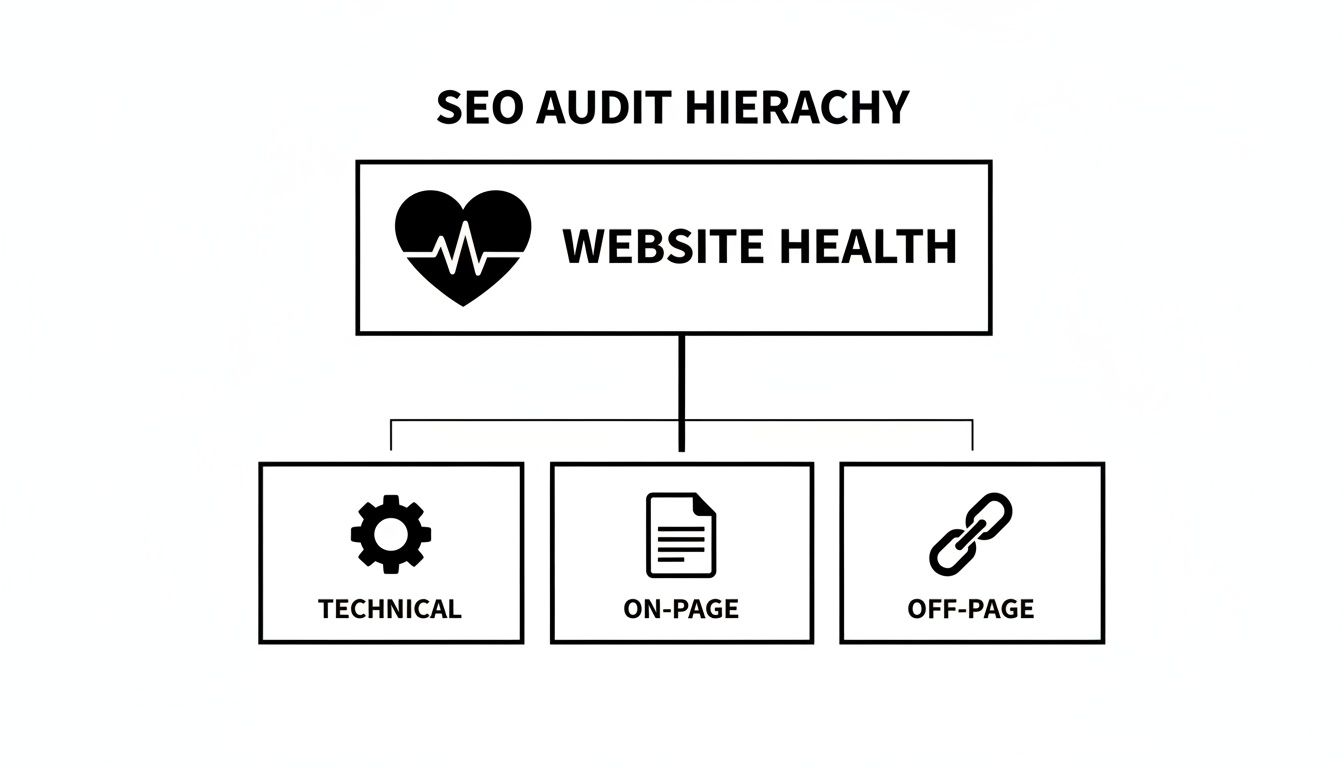
If any one of these pillars is weak, the entire structure is at risk of falling behind your competitors. Let's break down what each one covers.
A comprehensive SEO audit is built on five core pillars, each examining a different facet of your website's performance. The table below outlines these pillars, what they focus on, and why they are essential for your online success.
Key Pillars of a Website SEO Audit
| Audit Pillar | Key Focus Areas | Why It Matters |
|---|---|---|
| 1. Technical SEO | Crawlability, indexability, site speed, mobile-friendliness, security (HTTPS), site architecture, schema markup. | This is the foundation. If search engines can't find, crawl, or understand your site efficiently, nothing else matters. |
| 2. On-Page SEO | Title tags, meta descriptions, header tags (H1s, H2s), keyword targeting, content structure, internal linking. | This pillar ensures each page is perfectly optimized to communicate its topic and value to both search engines and users. |
| 3. Content | Quality, relevance, originality, keyword gaps, user intent alignment, content performance analysis. | High-quality content is what satisfies users and earns rankings. A content audit finds what's working and what's not. |
| 4. Off-Page SEO | Backlink profile quality, referring domain authority, toxic link identification, competitor backlink analysis. | Your backlink profile is your site's reputation. Strong, relevant links build authority; toxic links can destroy it. |
| 5. User Experience (UX) | Site navigation, mobile usability, call-to-action clarity, bounce rate analysis, page engagement metrics. | Search engines prioritize sites that provide a great user experience. If visitors leave frustrated, your rankings will suffer. |
By systematically reviewing these five areas, an audit provides a complete picture of your website's health and a clear roadmap for improvement.
Pillar 1: The Technical Audit Foundation
First up is the technical audit. This is the "foundation and wiring" of your website. If search engines can't easily crawl, understand, and index your pages, all your amazing content is basically invisible. It's the absolute starting point for any serious SEO effort.
We're looking at the nuts and bolts here:
- Crawlability & Indexability: Are there roadblocks preventing Google from finding your pages? We check things like your robots.txt file, XML sitemaps, and any stray "noindex" tags that might be hiding important content.
- Site Speed: How fast does your site load? Speed is a known ranking factor, but more importantly, slow sites drive users away. We pinpoint the exact elements—like bulky images or clunky code—that are slowing you down.
- Mobile-Friendliness: Most people are searching on their phones. Your site has to work flawlessly on a small screen. It's not optional anymore.
- Website Security: Does your site use HTTPS? An encrypted, secure site is a baseline requirement for building trust with both users and Google.
Without a rock-solid technical base, everything else you do for SEO is built on shaky ground.
Pillar 2: On-Page and Content Audit
With the foundation secure, we move on to the actual rooms—your individual pages and content. An on-page and content audit looks at how well each page is structured to communicate its topic to people and search engines.
A thorough content audit for your website is a huge piece of this puzzle. It's a deep dive into every blog post, service page, and article to see what's a hit, what's a miss, and where you have opportunities to improve.
Think of on-page SEO as the signposts on your website. It makes sure your headlines, keywords, and descriptions all work together to tell a clear, consistent story that answers a searcher's question.
This part of the audit specifically checks:
- Effective use of title tags, meta descriptions, and headers (H1, H2s).
- Whether your content actually matches what people are searching for (search intent).
- Smart internal linking that helps users and search engines discover more of your great content.
- The overall quality, originality, and depth of your information.
Pillar 3: Off-Page and Backlink Audit
The off-page audit is essentially a reputation check. It looks at what the rest of the web is saying about you, primarily through your backlink profile.
Think of high-quality backlinks from other respected websites as votes of confidence. They tell search engines that you're a trusted authority on your topic. On the flip side, a bunch of spammy, low-quality links can be a major red flag that hurts your credibility and your rankings. This audit uncovers those harmful links so they can be removed and finds opportunities to earn the good ones.
Pillar 4 & 5: User Experience and Analytics Audits
Finally, we look at what happens when a real person lands on your site. The User Experience (UX) Audit examines how easy and intuitive your site is to use. Can people find what they're looking for without getting frustrated? Is the navigation a confusing mess? A bad user experience sends signals to Google that your site isn't very helpful.
And to measure all of this, you need good data. The Analytics Audit ensures your tracking is set up correctly in tools like Google Analytics. If your data is wrong, you're flying blind. This check confirms you're tracking the right goals and can trust the numbers you're using to make important business decisions.
What to Expect from Your SEO Audit Report
An SEO audit's real value isn't buried in the data; it’s in the report that brings that data to life. A top-tier website SEO audit service gives you more than a spreadsheet full of problems—it hands you a strategic roadmap for growth.
Think of it this way: a doctor could just give you a confusing lab report. Or, they could sit down with you, explain what the numbers mean, and lay out a clear treatment plan. A great SEO report does the latter. It translates raw technical data into business intelligence, connecting a crawl error or a slow page to real-world outcomes like lost traffic and missed sales.

The Executive Summary: A Quick Snapshot
Every solid audit report starts with an executive summary. This is the 30,000-foot view, designed for busy stakeholders who need the key takeaways in minutes, not hours. It should immediately answer the most pressing questions.
This summary will highlight your site’s overall SEO health, pinpoint the most critical issues found, and outline the biggest opportunities on the table. It sets the stage for the deep dive to come, making sure everyone understands the big picture right from the start.
A Prioritized Action Plan
This is the heart of the deliverable. A raw list of 100 problems isn't helpful; it's just overwhelming. A quality report organizes all those findings into a prioritized action plan, sorting them by impact, effort, and urgency.
This approach helps you focus your time and money where they'll matter most. The plan will usually break tasks down into a few key categories:
- Quick Wins: These are the low-hanging fruit—high-impact fixes that are relatively easy to implement and can produce results quickly.
- Critical Fixes: These are the red-alert issues actively hurting your performance, like a major indexing problem that's making your pages invisible to Google.
- Long-Term Projects: These are foundational improvements that take more time and resources but are essential for sustainable growth, such as a major content overhaul or site architecture change.
This structure turns a scary list of to-dos into a manageable, step-by-step project.
A valuable SEO audit report doesn’t just tell you what is wrong; it tells you why it's wrong, what to fix first, and how to fix it. It's a blueprint for action, not just a list of problems.
Detailed Findings with Clear Explanations
After the action plan, the report will get into the nitty-gritty. For every single recommendation, there should be a straightforward explanation of the problem, why it matters for your SEO, and the exact steps needed to fix it. Any technical jargon should be explained in plain English.
For example, instead of just saying "Fix Core Web Vitals," a good report would explain: "Your product pages are taking too long to load because of large image files. This frustrates users and can cause Google to rank you lower. To fix this, we need to compress these images and enable lazy loading." This level of detail empowers your team to actually get the work done.
Finally, the best reports add competitive context. Seeing how your site speed, backlink profile, or content compares to your top three competitors is incredibly powerful. It shows you exactly where you’re lagging and what it will take to close the gap. For a closer look at everything that goes into a comprehensive review, our ultimate website audit checklist provides expert-level guidance. This competitive insight transforms the audit from a simple health check into a strategic weapon.
How SEO Audit Services Are Priced
Let's get straight to the big question: what does a professional website SEO audit service actually cost? It's a common point of confusion because there's no single price tag. The cost isn't a simple, off-the-shelf number; it's calculated based on how deep we need to dig to find what's really going on with your website.
Think of it like getting a home inspection. Inspecting a small, one-bedroom condo is a very different job than inspecting a sprawling, historic mansion with a dozen rooms. In the same way, auditing a 10-page website for a local dentist is a much lighter lift than a full-scale analysis of a 500-page e-commerce site with thousands of product SKUs. The bigger and more complex your digital "property," the more time, sophisticated tools, and human expertise it takes.
Common Pricing Models Explained
As you start exploring options, you'll run into a few different ways providers structure their fees. Getting a handle on these models will help you find a partner that fits your budget and long-term goals, so there are no surprises later.
Here are the most common approaches you'll see:
- One-Time Project Fee: This is exactly what it sounds like—a flat fee for a single, comprehensive audit. It’s a great fit if you need a thorough diagnostic to build a clear roadmap that your own team can then run with. The scope is locked in from the start, so you know exactly what you're paying for and what you'll get.
- Hourly Rates: Some consultants and agencies charge by the hour. This model works well for smaller, more targeted tasks or follow-up analysis where the scope isn't as fixed. It's flexible, but it can be a bit harder to budget for if the work ends up taking longer than expected.
- Monthly Retainer: An audit is often the kick-off to a longer-term SEO engagement. Many agencies will roll the initial audit into a monthly retainer that also covers the hands-on work of implementing fixes and providing ongoing optimization.
What Determines the Final Cost
A few key things directly impact the final price. The biggest factor is simply the size of your website—more pages mean more data to crawl, more potential errors to uncover, and more content to analyze. Complexity is another major driver. An e-commerce site with layered navigation, faceted search, and international targeting is a much bigger beast to tackle than a straightforward brochure site.
The price of an SEO audit is a direct reflection of the value and expertise being delivered. A cheap audit often just scratches the surface with automated tools, while a premium service provides the strategic, human-led analysis that uncovers game-changing growth opportunities.
The experience of the provider matters, too. A seasoned agency with a proven track record of getting real results will naturally charge more than a freelancer who is just starting out. You're not just paying for their time; you're paying for their years of accumulated knowledge, access to advanced tools, and battle-tested processes.
Globally, the investment in SEO is massive. The market has hit $83.98 billion, which shows just how much businesses value it. In the US, it's common to see agency rates between $150-$500 per hour. Project-based audits can range anywhere from $5,000 for a small business to well over $50,000 for enterprise-level websites. You can find more SEO spending statistics at AIOSEO.com. This isn't just a cost—it's an investment in the critical intelligence you need to win online.
How to Choose the Right SEO Audit Provider
Picking the right partner for your website audit is just as important as the audit itself. The market is flooded with website SEO audit services, but they are far from equal. The right choice gives you a clear, actionable roadmap for growth, while the wrong one leaves you with a confusing, cookie-cutter report.
You're not just looking for a data dump. You need a partner who can see past the numbers and truly understand your business goals. Think of it like hiring a specialist doctor instead of a general practitioner. Both can check your vitals, but only a specialist has the deep experience to diagnose a complex issue and prescribe a precise fix. Your job is to find that specialist.

Look for Proven Results and Case Studies
The best way to know if a provider can deliver is to look at their track record. Any agency worth its salt will be eager to show you case studies and examples of past wins. Don't get taken in by a slick sales pitch; ask to see the proof.
Make sure the examples are actually relevant to your business. If you run a Shopify e-commerce store, a case study about a local law firm on WordPress doesn't really show they can handle your specific challenges. You want to see that they’ve solved problems like yours before.
Demand Transparency in Their Process
A trustworthy SEO provider should be an open book. They need to be able to walk you through their methodology, name the tools they use, and explain how they connect the dots to form their conclusions. If their process feels like a mysterious "black box," that's a huge red flag.
You should feel completely comfortable asking questions and expect clear, jargon-free answers.
A great provider educates you as they go, helping you understand the 'why' behind their recommendations. They act as a partner, not just a vendor, empowering you to make smarter decisions for your business long-term.
Key Questions to Ask Potential Providers
Before you even think about signing a contract, have a list of sharp questions ready. The way they answer will tell you everything you need to know about their expertise, their strategic thinking, and their commitment. This is how you cut through the fluff and find out who can actually help.
Here are a few essential questions to get the conversation started:
- How do you prioritize your recommendations? A solid answer will touch on a mix of factors: potential impact on traffic and revenue, the effort required to implement the fix, and any technical urgency. A simple "to-do" list isn't enough.
- What kind of support do you offer for implementation? This is critical. Do they just hand you a PDF and wish you luck, or do they offer hands-on help to get the fixes across the finish line?
- What experience do you have with websites like mine? Get specific. Ask about their work in your industry, with your business model (e.g., e-commerce vs. lead generation), and on your specific platform (WordPress, Shopify, Webflow, etc.).
- How will you measure the success of the audit and subsequent changes? They should immediately talk about clear Key Performance Indicators (KPIs) like organic traffic growth, keyword ranking improvements, and better conversion rates.
Choosing the right provider is a real investment in your website's future. By focusing on proven results, demanding transparency, and asking the right questions, you can find a partner who will deliver an audit that truly moves the needle.
Turning Your Audit into Action and Growth
Getting your finished SEO audit report can feel like crossing the finish line, but here’s the reality: it’s actually the starting pistol. A brilliant, detailed report gathering dust in your inbox won't do a thing for your business. The true power of any website SEO audit service is only unleashed when you start putting its recommendations into practice. This is where the real work begins—and where diagnosis turns into measurable growth.
Think of it like getting a full diagnostic on your car. The mechanic hands you a detailed report on everything that needs fixing. That report is incredibly valuable, but it won't get you back on the road. You still need someone to actually get under the hood and do the work. The best audit partners don't just hand you the complex report; they help you build the engine, fine-tune the parts, and get your site running at peak performance.
From Diagnosis to Development
This is the point where a genuine partnership really proves its worth—moving from knowing what's wrong to actually fixing it. It’s all about weaving the audit’s findings into a practical workflow that gets your developers, writers, and marketers all on the same page. A great provider helps manage this entire process, making sure your prioritized action plan becomes a living, breathing project, not just a document that gets filed away.
Here’s what that looks like in the real world:
- For Your Developers: A technical issue like "slow page load speed" becomes a concrete task. The developer receives a clear ticket with instructions to compress images, set up lazy loading, and tweak the code to boost your Core Web Vitals.
- For Your Content Team: A content gap analysis from the audit evolves into a fresh content calendar. A recommendation like "target long-tail keywords around 'small business accounting'" turns into a pipeline of new, highly optimized blog posts.
This kind of seamless integration makes sure every single fix contributes to your larger strategic goals.
The point of an audit isn't just to generate a perfect report. It's to kickstart a cycle of continuous improvement that makes your website a more powerful and reliable business asset.
Measuring Success and Ensuring Long-Term Growth
Okay, so the fixes are in place. Are we done yet? Not quite. The final, critical phase is all about measuring the impact of those changes. By keeping a close eye on the key metrics identified in the audit—things like organic traffic, keyword rankings, and conversion rates—you can see the direct results of your hard work. This data proves the value of your investment and gives you fresh insights for the next round of optimizations. To really get a handle on this, it's essential to know how to calculate marketing ROI.
This loop of auditing, implementing, and measuring is what drives sustainable, long-term growth. A one-off audit gives you a fantastic snapshot in time, but the most successful companies treat it as the beginning of an ongoing journey. They commit to a long-term partnership that keeps the momentum going, ensuring their website not only fixes its problems but consistently stays ahead of the competition. This is precisely what a website management agency like OneNine does best—turning audit insights into ongoing success stories.
Common Questions About SEO Audit Services
It's completely normal to have a few questions when you're thinking about investing in a website SEO audit service. You're probably wondering about how often you need one, whether you can just do it yourself, and what kind of return you can expect. Let's walk through some of the most common questions we get.
Think of this as the practical side of things—the details that help you turn the idea of an audit into a real plan for your business.
How Often Should I Get a Website SEO Audit?
For most businesses, a deep-dive SEO audit once a year is a solid rule of thumb. This annual check-up gives you a chance to catch any new problems, see what's working, and adjust your strategy for the year ahead.
That said, sometimes you need to do it more often, maybe every six months. You'll want to consider a more frequent audit if you've recently:
- Gone through a major website redesign or moved to a new platform.
- Seen a sudden, confusing drop in your organic search traffic.
- Jumped into a really competitive market where things change fast.
Staying on top of it with regular audits keeps small technical hiccups from turning into major ranking disasters down the road.
Can I Do an SEO Audit Myself with Online Tools?
Absolutely. Tools like Ahrefs, Semrush, or Moz are great for a first pass. They can quickly flag things like broken links, missing title tags, or slow-loading pages. It's a fantastic starting point.
But here’s the catch: these tools can't think strategically. They'll tell you what's broken, but they won't tell you why it matters for your specific business or—and this is the important part—what you should fix first to get the biggest bang for your buck.
A professional service goes beyond just the data. An expert connects the dots between a technical issue and your business goals, finding those subtle, strategic opportunities that an automated tool will always miss.
What Is the Typical ROI of an SEO Audit?
The return on a professional audit can be huge. Once you fix the critical errors holding your site back and start acting on the opportunities you've uncovered, most businesses see real, measurable growth within three to six months.
This isn't just a vague feeling of improvement. You'll see it in hard numbers, like:
- A clear increase in organic traffic from search engines.
- Higher rankings for the keywords that actually bring in customers.
- More leads and sales coming directly from your website.
An audit isn't just about fixing what's broken today. It sets a strong foundation for all your future SEO work, making its long-term value incredibly high. It’s an investment in a reliable growth channel for your business.
Ready to stop guessing and start growing? OneNine provides comprehensive website audits that deliver a clear, prioritized action plan to boost your traffic and revenue. Let’s uncover your website’s true potential today.


