

It's no secret that finding a great web developer in a sea of options can feel like a daunting task. The good news? It doesn't have to be. The whole process becomes much more manageable when you break it down into a few key stages.
Before you even start looking, you need to get crystal clear on what you need. From there, you can explore the right places to find talent, whether that’s a specialized agency or a top-tier freelancer. Finally, it’s all about a careful evaluation to make sure you’ve found the right fit. This systematic approach is your best defense against the classic headaches—blown budgets, missed deadlines, and a final product that just doesn't hit the mark.
A 3-Phase Playbook for Hiring Your Web Developer
Think of your website as your most powerful digital asset. It’s often the first impression a customer has of your brand. The right developer is more than just a programmer; they're a partner who can translate your business vision into a website that actually drives growth. Your goal isn't just to check "new website" off your to-do list, but to find someone who can build an engine for your business's future success.
This guide is designed to cut through the noise and give you a practical, step-by-step playbook for doing just that.
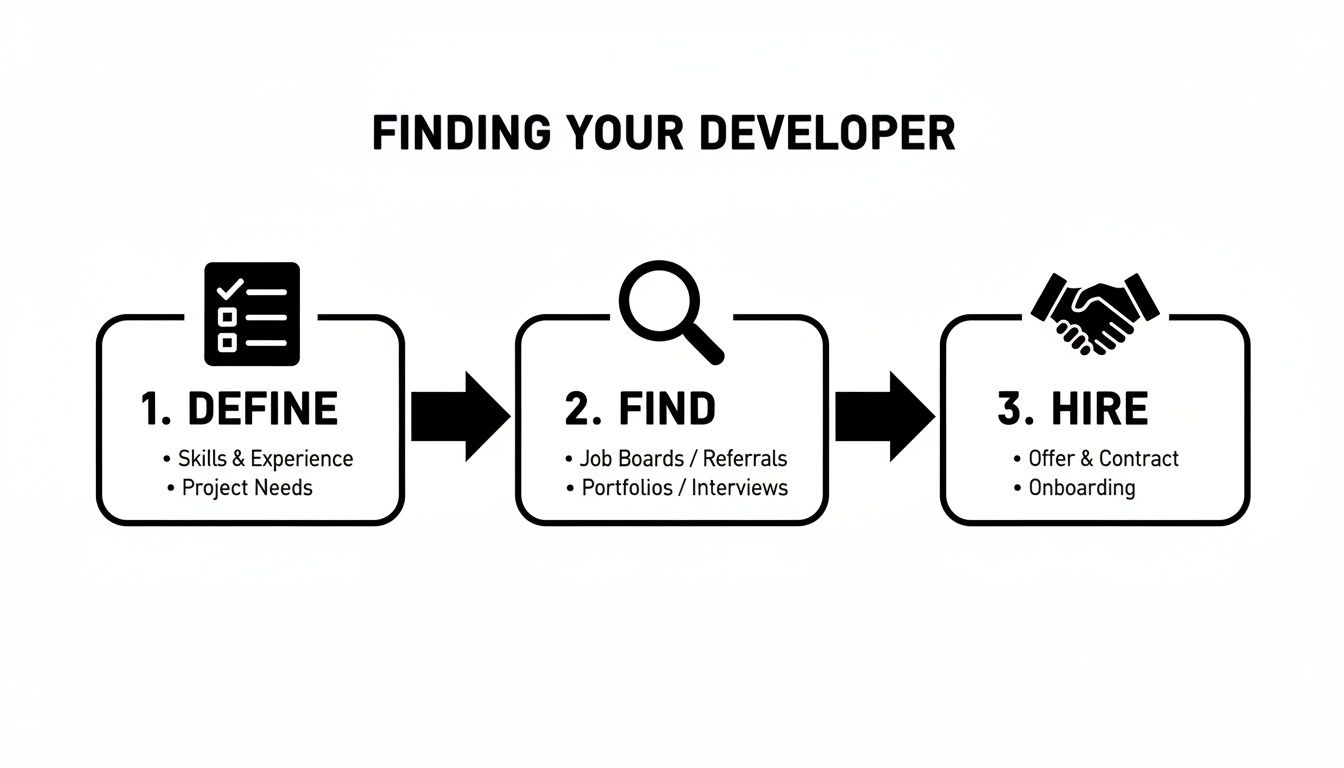
We'll walk through this entire process—from defining your project goals to confidently signing on the dotted line.
Understanding Today's Web Development World
There’s no question that a solid web presence is non-negotiable. The numbers back it up: the global web development market is set to explode, growing from USD 65.35 billion in 2023 to an estimated USD 130.9 billion by 2032. This boom means there are more developers out there than ever before, but it also means the quality of work can be all over the map.
Interestingly, 59% of website projects are now outsourced to specialized agencies. For many small and mid-sized businesses, this is the smartest path forward. It gives you access to a team of experts without the long-term commitment and overhead of hiring an in-house team.
Why You Can't Afford to Wing It
Jumping into the hiring process without a clear plan is a recipe for disaster. You might get tempted by a low price, only to discover later that your developer doesn’t have the technical chops or—just as importantly—the communication skills to get the job done right. A structured approach ensures everyone is on the same page from day one.
For a lot of businesses, the first step is looking into hiring a website development outsourcing company. This route is popular because it often gives you a full package—designers, developers, and project managers all under one roof. But whether you go with an agency or a freelancer, the core principles of a good hire are the same. Before you start your search, it pays to understand what the best website development agency looks like so you know what to watch for.
To give you a bird's-eye view of the journey ahead, here’s a quick breakdown of the core phases we'll cover.
Key Steps to Find Your Ideal Web Developer
| Phase | Key Action | Why It Matters |
|---|---|---|
| 1. Define | Create a detailed project brief and set a realistic budget. | A clear scope prevents misunderstandings and ensures you and your developer are aligned from the start. |
| 2. Find | Explore different channels like agencies, freelance platforms, and referrals. | Casting a wide net helps you discover a diverse pool of talent, increasing your chances of finding the perfect fit. |
| 3. Hire | Conduct structured interviews, check portfolios, and finalize the contract. | A thorough vetting process confirms technical skills, communication style, and professional reliability. |
Following these key steps will provide a solid foundation for a successful project and a lasting professional relationship.
Where to Look for Top Web Development Talent
Finding the right website developer can feel like searching for a needle in a haystack. You know the talent is out there, but where do you even begin? The key is to be strategic. Instead of casting a wide, generic net, you need to focus your search on the channels that actually make sense for your project's scope, budget, and long-term vision.

Most of the time, this big decision boils down to one question: should you hire a freelancer or partner with an agency? Each path has its own distinct advantages, and knowing the difference is the first step toward making a smart choice.
Freelance Marketplaces: A World of Options
Let's start with the obvious places. Platforms like Upwork, Toptal, and Freelancer.com are often the first stop for many businesses. They offer a direct line to a massive global talent pool, which can be a game-changer if you need a specific skill set or are working with a leaner budget.
Here’s the breakdown of what you get—and what you need to be wary of:
- Flexibility: Freelancers are perfect for projects with a clear start and end date. Got a specific feature you need built? Hire them for that task, and you're done. No long-term commitments.
- Cost-Effectiveness: You're paying for the developer's expertise, not an agency's overhead. This often means you'll find more competitive rates.
- Direct Communication: You work one-on-one with your developer. This can speed things up and cut down on miscommunication.
The catch? The project management burden is all yours. You are the one responsible for vetting candidates, setting timelines, and making sure the final product is up to snuff. It’s a much more hands-on role.
Pro Tip: When you're on a freelance site, don't just sort by the lowest hourly rate. Pay close attention to a developer's job success score, their work history, and what past clients have said. A proven pro who costs a bit more is almost always a better investment than a cheap gamble.
Specialized Web Development Agencies
If you're looking at a larger, more complex build or something that will require ongoing work, an agency is often the smarter route. You’re not just hiring a developer; you’re getting a whole team—designers, project managers, QA testers, and more—all working together.
This all-in-one approach has some serious perks:
- Comprehensive Services: An agency can take you from the initial strategy session all the way to launch and beyond with ongoing maintenance and support.
- Accountability and Reliability: A project manager serves as your single point of contact, and there's a full team to ensure deadlines are met. You don't have to worry about a developer going MIA mid-project.
- Scalability: As your business grows, a good agency can easily scale with you, dedicating more resources to your project without you having to go through the hiring process all over again.
The main trade-off here is, of course, the cost. You’ll pay a premium for agency services, but that price tag includes project management, quality assurance, and the peace of mind that comes with a strategic partnership.
Navigating the Freelance Versus Agency Dilemma
Choosing between a freelancer and an agency is a common sticking point. The trend is clear: 59% of all website development is now outsourced globally, as companies tap into specialized talent without the overhead of full-time staff.
In a web design industry now valued at $11 billion, results are everything. And with mobile-friendly designs driving a staggering 72.9% of e-commerce revenue, it’s proof that a skilled developer—freelance or agency—who gets responsive design can deliver a serious return on investment. You can dig into more of these web development trends to see how they're shaping hiring decisions.
Tapping Into Your Professional Network
Sometimes, the best talent isn't on a public marketplace. Don't underestimate the power of your own professional network—a referral from a trusted colleague is one of the safest bets you can make.
- LinkedIn: Get specific with your searches. Filter for developers in your industry or local area. Pay attention to profiles with strong, detailed recommendations.
- GitHub: If your project is highly technical, head straight to GitHub. A developer’s public repositories are a direct window into their coding style, quality, and real-world experience.
- Industry Communities: Look for niche forums, private Slack channels, or local tech meetups. These are places where passionate developers connect and share knowledge—and where you can find talent recommended by their peers.
Ultimately, there's no single "best" place to find a developer. It all comes down to your needs. By carefully weighing the pros and cons of each channel, you can focus your search and find the right partner to bring your project to life.
How to Vet a Web Developer and Not Get Burned
Alright, you’ve got a shortlist of developers who look promising on paper. Now comes the real work: figuring out who can actually deliver and who just has a slick sales pitch. This is where you separate the pros from the pretenders, and it's the most critical step to avoid a project that goes off the rails.
A great-looking portfolio is just the start. You need to dig deeper to see if they have the technical chops, communication skills, and business sense to be a true partner.

Go Beyond the Pretty Pictures
Anyone can pull together a few nice-looking screenshots. A truly skilled developer’s portfolio tells a much deeper story. Don't just skim the surface; it's time to put on your detective hat.
Here’s what to look for when you're digging in:
- Live Project Links: This is non-negotiable. If they only send screenshots, that's a red flag. Get the links to the live websites they've built. Click around. Does it feel clunky or smooth? Is the navigation easy to follow? Crucially, test it on your phone—is it responsive and fast?
- Case Studies That Show Real Impact: The best developers aren't just coders; they're problem-solvers. Look for case studies that spell out the client's original problem, what the developer built to solve it, and—most importantly—the results. Did they increase leads? Boost sales? Improve user time-on-site?
- Signs of Quality Code: You don't need to be a coding expert to spot the basics. Are the sites secure (check for the "https" in the URL)? Are there broken links or weird glitches when you click through? Little things like this tell you a lot about their attention to detail.
A strong portfolio proves they understand not just design, but also user experience (UX) and sound technical execution. For a deeper dive, our guide on how to choose a website developer has a handy checklist.
It's Not Just About Code: Assessing the Whole Package
Technical skill is the price of entry, but it’s the soft skills that make or break a project. Believe it or not, some studies suggest that as much as 75% of long-term job success is tied to soft skills. This is especially true in a collaborative field like web development.
A developer who can’t communicate clearly or manage their time is going to cause more headaches than their code will ever solve. You need a partner who is organized, responsive, and tells you what's going on before you have to ask.
To really get this right, you need to know the essential qualities of a great tech hire, which always come down to a mix of technical curiosity and good old-fashioned people skills.
Here's a simple way to think about what you’re screening for:
| Skill Type | What to Look For |
|---|---|
| Technical Skills | Do they have real expertise in your platform (WordPress, Shopify, Webflow, etc.)? Do they know the right languages? Do they talk about security? |
| Soft Skills | Are their emails and messages clear? Do they solve problems or just state them? Do they seem organized? Are they professional and easy to work with? |
Do Your Homework and Check Their Reputation
Finally, it's time to verify everything. Don't just take their word for it—do a little background check. A developer’s reputation is one of the best indicators of what it's really like to work with them.
Here are a few practical ways to do this:
- Check Verified Reviews: Look them up on sites like Clutch or G2. These platforms verify that the reviews are from actual clients, so you get an honest, unfiltered perspective on their work.
- Ask for References (and actually call them): Request to speak with one or two past clients. When you talk to them, ask about communication, deadlines, and how the developer handled things when something unexpected came up. That last part is key.
- Look at Their Online Footprint: Check out their LinkedIn profile. Does it look professional? Are there recommendations from past clients or colleagues? If they have a blog or contribute to open-source projects on GitHub, that’s a great sign they’re passionate about their craft.
This might seem like a lot of upfront effort, but trust me, it’s worth it. A little diligence now can save you from a massive headache later and is the single best way to find a developer who will deliver fantastic results.
Conducting an Interview That Reveals True Expertise
Alright, you’ve shortlisted a few developers. Now for the most important part: the interview. This is where you get past the slick portfolio and find out how they really operate. The goal here isn't to stump them with "gotcha" technical questions. It’s to have a real conversation that reveals how they think, communicate, and solve problems.
A great developer doesn't just sling code; they ask smart questions, anticipate roadblocks, and keep you in the loop. The right interview questions will tell you everything you need to know.

Go Beyond Technical Trivia
Forget asking them to define obscure acronyms from a textbook. That just tests their memory. Instead, dig into their actual experience with questions that require them to tell a story. This approach is far more telling than any pop quiz.
You want to see how they apply their knowledge in the real world. That’s the difference between hiring a pair of hands to type code and hiring a strategic partner who can help you grow.
Here are a few questions I’ve found to be incredibly revealing:
- "Walk me through a complex project you’re proud of. What was the business trying to achieve, and how did your work help them get there?" This shows if they can connect their technical skills to actual business outcomes.
- "Tell me about a time a project went completely off the rails. What happened, and what did you do to get it back on course?" Things always go wrong. You need someone who takes ownership and finds solutions, not someone who makes excuses.
- "How do you handle it when a client asks for 'just one more little thing' that wasn't in the original scope?" Their answer reveals a lot about how they manage expectations, communicate about budget, and protect the project's timeline.
Assess Their Process and Communication Style
The best developers I've worked with all have one thing in common: a clear, repeatable process. From kickoff to launch day, they know what needs to happen and when. Your interview should absolutely dig into their workflow. A developer who can’t explain their process is a major red flag for chaos ahead.
You’re not just hiring technical skill; you’re hiring a brain and a communication style. Pay attention to how they explain complex ideas. Do they bury you in jargon, or can they break things down so a non-techie can understand? Clarity is a skill, and it’s a critical one.
Also, notice if they ask you questions. A developer who isn’t curious about your business, your customers, or your goals is probably just looking for a quick paycheck. The right partner will be genuinely invested in your success from the very first conversation.
Key Questions to Uncover True Expertise
To make sure you cover all your bases, it helps to group your questions into a few key categories. This framework ensures you get a well-rounded picture of each candidate, making it easier to compare them later.
Here’s a breakdown of questions I always ask, categorized by what they’re designed to uncover.
Essential Interview Questions for Web Developers
| Category | Sample Question | What to Listen For |
|---|---|---|
| Problem-Solving | "Tell me about the most difficult technical bug you've ever had to fix. How did you troubleshoot it?" | A logical, step-by-step process. Do they describe how they isolated the problem, tested hypotheses, and eventually found a solution? You want a methodical thinker, not a guesser. |
| Project Management | "How do you prefer to communicate project updates, and at what frequency?" | A clear system, whether it’s weekly calls, daily emails, or a project management tool like Asana or Trello. Look for someone who is proactive, not someone you'll have to chase for an update. |
| Security & Maintenance | "What specific steps do you take to make sure a new website is secure from common threats?" | Mention of best practices like SSL certificates, secure password policies, regular software updates, and firewalls. This shows they’re thinking about your site's long-term health, not just launch day. |
| Client Collaboration | "How do you handle feedback or criticism on your work that you disagree with?" | Professionalism and a collaborative spirit. Do they see feedback as a personal attack, or do they see it as part of a healthy process to get to the best possible result? The answer is telling. |
Focusing your interview on these practical areas helps you see the developer in action. You'll learn how they think under pressure, how they communicate, and how they would actually work with your team. This thoughtful approach is your best bet for finding a developer who will be a genuine asset to your business.
Navigating Contracts, Costs, and the Project Kickoff
Alright, you’ve found a developer who nailed the interview. Now the conversation gets real. It’s time to shift from skills and portfolios to dollars and deadlines.
This is where you hammer out the business details that will make or break your partnership. Getting the contract, budget, and kickoff right is non-negotiable for a project that finishes on time, on budget, and without headaches.
Decoding Developer Pricing Models
Hiring a developer is a serious investment, so let's talk about how they charge. Most will pitch you one of three models, and each has its place depending on what you’re trying to build.
-
Hourly Rate: You pay for the actual time they spend working. This is perfect for small jobs, ongoing tweaks, or projects where the scope is a bit fuzzy. The only catch? Costs can spiral if the project isn't managed with an iron fist.
-
Fixed-Project Price: One price for the whole shebang. This is based on a super-detailed scope of work. It’s fantastic for budget predictability (which CFOs love), but it’s rigid. Changes and "can-we-just-add" requests will cost you extra.
-
Retainer: A set monthly fee for a guaranteed chunk of their time or ongoing support. This is the way to go if you need consistent updates, security checks, and a pro on standby without adding a full-timer to your payroll.
The web development world is booming, with the market expected to hit USD 80.6 billion in 2025 and jump to USD 125.4 billion by 2030. That growth is fueled by new demands for things like AI-driven personalization and augmented reality. For marketing leaders, this means finding partners who can build modern, custom solutions. You can dive deeper into these web application development trends to see what’s coming.
Setting a Realistic Budget
So, what’s the damage? Honestly, it’s all over the map. The final price tag depends on the project's complexity, the developer's experience, and whether you're hiring a freelancer or a full-blown agency.
A simple, clean brochure website with a handful of pages might run you a few thousand dollars. But if you’re building a custom e-commerce powerhouse with payment gateways, customer accounts, and slick integrations, you’re easily looking at tens of thousands.
My advice? Get quotes from at least three different candidates to get a true feel for the market rate.
A detailed project brief is your secret weapon for getting an accurate quote. The more you define upfront, the tighter the estimate will be. It’s the single best way to avoid surprise costs later.
The Contract Essentials You Cannot Skip
Forget a handshake deal. Your contract is the project's rulebook. It protects you, it protects the developer, and it gets everyone on the same page. Put it in writing. All of it.
A solid agreement should have a few key sections nailed down.
- Detailed Scope of Work (SOW): This is the heart of the contract. It should list every single feature, page, and deliverable. No ambiguity.
- Payment Milestones: Never pay 100% upfront. Break the total cost into chunks tied to progress (e.g., 25% to start, 25% after design approval, 50% at launch).
- Timeline and Deadlines: Put key dates in writing for major milestones and the final go-live.
- Intellectual Property: Make it crystal clear that once you pay for the work, you own the code and design files. It should belong to your company, period.
- Termination Clause: Things go wrong. Define how either party can walk away from the agreement if needed.
Getting the legal side right is huge. If you need a great starting point, this website development contract template covers the critical areas you’ll want to include.
Your Project Kickoff Checklist
Contract signed? Great. Time to get to work. A smooth kickoff sets the tone for the entire project and helps your new developer start delivering value from day one.
Here’s a quick checklist to make sure you’re ready:
- Share All Brand Assets: Get them your logo files (in vector format!), brand style guide, fonts, and any key marketing collateral.
- Grant Necessary Access: Hand over the keys. They'll need logins for your domain registrar, hosting account, Google Analytics, and any other tools they need to integrate.
- Establish Communication Channels: Decide how you'll talk. Will it be Slack for quick chats? A tool like Asana for tasks? Or just email? Set the expectation.
- Schedule a Kickoff Meeting: This is a must. Get everyone on a call to walk through the goals, timeline, and what needs to happen first.
A little organization here goes a long way. It builds momentum and shows your new partner you're ready to get things done.
Got Questions About Hiring a Developer? We’ve Got Answers.
Even with the best playbook, you’re bound to have questions when it's time to hire a website developer. It’s a big investment, and you want to get it right. We get it.
Here are the most common questions we hear from business owners and marketing leaders, with straight-to-the-point answers to help you move forward with confidence.
How Much Should I Expect to Pay for a Website Developer?
This is always the first question, and the honest-to-goodness answer is: it really depends. The cost to hire a developer swings wildly based on their experience, where they're located (a developer in New York will charge more than one in a smaller city), and whether you’re working with a freelancer or an agency.
It helps to think of it like buying a car. You can get a reliable sedan that gets the job done, or you can spring for a luxury SUV with all the high-tech features. Websites are no different.
- Simple "Brochure" Websites: For a basic, informational site of about 5-10 pages, think of a portfolio or a simple local service business. You’re likely looking at a range of $3,000 to $10,000.
- Business Websites with a CMS: If you need something more dynamic built on a platform like WordPress or Webflow, with a blog or other custom features, the budget typically lands between $10,000 and $25,000.
- Custom E-commerce Platforms: A fully custom online store with payment processing, customer accounts, and inventory management is a serious project. These builds usually start around $25,000 and can easily sail past $100,000 for complex systems.
These are just ballpark figures, of course. The only way to get a real number is to put together a detailed project brief and get quotes from a few different candidates. That process alone will teach you a ton about the going rate for the kind of work you need.
What’s the Difference Between a Web Developer and a Web Designer?
This trips a lot of people up, but the distinction is critical. They are two sides of the same coin and their roles definitely overlap, but they are responsible for very different parts of the process.
The Web Designer is the architect. They’re all about the user experience (UX) and the user interface (UI). Their job is to map out how the site will feel, where everything goes, and what the visual style will be. They work in tools like Figma or Adobe XD to create the blueprint.
Think of them as handling:
- Visuals (colors, fonts, imagery)
- User flow and navigation
- Wireframes and mockups
The Web Developer is the builder. They take the designer's blueprint and write the code that brings it to life. They’re the ones who handle the technical construction, making sure everything actually works.
Their world includes:
- Writing HTML, CSS, and JavaScript
- Building the back-end and connecting the database
- Making sure the site is fast, secure, and works on all devices
A simple way to think about it: the designer decides where to put the doors and windows in a house and what color the walls should be. The developer actually builds the walls, installs the plumbing, and wires the electricity. At an agency like ours, you'll have both on your team to make sure the vision translates perfectly into a functional site.
How Long Is This Going to Take?
Just like cost, the timeline is completely tied to the complexity of the project. A simple site using a pre-made template might be up in a few weeks. A highly custom build, on the other hand, can easily stretch over several months.
Here are some general timelines to give you a realistic starting point:
- Simple Brochure Site: 4-8 weeks
- Corporate Website with CMS: 8-16 weeks
- Custom E-commerce Site: 4-6+ months
What’s the biggest factor that can speed up or slow down a project? Client feedback. Hands down. If you’re able to give clear, timely feedback at each review stage, things will move smoothly. The most common source of delay is waiting on content, photos, or approval from the client’s side.
What Do I Need to Have Ready Before I Hire a Developer?
Showing up prepared is the single best thing you can do for your project’s success. It saves everyone time, prevents a lot of guesswork, and ultimately keeps your budget in check. Before you even start reaching out, try to get these things sorted out:
- A Clear Goal: What’s the number one thing this website needs to accomplish? Generate leads? Sell products? Position you as a thought leader?
- A Feature Wishlist: Jot down every single thing you need the site to do. For example: contact form, blog, online store, appointment booking, etc.
- A Realistic Budget: Know what you can comfortably invest. This immediately helps you filter out the wrong candidates and keeps conversations about scope grounded in reality.
- A "Mood Board" of Websites: Find 3-5 sites you love and maybe a few you can't stand. Be ready to explain why you feel that way about them—the layout, the colors, the functionality.
- Your Brand Assets: Get your logo files, brand color codes, and any other brand guidelines organized and ready to share.
Having this homework done before your first call shows a developer you’re serious and organized. It sets a professional tone for the entire project right from the get-go.
At OneNine, we help businesses navigate these questions every day to build websites that actually move the needle. If you’re looking for a team to guide you through design, development, and beyond, we’re here to help. See how we work at https://onenine.com.


