

Think of a solid website development contract template as the blueprint for your entire project. It's more than just a legal document; it's the shared roadmap that keeps you and your client heading in the same direction, clearly defining the scope, payment terms, and ownership right from the get-go.
Why Your Project Needs a Strong Contract

Before you even think about grabbing a template, let's talk about why this piece of paper is absolutely non-negotiable. A good contract is your best project management tool and the bedrock of a healthy client relationship. Trying to run a project on verbal agreements and assumptions is like building a house without a foundation—it’s just a matter of time before it all comes crashing down.
We've all been there. The client asks for "just one more small tweak." Without a contract to define the scope, that single request snowballs into an avalanche of revisions. This is scope creep, and it will absolutely wreck your timeline and your profit margins.
Setting Clear Expectations From Day One
A well-written agreement becomes the single source of truth for everyone involved. It forces you to have the tough, detailed conversations about expectations before a single line of code is written. That upfront work is priceless.
This proactive approach stops conflicts before they start by spelling out the essentials:
- Deliverables: What are you actually building? How many pages? What specific features and functionalities are included?
- Timeline: What are the major milestones? When is the final handoff?
- Payment Schedule: How much is due and when? Tying payments to milestone completion is key.
- Ownership: When the project is done, who owns the code, the designs, and the content?
Nailing these details down turns vague ideas into solid, mutual commitments. It builds trust and immediately shows your client that you’re a professional who takes their project seriously.
A contract isn’t about mistrust; it’s about clarity. It ensures that both you and your client are on the same page, building a foundation of mutual understanding that prevents disputes before they even have a chance to start.
Avoiding Costly Disputes and Misunderstandings
Nothing sours a client relationship faster than a payment dispute. A contract with a crystal-clear payment schedule, tied to specific and measurable milestones, protects everyone. You get paid for the work you've done, and the client knows exactly what they’re paying for at every step.
Here’s another all-too-common scenario: the project grinds to a halt because you're waiting on the client for content or feedback. A good contract includes clauses that outline the client’s responsibilities and what happens if delays on their end occur. This isn't about pointing fingers; it's about having a fair and agreed-upon process for handling the inevitable bumps in the road.
To make sure your contract is airtight from the start, an AI legal template generator can be a fantastic resource for creating a robust and well-structured document. In the end, a solid agreement is your best defense for keeping projects on time, on budget, and on good terms with your clients.
Key Components of a Website Development Contract

A solid website development contract isn't just a pile of legalese. It’s a roadmap. Think of each clause as a critical gear in the project machine, working together to keep things running smoothly and prevent costly breakdowns.
When you understand the why behind each section, you can turn a generic template into a powerful agreement that protects your business, manages client expectations, and makes sure you get paid for your hard work. Let's dig into the essential pieces that make a contract genuinely effective.
Defining a Bulletproof Scope of Work
The Scope of Work is the absolute heart of your agreement. This is your number one defense against scope creep—that slow, painful expansion of project requirements that can completely tank your profitability. A vague scope is an open invitation to misunderstandings and endless, unpaid revisions.
Your goal here is total, obsessive clarity. Be painfully specific about what you will and will not deliver.
Instead of just saying "build a contact page," spell it out. For example: "Design and develop a single contact page with five form fields (Name, Email, Phone, Subject, Message). Submissions will be sent to the client's designated email address and will display a 'Thank You' message on the screen after submission." See the difference? No room for assumptions.
To build a truly effective scope, your contract should list out:
- Specific Deliverables: Every single thing the client will receive. This means wireframes, design mockups, the exact number of page templates, and final access to the live site.
- Key Features and Functionality: All the major moving parts. Think e-commerce capabilities, user login systems, blog functionality, or specific third-party API integrations.
- The Tech Stack: Mention the core technologies you'll be using (e.g., WordPress with specific plugins, Shopify, a custom React build) to set clear technical expectations from the start.
- What's Not Included: This is just as important. Clearly state what’s out of scope, like content creation, logo design, recurring third-party fees, or ongoing SEO services.
For bigger, more complex projects, it's a great idea to create a separate, more detailed scope document that you reference in the main contract. You can get a head start by checking out this project scope document template.
Structuring a Fair Payment Schedule
Getting paid on time is non-negotiable. Your contract is the tool that makes it happen. A well-designed payment schedule ties your compensation directly to project milestones, which is fair to both you and the client. You get consistent cash flow, and the client feels secure knowing they're only paying for completed, approved work.
Web development costs can be all over the map, from a $5,000 landing page to a complex $60,000 e-commerce platform. This is exactly why a clear, milestone-based payment structure is so vital.
Here’s a common and effective schedule:
- Upfront Deposit (30-50%): Paid before any work begins. This secures the project in your calendar and covers initial discovery, research, and design time.
- Milestone 1 (25%): Due upon client approval of the final design mockups.
- Milestone 2 (25%): Due once development is complete and the site is ready for review on a staging server.
- Final Payment (Remaining Balance): Due after the client gives their final approval, and before you push the site live.
A milestone-based payment structure does more than just ensure you get paid. It acts as a natural check-in point, forcing both parties to review and approve progress, keeping the project aligned and moving forward.
Before we move on, let's summarize the absolutely essential clauses you'll need.
Essential Clauses for Your Contract Template
This table breaks down the non-negotiable clauses every website development contract must include to protect both you and your client.
| Clause | Primary Purpose | Key Details to Include |
|---|---|---|
| Scope of Work | To prevent scope creep and define project boundaries. | Specific deliverables, key features, technology stack, and clear exclusions. |
| Payment Schedule | To ensure timely and predictable payment. | Total project cost, deposit amount, milestone-based payment dates, and late fees. |
| Intellectual Property | To clarify ownership of the final website and code. | States client owns the final product after full payment; developer retains rights to pre-existing code. |
| Timelines & Delays | To set clear expectations for project duration. | Estimated completion dates for phases, and a process for handling client-caused delays. |
| Confidentiality | To protect sensitive business information. | Defines what is considered confidential and how it must be handled by both parties. |
| Termination Clause | To provide a clear exit strategy if things go wrong. | Outlines conditions for termination, notice periods, and payment for work completed. |
Including these clauses provides a strong foundation, turning your template from a simple document into a professional project management tool.
Clarifying Intellectual Property Ownership
Confusion over who owns what after a project wraps up can lead to some serious legal and professional headaches down the road. The Intellectual Property (IP) Rights clause clears this up entirely by stating exactly who owns the final website and the underlying tools used to build it.
The industry standard is pretty straightforward: upon receipt of the final payment, the client owns the finished product. That means the unique visual design, the content, and the compiled code that makes their website work.
However, you (the developer or agency) almost always retain ownership of your proprietary tools, reusable code libraries, plugins, and internal processes. This clause should explicitly state that you grant the client a license to use these foundational elements as part of their website, but you keep the right to use them for other projects. This protects your valuable assets while giving the client everything they paid for.
Establishing Clear Timelines and Deliverables
A project without a timeline isn't a project; it's a wish. This part of your contract sets firm, realistic expectations for how long the project will take and when key items will be delivered. It’s the roadmap that holds both sides accountable.
Break the project into phases with estimated completion dates for each. For example:
- Discovery & Strategy: 1-2 Weeks
- UI/UX Design: 2-3 Weeks
- Development & Build: 4-6 Weeks
- Testing & Launch: 1 Week
It's also absolutely critical to include language that addresses what happens when there are delays. A "Client Responsibilities" section should state that your timeline is dependent on the client providing timely feedback, content, and approvals. If their delays push back the schedule, the contract should outline a fair process for adjusting the final delivery date. This protects your schedule and prevents one delayed project from derailing your entire workflow.
Adapting Your Contract for Different Projects
No two web projects are ever the same. You wouldn't use the same blueprint for a garden shed and a skyscraper, and you shouldn't use the exact same website development contract template for a simple brochure site and a complex e-commerce build. A one-size-fits-all approach just doesn't work—it leaves you exposed to risks you never saw coming.
The real power of a great template isn't its rigidity; it's how easily you can mold it. When you know how to adjust your core agreement for different scenarios, you create a document that truly reflects the scope of work. It protects you from headaches down the road and gives your client total confidence in the process.
One-Off Projects vs. Ongoing Retainers
One of the biggest forks in the road is deciding between a one-time project and an ongoing support retainer. These are fundamentally different relationships, and your contract needs to reflect that. A project contract has a clear finish line, while a retainer is all about continuous service.
Here’s how I think about tailoring a contract for each:
- For One-Off Projects: The contract has to be laser-focused on a detailed Scope of Work. You need to nail down the specific project milestones and define what "done" looks like with a final sign-off process. The termination clause is also key—it needs to spell out what happens if the project gets canceled halfway through.
- For Ongoing Retainers: The language shifts from "scope of work" to a "scope of services." Instead of a list of deliverables, you’ll define the services you'll provide each month, like software updates, security scans, or a set number of support hours. It's also critical to include terms for how unused hours are handled and the process for requesting work that falls outside the retainer.
If you blur these lines, it can get expensive fast. Using a project-based contract for maintenance could trap you in a loop of endless "support" requests that were never properly scoped or paid for.
Customizing for E-Commerce Builds
An e-commerce website is a whole different animal. You’re dealing with sensitive customer data, payment processing, and complicated inventory systems. A generic contract just won't cut it here; it leaves both you and your client wide open to serious liability.
When I take on an e-commerce project, I make sure the agreement includes specific clauses to cover these risks:
- Payment Gateway Integration: The contract needs to clearly name which payment gateways you'll integrate, like Stripe or PayPal. It should also state that you aren't responsible for the client’s relationship with the gateway provider—their fees and terms are on them.
- Data Security and Compliance: Add language that outlines the security measures you’ll implement, such as SSL certificates. The most important part? Clarify that the client is ultimately responsible for PCI DSS compliance and protecting their customer data after launch.
- Third-Party Services: E-commerce sites almost always lean on other tools for shipping calculations, tax APIs, and inventory management. Your contract must make it clear that the client is on the hook for all those third-party fees and subscriptions.
Think of your contract as a living document. For a high-stakes project like e-commerce, your template needs an upgrade with clauses that specifically address payment processing, data handling, and the intricate web of third-party integrations.
Adapting for Content-Heavy Sites and Blogs
A project centered around a custom blog or a massive content platform brings its own set of challenges. It might not have the financial complexity of an e-commerce site, but it introduces major content management and user interaction requirements that have to be spelled out.
For these kinds of builds, I always consider adding these details to the agreement:
- Content Management System (CMS) Training: Will you train the client's team on how to use the backend? If so, define how many hours of training are included and what format it will take (e.g., a live video call or written documentation).
- User Roles and Permissions: If the site will have multiple authors or editors, the contract should specify that you'll set up a certain number of user roles with distinct permissions, like Administrator, Editor, and Contributor.
- Content Migration: Is the client moving from an old website? The contract must detail the scope of the content migration. Be specific about how many posts or pages you'll move over, and clarify that reformatting old, broken content isn't included unless you explicitly say it is.
Thinking through these project-specific needs helps you get ahead of potential arguments and address them before they start. This level of detail shows you're a true professional and helps you put together a much more accurate timeline and budget. For a deeper dive into scoping, check out our guide on creating a request for proposal for website development. Taking the time to adapt your contract ensures it serves as a precise roadmap for the unique journey of each project.
How to Handle Common Contract Pitfalls
Even with a rock-solid website development contract, projects hit snags. The real world is messy, but a good contract gives you a playbook for navigating those inevitable bumps in the road. Knowing how to handle these challenges before they pop up is what separates the pros—it protects your time, your money, and your sanity.
The most common issue I see, by far, is scope creep. It almost always starts with a client asking for "just one quick change." Before you know it, you're buried in work that isn't on the invoice, deadlines are flying by, and your profit margin is evaporating. This is where your contract stops being a document and starts being your best friend.
Your agreement absolutely must include a formal change order process. This isn't about being rigid; it's about being clear and fair to everyone involved. The second a client asks for something that wasn't in the original plan, this process should kick in automatically.
Managing Scope Creep with a Change Order Process
A change order process is your secret weapon. It’s a simple, structured way to handle new requests that ensures every new idea is properly evaluated, quoted, and approved before you write a single line of code. It puts a stop to misunderstandings and guarantees you get paid for every bit of work you do.
Here’s a simple process that works wonders:
- Get it in Writing: The client must submit any new request via email. No exceptions. This creates a paper trail you can both refer to.
- Assess the Impact: You take a look at the request and figure out what it will do to the project's timeline and budget.
- Send a Formal Quote: You create a quick change order document. It should clearly state the new work, the extra cost, and any new deadlines.
- Wait for Approval: This is the most important part. You don't start the new work until the client has signed off on that change order.
By sticking to this, you turn scope creep from a project-killer into a manageable—and profitable—opportunity. If you want to dive deeper, our guide on how to prevent scope creep is packed with more practical strategies.
Addressing Late Payments and Financial Issues
Chasing down late payments is another headache that can quickly sour a great client relationship. It's awkward and frustrating for everyone. Your contract can prevent this friction before it starts by clearly defining your payment terms and the consequences for missing them.
Make sure your payment schedule has specific due dates tied to project milestones. More importantly, include a late fee policy—a small percentage, like 1.5% per month, on any overdue balance is pretty standard. This simple clause encourages clients to pay on time and gives you a clear, contractual leg to stand on if an invoice goes unpaid.
Protecting Information with Confidentiality Clauses
Throughout a project, you'll likely be handling sensitive client information—business plans, customer lists, private login details. Including a Confidentiality clause, sometimes called a Non-Disclosure Agreement (NDA), is non-negotiable for building trust and protecting both of you.
This clause legally binds you and your client to keep private information under wraps. It should spell out what counts as "confidential" and make it clear that this obligation doesn't just disappear once the project is finished. It’s a mark of professionalism and provides legal backup if anything ever gets leaked.
Think of these clauses as the fire extinguisher in your office. You hope you never need it, but you'll be incredibly glad it's there if a problem flares up. They give you a calm, predetermined way to handle stressful situations.
Finally, while a good template is an amazing head start, getting a lawyer to glance over it can be a smart move. Drafting a software development agreement from scratch can cost around $850, but a professional review is much more affordable at about $460. Combining a solid template with a quick legal check is a cost-effective way to get peace of mind. That small upfront investment is a tiny price to pay to avoid massive, costly disputes down the road.
Using Your Contract to Manage the Project
Once the ink is dry, your website development contract shouldn't just be filed away in a digital folder. The best projects I've worked on have one thing in common: the contract is treated as a living document. It's our shared guidepost, the map that keeps everyone aligned from kickoff to launch.
When you treat it this way, you shift the dynamic from a defensive legal shield to a proactive project management tool. Referencing the contract during check-ins becomes a normal part of the conversation, not a confrontational act. This builds a massive amount of client trust and, frankly, makes the entire process so much smoother for everyone.
Turning Your Contract Into a Project Roadmap
Think of your contract as the ultimate source of truth for the project's scope, timeline, and deliverables. It's the perfect agenda for your client meetings.
Try using a simple phrase like, "Looking at our timeline, we're on track to complete the initial mockups by Friday. Let's make sure we get your feedback by then to keep everything moving." This directly connects your weekly progress to the agreement you both signed.
This small habit keeps the project grounded in reality. It subtly reinforces boundaries and makes it far easier to bring up potential delays or new requests down the line.
By actively using your contract in conversations, you transform it from a document that only gets pulled out when something goes wrong into a tool that prevents things from going wrong in the first place.
This infographic lays out some of the most common contract pitfalls that active management helps you sidestep.
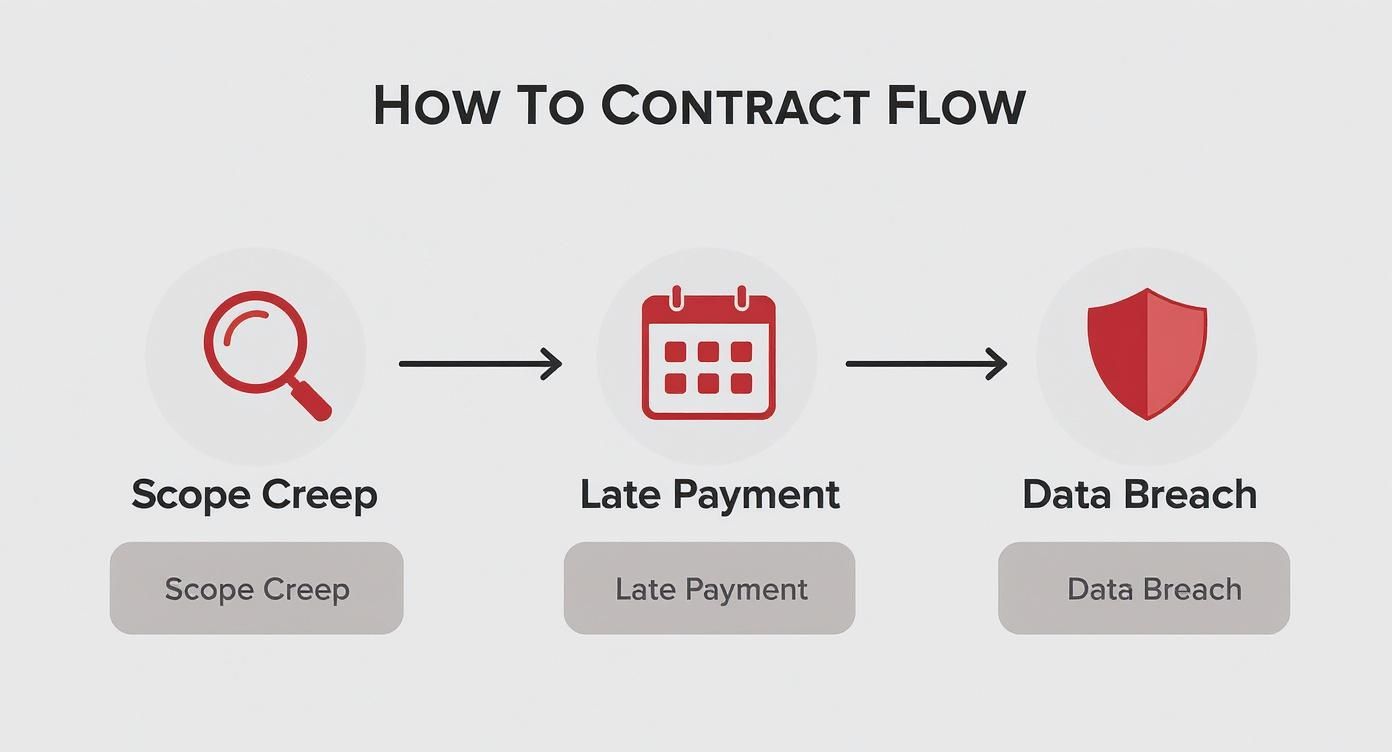
As you can see, issues like scope creep and late payments often start with a simple failure to communicate and manage expectations.
Keeping Versions and Signatures Organized
Projects evolve. It happens. A client might approve a change order, or you might both agree to shift a deadline. The key is to document these changes with a formal amendment or addendum to the original contract. It doesn't have to be complicated—a simple, signed document that references the original agreement and spells out the change is all you need.
For getting signatures, digital platforms have made life so much easier. Tools like DocuSign or PandaDoc offer a legally binding and easily trackable way to get approvals, whether it’s for the initial contract or a mid-project change order. No more printing and scanning. You get a clean, professional paper trail that protects everyone.
This whole process is a core part of what’s known as Contract Lifecycle Management (CLM). There's a reason the CLM market is projected to hit $12 billion by 2025. It’s because poor contract practices lead to value erosion that averages 8.6% globally. Your website contract template is the first step in avoiding that.
If you're interested in diving deeper, you can find more guidance in these best practices for contract management.
Fostering Transparency and Building Trust
At the end of the day, using your contract as a management tool is really about building a solid client relationship. When a client sees you referencing the agreement to keep things on track, it screams professionalism. It shows you're committed to delivering exactly what you promised.
This approach creates a true partnership, not an adversarial relationship. It ensures that when the project wraps up, both you and your client feel the process was fair, transparent, and well-managed. That's the kind of experience that leads to glowing testimonials and repeat business—the real markers of success.
Common Questions About Web Contracts
When you're hammering out the details of a web development project, a few questions always seem to pop up. Whether you're a freelancer or a client, getting these sorted out from the get-go is the best way to build a solid working relationship. Let's tackle some of the most frequent ones.
What's the Single Most Important Clause?
If I had to pick just one, it would be the Scope of Work. Hands down, this is where most projects either succeed or fail. This clause is your project's blueprint, defining exactly what you're building.
Think of it this way: a vague scope is a direct invitation for scope creep, blown budgets, and friction down the road. You need to get granular. Don't just say "a contact page"; specify the exact fields, the success message, and where the submissions will be sent. When the scope is ironclad, there's no room for misunderstandings.
Who Actually Owns the Website and Code?
This is a big one, and it's covered under the Intellectual Property Rights clause. The standard industry practice is pretty clear: once the final invoice is paid, the client owns the finished product. That means the unique design, the content, and the functional website they can use for their business.
However, as the developer, you typically hang on to the rights for your underlying code, any proprietary plugins, or internal tools you used to build it. It’s crucial to spell this out in the contract to prevent any future arguments over ownership.
Do I Really Need a Lawyer to Look This Over?
While a solid website development contract template from a trusted source is a great starting point, getting a lawyer to give it a once-over is always a smart move. This is especially true if you’re dealing with a complex project or a significant amount of money is on the line.
A quick chat with a lawyer can confirm your contract is enforceable where you live and work. Think of it as a small insurance policy. That upfront cost can save you from a potential dispute that could run into the thousands.
What Do I Do When the Client Asks for "One More Thing"?
This happens on every project. That's why your contract needs a Change Order Process clause. This creates a simple, professional system for handling any new requests that weren't in the original scope. It stops those "can you just quickly add…" requests from piling up and ensures you get paid for every bit of work you do.
Here's how it works:
- The client puts the new request in writing.
- You send back a quote detailing the extra cost and time.
- You don't start the new work until they've approved that quote in writing.
This process keeps everything transparent, fair, and on track.
At OneNine, we know that a great contract is the bedrock of any successful web project. If you're looking for a partner to guide your development with clarity and experience, visit us at OneNine to learn how we can help.


