
At its core, a multi-channel marketing strategy is all about being where your customers are. It means you're not putting all your eggs in one basket; instead, you're using a mix of different platforms to connect with people.
Think of it like fishing. You wouldn't just use one type of bait in one spot, right? You’d cast different lines in different parts of the lake. That's multi-channel. You might have a paid ad on Instagram, a weekly email newsletter, and a blog post, with each one designed to catch the attention of a specific group within your audience.
The Real-World Logic Behind Multi-Channel Marketing
Let's break this down. In a multi-channel setup, each platform acts as its own independent powerhouse. Your social media presence isn’t necessarily “talking” to your email campaigns, and your blog content operates on its own terms. They all share the same brand message, but they don't rely on each other to function.
This is a huge step up from single-channel marketing, where you’re just hoping everyone sees your one billboard on the highway. By diversifying your efforts, you’re creating more doors for customers to walk through. It’s about maximizing your presence and giving people options.
What Does a Multi-Channel Strategy Actually Look Like?
A solid strategy isn't just about showing up everywhere; it's about having a game plan. You need to know which channels your customers actually use and what kind of message will resonate on each one.
It’s a cycle: you plan your attack, you execute it across your chosen channels, and then—most importantly—you analyze the results to see what worked.
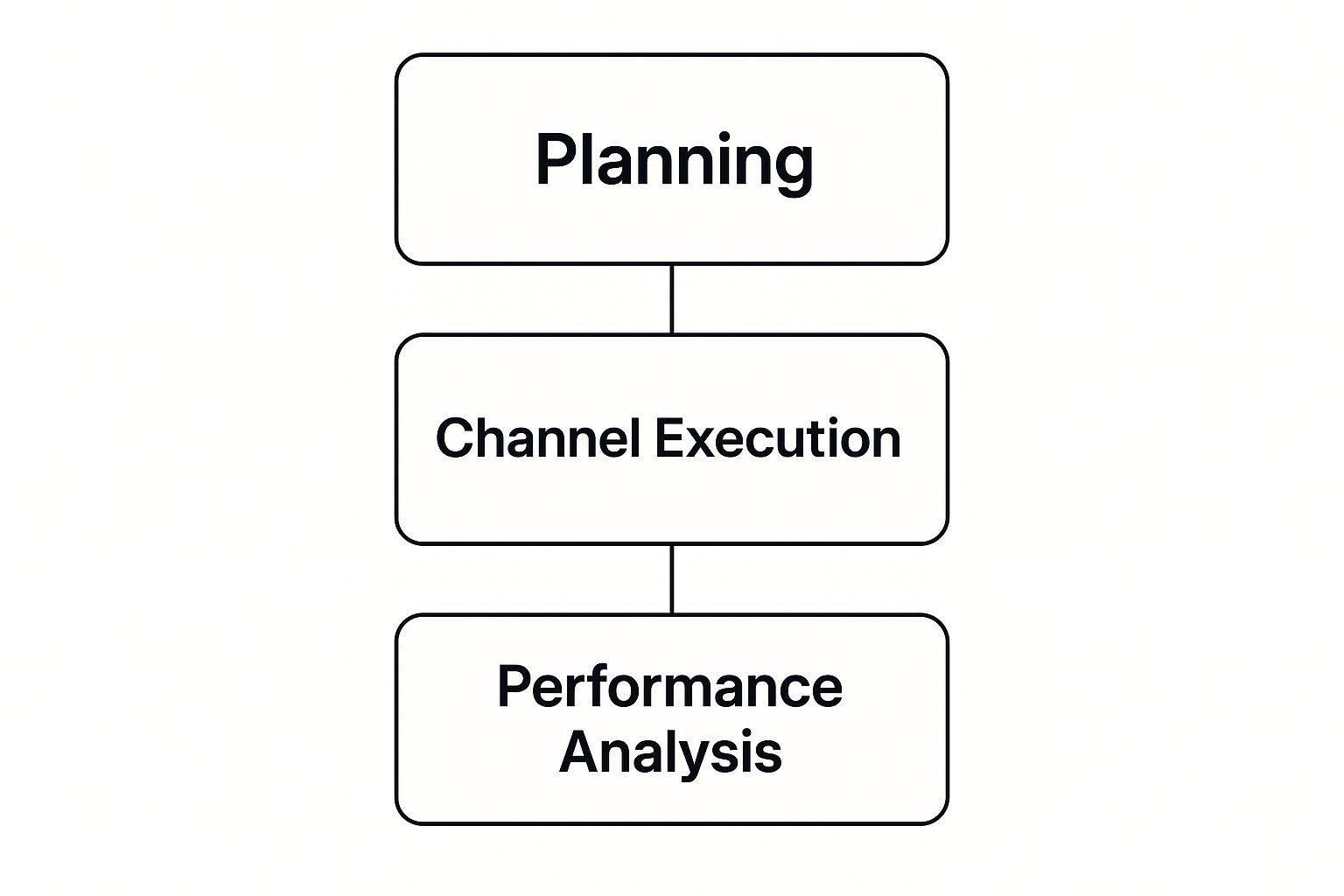
As you can see, everything flows from that initial strategy. Your plan dictates what you do on each channel, and the data you gather tells you how to adjust your plan for the next round. It’s a continuous loop of improvement.
Multi-Channel vs. Omni-Channel: What’s the Difference?
This is where a lot of people get tripped up. It's easy to confuse multi-channel with its close relative, omni-channel, but the distinction is crucial. While both use multiple platforms, their entire approach to the customer experience is different.
Multi-channel focuses on maximizing the reach of your message through various independent channels. Omni-channel, on the other hand, is all about creating one seamless, unified customer journey where all channels work together.
Let’s put that into perspective. With a multi-channel approach, a customer might see your ad on Facebook and later get a separate promotional email. The two experiences are completely disconnected.
An omni-channel approach knits everything together. The ad that customer saw on Facebook might trigger a personalized follow-up email about that exact product. Every interaction builds on the last, creating a single, continuous conversation. If you want to dive deeper into this integrated approach, it’s worth learning how to build a winning omnichannel communication strategy.
To make it even clearer, here’s a quick breakdown of how they stack up.
Multi Channel vs Omni Channel Marketing At a Glance
| Aspect | Multi Channel Marketing | Omni Channel Marketing |
|---|---|---|
| Approach | Channels work independently (in silos) | Channels are integrated and work together |
| Customer Experience | Inconsistent; experience varies by channel | Consistent and seamless across all channels |
| Business Focus | Brand-centric; focused on maximizing reach | Customer-centric; focused on the entire journey |
Ultimately, multi-channel is about being available on multiple platforms, while omni-channel is about creating a unified experience across those platforms. The choice between them really depends on your resources and your ultimate goal.
Why a Multi-Channel Approach Drives Growth
Relying on a single marketing channel today is like trying to catch rain in a thimble—you’ll get a few drops, but you're going to miss the downpour. A multi-channel marketing strategy isn't just a nice-to-have anymore; it's the bedrock of sustainable business growth. The whole idea is beautifully simple: show up where your customers are already spending their time.
This immediately expands your brand’s footprint. Instead of just hoping your ideal customer stumbles upon your blog, you’re actively meeting them where they live online. That could be through an engaging Instagram story, a helpful YouTube tutorial, or a perfectly timed email offer. All this added visibility doesn't just attract new eyes; it builds a sense of familiarity and trust with your audience over time.

Amplify Your Market Reach
Think of your business as a storefront. A single-channel strategy gives you one door on a quiet backstreet. A multi-channel approach, on the other hand, puts doors on every major avenue in the city—social media feeds, search engine results, email inboxes, you name it. You’re going to get more foot traffic just by being easier to find.
This expanded reach also creates a powerful compounding effect. A customer might first discover your brand through a Google ad, then decide to follow you on social media for updates, and finally make a purchase after seeing a special offer in an email. Each channel supports the others, creating a web of pathways that all lead back to you.
Gather Richer Customer Insights
One of the biggest perks of using multiple channels is the sheer amount of data you can collect. Each platform offers a unique window into how your customers behave, what they like, and what their problems are. For any marketer, this information is pure gold.
By analyzing how people interact with you across different touchpoints, you start to build a much more complete picture of who your customer really is. For example, you might find that your audience loves video content on Facebook but prefers deep-dive guides on your blog. Insights like that let you fine-tune your content to make the biggest splash on each platform.
To get a handle on all the moving parts, you can reference a complete digital marketing strategy template to make sure no stone is left unturned.
Enhance Customer Engagement and Convenience
Let's face it, modern consumers expect convenience. They want to connect with brands on their own terms, whenever and wherever they choose. A multi-channel strategy is built to meet this exact expectation by making your brand effortlessly available.
By offering multiple touchpoints for communication and purchasing, you remove friction from the customer journey. This isn't just about a better user experience; it's about fostering real loyalty and encouraging repeat business.
When a customer can easily find you, ask a question, and buy something through their favorite app or website, their satisfaction skyrockets. That positive experience is a major driver of long-term growth and keeps people coming back.
Boost Conversions and Lifetime Value
At the end of the day, the goal of any marketing strategy is to grow the bottom line. This is where a multi-channel approach truly shines, consistently outperforming single-channel efforts. The numbers don't lie: customers who connect with a brand across multiple platforms are simply more valuable.
In fact, shoppers who use multiple channels have a customer lifetime value that is 30% higher than those who stick to just one. And while only 14% of companies are effectively coordinating their marketing platforms, a whopping 72% of consumers prefer it when they do. Being present and consistent where your customers are doesn't just feel better for them—it directly translates to more loyal, profitable relationships for you.
Choosing the Right Channels for Your Business
Diving into a multi-channel strategy doesn't mean you have to be everywhere at once. In fact, that's a classic mistake. Spreading yourself too thin is a fast track to burnout with very little to show for it.
The goal isn't to plant your flag on every platform out there. It’s to show up on the right ones—the places where your ideal customers are already spending their time. More isn't better. Better is better.
Start with Your Ideal Customer
Before you pick a single channel, you need to know exactly who you're talking to. The most important first step you can take is building a detailed customer persona. This goes way beyond basic demographics like age and location.
You need to get inside their head. What does their day-to-day life look like? Where do they hang out online? What apps are they scrolling through on their lunch break? Answering these questions gives you a clear roadmap.
For instance, a B2B software company trying to reach tech executives will find them on LinkedIn, not TikTok. On the flip side, a fashion brand for Gen Z will get way more traction on visual-heavy platforms like Instagram and TikTok. Your customer's habits should always lead the way.
To really nail this, you need a solid foundation in developing a robust marketing channel strategy. This knowledge helps you perfectly match your audience to the right platforms.
Align Channels with Business Goals
Okay, you know your audience. Now what? The next step is to match potential channels with what you actually want to accomplish. Every platform has its own strengths, and picking the right one depends entirely on your objective.
Are you trying to build brand awareness, generate leads, or drive direct sales? Your goal points you to the right tool for the job.
- Want to build brand awareness? Think big. Channels with massive reach and great visual storytelling, like Facebook, Instagram, or YouTube, are fantastic for this. They let you show off your brand's personality and connect with a wide audience.
- Need to generate qualified leads? Time to get specific. Platforms like LinkedIn (for B2B) or highly targeted Google Ads (for B2C) are perfect. They help you zero in on people who are already looking for the solutions you offer.
- Looking to drive direct sales? Go for the close. Email marketing and social commerce features on platforms like Instagram and Pinterest are incredibly powerful. They create a short, simple path from discovery to checkout.
When you match the channel to the goal, you ensure every part of your strategy is working toward a specific, measurable outcome.
Evaluating Key Marketing Channels
It's important to remember that not all channels are created equal. Each one serves a different purpose and demands a unique style of content. Think of it like a toolkit—you wouldn't use a hammer to saw a piece of wood.
To help you get started, here's a quick look at some of the most popular channels and their primary strengths.
Key Marketing Channels and Their Primary Strengths
This table breaks down a few core marketing platforms, what they do best, and how to measure their success.
| Channel | Best For | Key Metrics |
|---|---|---|
| Email Marketing | Nurturing leads and driving repeat sales with a highly engaged audience. | Open Rate, Click-Through Rate (CTR), Conversion Rate |
| SEO (Search Engine Optimization) | Capturing high-intent organic traffic from users actively seeking information. | Keyword Rankings, Organic Traffic, Bounce Rate |
| Social Media (e.g., Instagram, LinkedIn) | Building community, enhancing brand awareness, and engaging with customers. | Engagement Rate, Reach, Follower Growth |
| Paid Ads (PPC) | Driving immediate, targeted traffic and generating leads quickly. | Cost Per Click (CPC), Cost Per Acquisition (CPA), Return on Ad Spend (ROAS) |
Ultimately, choosing your channels is an ongoing cycle of testing, learning, and optimizing. Start small. Pick two or three platforms where you're most confident you can reach your audience. Master those, see what the data tells you, and then strategically expand your presence from there. This measured approach is what makes a multi-channel strategy both sustainable and incredibly effective.
How to Build a Cohesive Marketing Strategy
Connecting the dots between your different marketing channels is what separates a good plan from a great one. Building a cohesive multi channel marketing strategy isn't just about showing up on a bunch of platforms; it’s about making sure every channel works together to create a smooth, unified experience for your customers.
Think of it like conducting an orchestra. Each instrument—your email, your social media, your blog—has its own part to play. If they all just play their own tune without listening to the others, all you get is noise. But when a conductor guides them from the same sheet of music, you get a beautiful symphony. Your strategy is that sheet of music.

This is how you move from random acts of marketing to a focused, results-driven operation that makes perfect sense to your audience. Let's break down how to build this framework from the ground up.
Establish Clear and Measurable Goals
Before you even think about writing a social media post or sending an email, you have to know what you're trying to accomplish. Vague goals like "increase sales" just won't cut it. Your objectives need to be specific, measurable, achievable, relevant, and time-bound (SMART).
A strong goal gives every channel a distinct purpose. For instance, instead of a fuzzy objective, you might set a goal to "increase qualified leads from organic search by 20% over the next quarter."
That specific target immediately clarifies what certain channels need to do. Your SEO and content teams now have a clear mission: create high-value blog posts and optimize key website pages to capture what people are searching for. Every other channel can then work to support that main goal.
Maintain Consistent Brand Messaging
Consistency is the glue that holds your entire multi-channel strategy together. Your brand's voice, tone, and visual identity should feel familiar to customers no matter where they find you. A person should never feel like they're dealing with two different companies when they click from your Instagram page to your website.
This means you need a unified brand style guide that lays out:
- Tone of Voice: Are you professional and authoritative, or more casual and witty? This needs to be consistent everywhere.
- Visual Identity: Your logos, color schemes, and fonts must be the same across all platforms to build instant recognition.
- Core Messaging: Your unique value proposition and key selling points should be clear and repeated consistently.
A cohesive brand message builds trust and reinforces who you are. When customers see consistency, they see your brand as reliable and professional, which is essential for building long-term loyalty.
Solid website management is a cornerstone of this, ensuring your main digital hub always reflects your brand's core identity.
Tailor Content for Each Platform
While your brand message has to stay consistent, the format of your content needs to be tailored to the unique strengths and audience expectations of each channel. A one-size-fits-all approach is a recipe for failure. What works on TikTok will almost certainly fall flat on a professional LinkedIn feed.
Let's walk through a real-world example. Imagine a modern retail brand that sells sustainable activewear.
Example: A Sustainable Activewear Brand
Let's say their core message is "High-performance activewear that's kind to the planet." Here’s how they could adapt their content while keeping that message consistent:
- TikTok and Instagram Reels: Here, they'd post short, high-energy videos showing the clothes in action—people hiking, doing yoga, or running. The focus is visual and trend-driven, using popular music to show off the style and performance of the gear.
- Email Newsletter: The emails would give subscribers exclusive deals, early access to new collections, and behind-the-scenes stories about their sustainability efforts. The tone is more personal and direct, built to nurture relationships and drive repeat business.
- SEO-Optimized Blog: On their blog, they'd publish long-form articles like "5 Eco-Friendly Hiking Trails Near You" or "How to Choose Sustainable Activewear." This content is designed to attract new customers through Google by providing genuinely helpful information, positioning the brand as an expert in the space.
In this scenario, every channel supports the same core message, but the execution is perfectly adapted to the platform. The result is a seamless strategy where each piece feels right at home, creating a far more effective and engaging experience for the customer.
Measuring Success and Optimizing Performance
Launching a multi-channel marketing strategy without a way to measure it is like sailing without a compass. Sure, you're moving, but are you heading in the right direction? This is where data becomes your North Star, turning educated guesses into a clear, actionable plan for growth.
Measuring performance isn't just about patting yourself on the back when things go well. It’s about understanding why they're working. It helps you pinpoint your most valuable channels, see how customers are actually behaving, and make smart calls on where to put your time and money. This feedback loop is what turns a static plan into a dynamic engine that gets better over time.
Key Metrics for a Multi-Channel Strategy
To get a clear picture, you need to track metrics that show both the big picture and the nitty-gritty details of each channel. Don't get lost in a sea of data; focus on a handful of key performance indicators (KPIs) that really matter.
Here are the essentials you should be watching:
- Customer Acquisition Cost (CAC): This is the bottom-line cost to get one new customer through the door. A low CAC means your strategy is efficient and profitable.
- Customer Lifetime Value (LTV): LTV tells you the total revenue you can expect from a single customer over their entire relationship with your brand. The goal is simple: your LTV needs to be way higher than your CAC.
- Channel-Specific Conversion Rates: How well is each channel (email, social, SEO) turning visitors into leads or customers? This shows you which platforms are your heavy hitters.
- Overall Return on Investment (ROI): The ultimate report card. This tells you exactly how much revenue your multi-channel efforts are generating compared to what you spent.
If you want to get deeper into the financial side of things, this guide on measuring content marketing ROI is an invaluable resource.
Understanding Marketing Attribution
One of the trickiest parts of a multi-channel strategy is figuring out which touchpoints get the credit for a sale. A customer might see a Facebook ad, read a blog post a week later, and then finally click a link in an email to buy. So, who's the hero? This is where marketing attribution models come in.
Attribution models are basically the rules you use to assign credit to each step in the customer's journey. Picking the right one helps you accurately see what’s really driving sales.
There are a few common ways to do this:
- First-Touch Attribution: This model gives all the credit to the very first interaction. It’s great for understanding how people are discovering you in the first place.
- Last-Touch Attribution: The complete opposite. It gives 100% of the credit to the final touchpoint before the sale. It’s the simplest model but often ignores all the hard work done by other channels earlier on.
- Multi-Touch Attribution: This is the most balanced approach. Models like Linear or Time-Decay spread the credit across multiple touchpoints, giving you a much more realistic view of how all your channels work together.
Tools and Technologies for Optimization
You can’t improve what you don’t measure, and having the right tools makes all the difference. The market for platforms that help manage and analyze these efforts is booming. In fact, the global multi-channel marketing hubs market was valued at $6 billion and is projected to grow at a rapid rate of 17.7% annually through 2034, driven by advancements in AI and data integration. You can find more details in this market growth analysis.
To get started, make sure you have these foundational tools in your corner:
- Google Analytics: Absolutely essential for tracking website traffic, seeing how people behave on your site, and monitoring conversions from different sources.
- CRM (Customer Relationship Management): Platforms like HubSpot or Salesforce pull all your customer data into one place. This gives you a complete, unified view of every interaction across every channel.
- Channel-Specific Analytics: Don't forget the tools you already have. Your email provider, your social media accounts—they all have their own built-in analytics dashboards. Use them to dig deep into how each specific channel is performing.
By regularly checking this data, you can spot the weak links in your strategy, double down on what’s working, and constantly fine-tune your approach. This commitment to data-driven improvement is one of the most powerful website optimization strategies you can have for building lasting success.
Common Multi-Channel Marketing Questions
Alright, so you've got the roadmap. But let's be honest, moving from a plan on paper to a real-world multi-channel strategy always brings up a few "what ifs" and "how tos." It's completely normal.
Let's tackle some of the most common questions that pop up when businesses start weaving their channels together. Getting these answers straight will help you sidestep common hurdles and build something that actually works.
What Is the Biggest Mistake to Avoid?
If there’s one mistake that can completely torpedo your efforts, it's this: treating each channel like its own little island. This is the silo effect in action. Your social media team has no idea what your email team is doing, and neither of them is synced up with the latest blog post. The result? A disjointed, confusing, and frankly, annoying experience for your customer.
Think about it. You see a great flash sale on Instagram, click through to the website, and… nothing. The offer is nowhere to be found. That kind of disconnect doesn't just feel sloppy; it kills trust. Customers expect a smooth journey, and when your messaging is all over the place, they notice right away.
Your goal isn't just to be on multiple channels. It's to create one unified brand experience across them. Each channel should feel like a different room in the same house, not a bunch of separate buildings. A great strategy makes sure every channel is singing from the same hymn sheet, telling one consistent story.
How Can a Small Business Implement This on a Budget?
You absolutely do not need a massive war chest to pull this off. For a small business, the name of the game is being strategic and focused, not trying to be everywhere at once. The "start small, scale smart" mindset is your best friend here.
First off, resist the temptation to launch on five or six platforms right out of the gate. Instead, figure out the two or three channels where your ideal customers are actually spending their time. For most small businesses, this usually points to a few high-impact, low-cost starting points:
- Email Marketing: You're talking directly to people who have already said they want to hear from you.
- Organic Social Media: Focus on one or two platforms to build a real community.
- Content & SEO: Create genuinely helpful blog content that draws in traffic for months and years to come.
The secret weapon for making this work on a tight budget? Repurposing. A single, well-researched blog post is a goldmine. It can be sliced and diced into a dozen different assets—a series of social media posts, a segment in your email newsletter, the script for a short video, or even a simple infographic. This way, you squeeze every drop of value out of the work you've already done.
Focus on quality over quantity. See what's actually working with your analytics, and only expand to new channels once you've got a profitable system humming along on your core ones.
How Long Does It Take to See Results?
This is the classic "it depends" question, and for good reason. How quickly you see results from a multi-channel strategy hinges on the channels you pick, how competitive your market is, and how consistently you show up. Setting the right expectations from the start is crucial.
Some channels are built for speed. Pay-per-click (PPC) advertising, for instance, can start bringing people to your site the day you turn it on. The feedback is almost immediate.
But many of the most powerful channels are a long game. SEO and content marketing are marathons, not sprints. You're building an asset over time. It can easily take 6 to 12 months of consistent effort—publishing great content, earning links—before you see a real, meaningful lift in your organic traffic.
You should, however, start seeing early signs of life within the first 1 to 3 months. Look for things like more website visitors, better engagement on your social posts, or a growing email list. These are the green shoots that tell you you're on the right track. The big wins, like a major jump in revenue, will come later as all your channels start working together and their effects begin to compound.
At OneNine, we specialize in turning your website into the powerful, central hub your multi-channel strategy needs. We build and manage high-performance websites that create seamless customer experiences. Learn how we can help you build a stronger online presence.


