

If you want to boost online sales, you need to stop thinking of your website as a digital brochure. It’s your most important salesperson, working around the clock. This means making sure it's fast, easy to navigate, and persuasive. The whole point is to create a smooth, trustworthy experience that naturally guides people from just looking to actually buying.
Turn Your Website Into a Sales Machine

When it comes to increasing online sales, your website is your single most valuable asset. It's where you make a first impression, build trust, and ultimately, close the deal. Just having a pretty site is no longer enough; every single element needs to work together to eliminate friction and encourage people to make a purchase.
Too many businesses let their websites sit like static catalogs. The brands that really succeed in e-commerce, however, treat their site as their #1 sales tool. The secret is an almost obsessive focus on the user experience. You have to go deeper than just surface-level design and get into the nitty-gritty of what actually makes someone click "Add to Cart."
Prioritize Blazing-Fast Site Speed
In e-commerce, speed isn’t a nice-to-have, it’s a must-have. A slow website is the quickest way to kill a sale. In fact, just a one-second delay in your page load time can tank your conversions by 7%. If your store makes $100,000 a day, that's a staggering $2.5 million in lost sales every year.
To stop leaving that money on the table, you need to get serious about your site’s performance. Here’s where to start:
- Compress Your Images: Large, unoptimized images are the usual suspects for slow-loading pages. Use a tool to shrink their file size without making them look pixelated.
- Minimize Your Code: Clean up any clunky or unnecessary HTML, CSS, and JavaScript that’s slowing things down.
- Use a Content Delivery Network (CDN): A CDN is a game-changer. It stores copies of your site on servers all over the globe, so your content loads for users from the server closest to them, making everything much faster.
Think of it this way: a slow site is just like a physical store with impossibly long checkout lines. People will get frustrated, ditch their cart, and go somewhere else. Making your site load in a snap is one of the most direct ways to protect your bottom line.
Craft Intuitive and Simple Navigation
This one’s simple: if people can't find what they're looking for, they can't buy it. A confusing or cluttered navigation menu is a huge roadblock that will send visitors straight to the back button. Your job is to create a crystal-clear path that guides users to the products they want with zero frustration.
A great navigation menu is like a helpful store employee pointing customers exactly where they need to go. Use clear, descriptive labels for your categories. For example, don't use a vague term like "Products." Instead, get specific with "Men's Running Shoes" or "Kitchen Appliances."
Key Insight: Your website's navigation should be so intuitive that a first-time visitor can find any product in three clicks or less. This "three-click rule" is a powerful benchmark for user-friendly design.
Don't forget to include a prominent search bar with good filtering and sorting options. This lets people who already know what they want to skip the menus and get straight to the product. Getting this right is a core part of the https://onenine.com/website-design-confirmation/ process, ensuring the final site is built around the user.
Write Product Descriptions That Truly Sell
Your product descriptions have a bigger job than just listing features—they need to tell a story and solve a problem. This is your chance to talk directly to your ideal customer, showing them you understand their needs and that your product is the solution.
Instead of saying a backpack has "durable polyester fabric," paint a picture. Say it's "built with tear-resistant polyester to withstand your toughest adventures, keeping your gear safe on the trail." The first is a boring feature; the second is a benefit that sparks an emotional connection.
For a deeper look at optimizing your entire website for sales, I'd recommend exploring these conversion rate optimization strategies. They cover everything from landing pages to checkout, helping you plug leaks in your sales funnel.
Use High-Quality Visuals and Clear Calls-to-Action
Let's be honest, people buy with their eyes. High-resolution product photos and videos are completely non-negotiable in today's market. Show your products from every angle, in different settings, and ideally, in use. Selling clothes? Show them on models with different body types. Even better, showcase photos from your actual customers—it’s incredibly persuasive.
Finally, every single page on your site needs a clear, compelling call-to-action (CTA). Your "Add to Cart" or "Buy Now" buttons should pop with a contrasting color and use direct, action-focused text. Never make your visitors wonder what to do next. Guide them confidently through the checkout process and turn your website into the well-oiled sales machine it was always meant to be.
Create an Experience That Brings Customers Back
Getting that first sale is a great feeling, but the real secret to long-term success isn't just about chasing new customers. It's about getting the ones you already have to come back again and again. That's how you turn a small online shop into a brand people genuinely love.
This is where the post-purchase experience comes into play. Every single interaction after a customer clicks "buy"—from the order confirmation email to the package arriving at their door—is a chance to build a real relationship. A memorable experience turns a one-time buyer into a repeat customer, and eventually, a vocal fan of your business.
Deliver Outstanding Customer Support
Sooner or later, something will go wrong. A package gets delayed, an item arrives damaged—it happens. How you handle these moments is what truly defines your customer service. A problem isn't just a problem; it's an opportunity to win a customer for life.
There's a fascinating concept in business called the service recovery paradox. It basically says that a customer who has a problem solved efficiently can end up being more loyal than a customer who never had an issue in the first place. You’ve turned a negative into a huge positive.
To pull this off, you have to be fast, empathetic, and make things right without any hassle. Don't force customers to jump through a bunch of hoops. A simple, pain-free return or exchange process shows you stand behind your products and respect their time and money.
Personalize the Entire Shopping Journey
Personalization is so much more than just plugging a customer's first name into an email template. It’s about creating an experience that feels like it was designed specifically for them, showing that you actually get them.
It all starts with smarter product recommendations. If someone buys a pair of running shoes from you, don't follow up with random offers. Show them things they might actually want or need.
- Smart Cross-Sells: Suggest high-performance running socks or a hydration belt to go with their new shoes.
- Logical Upsells: A few months down the line, let them know about the new-and-improved version of the shoe model they bought.
- Refill Reminders: If you sell things like coffee, vitamins, or skincare, send a friendly reminder right around the time they're probably running low.
This kind of attention to detail makes the customer feel understood, not just like another number on a sales report.
Design a Loyalty Program People Actually Use
A great loyalty program can be a powerful motivator for repeat business. The problem is, most of them are too complicated or the rewards just aren't that exciting. For a program to work, it needs to be simple, clear, and offer real value.
A recent study showed that for two-thirds of consumers, the chance to earn rewards actually changes their spending habits. The trick is making those rewards feel both achievable and genuinely desirable.
Think beyond just a basic points system. A tiered program where customers unlock better perks as they spend more can be incredibly effective. Imagine offering benefits like:
- Early Access: Let your best customers shop new collections or sales events before anyone else.
- Exclusive Products: Create limited-edition items or special merchandise that's only available to members.
- Free Shipping for Life: This is a killer perk you can reserve for your absolute top-tier, most loyal fans.
Rewards like these build a sense of community and exclusivity, giving people a compelling reason to choose your store over a competitor.
The online marketplace is more crowded than ever. The number of e-commerce businesses is expected to hit nearly 28 million worldwide by 2025—a massive increase from just a few years ago. With that much noise, standing out with a superior customer experience isn't just a nice-to-have; it's critical for survival. You can get more details on the competitive e-commerce environment from LinkMyBooks.com.
Master Post-Purchase Communication
Your job isn't done after the payment goes through. In fact, this is where you can build the most trust. Keep your customers in the loop with clear, proactive communication about their order status.
Don't ever make them wonder, "Where's my stuff?" Be the one to reach out first. Set up automated emails or texts for these key moments:
- Right after the order is confirmed
- As soon as it ships (with a tracking link!)
- When it's been delivered
- A week or so later to ask for feedback
This level of transparency calms any shipping anxiety and shows you're a reliable, professional brand that cares about the entire experience.
Find and Attract Your Ideal Buyers
Let's be honest. A beautiful website with a slick checkout process is great, but it won’t make you a dime if no one ever sees it. This is where the real work begins: learning how to attract the right kind of traffic. We're not talking about just any visitor; we want people who are actually primed and ready to buy.
Pouring money into generic advertising is a bit like casting a huge net into the ocean hoping to catch a specific type of fish. It’s expensive, and most of what you catch isn't what you were looking for. What you really need is a focused approach that puts your products right in front of your ideal customers. It's about getting smart with both your paid ads and your organic marketing to build a reliable stream of qualified visitors.
Master Targeted Advertising Campaigns
This is where you get to be a sniper, not a shotgun. Paid advertising platforms like Google, Facebook, and Instagram give you an incredible ability to zero in on specific groups of people. The goal isn't to reach everyone; it's to reach the people whose online behavior screams, "I'm looking for exactly what you sell!"
Just think about the data you have at your fingertips. You can build audiences based on:
- Demographics: The basics like age, location, and gender.
- Interests: What pages they follow, hobbies they have, and content they interact with.
- Behaviors: Things like their past purchase history, the devices they use, or even their travel habits.
Let's say you sell high-end camping gear. You could create an Instagram ad campaign that only targets users who follow hiking influencers, have shown interest in brands like Patagonia or The North Face, and live near mountainous areas. This kind of laser focus ensures your ad budget isn’t wasted on people who will never buy your products.
My two cents: Don't get obsessed with just getting cheap clicks. A low-cost click from someone who's not interested is worthless. A more expensive click from your perfect customer is an investment that pays for itself.
Build Authority with Content and SEO
While paid ads can give you a quick boost, content marketing and search engine optimization (SEO) are your long-term engines for growth. This strategy is all about creating genuinely helpful content that answers your customers' biggest questions, drawing them to your site naturally.
When you create content that solves a real problem for your audience, you stop being just a seller and start becoming a trusted authority. This is a core pillar of any solid strategy for small business lead generation, as it warms up potential customers long before they even see a "buy now" button.
Imagine you sell natural skincare. Instead of just running ads for your face cream, you could write a blog post titled, "5 Natural Ingredients That Actually Soothe Dry, Irritated Skin." People searching for solutions to their skin problems find your article, see you as an expert, and then naturally discover your products. This approach builds a pipeline of organic traffic that doesn't just vanish the moment you turn off your ads.
This lines up with a massive global trend. Ecommerce's share of total retail sales is climbing steadily and is expected to hit 20.5% worldwide by 2025. This shift means putting real effort into channels like SEO isn't just a good idea—it's essential for grabbing your piece of the pie. You can dive deeper into these shopping patterns with these e-commerce insights from Backlinko.
Make Data-Driven Decisions
You can't improve what you don't measure. It’s that simple. Both your paid ads and your SEO efforts produce a goldmine of data. Your job is to dig into that data to make smarter decisions and constantly refine your strategy.
Think of your website analytics as your mission control. It tells you exactly what’s working and what’s not, showing you which channels are bringing in traffic that actually turns into sales.
| What to Track | What It Tells You | What to Do About It |
|---|---|---|
| Conversion Rate by Channel | Which source (Google, Facebook, etc.) brings in the most buyers. | Double down on the winners; rethink or pause the losers. |
| Cost Per Acquisition (CPA) | How much you're spending to get one new customer from an ad. | Tweak campaigns to get this number down and boost your profit. |
| Top Organic Landing Pages | Which blog posts or pages are your biggest traffic magnets. | Create more content around these successful topics. |
By checking these numbers regularly, you can move your budget to the strategies that give you the best return. This turns your marketing from a guessing game into a predictable, data-backed system for growth, keeping your pipeline full of people ready to make a purchase.
Fix Your Checkout to Stop Losing Sales
Your checkout page is where the deal is sealed. It's the final, make-or-break moment where a curious visitor becomes a loyal customer. Yet, for so many online businesses, this is precisely where things fall apart. A clunky, confusing, or slow checkout process is like a wide-open exit door for your sales.
Think of it like the final handshake after a great meeting. If it's weak or awkward, it can sour the entire interaction. By smoothing out the payment experience, you can plug those leaks, dramatically lower your cart abandonment rate, and see a real, tangible lift in your revenue.
This whole process is a journey, guiding people from discovery right through to that final "buy" button.
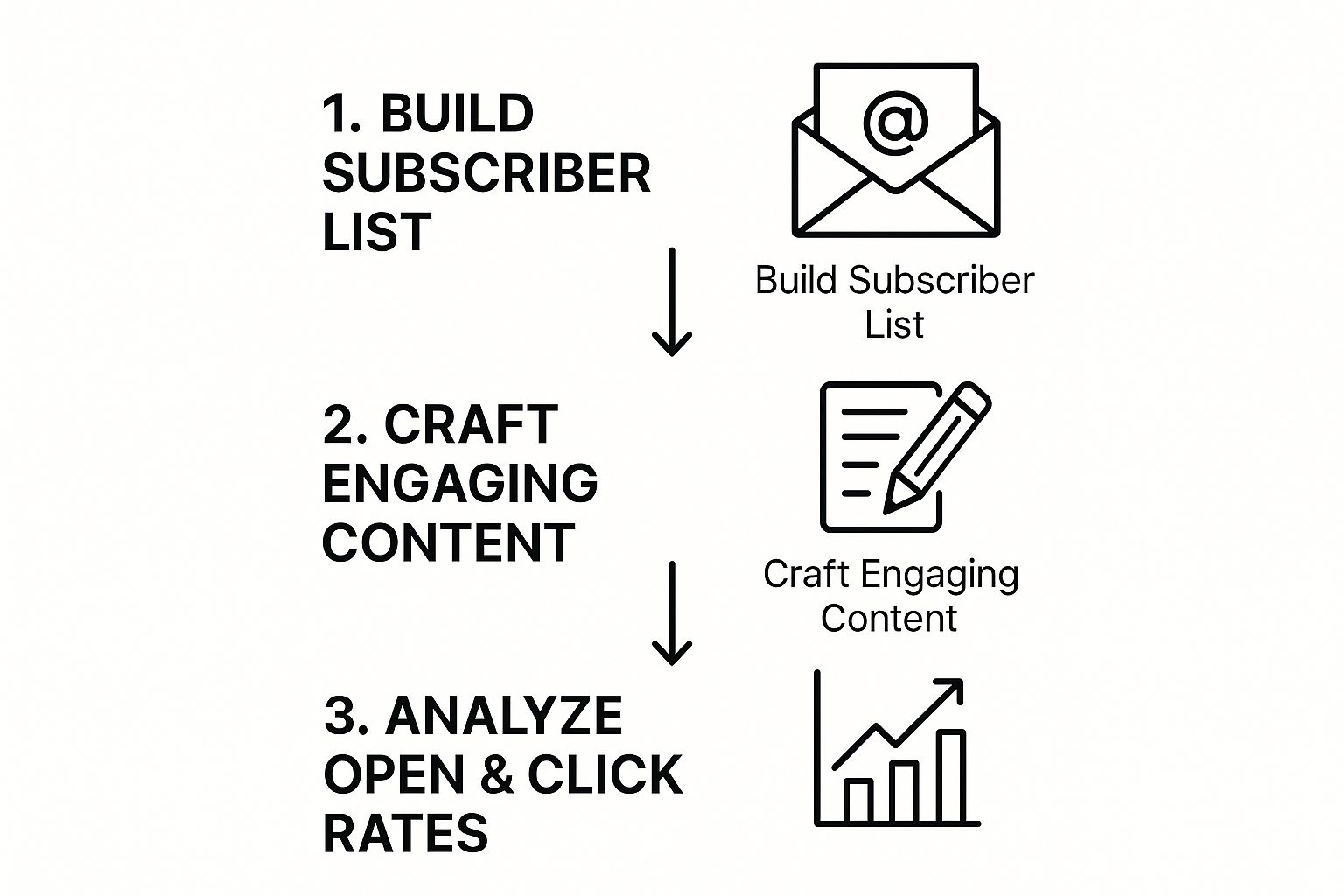
As the workflow shows, every part of your marketing—from building an email list to analyzing results—is designed to get customers to that critical checkout step. Let’s make sure it’s ready for them.
Don't Force Account Creation
What’s one of the quickest ways to kill a sale? Forcing someone to create an account. While gathering customer info is great for your marketing, putting a mandatory sign-up wall in front of the "pay" button is a guaranteed way to lose people.
Many shoppers, especially if it’s their first time buying from you, aren’t looking for a long-term relationship just yet. They just want your product. Making them create a password and fill out extra forms adds friction and kills momentum.
My Advice: Always, always offer a guest checkout. It's a simple feature that respects your customer's time and can give your conversion rate an immediate boost. If you want them to sign up, ask on the "thank you" page after the purchase is complete. The pressure is off, and they're much more likely to say yes.
Be Transparent About All Costs
Have you ever gotten to the very last step of a purchase, only to be hit with an outrageous shipping fee you never saw coming? It’s frustrating, and for most people, it's an instant deal-breaker. In fact, unexpected costs are the #1 reason for cart abandonment.
Last-minute surprises feel deceptive and break the trust you've worked so hard to build. You have to be upfront about every single cost—especially shipping—long before the customer has to enter their credit card details.
Here’s how to do it right:
- Add a shipping calculator right on the cart page. Let them pop in their zip code to see the costs.
- Offer free shipping over a certain amount (e.g., "Free shipping on all orders over $75!") and display it prominently in your site header.
- Show estimated delivery times. Don’t leave customers guessing.
This kind of transparency manages expectations and eliminates the sticker shock that sends potential buyers packing. It's a small change that shows you respect your customer.
Embrace Modern Payment Methods
The days of only offering a standard credit card form are over. To capture every possible sale, you need to let people pay the way they want to pay.
The global e-commerce market is set to explode, projected to hit an incredible $8.3 trillion by 2025. A huge driver of this growth is the shift to digital wallets like Apple Pay and Google Pay, which already account for more than half of all online transactions. With over 70% of purchases happening on mobile, these one-click payment options aren't just a "nice-to-have"—they're essential.
By integrating these modern wallets, you accomplish two critical things:
- You drastically speed up the checkout, especially for mobile users.
- You build instant trust by using a secure, familiar service they already have on their phone.
Key Checkout Features to Reduce Cart Abandonment
To bring it all together, here are some of the most impactful features you can implement on your checkout page. Each one is designed to remove a specific point of friction and make it easier for customers to complete their purchase.
| Feature | Impact on Sales | Implementation Tip |
|---|---|---|
| Guest Checkout | Directly increases conversion by removing the sign-up barrier for new or impatient customers. | Add a prominent "Checkout as a Guest" button alongside the "Login" option. |
| Digital Wallets | Boosts mobile conversions significantly by offering fast, one-tap payment options. | Integrate major players like Apple Pay, Google Pay, and PayPal Express Checkout. |
| Shipping Calculator | Reduces cart abandonment by eliminating surprise costs at the final step. | Place it on the cart page, not just the final checkout screen. |
| Simplified Forms | Speeds up the process and lowers the chance of user error or frustration. | Only ask for essential information. Use address auto-fill to reduce typing. |
| Security Badges | Builds trust and reassures customers that their payment information is safe. | Display recognizable logos like Norton, McAfee, or SSL certificates near the payment fields. |
Implementing even a few of these features can have a noticeable effect on your bottom line. The goal is to make buying from you feel effortless and secure.
Optimize for Speed and Simplicity
Every extra second of load time and every unnecessary form field is another chance for a customer to walk away. In e-commerce, speed is money. A slow-loading checkout page creates doubt and can make people question whether your site is even secure.
Start by ruthlessly simplifying your forms. Do you really need a phone number? Can you combine "First Name" and "Last Name" into a single "Full Name" field? Small tweaks add up.
A fast, clean checkout experience is a hallmark of any successful online store. To dive deeper, our guide on effective website loading speed optimization can help you ensure your entire site is running at peak performance. When you remove those final roadblocks, you make it incredibly easy for customers to give you their business.
Build Lasting Trust with Social Proof
In a crowded online world, shoppers are naturally wary. They're constantly asking themselves, "Can I actually trust this brand?" or "Is this product as good as it looks?" Before you can even think about making a sale, you have to answer those questions convincingly.
This is where social proof comes in. It’s a simple concept: people are heavily influenced by the actions and opinions of others. When a potential customer sees that real people already use, love, and trust your products, their guard immediately comes down. You build the credibility needed to turn a hesitant browser into a confident buyer.
Showcase Authentic Customer Reviews
The most straightforward form of social proof? The humble customer review. And today, they're non-negotiable. A staggering 93% of customers read online reviews before buying anything. They aren't just scanning for five-star ratings; they're looking for honest, authentic feedback.
So, make leaving and finding reviews ridiculously easy. Don’t bury them on some forgotten page. Weave them directly into your product pages, right under the description where they can’t be missed. It’s also worth noting that a mix of reviews—even some less-than-perfect ones that you've responded to thoughtfully—can feel more genuine than a page of flawless praise.
Key Takeaway: Think about a product page you've seen with hundreds or even thousands of reviews. It sends a powerful message, doesn't it? It tells new visitors that the product is not just popular, but has been thoroughly tested by a real community, making the purchase feel a whole lot safer.
When you let your happy customers do the talking, their unbiased opinions carry far more weight than any marketing copy ever could.
Let User-Generated Content Do the Selling
What’s even better than a written review? A photo or video of a real person using your product in their own life. This is user-generated content (UGC), and it's marketing gold. It gives shoppers visual proof that your product delivers on its promises out in the wild, not just in a sterile photo studio.
How do you get it? Encourage your customers to share.
- Create a unique brand hashtag and ask people to tag their photos on social media.
- Run a contest or offer a small discount for customers who share their pictures.
- With permission, feature these real-world photos directly on your product pages, homepage, and even in your ads.
This approach effectively closes the gap between the online and real-life experience. It gives shoppers that final nudge of confidence they need to hit the "buy" button.
Feature Mentions from Influencers and the Press
While customer reviews build trust from the ground up, endorsements build authority from the top down. When a respected influencer, blogger, or media outlet gives your brand a shout-out, you instantly borrow their credibility.
Don't just focus on the big names. Mentions from smaller, niche influencers can be incredibly powerful. These creators often have highly dedicated audiences who genuinely trust their recommendations. A single partnership can place your product in front of a perfectly targeted and receptive group of buyers.
Display these endorsements proudly. Create an "As Seen In" logo bar on your homepage. If an influencer posts a great video review, why not embed it right on that product's page? These trust signals act as a stamp of approval, assuring new visitors that you're a legitimate and respected player in your field—a critical step in boosting your online sales.
Your Top Questions About Increasing Online Sales, Answered
When you're trying to grow your online sales, it’s easy to feel like you're drowning in advice. Let’s cut through the noise. From my experience working with hundreds of businesses, the same questions pop up time and time again.
Here are some straightforward answers to the challenges you're probably facing right now.
What Is the Quickest Way to Get More Sales?
If you want to see a fast improvement, look at your checkout process. This is where most businesses unknowingly lose customers. The fastest wins almost always come from fixing these "leaks" in your sales funnel.
Think about it: a customer is ready to give you their money, but then they hit a snag. Adding a guest checkout option is a huge one. Forcing people to create an account is a major conversion killer. Also, integrating one-click payment options like Apple Pay or Google Pay makes the final step seamless. These small tweaks can give you an immediate lift you can see in your daily reports.
Should I Offer Discounts or Focus on Brand Value?
This is the classic tug-of-war for business owners. Discounts and flash sales can definitely give you a quick revenue spike, which feels great. But if you do it too often, you're just teaching your customers to wait for a sale. That slowly chips away at what your brand is worth.
The best approach is a balanced one. You don't have to choose one or the other.
- Be strategic with your promotions. Use them for big shopping holidays or to move last season's inventory.
- Build your brand's value every single day. This comes from amazing customer service, a product that actually delivers, and creating a real community around what you do.
At the end of the day, a strong, trusted brand will always outperform a business that’s constantly cutting prices.
A revealing study found that for two-thirds of consumers, the opportunity to earn rewards is enough to change their spending habits. This tells you that adding value through things like loyalty programs can be far more powerful than just slashing prices.
How Much Should I Spend on Marketing?
There's no single magic number here—it really depends on your industry, your margins, and how fast you're trying to grow. As a general rule of thumb, most e-commerce businesses I see are comfortable spending somewhere between 5% to 15% of their total revenue on marketing.
But honestly, don't get too hung up on the percentage. It's much more important to focus on your metrics. Keep a close eye on your Return on Ad Spend (ROAS) and Customer Acquisition Cost (CAC). If you know that every $1 you spend on ads brings in a customer who spends $5, you’ve found a winning formula. The real key is to track your results obsessively and double down on what’s actually working.
Do I Really Need to Be on Social Media?
Yes, absolutely. But—and this is a big but—you don't need to be on every platform.
With over 61% of the entire world's population on social media, your customers are there. The trick isn't being everywhere; it's being where your people are.
For example, if you sell beautiful home decor, Instagram and Pinterest are non-negotiable. If you're a B2B service provider, LinkedIn is probably your best bet. My advice? Pick one or two channels, truly learn them, and show up consistently. It’s far better to be a master of one platform than to be spread thin and mediocre across five.
At OneNine, our job is to take the technical headaches out of running your website so you can get back to what you do best: growing your business. Whether that means building a faster checkout, improving your site's design, or just having a reliable partner to handle the tech, we've got you covered. Check out what we can do for you at https://onenine.com.


