

Search Engine Optimization, or SEO, is the art and science of getting your website to show up higher in search results on platforms like Google.At its heart, it’s all about making your site more visible to the exact people who are actively looking for your products, services, or expertise.
What Is SEO in Simple Terms

Let's try a simple analogy. Imagine the internet is a massive, sprawling library and Google is the head librarian. Your website is one of the millions of books sitting on the shelves. Without any guidance, it's almost impossible for that librarian to know what your book is about or who would find it useful.
This is where understanding what search engine optimization is really clicks. SEO is how you organize and label your "book" (your website) so the librarian (Google) can instantly grasp what it covers. You're essentially giving it a clear title, a helpful table of contents, and making sure the information inside is easy for anyone to read and understand.
When someone walks up to the librarian and asks for a book on a certain topic, yours is the one they can confidently pull off the shelf and recommend. In the digital world, that "recommendation" is your website appearing right at the top of the search results page.
Why Does This Matter So Much?
Landing on that first page is everything. Consider this: over 75% of people never bother clicking past the first page of search results. If you’re not there, you’re basically invisible to a huge chunk of your potential audience.
SEO isn’t just about being found. It’s about being seen as a credible, trustworthy answer to someone’s question. High rankings build instant authority.
At its core, all SEO efforts are designed to improve search engine ranking and boost your online presence. This process puts you directly in front of people at the very moment they need what you offer. The goal isn't just to get more website visits—it's to attract high-quality traffic from people who are genuinely interested in what you do.
To put it simply, SEO aims to achieve a few key objectives that work together to grow your business.
This table breaks down the main goals of any solid SEO strategy.
The Core Goals of SEO at a Glance
| SEO Goal | What It Means for Your Website | Why It Matters for Your Business |
|---|---|---|
| Increase Visibility | Ranking higher for relevant search terms. | More people discover your brand when they need you. |
| Drive Organic Traffic | Attracting visitors from unpaid search results. | You get a steady stream of interested visitors without paying per click. |
| Build Credibility & Trust | Appearing as an authoritative source in search. | Customers trust brands that Google recommends. |
| Improve User Experience | Making your site fast, easy to navigate, and mobile-friendly. | Happy visitors stay longer and are more likely to become customers. |
Each of these goals is a piece of the puzzle, contributing to a stronger, more sustainable online presence.
More Than Just Keywords
While keywords are a big part of the conversation, modern SEO goes much deeper. It's about ensuring your website is not only easy for search engines to crawl and index but also provides a fantastic experience for the people who visit it. The main pillars include:
- Technical Health: Making sure your site is fast, secure (HTTPS), and works perfectly on mobile phones.
- Quality Content: Creating genuinely helpful, informative, and engaging articles, videos, or guides that solve problems for your audience.
- Authority Building: Earning trust and credibility by getting links from other respected websites in your industry.
Ultimately, SEO isn't just a marketing tactic; it's a long-term investment that builds a valuable asset for your business. It drives consistent, organic traffic that delivers results long after you've done the work—unlike paid ads, which disappear the moment you stop paying.
A Quick Journey Through SEO History

To really get a handle on what search engine optimization is today, it helps to look back at where it all started. Think of the internet in the 1990s as the Wild West. Search engines were pretty basic, and the rules were loose, which meant the name of the game was finding clever loopholes, not creating quality content.
The go-to trick was keyword stuffing. This meant jamming a webpage full of target keywords, sometimes even hiding them by making the text the same color as the background. It was all about manipulation, and for a little while, it actually worked.
The Arrival of Google
Everything changed when Google showed up in 1998 with its game-changing PageRank algorithm. Instead of just counting keywords on a page, Google treated links between websites like "votes." If a trusted, well-respected site linked to you, it was a strong sign that your content was actually valuable.
This one simple idea forced website owners to start earning respect instead of just trying to fool a machine. It was the first big step in SEO’s long journey from pure trickery to a system based on merit. Of course, the system was still far from perfect, and people quickly found new ways to bend the rules.
The years from 1995 to 2010 were defined by this cat-and-mouse game, from keyword stuffing and hidden text to the rise of PageRank. You can find more great details about this transformative era of SEO on Amsive. Understanding this history is crucial to seeing why the next big shift was so important.
A New Era Focused On Quality
The real revolution began with a series of major Google updates that completely reshaped the world of SEO. These updates were built to penalize low-quality sites and reward the ones that gave people a genuinely good experience.
The message from Google was loud and clear: stop trying to game the system and start helping your users. That simple philosophy is what drives all successful SEO work today.
These updates forced the entire industry to grow up. Here are a few of the key milestones:
- Panda (2011): This update went after sites with "thin" or poor-quality content, duplicate pages, and too many ads. It rewarded sites that provided unique, helpful information.
- Penguin (2012): This one targeted spammy link-building schemes. It punished sites that bought links or used other shady tactics to fake their authority.
These changes were massive. They completely tanked the rankings of countless websites that were still using old-school tricks. The focus had to shift to creating great content and building real relationships to earn links the right way. This evolution also trickled down into more specialized areas; for instance, see how much has changed in our guide on how to optimize your website for local search.
This journey—from simple tricks to a complex, user-focused field—is why modern SEO is less about outsmarting a program and more about creating the absolute best resource for your audience.
Understanding the Three Pillars of SEO
Search engine optimization isn’t a single task you can just check off a list. It’s a complete strategy built on what we call the "three pillars" of SEO. A great way to visualize this is to think of your website as a house. For people to want to visit (and for your house to have value), it needs to be solid from the ground up—from a strong foundation to beautiful interior design and a good reputation in the neighborhood.
This simple analogy breaks down SEO into three distinct, but deeply connected, areas. To succeed, you need to get all three right.
On-Page SEO: The Interior Design
First up is On-Page SEO. This covers everything you do on your website's pages to make them more appealing to both search engines and actual people. Think of this as the interior design of your house—it’s about making the inside welcoming, useful, and easy to understand.
This is where your content and structure come into play. Key activities include:
- Keyword Research: Finding the actual words and phrases your ideal customers are typing into Google.
- Content Quality: Creating genuinely helpful, well-written content that solves the searcher's problem.
- Page Structure: Using clear titles, headings (like H1s and H2s), and meta descriptions to organize your content and signal its purpose to Google.
Good keyword research is about finding a sweet spot. You want terms people are searching for, that are relevant to your business, and that you have a realistic chance of ranking for.
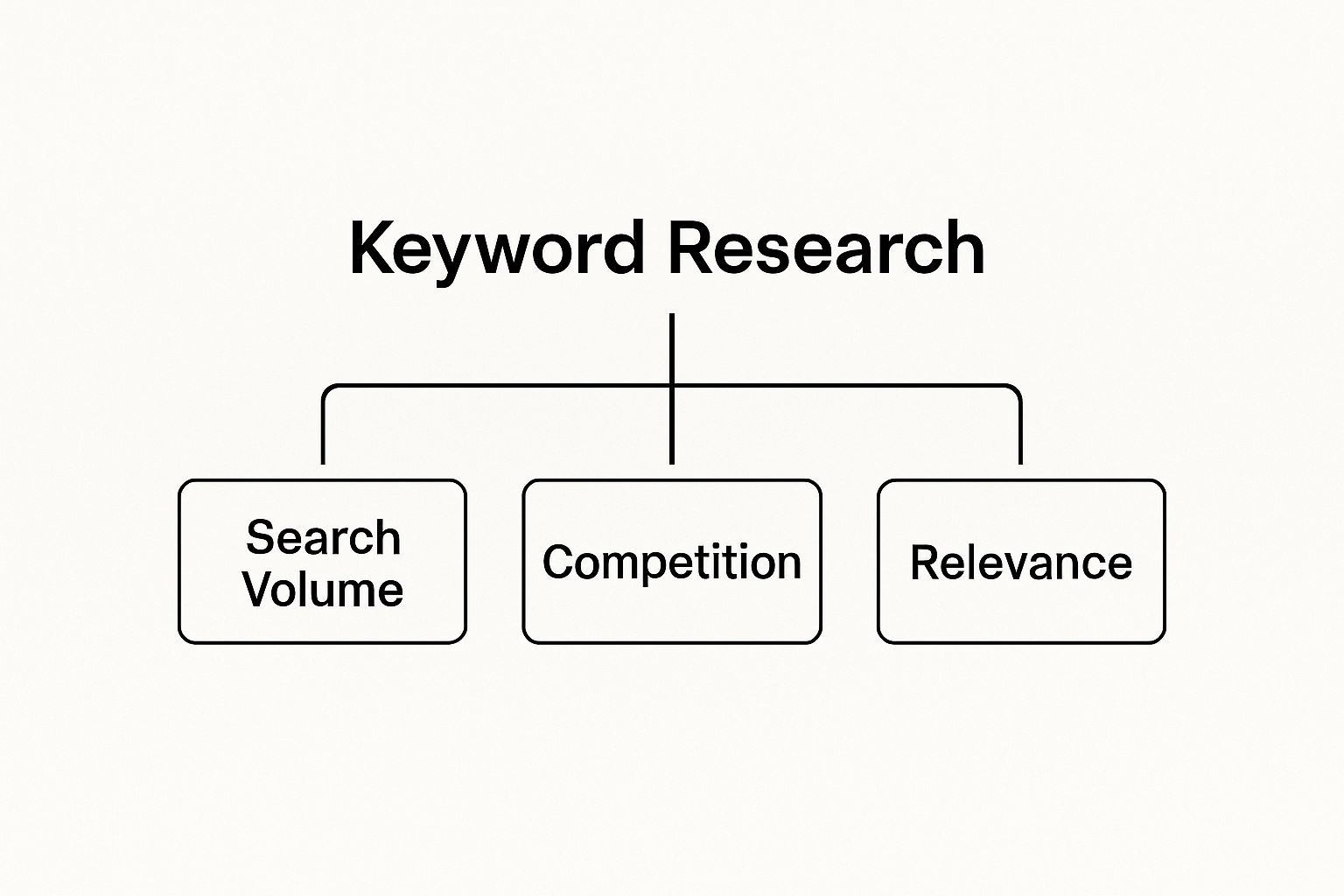
As the image shows, the goal is to hit that perfect intersection of search volume, relevance, and competition. This is the blueprint for all your content creation efforts.
Off-Page SEO: Your Neighborhood Reputation
Next, there's Off-Page SEO. This refers to all the things you do outside of your website to build its authority and credibility. Sticking with our house analogy, this is your home's reputation in the community. Are you the house everyone trusts and recommends?
The most significant factor here is backlinks.
A backlink is a link from another website to yours. When a reputable, well-known site links to you, it’s like a public endorsement. It signals to Google that your content is trustworthy and valuable.
Earning these "votes of confidence" is the core of off-page work. It’s not just about getting any link, but learning how to build backlinks naturally from relevant and authoritative sources.
Technical SEO: The Foundation of Your House
Finally, we have Technical SEO. This is the solid foundation your house is built on. It’s all the behind-the-scenes work that makes it possible for search engines to find, crawl, and index your website effectively. If the foundation is cracked, it doesn't matter how amazing your interior design is—the whole structure is at risk.
Technical SEO ensures your site is fundamentally sound. This includes:
- Website Speed: How fast your pages load for visitors.
- Mobile-Friendliness: Making sure your site is easy to use on a smartphone.
- Site Architecture: Having a logical, easy-to-follow structure for both users and search engine bots.
Getting these technical elements right is non-negotiable for a good user experience, which Google heavily rewards. For a deeper look at this, our guide on website performance optimization strategies is a great next step.
To bring it all together, here's a quick comparison of the three pillars. Each one has a different focus, but they all work toward the same goal: improving your visibility in search results.
On-Page vs. Off-Page vs. Technical SEO
| Pillar of SEO | Primary Focus | Example Activities |
|---|---|---|
| On-Page SEO | The content and structure of your individual web pages. | Keyword research, content writing, optimizing titles and headers, internal linking. |
| Off-Page SEO | Building your website's authority and reputation online. | Link building, guest posting, brand mentions, social media marketing. |
| Technical SEO | The behind-the-scenes health and performance of your website. | Improving site speed, ensuring mobile-friendliness, creating an XML sitemap. |
When these three pillars—great content, strong authority, and a flawless technical foundation—are working in harmony, you create a powerful, sustainable SEO strategy that can stand the test of time.
How Search Engines Actually Work
Before we dive deep into SEO strategy, let's pull back the curtain on how search engines like Google actually operate. It might seem like magic when you get instant answers to any question, but it's really a powerful, logical process that never stops.
Imagine Google is a librarian with an impossible task: to create a perfect, ever-expanding library of the entire internet. To pull this off, they need a system to find new information, organize it all, and then recommend the best possible answer to every visitor.
This whole operation boils down to three core steps that run in a continuous cycle: crawling, indexing, and ranking. Once you understand how these three pieces work together, your own SEO efforts will start to click.
Step 1: Crawling — The Discovery Process
First up is crawling. This is how search engines find new and updated pages on the web. They deploy armies of automated programs, often called "crawlers" or "spiders," that constantly travel across the internet. These spiders start with a list of known pages and follow the links on them to discover new ones.
It’s like our librarian sending out scouts to every corner of the globe. Their job isn't to read the books just yet—it's simply to find them and report back. They're building a massive, running list of every single piece of content they can get their digital hands on.
This is exactly why having a smart internal linking structure on your own website is so crucial. By linking your pages together logically, you're essentially giving these crawlers a clean, easy-to-follow map of all your great content.
Step 2: Indexing — The Filing System
After a crawler discovers a page, the next step is indexing. This is where the search engine analyzes the page's content—its text, images, and videos—and stores that information in a gigantic database called an index. Just to give you a sense of scale, Google's index holds trillions of pages and is well over 100,000,000 gigabytes.
Think of the index as the library's master catalog. After a scout finds a new book, the librarian analyzes it to understand what it's about. Then, they create a detailed catalog card noting its topic, contents, and where it belongs.
During this indexing phase, Google is trying to figure out:
- What topics the page is truly about.
- What the images and videos on the page show.
- How fresh and current the content is.
- The overall quality of the page's user experience.
Bottom line: if your site isn’t in the index, it can't show up in search results. It’s a book that the library doesn’t even know exists.
Step 3: Ranking — The Final Selection
The final step is the one we're all most familiar with: ranking. This is what happens the moment you type a search query and hit Enter. The search engine zips through its massive index, pulls all the pages that could possibly be relevant, and then runs them through a complex algorithm to sort them from best to worst.
This algorithm weighs hundreds of different signals to decide the final order. Factors range from the website's authority and the relevance of its content to the quality of the user experience. This is where all your hard work in SEO pays off, as you’re directly influencing Google’s decision to place your page at the top. It’s our librarian confidently handing you the single best book to answer your question.
Why SEO Is a Must-Have for Your Business
Knowing what SEO is and how it works is great, but the real magic happens when you see what it can do for your bottom line. So, why should you really bother with search engine optimization? The answer is simple: it places you right in front of people who are actively looking for what you offer.
Think about the last time you used Google. You had a question or a problem, and you wanted an answer now. That's the key difference. Unlike traditional ads that interrupt people’s day, SEO connects you with an audience that already has a need. When your business pops up at the top of their search results, you become the most convenient and credible answer at the perfect moment.
This kind of organic traffic is pure gold. You’re not just getting more website visitors; you’re getting the right visitors—people who are much closer to making a purchase because they came looking for you first.
Building Trust at Scale
Showing up high in Google's rankings does more than just send traffic your way; it builds instant credibility. We’ve all been conditioned to trust Google’s top results. When your website earns one of those coveted spots, that trust naturally extends to your brand.
Being on the first page sends a powerful signal to potential customers: you're a serious, authoritative player in your field. This builds a foundation of trust before they even click your link.
This effect snowballs. The more consistently you appear for relevant searches, the more people see you as the go-to expert. If your business relies on local customers, learning how to boost your business with local SEO is an incredibly effective way to build this kind of trust within your community.
A Sustainable Marketing Asset
One of the biggest arguments for SEO is its lasting power. Paid ads are like a faucet—the second you stop paying, the traffic stops flowing. SEO is different. A well-ranked page can keep bringing in traffic and leads for months, or even years, without any additional cost.
Think of every blog post or optimized page as a permanent marketing asset. You do the work upfront, and it continues to deliver value over the long haul. This makes SEO one of the most cost-effective marketing channels out there. For smaller companies, using specialized SEO services for small business can be a smart way to build these foundational assets from the start.
The sheer volume of search is hard to ignore. Google handles over 8.5 billion searches per day. If you’re not there, you’re invisible to a huge ocean of potential customers. Investing in SEO isn't just about playing defense; it’s about giving your business a direct path to sustainable growth and a serious competitive advantage.
Answering Your Biggest SEO Questions
Alright, you get the big picture of SEO. But now the practical questions start popping up. How long does this actually take? Can I do it myself? What does it all mean with AI and social media in the mix?
Let's clear up some of the most common questions people have when they're ready to get their hands dirty with SEO.
How Long Does SEO Take to Show Results?
This is usually the first thing everyone wants to know, and the honest answer is that SEO is a marathon, not a sprint. While you might see some small wins in a few weeks—maybe ranking for a less common search term—you're typically looking at 4 to 12 months before you see truly significant, lasting results.
Think of it like planting a tree. For the first few months, you're just preparing the soil and watering the seed. Not much is happening above ground, but underneath, a strong root system is forming. The early days of SEO are just like that. You're building a solid foundation, and the real growth compounds over time, delivering value that keeps on giving long after the initial work is done.
Can I Do SEO Myself, or Should I Hire Someone?
You can absolutely start doing SEO on your own. If you have a small business or a personal website, learning the fundamentals of on-page SEO—like writing good page titles and creating genuinely helpful content—is a fantastic starting point. There are countless free guides and tools out there to help you.
But as you get deeper, you'll quickly realize that SEO is a sprawling and ever-changing field. If you're in a competitive market or you really want to grow your business effectively, hiring an SEO professional or an agency is a smart move. They come with specialized tools, deep technical knowledge, and the hard-won experience to handle tricky algorithm updates and tough competition.
A pro can often get you results in a few months that might take you years of trial and error to achieve on your own. Their expertise helps you sidestep common mistakes and gets you on the fast track to real growth.
What Is the Difference Between SEO and SEM?
This is a really common point of confusion, but the difference is pretty straightforward once you see it. Search Engine Optimization (SEO) and Search Engine Marketing (SEM) are two sides of the same coin.
- SEO (Search Engine Optimization): This is all about earning organic (unpaid) traffic from search results. Everything we’ve talked about—on-page tweaks, backlinks, and technical fixes—falls into this bucket.
- SEM (Search Engine Marketing): This is the bigger picture. It’s an umbrella term that includes both SEO and paid advertising. Those ads you see at the top of Google, often with a "Sponsored" label? That’s the paid part of SEM.
Simply put, SEO is a vital piece of a complete SEM strategy. One helps you earn traffic over time, while the other lets you pay for immediate visibility.
Is SEO Still Important with AI and Social Media?
Yes, absolutely—arguably more than ever. The rise of AI isn't killing SEO; it's just raising the bar. It's making genuine, high-quality content even more important. AI-driven search engines are getting incredibly good at spotting content that is truly helpful and written by someone with real expertise.
And while social media is fantastic for building a brand and connecting with your audience, search engines fill a completely different need. People go to Google with active intent. They are looking to solve a problem, find an answer, or buy something right now. SEO is what makes you visible in that exact moment of need, connecting you with people who are already searching for a solution just like yours. It's a non-negotiable part of any modern marketing plan.
Navigating the world of SEO can be complex, but you don't have to do it alone. The team at OneNine specializes in creating and managing high-performance websites that are built to rank. Let us help you build a strong online presence today.


