

In today's competitive landscape, efficiency isn't just a goal; it's a core survival strategy. Businesses that consistently refine their operations gain a significant edge, reducing costs, improving quality, and boosting customer satisfaction. The key lies in adopting a structured approach rather than making random changes. This article is your comprehensive guide to nine powerful business process improvement methods, each offering a unique framework for transforming how your organization works.
From the data-driven precision of Six Sigma to the continuous, small-step enhancements of Kaizen, we provide a detailed roadmap for each methodology. You will learn how to identify waste, eliminate operational bottlenecks, and foster a culture of constant improvement. To make these changes stick, many teams find that leveraging modern solutions like no-code automation tools can be a practical first step, freeing up valuable time for more strategic initiatives.
Whether you run a small business or lead a large enterprise, mastering these proven techniques will equip you to achieve sustainable growth and operational excellence. We will break down when and how to apply each method, giving you the actionable insights needed to streamline your company for peak performance.
1. Six Sigma
Six Sigma is a highly disciplined, data-driven methodology designed to eliminate defects and reduce variability in any business process. As one of the most rigorous business process improvement methods, it uses statistical analysis to measure performance and pinpoint root causes of errors, aiming for near-perfection: just 3.4 defects per million opportunities.
The core of Six Sigma is the DMAIC framework: Define, Measure, Analyze, Improve, and Control. This five-phase cycle guides teams to systematically understand a problem, validate it with data, identify the sources of variation, implement effective solutions, and sustain the gains over the long term.
When to Use Six Sigma
This method is ideal for complex, high-volume processes where quality and consistency are critical. It excels at solving problems with unknown causes, such as reducing manufacturing defects, minimizing errors in financial transactions, or improving customer service response times. If your goal is to make a process more predictable and reliable, Six Sigma provides the statistical tools to achieve it.
Key Insight: The power of Six Sigma lies in its focus on data-backed decisions. It moves organizations away from guesswork and toward verifiable, repeatable improvements that directly impact the bottom line and customer satisfaction.
How to Implement It Effectively
To successfully implement Six Sigma, start with a targeted pilot project that has a clear business impact. This helps demonstrate value and secure crucial leadership commitment.
- Invest in Training: Ensure your team members receive proper training and certification (e.g., Green Belt, Black Belt) to effectively use Six Sigma's statistical tools.
- Maintain Momentum: Use regular communication and project reviews to keep the team engaged and focused on achieving defined project goals.
The following graphic summarizes the core principles and proven impact of the Six Sigma methodology.
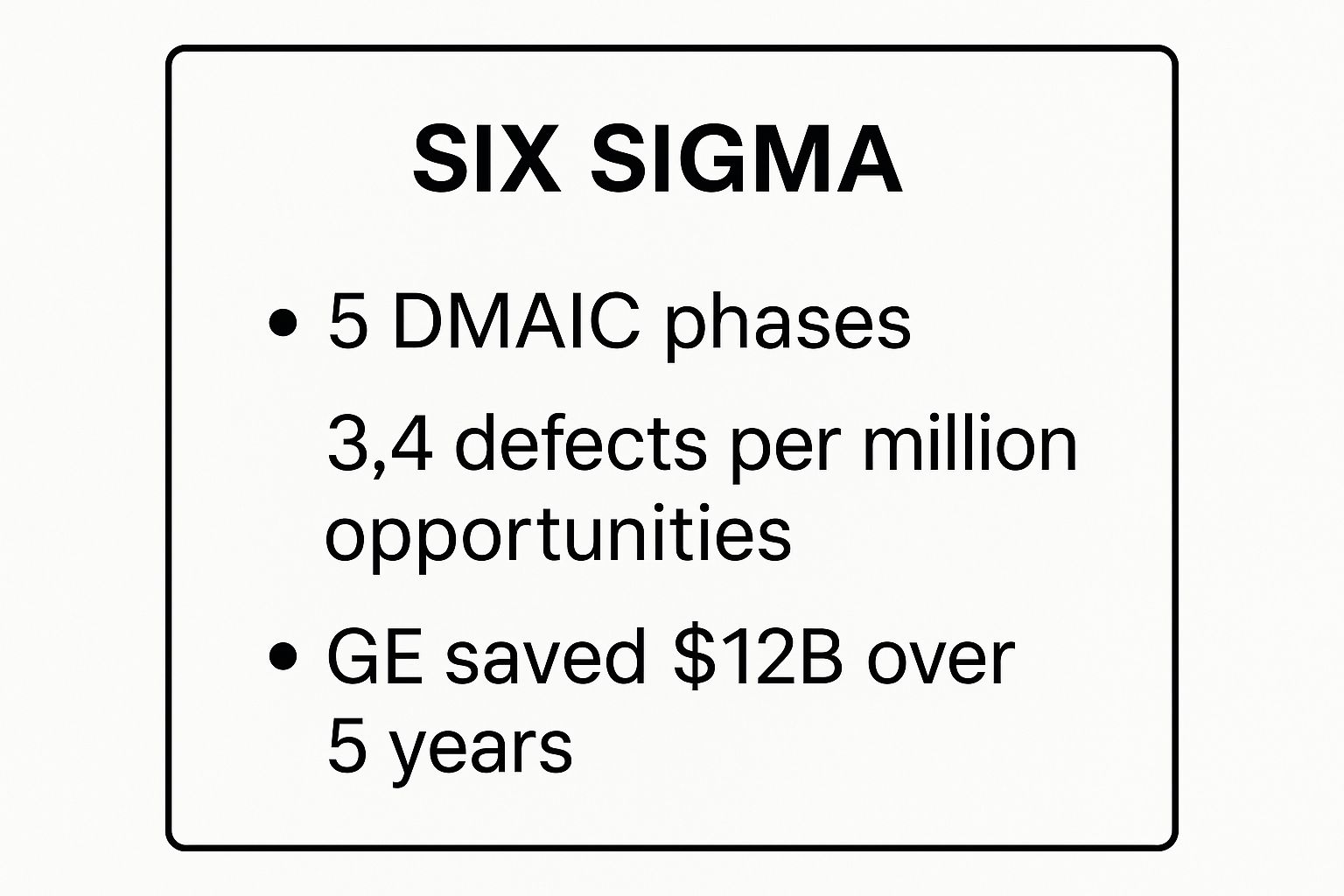
These figures highlight the structured approach and extraordinary financial returns that make Six Sigma a premier choice for process optimization. Companies like General Electric have shown that a commitment to its principles can transform operational efficiency on a massive scale.
2. Lean Manufacturing/Lean Thinking
Lean Manufacturing, often called Lean Thinking, is a systematic approach to identifying and eliminating waste (muda) in any process while maximizing value for the customer. As one of the most foundational business process improvement methods, Lean focuses on continuous improvement (kaizen), just-in-time production, and respect for people to create highly efficient, streamlined operations.

The methodology, famously pioneered by Toyota, revolves around creating more value with fewer resources. It empowers teams to identify non-value-adding activities like overproduction, waiting, unnecessary transport, excess inventory, and defects, and then systematically remove them.
When to Use Lean Thinking
This method is exceptionally effective for organizations looking to increase speed, improve workflow, and reduce operational costs without sacrificing quality. It is perfect for streamlining production lines, accelerating service delivery, or optimizing administrative tasks. If your goal is to make processes faster and more resource-efficient, Lean provides the framework to do more with less. Its principles are a cornerstone of many digital transformation for small business initiatives.
Key Insight: Lean’s core philosophy is that the people doing the work are the best ones to improve it. It fosters a culture of continuous improvement by engaging every employee in problem-solving, which drives both operational excellence and team morale.
How to Implement It Effectively
To successfully adopt Lean, focus on creating a visual and transparent workflow that makes waste easy to spot. Start small and build momentum with visible wins.
- Map the Value Stream: Begin by creating a value stream map to visualize every step of a process, identifying where value is created and where waste occurs.
- Implement 5S: Use the 5S methodology (Sort, Set in Order, Shine, Standardize, Sustain) to organize the workplace for efficiency and safety.
- Empower Your Team: Actively involve employees in identifying problems and developing solutions, giving them the tools and authority to make changes.
The power of Lean is proven across industries. Boeing famously used it to reduce aircraft assembly time by 50%, while Virginia Mason Medical Center applied its principles to dramatically improve patient safety and care quality.
3. Kaizen
Kaizen is a Japanese philosophy centered on continuous, incremental improvement involving every employee, from the C-suite to the front line. Rather than pursuing radical, disruptive change, Kaizen promotes a culture where small, ongoing enhancements compound over time to create significant long-term results. It stands out among business process improvement methods for its focus on empowering people and fostering collective ownership of operational excellence.
At its core, Kaizen is driven by the belief that everything can and should be improved. It often utilizes frameworks like the PDCA (Plan-Do-Check-Act) cycle to test and implement new ideas, ensuring that changes are methodical and effective. This approach turns problem-solving into a daily habit for the entire organization.
When to Use Kaizen
Kaizen is highly effective for organizations seeking to build a sustainable culture of continuous improvement rather than just completing one-off projects. It is ideal for enhancing teamwork, boosting employee morale, and making gradual gains in quality, efficiency, and safety. Use it when you want to empower your team to identify and solve problems directly at the gemba, or "the real place" where work happens. Companies like Toyota have famously used it to refine manufacturing processes to world-class levels.
Key Insight: Kaizen’s true strength is its human-centric approach. It empowers employees by valuing their expertise and suggestions, transforming process improvement from a top-down mandate into a shared, bottom-up responsibility that boosts engagement and innovation.
How to Implement It Effectively
Successful Kaizen implementation relies on creating an environment where employees feel safe and encouraged to contribute ideas.
- Establish a Suggestion System: Create a simple, accessible system for employees to submit improvement ideas and ensure every suggestion is reviewed and acknowledged.
- Celebrate Small Wins: Regularly recognize and reward individuals and teams for their contributions, no matter how small. This reinforces the value of incremental progress.
- Provide Foundational Training: Equip your team with basic problem-solving tools and an understanding of the PDCA cycle to help them structure their improvement efforts.
4. Business Process Reengineering (BPR)
Business Process Reengineering (BPR) is a radical approach that involves rethinking and fundamentally redesigning core business processes from scratch. Instead of making incremental adjustments, BPR challenges long-held assumptions and aims for dramatic, game-changing improvements in critical performance measures like cost, quality, service, and speed. It is one of the most ambitious business process improvement methods.
Popularized by thinkers like Michael Hammer and James Champy, BPR begins with a clean slate, asking: "If we were to create this company today, what would our processes look like?" This approach often leads to complete operational overhauls, such as when Ford Motor Company reengineered its accounts payable process to reduce staff by 75% by changing when an invoice is paid.
When to Use Business Process Reengineering
BPR is best suited for situations where minor tweaks are no longer sufficient and a fundamental transformation is needed to remain competitive. It is highly effective when facing significant market disruption, new technological capabilities, or when processes are so broken or outdated that they hinder growth. If your goal is to achieve breakthrough performance rather than gradual improvement, BPR provides the framework for a revolutionary change.
Key Insight: BPR is not about fixing a process; it's about reinventing it. Its strength lies in its "big picture" focus, enabling organizations to break free from inefficient traditions and achieve massive leaps in productivity and customer value.
How to Implement It Effectively
Successful BPR requires top-down support and a deep commitment to managing organizational change. Start by identifying the core processes that have the most significant impact on your customers.
- Secure Strong Leadership: BPR is disruptive and cannot succeed without unwavering commitment and vision from the highest levels of leadership.
- Invest in Change Management: Prepare your organization for significant shifts in roles, responsibilities, and culture. Communication and training are paramount.
- Focus on Customer Value: Use customer needs as the guiding principle for redesigning processes to ensure the changes deliver meaningful results.
5. Total Quality Management (TQM)
Total Quality Management (TQM) is a comprehensive, organization-wide philosophy centered on the continuous improvement of all processes to achieve customer satisfaction. Unlike methods that focus on specific projects, TQM integrates quality improvement into the very culture of the company. It empowers every employee, from the front line to the executive suite, to take responsibility for the quality of their output.
The core principle of TQM is that every part of the organization contributes to the final product or service. This approach systematically enhances processes by focusing on customer needs, employee involvement, and data-driven decision-making. By making quality a shared mission, TQM aims to build long-term success through consistent value delivery.
When to Use TQM
TQM is best suited for organizations aiming to build a sustainable culture of excellence rather than just fixing isolated problems. It is highly effective when the goal is to improve customer loyalty, increase employee morale, and enhance overall business performance holistically. Use TQM if you want to shift your organization's mindset from reactive problem-solving to proactive, continuous improvement in every single department.
Key Insight: TQM's strength is its holistic nature. It transforms quality from a departmental function into a core business strategy, ensuring that customer satisfaction drives every decision and action across the entire organization.
How to Implement It Effectively
Successful TQM implementation requires a top-down commitment that permeates every level of the company. A clear vision from leadership is the foundation for company-wide adoption.
- Establish a Customer-First Focus: Anchor all improvement efforts in a deep understanding of customer requirements and feedback.
- Invest in Employee Empowerment: Provide comprehensive training and create cross-functional quality improvement teams to foster collaboration and ownership.
- Implement Systematic Measurement: Use metrics to track progress, identify areas for improvement, and celebrate successes to maintain momentum.
Companies like Xerox have used TQM to dramatically improve customer satisfaction, demonstrating that a commitment to its principles creates a powerful competitive advantage.
6. Agile Methodology
Agile is an iterative and flexible approach to process improvement that prioritizes rapid delivery, continuous feedback, and adaptive planning. Originally from the software world, its principles are now among the most effective business process improvement methods for any project facing uncertainty or evolving requirements. By breaking down large projects into small, manageable increments called "sprints," teams can deliver value faster and adjust to change on the fly.
This methodology thrives on collaboration, with cross-functional teams working together in short cycles. Popular frameworks like Scrum and Kanban provide structure for managing tasks and visualizing workflow. For teams exploring these options, understanding the differences between Kanban vs. Scrum is key to choosing the best fit for their specific project needs.
When to Use Agile Methodology
Agile is best suited for dynamic environments where requirements are expected to change or are not fully known at the outset. It excels in projects that require innovation, speed to market, and close customer collaboration, such as new product development, marketing campaigns, or organizational transformations like those seen at ING Bank and Amazon. If your goal is to respond quickly to market feedback and deliver customer value incrementally, Agile is an ideal choice.
Key Insight: Agile’s strength is its ability to embrace change as a competitive advantage. Instead of rigid, long-term plans, it focuses on producing working results quickly and using feedback to guide the next steps, ensuring the final outcome truly meets user needs.
How to Implement It Effectively
To successfully adopt Agile, focus on creating an environment of trust, transparency, and continuous learning. Begin with a single, dedicated team before scaling the methodology across the organization.
- Start with Pilot Teams: Implement Agile with a small, cross-functional team on a well-defined project to build momentum and learn the process.
- Focus on Customer Collaboration: Involve stakeholders and customers throughout the process to ensure the team is building the right thing at every stage.
- Implement Regular Retrospectives: Hold consistent meetings after each sprint to discuss what went well, what didn't, and how to improve in the next cycle. You can learn more about applying the Agile Methodology to various business functions.
7. Value Stream Mapping (VSM)
Value Stream Mapping (VSM) is a powerful Lean management tool used to visualize, analyze, and improve the flow of information and materials required to bring a product or service to a customer. As one of the most visual business process improvement methods, it creates a detailed map of the entire process, highlighting every step from the initial request to final delivery. This helps teams clearly identify and eliminate non-value-adding activities, or "waste."
The VSM process involves creating a "current state" map to document how things currently work, followed by a "future state" map that illustrates a leaner, more efficient process. This visual comparison makes it easy to spot bottlenecks, delays, and excess inventory, providing a clear roadmap for targeted improvements.
When to Use Value Stream Mapping
VSM is ideal when you need a holistic view of an entire workflow rather than just one isolated part. It is exceptionally effective for identifying system-wide inefficiencies in manufacturing, supply chain logistics, software development, and even healthcare, where companies like Pratt & Whitney have used it to improve delivery performance. If your goal is to reduce lead time and increase overall process velocity, VSM is an essential tool.
Key Insight: Value Stream Mapping's strength is its focus on the entire value stream from the customer's perspective. It forces teams to look beyond individual departments and see how value truly flows (or doesn't flow) through the organization.
How to Implement It Effectively
To successfully use VSM, involve a cross-functional team that represents every stage of the process you are mapping. This ensures the map is accurate and builds collective ownership of the improvement initiatives.
- Start with High-Impact Processes: Choose a process that is critical to customer satisfaction or has known performance issues to demonstrate quick, meaningful wins.
- Focus on Customer Value: Constantly ask whether each step adds value from the customer’s viewpoint. This focus helps ruthlessly prioritize what to fix.
- Involve Process Participants: The people who do the work every day have the deepest insights. Their direct involvement is non-negotiable for an accurate map.
The following video provides a practical overview of how to get started with Value Stream Mapping.
While Value Stream Mapping focuses on internal process flow, understanding the complete customer experience can also drive improvement, with insights gained from exploring various customer journey mapping tools. Combining both perspectives provides a comprehensive view of how to deliver more value, both internally and externally.
8. Design Thinking
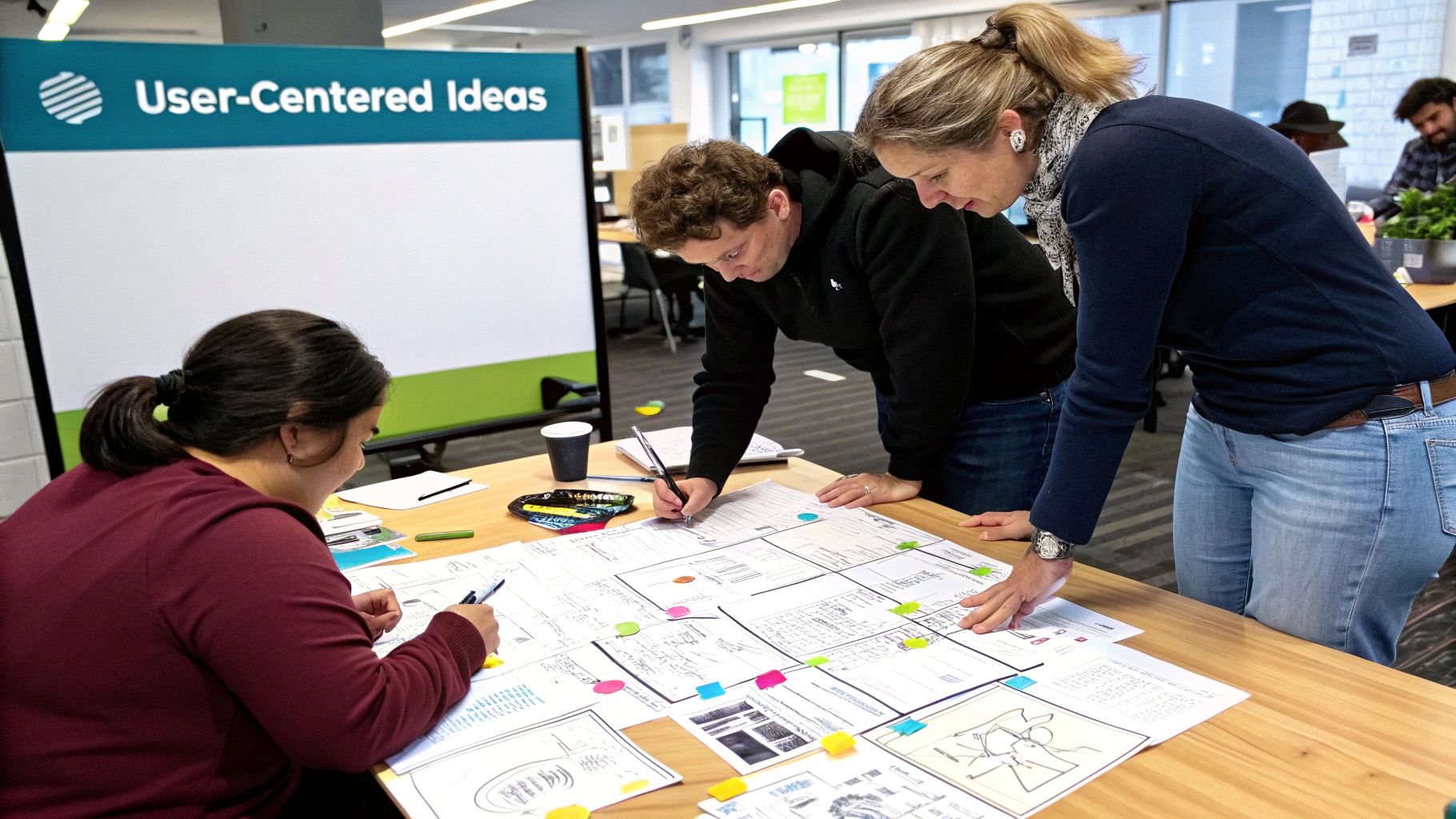
Design Thinking is a human-centered, iterative methodology for creative problem-solving and innovation. Unlike other business process improvement methods that focus on optimizing existing workflows, Design Thinking starts by deeply understanding the needs of the end-user. It prioritizes empathy to uncover unarticulated needs, framing problems from a human perspective.
The process typically follows five stages: Empathize, Define, Ideate, Prototype, and Test. This framework guides teams to move from understanding user pain points to brainstorming a wide range of creative solutions, building low-cost prototypes, and gathering feedback to refine the final product or service. Companies like Apple and Airbnb have famously used it to create intuitive user experiences that revolutionized their industries.
When to Use Design Thinking
This method is best applied to ambiguous or ill-defined problems where the primary goal is innovation rather than simple optimization. It is ideal for developing new products, improving customer or employee experiences, or reimagining complex services like patient care in healthcare. If you need to innovate and create solutions that truly resonate with people, Design Thinking offers a collaborative and creative path forward.
Key Insight: The core strength of Design Thinking is its relentless focus on empathy. By stepping into the user's shoes, organizations can uncover latent needs and develop breakthrough solutions that a purely analytical approach might miss.
How to Implement It Effectively
Successful implementation hinges on creating a culture that embraces curiosity, experimentation, and customer-centricity. Start with a specific innovation challenge that can benefit from a fresh, user-focused perspective.
- Embrace Diverse Teams: Assemble cross-functional teams with varied backgrounds and skill sets to foster a rich environment for brainstorming and ideation.
- Prototype Early and Often: Create simple, low-fidelity prototypes (like sketches or mockups) to make ideas tangible and gather user feedback quickly and cheaply.
- Test with Real Users: Move beyond internal assumptions by testing your prototypes with actual end-users to validate ideas and gather actionable insights for refinement.
9. Theory of Constraints (TOC)
Theory of Constraints (TOC) is a management philosophy that views any complex system as being limited by a single constraint. Instead of trying to optimize everything at once, TOC focuses on identifying and improving this one critical bottleneck, making it one of the most targeted business process improvement methods available.
Introduced by Eliyahu Goldratt in his novel The Goal, TOC operates on the principle that a chain is only as strong as its weakest link. By systematically managing the constraint, the overall performance of the entire system can be elevated. This approach uses the Five Focusing Steps: Identify the constraint, Exploit it, Subordinate everything else, Elevate its capacity, and Repeat the process.
When to Use Theory of Constraints (TOC)
TOC is exceptionally effective for improving throughput in linear processes, such as manufacturing production lines, supply chains, or project management workflows. If you notice work piling up at one specific stage while other parts of the system are underutilized, TOC provides a clear roadmap to resolving the bottleneck and improving flow. It has been used by Boeing to improve production flow by 30% and by hospitals to dramatically enhance patient flow.
Key Insight: TOC shifts the focus from cost-cutting across the board to maximizing throughput. By managing the system’s primary constraint, organizations can increase output and revenue without extensive investment in non-critical areas.
How to Implement It Effectively
Successful TOC implementation requires a laser focus on the system’s true bottleneck. Resist the temptation to "fix" everything at once.
- Identify the Constraint Accurately: Use data and observation to pinpoint the one part of the process that dictates the entire system’s output.
- Subordinate All Other Processes: Align every other activity to support the constraint. This means other parts of the system may run slower than their maximum capacity, which is essential for smooth overall flow.
- Continuously Re-evaluate: Once a constraint is resolved, a new one will emerge. The process of identifying and elevating the next bottleneck should be continuous.
Business Process Improvement Methods Comparison
| Methodology | Implementation Complexity 🔄 | Resource Requirements ⚡ | Expected Outcomes 📊 | Ideal Use Cases 💡 | Key Advantages ⭐ |
|---|---|---|---|---|---|
| Six Sigma | High – requires extensive training and certification | High – statistical tools, trained belts | Significant defect reduction, cost savings, improved quality | Large organizations with complex processes | Data-driven, structured, measurable ROI |
| Lean Manufacturing/Thinking | Medium – cultural change and continuous effort | Medium – employee engagement, training | Waste reduction, faster delivery, improved quality | Manufacturing and service with repetitive processes | Waste elimination, flexible and adaptable |
| Kaizen | Low – ongoing daily practice | Low – employee involvement | Gradual continuous improvements, employee engagement | Organizations seeking cultural and sustainable improvement | Low cost, builds culture of continuous improvement |
| Business Process Reengineering (BPR) | Very High – radical redesign with heavy change mgmt | Very High – cross-functional teams, tech | Dramatic performance improvements, process overhaul | Organizations under significant competitive pressure | Breakthrough improvements, technology leverage |
| Total Quality Management (TQM) | High – long-term cultural transformation | High – training and systematic approach | Improved customer satisfaction, morale, and quality | Organizations committed to sustained quality culture | Holistic approach, employee participation |
| Agile Methodology | Medium – requires disciplined teams | Medium – team training and customer involvement | Faster delivery, enhanced flexibility and collaboration | Organizations needing rapid adaptation and customer focus | Rapid iteration, customer collaboration |
| Value Stream Mapping (VSM) | Low-Medium – visual mapping and analysis | Low-Medium – skilled facilitators | Identifies waste, bottlenecks, and prioritizes improvements | Complex, multi-step processes | Clear process visualization, cross-functional engagement |
| Design Thinking | Medium – time-intensive and requires skilled facilitation | Medium – diverse teams and user research | Innovative, user-centered solutions | Innovation-driven organizations facing complex problems | User focus, encourages creativity and rapid prototyping |
| Theory of Constraints (TOC) | Medium – systematic, focused on bottlenecks | Low-Medium – needs accurate data | Improved throughput, quick wins by managing constraints | Organizations with clear bottlenecks | Focused prioritization, relatively simple to understand |
Choosing Your Path to a More Efficient Future
Embarking on a journey of business process improvement is a transformative step toward building a more resilient, competitive, and successful organization. Throughout this guide, we have explored a comprehensive suite of powerful business process improvement methods, from the data-driven precision of Six Sigma to the human-centered innovation of Design Thinking. Each framework offers a unique lens through which to view and refine your operations.
The key takeaway is that there is no single "best" method. The ideal approach for your business depends entirely on your specific goals, organizational culture, and the nature of the challenges you face. A startup aiming for rapid product iteration may gravitate toward Agile, while a mature manufacturing firm might find immense value in Lean or the Theory of Constraints.
From Knowledge to Action: Your Next Steps
The true value of these methodologies lies not in knowing them, but in applying them. Moving from theory to practice is the most critical step. Here’s a simple, actionable path to get started:
- Start with a Clear Diagnosis: Before you can prescribe a solution, you must understand the problem. Use a tool like Value Stream Mapping (VSM) to get a clear, visual representation of a current process. Identify the bottlenecks, waste, and areas of frustration.
- Select a Pilot Project: Don't try to overhaul your entire organization at once. Choose one specific, manageable process that is causing significant issues but offers a high potential for a visible win. This focused effort will help you build momentum and learn valuable lessons.
- Align the Method to the Goal: With your pilot project defined, select the methodology that best fits the challenge. Is your goal to reduce defects? Six Sigma is a strong candidate. Do you need to drastically rethink a broken process from the ground up? Business Process Reengineering (BPR) might be the answer.
- Empower Your Team: Lasting change is a team sport. Whether you are forming a small Kaizen group or a cross-functional Agile squad, success hinges on empowering your employees. Provide them with the training, authority, and resources they need to drive improvements from the ground up. This fosters a culture of Total Quality Management (TQM), where everyone takes ownership of quality and efficiency.
Ultimately, mastering these concepts is about more than just cutting costs or speeding up production. It's about building a learning organization-one that is adaptable, innovative, and relentlessly focused on delivering value to its customers. By fostering a culture of continuous improvement, you create a powerful competitive advantage that is difficult to replicate. This proactive mindset ensures your business doesn't just survive change, it thrives on it, unlocking its full potential and securing its long-term success.
Just as these methods streamline your internal operations, OneNine helps you optimize your most critical external process: your customer-facing digital experience. We build high-performance websites and digital solutions that are as efficient and effective as your newly improved business processes. To see how a streamlined digital footprint can drive growth, explore our services at OneNine.


