

Think of a competitor analysis framework as your strategic blueprint for understanding the competitive landscape. It’s a formal system that helps you organize what you know about your rivals so you can make smarter, faster decisions instead of just reacting to their moves.
What Is a Competitor Analysis Framework
Imagine you're coaching a basketball team. You'd never hit the court without first watching hours of your opponent's game film. You'd break down their offensive plays, identify their star players, and pinpoint their defensive weaknesses.
A competitor analysis framework does the exact same thing for your business. It's the "game film" that turns random observations about your competitors into organized, actionable intelligence.
Without a structured approach, your research can feel like a jumbled mess of facts. You might notice a rival launched a new feature or cut their prices, but you won't have the context to understand why they did it or what it means for you. A framework helps you connect those dots.
Beyond Random Guesswork
Many businesses fall into the trap of treating competitor research as a one-time project. A real competitor analysis framework is a repeatable process, a consistent lens you use to view the market over and over again. This helps you spot trends and anticipate what's coming next.
For example, noticing a competitor is consistently hiring for senior sales roles in a new region isn't just a random fact—it’s a signal they're planning a major market expansion. That’s the kind of insight a structured process uncovers.
This systematic approach is what separates proactive strategy from reactive damage control. It helps you answer the big questions:
- Where are the real opportunities in our market that everyone else is missing?
- What are our competitors' biggest blind spots or vulnerabilities?
- How are their specific marketing tactics, like their approach to SEO and link building, driving their growth? You can learn more about this by reading our guide on how to analyze competitor backlink profiles.
- Are there new threats on the horizon that we haven't even considered?
A framework transforms competitive analysis from a simple data-gathering task into a powerful strategic exercise. The goal isn't just to know what your competitors are doing, but to understand why it matters and decide what you're going to do about it.
In short, these frameworks are structured tools that businesses use to methodically evaluate competitors. By understanding their strengths, weaknesses, and overall market position, you can build and protect your own competitive advantage.
Core Benefits of Using a Competitor Analysis Framework
Adopting a formal framework isn't just about creating charts and reports; it's about driving tangible business outcomes. By systematically evaluating the competition, you gain a much clearer view of your own strategic path forward.
The table below breaks down the key advantages.
| Benefit | Strategic Impact |
|---|---|
| Identifies Market Gaps | Pinpoints underserved customer needs and new product opportunities. |
| Informs Strategic Planning | Provides objective data to guide marketing, sales, and product development. |
| Anticipates Competitor Moves | Helps you predict and prepare for rivals' next actions instead of being surprised. |
| Reveals Your Own Weaknesses | Highlights areas where your business is vulnerable compared to others. |
| Strengthens Market Positioning | Clarifies your unique value proposition and helps you stand out. |
Ultimately, a well-implemented framework provides the clarity and confidence needed to make bold, informed decisions that keep you one step ahead.
The Real Story Behind Competitive Strategy

The idea of a competitor analysis framework didn't just appear out of thin air. It grew out of a real need, as business strategy evolved from simple, gut-feel reactions to the structured, forward-looking models we use today. For a long time, what people called "competitor analysis" was just keeping a casual eye on what the other guy was charging or what their latest ad looked like.
It was a bit like driving by only looking in your rearview mirror. Sure, you knew who was right behind you, but you had no clue about the traffic, turns, or roadblocks up ahead. Businesses would react to isolated events—a rival's new product, a price drop—without grasping the bigger market forces at play. It was a game of tactics, but a very limited one.
From Reaction to Prediction
The game changed when business thinkers started seeing competition less as a series of individual skirmishes and more as a complex, interconnected system. As markets became faster, more global, and increasingly shaped by technology, the old reactive methods just weren't cutting it anymore. You couldn't just keep up; you needed to get ahead.
This shift in mindset was everything. It opened the door for organized methods that could dissect the entire competitive environment, not just the players you saw every day. The goal became creating a map of the whole territory, not just staring at the opponent across the table.
Key Takeaway: The evolution of competitive strategy was born from necessity. As markets got more complicated, businesses needed better tools—ones that provided a full picture of the landscape to anticipate change, not just react to it.
The frameworks we know today really started taking shape in the late 20th century. A key moment was in 1999, when strategist Liam Fahey suggested looking at competitors on three different levels: the system of rivals, individual companies, and the overall competitive environment. This layered model pushed businesses to think more proactively. You can find more on this strategic shift over at ecorn.agency.
Building a Framework for Modern Business
This new way of thinking is exactly why models like Porter's Five Forces became so popular. They offered a structured way to look at an industry's health and the power held by suppliers, buyers, and potential new players—things the old methods completely missed. Suddenly, it wasn't just about your direct competitor; it was about understanding the entire ecosystem you operate in.
Today, that evolution is happening faster than ever. Modern frameworks have to contend with forces that were barely on the radar a generation ago:
- Big Data: We can now analyze massive amounts of information to get a clear picture of competitor moves and customer feelings.
- Artificial Intelligence: AI tools can spot market shifts and identify emerging threats with incredible accuracy, almost like an early warning system.
- Global Market Shifts: A new competitor can pop up from anywhere on the globe, making a worldwide view non-negotiable.
The story of the competitor analysis framework is really a story of adaptation. It’s a journey from simple observation to smart prediction, giving modern businesses the foresight they need to not just survive, but thrive.
A Guide to Essential Competitor Analysis Frameworks
Now that we’ve covered why a competitor analysis framework is so important, let's dig into the most popular models you can actually use. Think of these frameworks not as strict rules, but as different lenses. Each one gives you a unique way to look at the competitive field, helping you spot things you might otherwise miss.
Choosing the right framework is a bit like a mechanic picking the right tool. You wouldn't use a huge wrench to fix a delicate sensor, and you wouldn't use a broad market analysis tool when you need to understand a single rival's internal strengths.
Let's break down the most useful frameworks. I'll use some simple analogies to show you what each one does best and when you should pull it out of your strategic toolkit.
SWOT Analysis: The Business Health Check
SWOT is probably the most famous framework out there, and for good reason. It’s like giving your business its annual health check-up. It offers a simple, high-level snapshot of where you stand by looking at four key areas:
- Strengths: What do you do better than anyone else? This could be your killer brand reputation, a unique piece of tech, or an incredibly talented team.
- Weaknesses: Where are the internal cracks? Maybe your marketing budget is tight, your software is a bit dated, or there are gaps in your product lineup.
- Opportunities: What external trends can you jump on? This could be a growing market, a shift in what customers want, or a competitor’s recent public fumble.
- Threats: What outside factors could trip you up? Think new players entering the market, changing government rules, or a looming economic downturn.
The real power of SWOT is its simplicity. It’s a fantastic starting point for any strategy session because it forces you to look both inward at your own company and outward at the market. When you match your strengths with opportunities, you can build aggressive growth plans. And by figuring out how to protect your weaknesses from potential threats, you build a much stronger defense.
This infographic really drives home why you need to understand your competition—both direct and indirect—before you even start a SWOT.
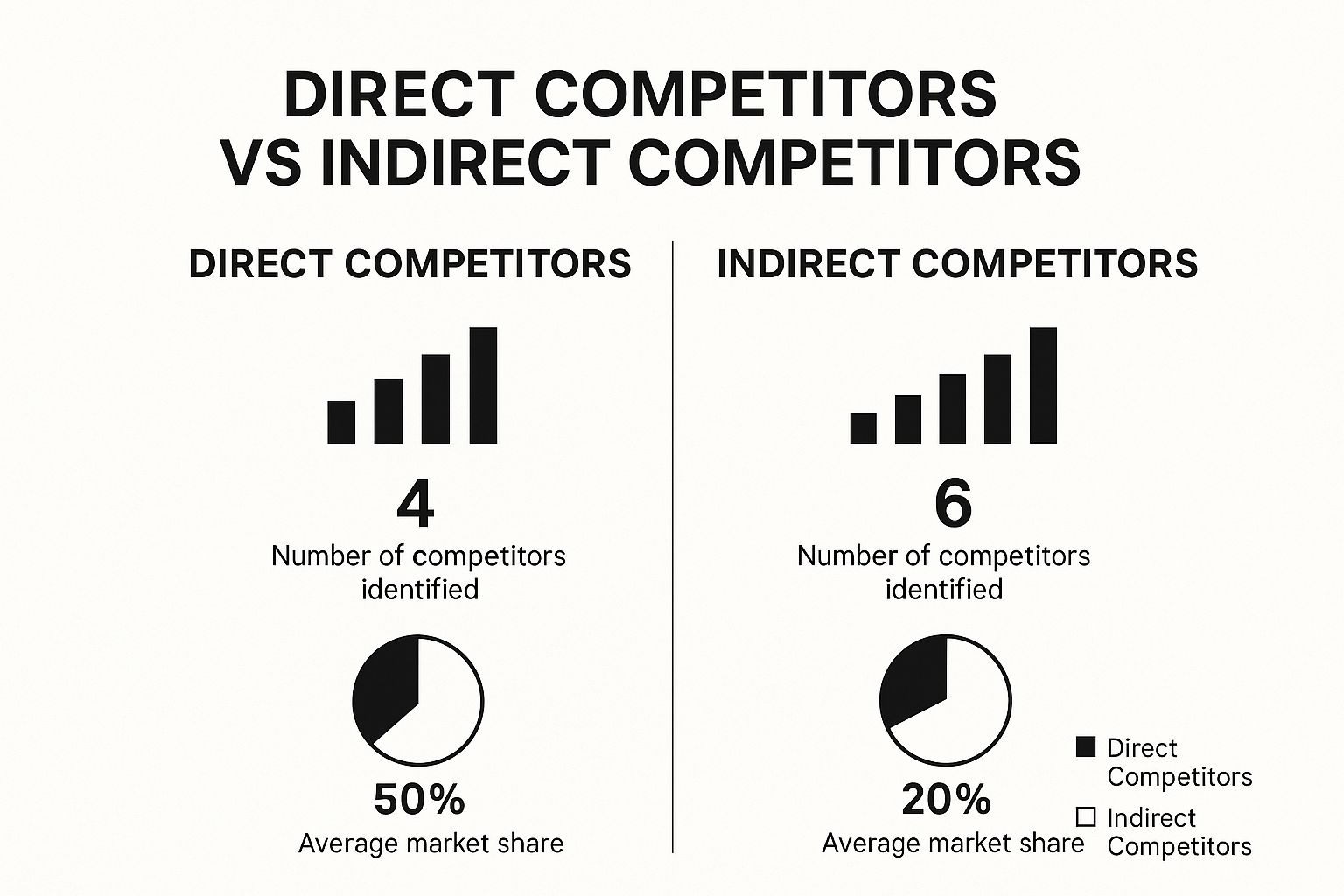
As you can see, a direct competitor might have a bigger slice of the pie, but don't underestimate the collective power of all those indirect players. Together, they can represent a huge challenge.
Comparison Of Key Competitor Analysis Frameworks
To help you decide which framework to use and when, this table breaks down the most common models at a glance. It compares their main goal, what situations they're best suited for, and what they really zero in on.
| Framework | Primary Purpose | Best For | Focus |
|---|---|---|---|
| SWOT Analysis | To assess internal capabilities and external factors affecting the business. | Quick strategic planning and identifying immediate priorities. | Internal (Strengths, Weaknesses) & External (Opportunities, Threats) |
| Porter's Five Forces | To determine the profitability and competitive intensity of an industry. | Market entry decisions and understanding industry structure. | External (Industry-level competition and power dynamics) |
| PESTEL Analysis | To scan the macro-environmental factors that could impact an organization. | Long-term strategic planning and risk management. | External (Broad environmental trends: Political, Economic, etc.) |
Each of these frameworks offers a valuable perspective on its own. However, the real magic often happens when you combine them for a more complete and nuanced view of your competitive environment.
Porter’s Five Forces: Mapping The Industry Power Dynamics
If SWOT is your company’s health check, then Porter's Five Forces is like the official rulebook for the entire league you're playing in. This model, created by Harvard professor Michael E. Porter, helps you figure out how attractive and profitable an industry really is by looking at five key pressures:
- Competitive Rivalry: How cutthroat is the competition among the companies already in your space?
- Threat of New Entrants: How easy is it for a new startup to jump in and compete with you?
- Bargaining Power of Buyers: How much control do your customers have to negotiate lower prices?
- Bargaining Power of Suppliers: How much power do your suppliers have to jack up their costs?
- Threat of Substitute Products or Services: How easily can your customers find a completely different way to solve their problem?
By weighing these five forces, you get a 360-degree view of the power dynamics that truly define your industry. It helps you move beyond a simple one-on-one comparison and see the bigger picture of what makes a market tick.
PESTEL Analysis: Scanning The Broader Environment
PESTEL analysis zooms out even further. Think of it as a powerful telescope scanning the horizon for massive trends that could shake up your entire industry. PESTEL is an acronym that stands for six macro-environmental factors:
- Political
- Economic
- Social
- Technological
- Environmental
- Legal
This framework is crucial for spotting risks and opportunities that come from way outside your immediate market. For example, a new data privacy law (Legal) or a massive consumer shift toward sustainability (Social) could force you to completely rethink your business model.
The smartest approach is often a hybrid one. By combining the internal focus of SWOT with the industry view of Porter's and the big-picture insights from PESTEL, you get a truly complete understanding of your position.
Beyond these core models, other methods can give you an edge. For example, a content gap analysis is a fantastic technique for finding keywords and topics your competitors are ranking for that you aren't, showing you exactly where to focus your SEO efforts.
It's also vital to see how your brand's look and feel measures up. You can learn more about this in our guide on https://onenine.com/competitor-benchmarking-for-visual-branding/.
How to Build Your Own Competitor Analysis

It’s one thing to know the theory behind these frameworks, but it's another thing entirely to roll up your sleeves and actually use them. Building your own competitor analysis might sound intimidating, but it’s really just about putting pieces of a puzzle together. Each piece is a new bit of information about your rivals, and your job is to see how they fit to reveal the bigger picture.
This is where the rubber meets the road—moving from abstract ideas to a practical plan. Let's walk through the steps to create an analysis that gives you a real strategic edge and turns all that raw data into a decisive advantage.
Step 1: Identify Your True Competitors
First things first, you need to know who you’re actually up against. It's tempting to only look at the big, obvious players, but your competitive landscape is almost always wider than you think. A great way to get clarity is to group them into categories.
- Direct Competitors: These are the ones that jump to mind immediately. They offer a very similar product to the same customers you're targeting. Think Coca-Cola and Pepsi.
- Indirect Competitors: These companies solve the same problem for your audience but in a different way. If you run a local movie theater, Netflix is a classic indirect competitor.
- Emerging Competitors: Keep an eye out for the new kids on the block. These are the startups and disruptors who might be small today but could become a major threat tomorrow. Think of how fintech startups shook up the traditional banking industry.
So, how do you find them? Start by talking to your sales team—they're on the front lines and know exactly who they lose deals to. After that, do some simple Google searches for the terms your customers would use. The companies that pop up again and again are your digital rivals.
Step 2: Decide Which Data Actually Matters
With your list of competitors in hand, the next step is figuring out what information is worth gathering. If you don't have a plan, you risk "analysis paralysis"—drowning in a sea of data with zero clear takeaways.
Focus on data that will actually inform your decisions. A good analysis also involves some thorough PPC competitor research to understand how rivals are using paid ads to win business.
The goal isn't to know everything about your competitors. It's to know the right things—the details that reveal their strategy and highlight your opportunities.
For each competitor, I recommend digging into these key areas:
- Product/Service Offering: What are their key features? How’s the quality? Customer reviews are gold here for finding out what people truly love or hate.
- Pricing Strategy: Note their different price points, discounts, and any freebies they throw in. This tells you a lot about how they position themselves in the market.
- Marketing & Sales Tactics: How are they getting the word out? Scrutinize their website, social media channels, blog content, and any ads you can find.
- Customer Feedback: Dive deep into review sites, forums, and social media comments. This is where you get unfiltered opinions on their real-world strengths and weaknesses.
By zeroing in on these areas, you collect intelligence you can act on, not just random trivia.
Step 3: Choose the Right Tools for the Job
Trying to gather all this information manually would be an absolute nightmare. Luckily, plenty of tools can automate the heavy lifting, freeing you up to do the important part: the analysis.
I like to think of the toolkit in 3 main categories:
- SEO & Content Tools: Tools like Ahrefs or Semrush are non-negotiable for understanding a competitor’s online footprint. You can see what keywords they’re ranking for, who links to them, and which of their pages bring in the most traffic.
- Social Listening Platforms: Using something like Brandwatch or Meltwater lets you monitor what people are saying about your competitors across the web. It's a fantastic way to gauge public opinion in real-time.
- Website Technology Analyzers: Free browser extensions like BuiltWith or Wappalyzer give you a peek under the hood of a competitor's website. You can see what e-commerce platform, analytics tools, or CRM they're using.
You don't need a huge budget to start. Many of these tools offer free trials or freemium plans that provide more than enough information for a solid first pass.
Step 4: Structure Your Findings for Action
This is the most critical step. Raw data in a spreadsheet is just noise. Your job is to organize it until it starts telling a story.
I find it helpful to create a simple "competitor profile" for each company. In each profile, summarize your findings and then run a quick SWOT analysis from your perspective:
- Their Strengths: Where are they consistently beating you?
- Their Weaknesses: What are their obvious flaws or biggest customer complaints?
- Your Opportunities: How can you exploit their weaknesses or serve an unmet need?
- Your Threats: Where do their strengths put your business at risk?
Once you compare these profiles side-by-side, patterns will start to emerge. Maybe you’ll notice that all your competitors are ignoring a certain type of customer, or that none of them offer a specific feature. These aren’t just interesting observations—they are your strategic openings. This is how you turn research into a roadmap.
Common Mistakes and How to Avoid Them

Even with the best frameworks, it's surprisingly easy to get competitor analysis wrong. You can get so lost in the data that you miss the big picture, turning what should be a powerful strategic tool into a time-wasting exercise. The trick is knowing the common traps before you fall into them.
Think of it like this: a map is essential for a road trip, but it's useless if you're reading it upside down or ignoring the "Bridge Out" signs. Your goal is to keep your analysis focused, actionable, and something that genuinely guides smart business decisions.
Focusing Only on Obvious Rivals
One of the biggest blunders is getting tunnel vision. You spend all your time watching the competitors who sell the same thing, in the same way, to the same people. While you absolutely need to track these direct rivals, this narrow view leaves you vulnerable to threats from unexpected places.
A classic example? A taxi company in 2008 would have been laser-focused on other local cab services, completely blindsided by the rise of ride-sharing apps. To avoid that fate, you need to broaden your "competitor radar."
How to Fix It:
- Map Out Your Competition: Make distinct lists of your direct, indirect, and emerging competitors.
- Think Like a Customer: Search for your main industry keywords. You might find blogs or media sites—"content competitors"—that are grabbing your audience's attention even if they don't sell a product.
- Stay Curious: Keep an eye on industry news and investment trends. These are often the first signs of a new player gaining momentum.
Getting Stuck in Analysis Paralysis
It's a real danger. You can track every tweet, price drop, and new hire, but without a clear purpose, you're just collecting facts. This is analysis paralysis—when the sheer volume of information stops you from making any actual decisions.
The purpose of a competitor analysis framework is not to know everything about your competitors. It's to find specific, actionable insights that give your business an advantage.
How to Fix It:
- Start with a "Why": Before you dive in, define what you're trying to accomplish. Are you looking for pricing gaps, content ideas, or ways to improve your product?
- Be Ruthless with Metrics: Focus only on the data that answers your question. If you're analyzing marketing, their social media engagement is vital; their new office location probably isn't.
Relying on Stale or Outdated Information
The market moves incredibly fast. A competitive analysis from last year is a historical document, not a strategic guide. Using old data is like navigating with an old map—the landscape has changed, new roads exist, and old ones are gone.
Making big decisions based on what your rival was doing six months ago is a recipe for falling behind. This is especially true in channels like organic search, where 53% of website traffic originates for many businesses and where competitor tactics shift constantly. Your analysis has to be a living, breathing process.
How to Fix It:
- Schedule Regular Check-ins: Block out time every month or quarter to refresh your most important data points.
- Use Real-Time Tools: Lean on social listening and SEO tools that can alert you to competitor moves as they happen.
- Create a Living Document: Treat your analysis as a dynamic report that your team can update whenever new information surfaces. This ensures it stays relevant and valuable.
Turning Your Insights into Winning Moves
A competitor analysis that just gathers dust in a folder is a wasted effort. I've seen it happen too many times. The real magic isn't in the data you collect, but in the smart, decisive actions you take because of it. This is where your hard work finally pays off and turns into a genuine competitive advantage.
Think of your findings as a treasure map. The map itself is just paper and ink; its value comes from guiding you to the X that marks the spot. Your insights point to strategic "treasures" like untapped market gaps, weaknesses in a rival's messaging, or a sweet spot for your pricing. The final, most critical step is to actually go dig them up.
This is about moving from observation to application. Your analysis shouldn't be a one-and-done report. It needs to become a living document that directly fuels your day-to-day decisions and keeps you agile.
Sharpen Your Marketing and Sales Messages
Your analysis is an absolute goldmine for refining how you talk to customers. When you dig into your competitors' websites, ads, and customer reviews, you start to see patterns. You can spot the exact language that resonates with your shared audience—and, just as importantly, where their messaging completely misses the mark.
For example, did you notice a top competitor consistently gets complaints about their confusing onboarding process? That's your cue. You can immediately make "Effortless Setup" a core part of your marketing, turning their weakness into your biggest strength. You’re not just making a random claim; you’re directly addressing a known customer frustration.
This same intelligence helps you craft killer calls-to-action (CTAs). If you see rivals using the same old "Learn More" or "Sign Up," you have a clear opportunity to stand out with more specific and compelling language. We cover this in more detail in our guide on how to analyze competitor CTAs.
Guide Product Development and Innovation
Competitive insights are your roadmap for building a better product, period. When your analysis shows that customers constantly rave about a specific feature in a competitor's product, it validates its importance. That helps you prioritize your own development backlog with confidence.
Even better, identifying features that are missing from every competitor's offering points to a major market opportunity. This is how you stop playing catch-up and start innovating.
Use your competitor analysis not just to keep up, but to find the "next big thing" your market is waiting for. If everyone else is zigging, your data might tell you it's time to zag.
To make this practical, create a simple action plan from your findings. Break it down.
- Quick Wins: What are the low-effort, high-impact changes you can make right now? This could be a small product tweak or a new marketing angle that exploits a competitor's weakness.
- Strategic Initiatives: These are the bigger plays. Think about entering a new market segment or developing a major new feature that will require more long-term planning.
- Defensive Moves: Where does a competitor have a clear advantage? Pinpoint those areas and create a realistic plan to close that gap over time.
By translating every insight into a potential action, you ensure your competitor analysis framework becomes a powerful engine for growth, not just an academic exercise. The job isn't done until your analysis starts shaping your strategy.
Frequently Asked Questions
Even with a solid plan, a few questions always pop up when you're getting ready to dive into a competitor analysis. Let's clear up some of the most common ones so you can get started with confidence.
Competitor Analysis vs. Market Research: What’s The Difference?
It's really easy to get these two mixed up, but they focus on different things.
Think of it like this: Market research is the 10,000-foot view. It's about understanding the entire neighborhood—how big it is, who lives there, and the general vibe. You're looking at the whole market's size, trends, and customer behaviors.
Competitor analysis, on the other hand, is like getting out a magnifying glass to look at the other houses on your block. You're zeroing in on what specific rivals are doing, what they're good at, and where they're dropping the ball.
Simply put, market research helps you understand the game, while a competitor analysis framework helps you figure out how to win it. You really need both.
How Often Should I Do a Competitor Analysis?
This isn't a "one and done" task. Running your business on last year's competitor data is like driving with an old, outdated map—you're bound to make a wrong turn.
How often you do it really depends on how fast your industry moves.
In fast-paced spaces like e-commerce or tech, you should probably do a full review every quarter. For more traditional, slower-moving industries, a deep dive once or twice a year might be perfectly fine.
The real trick is to make it a habit. Set up some simple alerts and do quick monthly check-ins on your main rivals. A quick peek at their pricing, new marketing campaigns, or social media buzz can keep you from being blindsided by a major move.
What Are The Best Free Tools For Competitor Analysis?
You don't have to break the bank to get great insights. There are plenty of fantastic free tools that give you more than enough data to build a solid analysis.
Here are a few of my go-to's for getting started:
- Google Alerts: Simple, effective, and totally free. Set it up to track mentions of your competitors' names, and you'll get a steady stream of their latest news and content.
- Similarweb: The free version is surprisingly powerful. It gives you a great snapshot of any competitor's website traffic, where their visitors are coming from, and basic audience demographics.
- Social Blade: Perfect for quickly checking out how your competitors are doing on social media. It tracks follower growth and engagement stats on major platforms like YouTube, X (formerly Twitter), and Instagram.
These tools are perfect for gathering that initial intelligence without spending a dime.
Ready to build a website that stands out from the competition? The team at OneNine specializes in custom web design, development, and strategic management to ensure your digital presence is powerful and effective. Let us help you turn competitive insights into a winning website. Visit us at https://onenine.com.


