

Let's cut through the noise and forget the confusing corporate-speak. At its heart, small business digital transformation is all about using today's technology to work smarter, not harder. It’s not about trying to become the next Amazon overnight. It’s about making targeted, intelligent changes to how you run your business and connect with your customers.
What Is Digital Transformation, Really?
Imagine your business is a classic, beloved local restaurant. A digital transformation isn't just a fresh coat of paint. It's like redoing the whole kitchen for maximum efficiency (your internal operations), adding an online ordering and delivery system (new ways to make money), and installing a modern payment terminal that also tracks your most popular dishes (better tools and data).
The point is to make the entire business run better from the ground up—making things stronger, faster, and way more convenient for your customers. This isn't just some passing fad; it's a real shift in how small businesses can punch above their weight.
The numbers back this up. By the end of 2023, a solid 68% of small businesses had already launched a website. And 55% of them were actively using digital tools to reach customers far beyond their local neighborhood.
The Three Pillars of Your Transformation
To get a grip on this, it helps to think about digital transformation in three main areas. These are the core pillars where technology can make a real, noticeable difference. Focusing on these helps you figure out where to start and what will give you the most bang for your buck. If you want to see how others are tackling this, it's worth checking out these digital transformation best practices.
Let's look at what these pillars really mean for your business.
This simple table breaks down the three fundamental areas where you can start making changes.
The Three Pillars of Digital Transformation
| Pillar | What It Means for Your Business | Example Technology |
|---|---|---|
| Enhancing Customer Experience | Making every interaction with your brand—from first click to final purchase—feel personal, easy, and impressive. This is how you build loyalty and get people talking. | A Customer Relationship Management (CRM) system to remember customer details, or an online booking tool that lets people schedule appointments 24/7. |
| Streamlining Daily Operations | Getting rid of the tedious, repetitive tasks that eat up your day. This saves time, cuts down on mistakes, and lets you focus on what actually grows the business. | Project management tools like Asana or Trello, or cloud accounting software like QuickBooks Online. |
| Making Data-Driven Decisions | Moving beyond guesswork and using actual numbers to see what's working. This helps you spot trends, understand customer habits, and make smarter choices. | Google Analytics to see who's visiting your website, or the sales reports from your e-commerce platform to know what’s selling best. |
By thinking in these terms, you can build a solid foundation for growth without getting overwhelmed.
The goal isn't just to buy a bunch of new software. It’s to solve real problems—like finding new customers, stopping wasted time, or creating a service so good people can't help but recommend it.
When you focus on these pillars, you create a clear path forward. To dive deeper and build your own plan, take a look at our complete guide on digital transformation for small business. This approach turns a massive concept into a series of small, manageable wins.
The Real-World Wins of Going Digital

Alright, we've covered the basics. But let's get to what really matters: what does a small business digital transformation actually do for you? This isn't about getting new tech just to look modern. It's about seeing real, measurable changes in your bank account, your daily schedule, and your relationships with customers.
Imagine a local bakery that's constantly juggling phone orders and a line out the door. After setting up a simple online ordering website, they see a 30% jump in sales in just a couple of months. Or picture a small consulting firm that starts using a basic Customer Relationship Management (CRM) system. Suddenly, they're not just tracking conversations—they're building stronger connections and landing more repeat business. These aren't just ideas; they're real results.
And the data backs this up. A massive 87% of companies say they've used digital tools to boost their profits over the last two years. Even more impressively, 59% of them saw their profits climb by 11% or more, all thanks to these digital changes. It's clear that investing in the right technology isn't just another expense—it's a proven way to create value.
Get More Done with Less Effort
One of the first things you'll notice is that you get your time back. Digital tools are brilliant at taking over the repetitive, mind-numbing tasks that eat up your day and lead to simple mistakes. This frees you and your team to put your energy into the work that truly moves the needle.
Here’s what that looks like in practice:
- Automated Invoicing: No more creating and sending invoices by hand. Accounting software can handle it for you, saving you hours every single month.
- Centralized Project Management: Tools like Trello or Asana give everyone a single source of truth, cutting down on the endless "just checking in" meetings and emails.
- Smarter Communication: Good CRM email integration strategies can automate follow-up messages and keep potential customers engaged, so no opportunity falls through the cracks.
The whole point is to let technology do the grunt work. That way, you can focus on strategy, delighting customers, and coming up with your next big idea—the stuff that only a human can do.
Reach Customers Far and Wide
As a small business, you no longer have to be limited by your zip code. Going digital smashes through geographic walls, opening your doors to customers from anywhere, at any time. A solid online presence means a much bigger world of potential buyers can find you.
This ability to expand your reach is a core part of building effective small business growth strategies. With the right digital tools, you can find and connect with completely new markets, often with surprising precision.
Make Decisions Based on Data, Not Guesses
Your gut instinct is valuable, but data gives you certainty. Digital tools unlock a goldmine of information about how your business is running and what your customers really want. This lets you make smart, informed decisions instead of just hoping you're on the right track.
Think about the clarity this provides:
- Know Your Customers: Website analytics can tell you which pages people love and where they came from, giving you clues about what's working.
- Optimize Your Sales: E-commerce data shows you which products are flying off the shelves and what times of day people are most likely to buy.
- Track Your Marketing Dollars: Digital ad dashboards show exactly which campaigns are bringing in sales, so you can stop wasting money and invest in what works.
When you start collecting and acting on this kind of data, you can spot trends, anticipate what's coming next, and fine-tune your entire business with confidence. It's a fundamental shift from reacting to problems to proactively building a better business.
How to Build Your Digital Transformation Roadmap
Jumping into digital projects without a plan is like starting a road trip with no destination. You'll burn through time and money, but you might not end up anywhere useful. A small business digital transformation roadmap is your strategic guide. It's not some rigid document, but a flexible plan that helps you make smart choices, stay focused, and build real momentum.
This plan turns a huge, intimidating goal into a series of smaller, manageable steps. By breaking it all down, you can start making real progress right away without feeling completely overwhelmed. I always tell my clients to think of it as a "crawl, walk, run" approach. You begin with small, easy wins that quickly prove their value, and then you build up to the bigger, more impactful projects.
Phase 1: Assess Your Current State
Before you can figure out where you're going, you have to be brutally honest about where you are right now. This means getting real about the bottlenecks, frustrations, and time-sucking tasks that are holding your business back. It’s all about finding the pain points that, if you could just fix them, would make the biggest difference.
Start by asking yourself and your team a few straightforward questions:
- What’s the one repetitive task that eats up the most time each week?
- Where do our communication breakdowns happen most often?
- Which part of our customer experience feels clunky or awkward?
- If you magically got one extra hour in your day, what would you do with it?
The answers here will point you straight to your biggest opportunities. For instance, if you realize manual invoicing is eating up five hours every single week, that’s a flashing neon sign to start looking at accounting software.
Phase 2: Define Clear Goals
Once you know your problems, you can set clear goals for what you actually want to achieve. Vague wishes like "be more digital" are useless. You need specific, measurable objectives that directly connect to the health of your business. Good goals act as your north star, keeping every decision focused.
For example, instead of a fuzzy goal, aim for something solid:
- Vague: "Improve customer service."
- Clear: "Cut customer response time by 50% in three months by implementing a shared inbox tool."
- Vague: "Sell more online."
- Clear: "Boost online sales by 15% next quarter by launching a simple e-commerce store."
A well-defined goal gives you a finish line. It tells you exactly what success looks like and helps you measure whether your digital efforts are actually working.
For small business owners, just adapting to change can be a huge hurdle. That's why many experts suggest looking at your business through three lenses: people, processes, and technology. This framework helps you spot and fill the digital gaps, ensuring you put your money where it will have the biggest impact and making the whole process feel much more manageable. Rochester Business Journal’s small business digital advances guide offers more great insights on this strategic approach.
Phase 3: Prioritize Your Initiatives
Here's a hard truth: you can't do everything at once, and you shouldn't even try. The secret to a successful roadmap is smart prioritization. You want to focus on the projects that deliver the highest impact for the lowest effort and cost. This is where the "crawl, walk, run" strategy really pays off.
A fantastic way to sort this out is with a simple impact/effort matrix. Just plot your potential projects based on how much value they'll bring versus how difficult they are to get done. The projects that land in the "High Impact, Low Effort" box are your quick wins. Tackle those first. They'll build confidence and free up resources for the bigger challenges down the road.
This visual shows a simple path from identifying your needs to putting a solution in place.
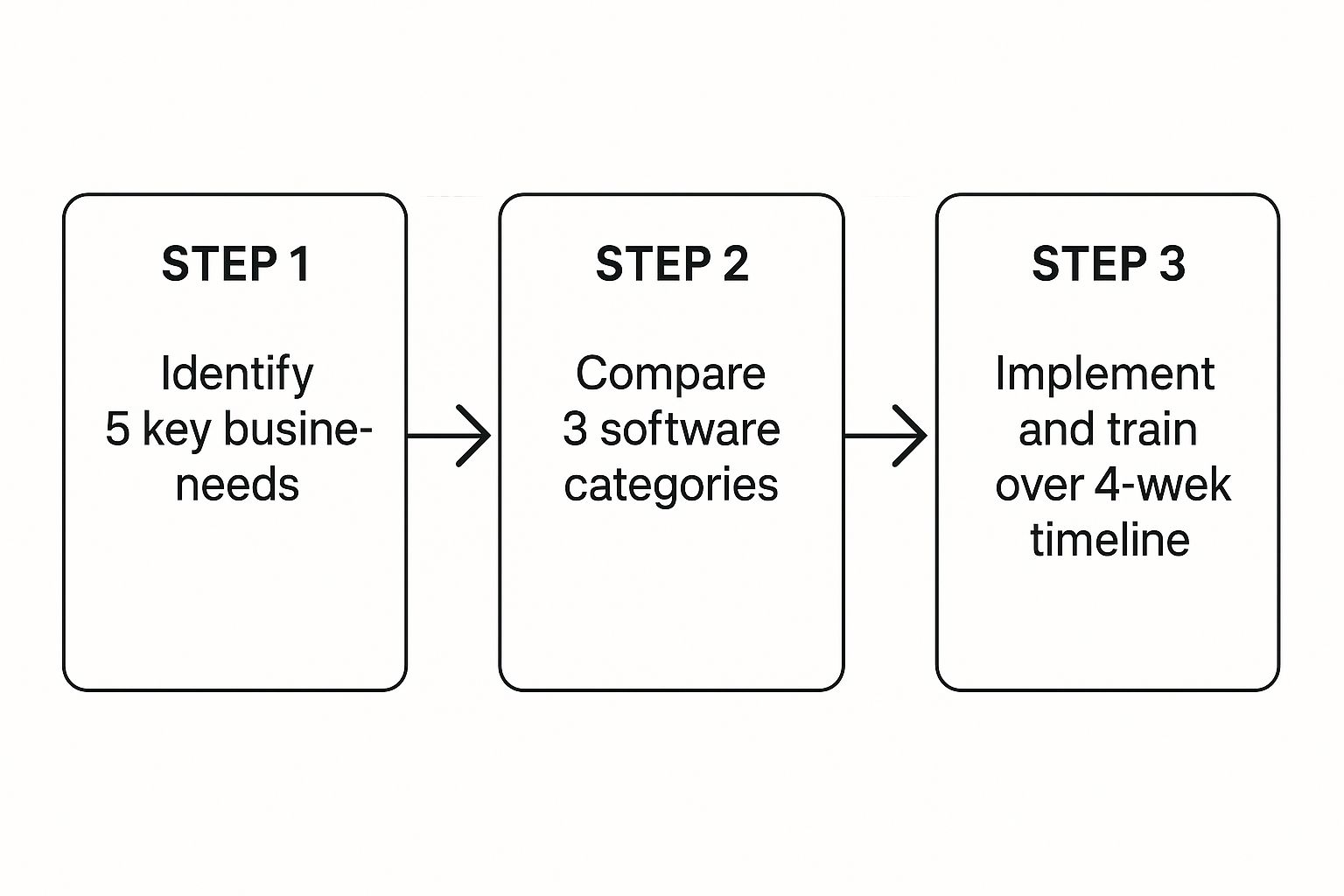
As the infographic shows, a focused, step-by-step plan makes choosing and implementing new tools a much clearer and more achievable process.
Phase 4: Choose the Right Tools
With your priorities locked in, it’s finally time to talk about tools. The goal isn't to find the most advanced or feature-loaded software on the market. It's to find the right-sized tool that solves your specific problem, fits your budget, and is easy enough for your team to actually use.
Here’s a practical way to approach technology selection:
- Start with the Problem: Never, ever start by browsing software. Always start with the problem you defined back in Phase 2.
- Research Categories, Not Brands: Instead of searching for "Brand X CRM," search for "best CRM for small businesses." This gives you a much better perspective on your options.
- Use Free Trials: Nearly every modern software-as-a-service tool offers a free trial. Use it! Get your hands dirty and see if the tool genuinely fits your team's workflow before you spend a dime.
- Consider Integration: Think about how a new tool will play with the systems you already have. You want tools that connect easily to avoid creating new headaches.
By following these four phases, you create a living document that guides your small business digital transformation. It's a plan you can—and should—revisit and adjust as your business grows and your needs evolve, ensuring your journey is both strategic and successful.
Picking the Right Tools for Your Digital Toolkit
Once you have a plan in place, it's time to choose the right tools. The real goal isn't to chase every new shiny app; it’s about building a practical toolkit that actually solves problems and makes your business run better.
Think of it like setting up a workshop. You don't just buy every tool at the hardware store. You start with the essentials—the hammers, screwdrivers, and drills you’ll rely on every single day.
Instead of an overwhelming list of hundreds of apps, let's focus on the core areas where technology can make the biggest difference for small businesses. Understanding these categories will help you pinpoint exactly where to begin.
Key Digital Tool Categories for SMBs
To build a solid foundation, it's helpful to see how different tools fit into your business operations. The table below breaks down the main types of software, what they do, and a few popular examples to get you started.
| Tool Category | Primary Business Function | Popular Examples |
|---|---|---|
| Customer Relationship Management (CRM) | Centralizes all customer data and interactions. | HubSpot, Zoho CRM, Freshsales |
| Marketing & Sales | Attracts new leads and converts them into customers. | Mailchimp, Buffer, WordPress |
| Operations & Productivity | Manages projects, tasks, and internal communication. | Trello, Asana, Slack |
| Financial Management | Handles invoicing, bookkeeping, and cash flow. | QuickBooks Online, Xero, Wave |
Each of these categories addresses a critical part of your business, from how you find customers to how you get paid. Let's look at each one a bit closer.
1. Organize Your Customer World with a CRM
A Customer Relationship Management (CRM) system is the digital heart of your business. It’s way more than a glorified address book—it's the single place where every email, phone call, meeting note, and purchase history lives. This gives you a complete, 360-degree view of every customer relationship.
Think of a CRM as foundational. It stops valuable customer details from getting lost in random spreadsheets, cluttered inboxes, or on sticky notes. For a deeper dive, check out these CRM best practices for small businesses.
- What It Solves: It prevents leads from falling through the cracks and helps your team provide more personal, informed service because all the information is right there.
- Affordable Examples: HubSpot CRM has a fantastic free plan, and other great options include Zoho CRM and Freshsales.
2. Power Your Growth with Marketing and Sales Tools
This is all about how you find new customers and turn them into buyers. These tools help you get your message out to the right people, build an audience, and guide them through the sales journey without missing a beat.
Your website is usually the centerpiece here. A professional site is your digital storefront—it builds credibility and works around the clock to bring in leads. If you need help building or upgrading your site, our guide on how to choose a web design agency can point you in the right direction.
Your marketing and sales tools are your engine for growth. They automate outreach, measure what’s working, and give you the power to compete with much larger companies.
Here are a few common tools in this space:
- Email Marketing Platforms: Tools like Mailchimp or ConvertKit let you build an email list and connect with your audience through newsletters or special offers.
- Social Media Schedulers: Apps like Buffer or Hootsuite are huge time-savers, letting you plan and schedule your social media content in advance.
3. Streamline Your Work with Operations and Productivity Software
These are the tools that bring order to the daily chaos. Operations and productivity software is all about helping your team collaborate better, manage projects, and get more done with less stress. This is where messy email chains and missed deadlines go to die.
For instance, a good project management tool allows you to create tasks, assign them to team members, set due dates, and see progress at a glance. It creates a single source of truth so everyone knows what to do and when.
- What It Solves: Disorganization, poor team communication, and missed deadlines. It clarifies who is responsible for what and keeps projects moving forward.
- Affordable Examples: Trello, Asana, and Monday.com are excellent for project management, while Slack is the go-to for team communication.
4. Master Your Money with Financial Management Apps
Finally, you need a smart way to manage your cash flow, track expenses, and handle payments. Modern financial software automates the tedious parts of accounting, giving you a clear, real-time picture of your business's financial health.
These tools are no longer just for accountants; they are designed for you, the business owner. Cloud-based platforms can link directly to your bank accounts, automatically sort transactions, and make tax time infinitely less painful.
- What It Solves: Messy bookkeeping, late invoicing, and the anxiety of not knowing where you stand financially. It helps you get paid faster and make smarter decisions with your money.
- Affordable Examples: QuickBooks Online and Xero are industry standards, while Wave offers fantastic free accounting and invoicing for small businesses.
How AI Is a Game Changer for Small Business

If "digital transformation" is all about upgrading your business with modern tools, then Artificial Intelligence (AI) is like giving those tools a brain. For a long time, AI felt like something out of science fiction, reserved for massive tech companies with deep pockets. Not anymore. Today, it’s a practical and surprisingly affordable ally for small businesses.
This isn’t about building robots to take over your shop. It’s about using smart software to handle repetitive work, get to know your customers on a deeper level, and make sharper, more confident decisions. A core part of any small business digital transformation is finding ways to work smarter, not just harder. AI is one of the most powerful ways to get that done.
Automating Your Operations with AI
One of the first things you'll notice when you bring AI into your business is how it can take over routine, time-consuming tasks. This is more than just basic automation; it involves systems that actually learn and adapt over time. The result? A more efficient business that can move faster and make fewer mistakes.
Think about these real-world examples that you could implement tomorrow:
- Customer Support Chatbots: Forget the clunky bots of the past. Modern AI chatbots can instantly answer common customer questions, 24/7. This frees up your team to tackle the more complex, high-touch issues.
- Smart Scheduling: AI tools can look at everyone's calendar, find the best open slot, and book meetings automatically. It's a simple fix that puts an end to those endless back-and-forth email chains.
- Content Creation Help: Need to draft a social media post, a product description, or an outline for a blog? AI writing assistants can give you a solid first draft in seconds, saving you hours of staring at a blank page.
The goal of AI in a small business isn't to replace people. It's to amplify their abilities, giving a small team the power and efficiency of a much larger one.
Gaining Deeper Insights from Your Data
Beyond just automating tasks, AI has an almost uncanny ability to find meaningful patterns in your business data—the kind a human could easily miss. It can sift through sales figures, website traffic, and customer behavior to give you a clear, honest picture of what's really going on.
For instance, an AI-powered analytics tool can help you predict which products are likely to be bestsellers next quarter. It can even flag which customers are at risk of leaving, allowing you to step in before they do. This moves you from just reacting to problems to proactively making smart, data-backed decisions that fuel growth. That’s a huge leap forward for any company.
The numbers back this up. For new ventures, a staggering 75% of owners now see AI as a crucial tool for getting their business off the ground. What’s more, nearly 44% of existing small businesses have already cut costs by using AI, proving its direct impact on the bottom line. You can dig into more of these small business AI statistics to see just how common this has become. It's clear that AI is no longer a "maybe someday" tool; it's a real-world advantage for improving your business's health right now.
Overcoming Common Transformation Hurdles
Let's be real—the path to a successful small business digital transformation isn't always a walk in the park. It’s completely normal to hit a few bumps along the way. The trick is knowing what those bumps are ahead of time so you can navigate around them and make sure your hard work pays off.
If you feel like you're playing catch-up, you're not alone. In the European Union, for instance, 58% of small and medium-sized enterprises have managed to get a basic level of digital tools in place. While that's a good start, it still lags behind the EU’s 2030 digital goals by about 30%. This gap shows just how many businesses are still wrestling with the initial challenges. You can dig deeper into these digital adoption benchmarks on WalkMe.com.
Most small businesses run into the same few problems. Let's break them down and talk about how to solve them with some practical, no-fluff advice.
Navigating Tight Budgets
The fear of sky-high costs is probably the number one thing that stops small businesses in their tracks. But here’s the good news: you don’t need a massive, corporate-sized budget to make meaningful changes. The key is to be smart and focus on things that give you the most bang for your buck.
- Start with "Freemium" Tools: So many great software companies offer free versions that are surprisingly powerful. You can get a free CRM to get your customer info organized, a free social media scheduler to reclaim hours of your week, or free accounting software to make invoicing less of a headache.
- Focus on One High-Impact Area: Don't try to digitize your entire business overnight. Pick your single biggest pain point—is it finding new customers? Managing projects?—and find one affordable tool that directly solves that problem. The time you save or the new revenue you generate can easily fund the next improvement on your list.
Bridging the Technical Skills Gap
"But I'm not a tech person!" I hear this all the time. Many owners worry they don’t have an in-house expert to run new systems. You don't need one. The best modern software is designed specifically for people who don't have a technical background, with clean layouts and simple setups.
The best tools for small businesses are the ones that don't require a computer science degree to operate. If a tool is too complex for you and your team to use easily, it's the wrong tool.
Make user-friendliness a top priority. Look for software that comes with great customer support and tons of free online tutorials. Most platforms today have huge libraries of video guides, how-to articles, and community forums. This lets you and your team learn on your own time, without needing to add a tech specialist to your payroll.
Managing Employee Resistance
Bringing in new technology can sometimes spook your team. People get used to their routines, and change, even for the better, can feel like a disruption. The secret to getting everyone on board is to make them part of the journey.
Explain the "why" behind the change. Focus on how a new tool will make their jobs easier, not just add another task to their plate. Better yet, ask for their input when you're shopping for software. The people on the front lines often have the sharpest insights into what will actually work day-to-day. When you include them in the decision and provide solid training, it stops feeling like a top-down order and starts feeling like a shared goal.
Your Digital Transformation Questions Answered
Taking the first steps toward digital transformation can feel overwhelming. It’s a big concept, and it's totally normal to have a ton of questions. Let's break down some of the most common ones so you can move forward with a clear head.
How Do I Start with a Small Budget?
Don't let a tight budget stop you. In fact, starting small is often the smartest way to go. The trick is to find free or "freemium" tools that solve your single biggest pain point right now.
For instance, you could start with a free CRM to get your customer contacts out of spreadsheets. Or maybe set up a Google Business Profile to show up in local searches. You could even use a free social media scheduler to reclaim hours of your week.
Pick one thing—like messy invoicing or clunky customer follow-up—and find a low-cost tool that fixes it. Once that new tool starts saving you time or bringing in more cash, you can reinvest those wins into your next digital upgrade.
Think of it as a series of small, strategic upgrades, not one giant, expensive overhaul. This keeps it affordable and helps you build momentum.
Which Area Should I Focus on First?
The right starting point is unique to your business. To find yours, ask a simple question: "What's the one thing holding us back the most right now?"
The answer will point you in the right direction.
- Struggling to find new customers? Your focus should be on digital marketing tools.
- Is the team disorganized and missing deadlines? Look into operational tools like project management software first.
- Are customers complaining about slow response times? Start with customer service tools, maybe something as simple as a shared team inbox.
By tackling your biggest bottleneck first, you'll see a real impact, fast. That quick win gives you the proof and the motivation you need to keep going.
How Do I Get My Team on Board?
This is a big one. If your team doesn't use the new tools, the whole effort falls flat. The key to getting them on board is to involve them from the very beginning.
Start by explaining the "why." Don't just tell them what is changing; show them how this new tool will make their jobs easier, less frustrating, or help the company grow. When you're picking out software, ask for their opinion. The people doing the work every day have the best feel for what will actually be useful.
Finally, make the training simple and be patient. There’s always a learning curve. When your team sees new technology as a helping hand, not just another task, they'll be much more likely to embrace it.
At OneNine, we know a powerful website is the cornerstone of any great digital strategy. If you're ready for a site that doesn't just look good but actually works hard for your business, we're here to help. We build and manage websites that drive real results. Learn more about our web design and management services.


